
Welcome to LED Control Wiki
About this project
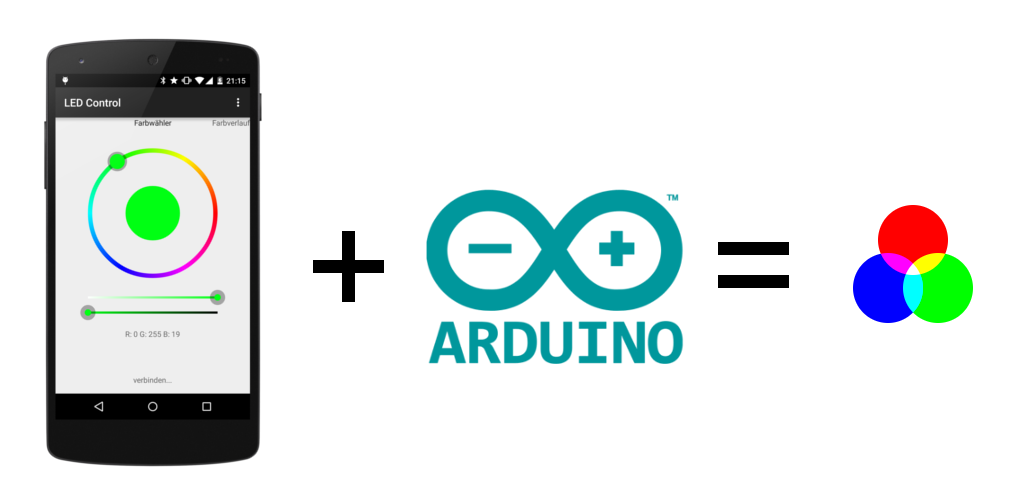
This project was developed after I had to find out that controlling my RGB ambient light with the normal infrared remote control was complicated and not reliable. Within a few months I build this solution that enabled controlling my LEDs with a Bluetooth-enabled Android Device running a self programmed app. On the hardware side an Arduino is receiving the commands and controlling three PWM signals.
The app is available at Google Play for free (but closed source), the Arduino sketch is released under Apache License. The used protocol is also documented in this wiki and open for usage by others.
If you like this project I would be pleased with recommendations or a good rating at Google Play. Let me also know when you find some bugs.
Requirements
You need a few things to get started:
- Arduino Uno
- Android powered Phone/Tablet with bluetooth running Android 4.0 or above
- RGB-LED-Stripes with common anode (one common '+' and a seperate '-/GND' for each color) (you can also use stripes with common cathodes, but the showed circuit diagramm will not work (in particular the output stage). A solution therefore is also available.)
- External Power Supply (to power Arduino and LEDs)
- USART capable bluetooth module (for example HC-06, available on ebay for < 10$)
- 3x 220 Ohm resistors (gate current limiter)
- 3x 10 kOhm resistors (gate pull-down)
- 3x N-Channel Power-MOSFETs (enhancement mode) (for example IRF1404)
optional voltage divider
- 1x 4,7 kOhm resistor
- 1x 10 kOhm resistor
Assembly
Connect the Arduino and the others parts as showed below. Be sure that you do not change the RX pin with the TX pin of the bluetooth module. In General: RX of the bluetooth module has to be connected to TX of Arduino and vice versa.
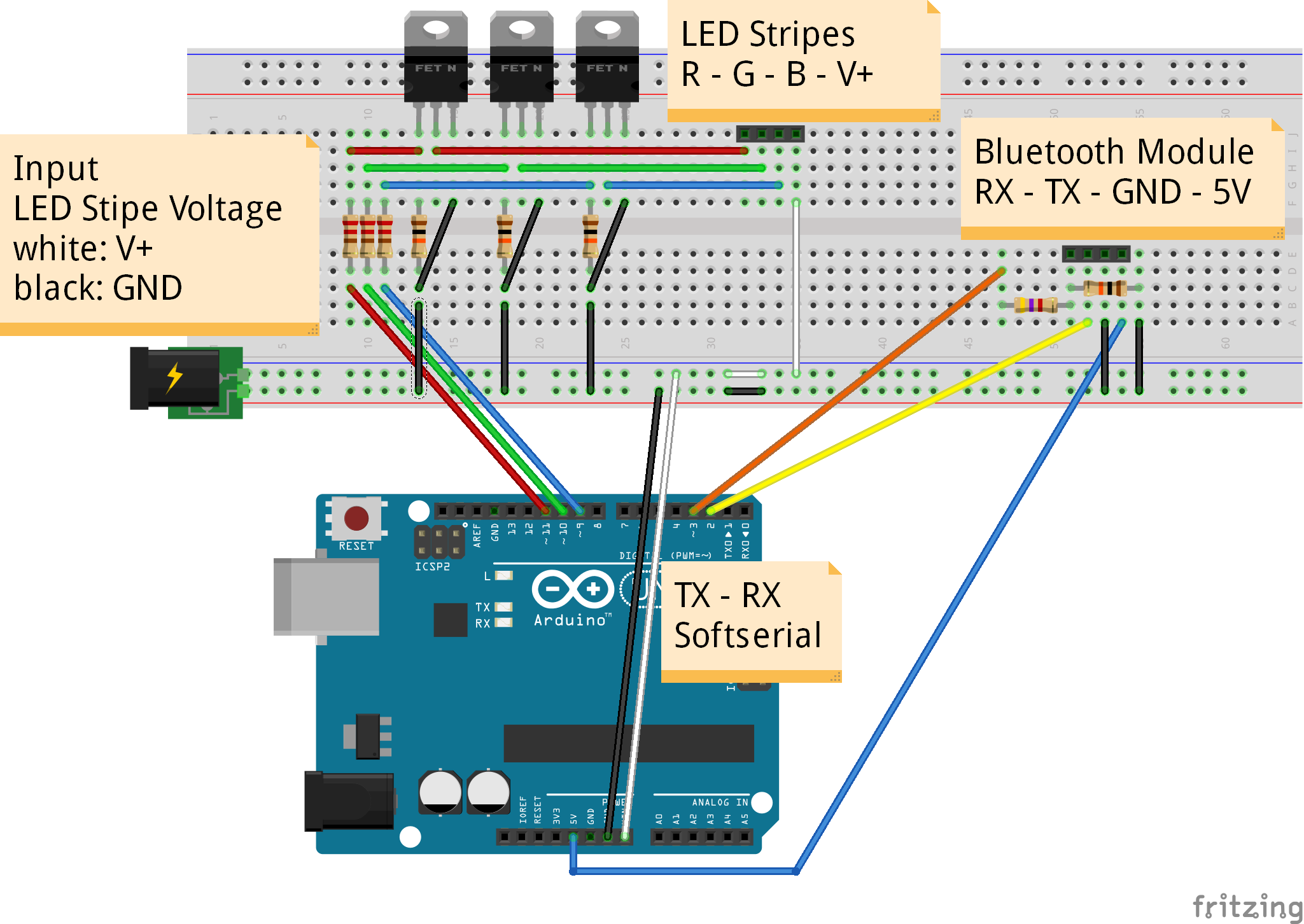
Caution: The HC-06 bluetooth module I bought works with 3,3V. You can power it with 5V because there is a built-in voltage regulator (make sure that yours has also one or power it with 3,3V), but RX and TX are not 5V tolerant. To avoid permanent damage the Arduino output-voltage is reduced to 3,3V by a voltage divider (therefore the 4k7 and 10k resistors). On the other hand a special step-up circuit is not necessary because the Arduino recognizes 3,3V of the bluetooth module as HIGH-Level.
Note: For permanent installations you should consider soldering your circuit on a Arduino Proto Shield (bought or home made). I personally soldered everything on a stripboard and put the whole thing in a small case.
Note: You don't need the connection from TX (pin 3) on Arduino to RX of the bluetooth module, because currently nothing will be send back to the Android device. Just remove the connection from pin 3 (Arduino) to RX (bluetooth module) and the voltage divider. It may be possible that a bidirectional communication will be used in future releases.
Installing the software
You're almost done. Now you need to install the software and select the target device.
- Upload the Arduino Sketch (https://github.com/fennel-labs/LED-control/blob/master/LEDControlArduino.ino)
- Install the Android app on your phone (https://play.google.com/store/apps/details?id=com.fennel.ledcontrol)
- Start a new bluetooth device discovery (Android -> Settings -> Bluetooth -> Add)
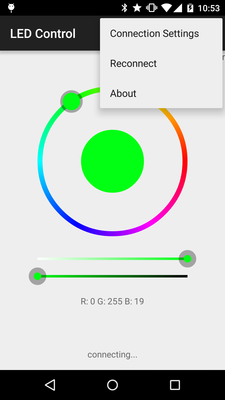
- Start the LED Control app and select your receiver (LED Control -> Connection Settings -> your device)
Troubleshooting
There are several reasons why your circuit may not work as intended. Here are some possibilities:
- Check if the LED voltage is high enough and your stripes have the right polarity by connecting them directly to your power source.
- Are RX and TX connected in the right way? Read also the notes above.
- By default, the Arduino sends some debug data to the PC via the hardware serial. If the Software in Arduino behaves abnormal check the console log.
- In case you are not sure whether your bluetooth module works properly or not, connect it directly to your Arduino (still keeping the voltage levels in mind, see note above). Therefore you have to remove the 328P chip temporary from your Uno.
- To check the output stage, you can try pulling the gate of each channel to ground or +5V.
thanks:https://github.com/fennel-labs
Welcome to LED Control Wiki的更多相关文章
- Matlab安装记录 - LED Control Activex控件安装
Matlab安装记录-LED Control Activex控件安装 2013-12-01 22:06:36 最近在研究Matlab GUI技术,准备用于制作上位机程序:在Matlab GUI的技术 ...
- 针对Windows 64位系统中Matlab没有LED Control Activex控件的解决方法
Win 10 64bits系统中Matlab 64位软件没有LED Control Activex控件,LED ActiveX Control控件位于Gauges Blockset模块中,而Gauge ...
- WPF自定义LED风格数字显示控件
原文:WPF自定义LED风格数字显示控件 版权声明:本文为博主原创文章,转载请注明作者和出处 https://blog.csdn.net/ZZZWWWPPP11199988899/article/de ...
- 【openwrt】再设置
https://wiki.openwrt.org/zh-cn/doc/uci/network https://wiki.openwrt.org/zh-cn/doc/uci/wireless https ...
- 剖析ironic
关键技术 在安装操作系统时需要存储介质来存储系统镜像.需要控制物理机开关机,在网络部署环境中还需要预启动环境. PXE (预启动环境) IPMI(电源管理) iSCSI(存储) 什么是PXE PXE( ...
- DIY PIXHAWK APM等飞控用的PPM转接板
需要的硬件 一块arduino pro mini(推荐这个,比较小,当然如果你没有USB转转口的烧写工具买个ardunio nano板也是不错的,直接用USB线连接电脑就可以,用nano板要注意.它的 ...
- 【网络——Linux】——IPMI详细介绍【转】
一.IPMI含义 智能平台管理接口(IPMI:Intelligent Platform Management Interface)是一项应用于服务器管理系统设计的标准,由Intel.HP.Dell和N ...
- AIX 常用命令和知识
BOOTLIST:#bootlist -m normal -o (查看bootlist)#bootlist -m normal (设置bootlist为空,谁要在我机器上执行我就要哭了)#boot ...
- arduino pro mini不能下载
刚毕业时就知道arduino,但当时崇拜技术极致,喜欢把单片机的性能用到尽,觉得操作寄存器运行效率高,对arduino 这种高效模式贬为投机取巧,不过其中也一直对arduino 有关注. 随着芯片技术 ...
随机推荐
- [问题2014S13] 解答
[问题2014S13] 解答 (1) 先证必要性:若 \(A=LU\) 是 非异阵 \(A\) 的 \(LU\) 分解,则 \(L\) 是主对角元全部等于 1 的下三角阵,\(U\) 是主对角元全部 ...
- Python namedtuple
我们都知道Python中的tuple是一个非常高效的集合对象,但是我们只能通过索引的方式访问这个集合中的元素,比如下面的代码: Bob=('bob',30,'male') print'Represen ...
- signtool
https://msdn.microsoft.com/en-us/library/8s9b9yaz(v=vs.110).aspx C:\Users\Administrator\.nuget\packa ...
- CSS-浮动篇float
Float是一个强大的属性,但是它也会困扰我们如果我们不知道它的工作原理的话.这篇文章主要介绍float的原理和基本用法. 我们可以看到float在印刷世界的应用-杂志.很多杂志文章都是左边一个图片, ...
- 关于web2py外网访问,图形界面不显示等问题的解决办法
首先系统版本是ubuntu 15.04,系统默认安装了两个版本的python, sudo python web2py.py 默认会调用python2.7版本来执行 会提示 pydo@planpls:/ ...
- package
1.设计package原因 理解基目录的概念,思考jre加载class的顺序,如果没有package会怎么样?有了之后又是怎么样..? 主要:确保类名的唯一性. 次要:方便组织代码 2.怎样访问\导入 ...
- ionic build android--> Build failed with an exception. Execution failed for task ':processDebugResources'.
执行 ionic build android, ionic 自动化生成安卓apk包, 出现以上报错的原因为:打包的文件中含有中文名,把中文名的文件去掉或改名即可打包成功.
- zabbix3.0.4 部署之五 (LNMP > nginx1.9.9)
1 wget http://nginx.org/download/nginx-1.9.9.tar.gz cd /opt/pcre-8.35 autoreconf -ivf Installing sha ...
- node.js基础 1之简单的nodejs模块
模块流程: 创建模块->导出模块->加载模块->使用模块 ndoejs主要就是把项目变成模块化在管理 实现一个模块的调用,编写student.js.teacher.js.klass. ...
- free函数
free函数 原型: void free(void *ptr) 功 能: 释放ptr指向的存储空间.被释放的空间通常被送入可用存储区池,以后可在调用malloc.realloc以及calloc函数来再 ...