
机器视觉:Convolutional Neural Networks, Receptive Field and Feature Maps
CNN 大概是目前 CV 界最火爆的一款模型了,堪比当年的 SVM。从 2012 年到现在,CNN 已经广泛应用于CV的各个领域,从最初的 classification,到现在的semantic segmentation, object detection,instance segmentation,super resolution 甚至 optical flow 都能看的其身影。还真是,无所不能。
虽然 CNN 的应用可以说是遍地开花,但是细究起来,可以看到 CNN 的基本模型还是万变不离其宗,总是少不了最基础的一些模块,比如 convolution layer, pooling layer 和 fully connected layer,就是基于这些最基础的模块,结合具体的应用,构造了不同的网络结构,进而达到不同的目的。
今天,我们想探讨一下 CNN 网络里面几个基本的概念,掌握并且熟悉这些概念对于理解 CNN 模型有很大的帮助。
我们要理解的概念包括:
卷积的基本运算
receptive field (感受野)
feature maps
卷积的基本运算
先介绍第一个概念,卷积的运算,我们知道图像处理里面有很多的滤波操作,比如高斯滤波,拉普拉斯滤波,这些其实都是基于卷积的一种运算。
这里 I" role="presentation" style="position: relative;">II 表示一张图像,而 g" role="presentation" style="position: relative;">gg 表示卷积核,或者滤波器。卷积简单来说就是对像素邻域的一种操作。这里,我们不讨论卷积的具体表示,我们讨论卷积运算前后图像的尺度变化,这个对于后面理解 receptive field 非常重要。一张 W1×H1" role="presentation" style="position: relative;">W1×H1W1×H1 的图像,经过一个 F×F" role="presentation" style="position: relative;">F×FF×F 卷积核运算,假设卷积运算时候的 stride 为 S" role="presentation" style="position: relative;">SS,那么我们可以求得输出图像的尺寸为:
W2=(W1−F)/S+1H2=(H1−F)/S+1" role="presentation" style="position: relative;">W2=(W1−F)/S+1H2=(H1−F)/S+1W2=(W1−F)/S+1H2=(H1−F)/S+1
比如说,一个 5×5" role="presentation" style="position: relative;">5×55×5 的图像块和一个 3×3" role="presentation" style="position: relative;">3×33×3 的卷积核做卷积,最后输出的图像块的尺寸为 3×3" role="presentation" style="position: relative;">3×33×3,这里我们默认卷积核是逐个像素滑动的,即 stride 为 1,有的时候,我们希望输出图像的尺寸和输入图像的尺寸一样大,这里有不同的处理方式,比较常见的一种方式就是给输入图像的四边补 0,也就是所谓的 zero padding, 我们先把输入图像变大,这样输出图像就会和原来的图像一样大。结合 zero padding,我们可以求得输出图像的大小为:
W2=(W1−F+2P)/S+1H2=(H1−F+2P)/S+1" role="presentation" style="position: relative;">W2=(W1−F+2P)/S+1H2=(H1−F+2P)/S+1W2=(W1−F+2P)/S+1H2=(H1−F+2P)/S+1
Receptive Field
知道了卷积的运算规则,我们来看看 CNN 中的 receptive field 这个概念,receptive field 顾名思义,就是一个像素的感受范围,因为卷积都是基于邻域的操作,所以一般来说,每一层的像素,都是前一层的一个邻域通过卷积运算得到的,我们来看一个层级的 receptive field:
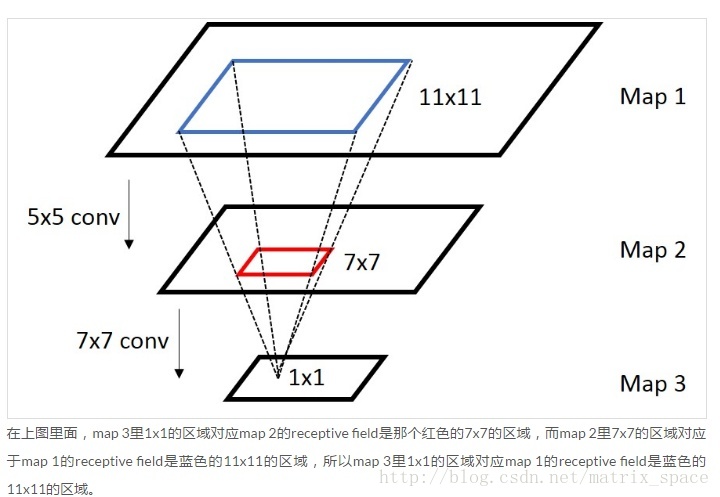
我们看到,最下面一层一个像素,对应的中间一层的 receptive field 是 7×7" role="presentation" style="position: relative;">7×77×7 的一个范围,因为卷积核是 7×7" role="presentation" style="position: relative;">7×77×7,而中间一层的每一个像素,对应最上面一层的 receptive filed 的范围是 5×5" role="presentation" style="position: relative;">5×55×5,那么,最下面一层的每一个像素,对应最上面一层的 receptive field 是多少呢?这里就要用到我们上面介绍的卷积运算的规则,我们可以把上面的卷积规则表示成更一般的表达式:
ri+1=(ri−F+2P)/S+1" role="presentation" style="position: relative;">ri+1=(ri−F+2P)/S+1ri+1=(ri−F+2P)/S+1
ri" role="presentation" style="position: relative;">riri 表示第 i" role="presentation" style="position: relative;">ii 层的 feature map 的尺寸, ri+1" role="presentation" style="position: relative;">ri+1ri+1 表示第 i+1" role="presentation" style="position: relative;">i+1i+1 层的 feature map 的尺寸,那么我们可以反过来求出:
ri=(ri+1−1)×S+F−2P" role="presentation" style="position: relative;">ri=(ri+1−1)×S+F−2Pri=(ri+1−1)×S+F−2P
以上图作为参考,r3=1" role="presentation" style="position: relative;">r3=1r3=1, 这里假设 stride S=1" role="presentation" style="position: relative;">S=1S=1, padding P=0" role="presentation" style="position: relative;">P=0P=0, 第二层到第三层的卷积核是 7×7" role="presentation" style="position: relative;">7×77×7,所以 F=7" role="presentation" style="position: relative;">F=7F=7, 我们可以求得 r2=(1−1)×1+7−2×0=7" role="presentation" style="position: relative;">r2=(1−1)×1+7−2×0=7r2=(1−1)×1+7−2×0=7,所以第二层的 receptive field 是 7×7" role="presentation" style="position: relative;">7×77×7, 那么 r1=(7−1)×1+5−2×0=11" role="presentation" style="position: relative;">r1=(7−1)×1+5−2×0=11r1=(7−1)×1+5−2×0=11,所以第一层的 receptive field是 11×11" role="presentation" style="position: relative;">11×1111×11 所以这就是我们计算每一层 receptive field 的公式,通过层层递推得到。
这是计算不同 layer 之间的 receptive field,有的时候,我们需要计算的是一种坐标映射关系,即 receptive filed 的中心点的坐标,这个坐标映射关系满足下面的关系:
在 Fast R-CNN, SPP-Net 等网络中,需要从 feature map 中找到对应的输入图像的 ROI,就是要用上面的表达式从后往前一层一层递推得到:
从上面可以看到,如果我们知道第 L" role="presentation" style="position: relative;">LL 层中一个像素点的位置 xL" role="presentation" style="position: relative;">xLxL,我们可以计算出输入图像上对应的 receptive filed 的中心点的位置 x0" role="presentation" style="position: relative;">x0x0, 这个最后可以总结成如下的表达式:
SPP-net 中,把 feature map 中的一个区域,映射到输入图像上的 ROI 的时候,做了一些处理,就是让每一层的 padding 都等于卷积核的半径,这样坐标最后只和 stride 有关。
Feature map
最后,我们说一下 feature map,这个可以说是 CNN 和传统的 MLP 的最大的不同,Feature map 中的神经元是共享权重系数的,feature map 中的每一个神经元对应的就是前一层的 feature map 中的某个邻域,反应的是这个邻域与卷积核做卷积之后的一种响应,因为这是一种局部的响应,所以 feature map 可以记录 feature ,也可以记录 location,响应的位置,利用这个特性,可以用来做 目标检测。
参考:
https://zhuanlan.zhihu.com/p/24780433 晓雷机器学习笔记
http://cs231n.stanford.edu/ CS231n: Convolutional Neural Networks for Visual Recognition
iccv2015_tutorial_convolutional_feature_maps_kaiminghe
机器视觉:Convolutional Neural Networks, Receptive Field and Feature Maps的更多相关文章
- Understanding the Effective Receptive Field in Deep Convolutional Neural Networks
Understanding the Effective Receptive Field in Deep Convolutional Neural Networks 理解深度卷积神经网络中的有效感受野 ...
- 《Deep Feature Extraction and Classification of Hyperspectral Images Based on Convolutional Neural Networks》论文笔记
论文题目<Deep Feature Extraction and Classification of Hyperspectral Images Based on Convolutional Ne ...
- A Beginner's Guide To Understanding Convolutional Neural Networks(转)
A Beginner's Guide To Understanding Convolutional Neural Networks Introduction Convolutional neural ...
- (转)A Beginner's Guide To Understanding Convolutional Neural Networks Part 2
Adit Deshpande CS Undergrad at UCLA ('19) Blog About A Beginner's Guide To Understanding Convolution ...
- (转)A Beginner's Guide To Understanding Convolutional Neural Networks
Adit Deshpande CS Undergrad at UCLA ('19) Blog About A Beginner's Guide To Understanding Convolution ...
- 深度卷积神经网络用于图像缩放Image Scaling using Deep Convolutional Neural Networks
This past summer I interned at Flipboard in Palo Alto, California. I worked on machine learning base ...
- 【论文笔记】Learning Convolutional Neural Networks for Graphs
Learning Convolutional Neural Networks for Graphs 2018-01-17 21:41:57 [Introduction] 这篇 paper 是发表在 ...
- AlexNet论文翻译-ImageNet Classification with Deep Convolutional Neural Networks
ImageNet Classification with Deep Convolutional Neural Networks 深度卷积神经网络的ImageNet分类 Alex Krizhevsky ...
- 卷积神经网络用于视觉识别Convolutional Neural Networks for Visual Recognition
Table of Contents: Architecture Overview ConvNet Layers Convolutional Layer Pooling Layer Normalizat ...
随机推荐
- idea 快键件大全
最常用快捷键1.Ctrl+E,可以显示最近编辑的文件列表2.Shift+Click可以关闭文件3.Ctrl+[或]可以跳到大括号的开头结尾4.Ctrl+Shift+Backspace可以跳转到上次编辑 ...
- alter table add constraint 用法
1.主键约束: 要对一个列加主键约束的话,这列就必须要满足的条件就是分空 因为主键约束:就是对一个列进行了约束,约束为(非空.不重复) 以下是代码 要对一个列加主键,列名为id,表名为emp 格式 ...
- 重置root密码后仍然不能登陆
一.忘记密码:二.输入正确用户名和密码时依旧无法登录. 一.忘记密码 进入单用户模式重置密码: 开机启动时,按‘E’键(倒计时结束前)进入界面 选择第二项,按‘E’键再次进入 在最后一行添加‘ 1’( ...
- HTML5 SVG世界地图
在线演示 本地下载
- VS 安装部署项目自解压程序解压后按顺序执行多个程序
这篇blog介绍了如何用VS创建安装部署方案,以及如何制作自解压程序.然后我的程序中需要解压后按照顺序先后安装2个exe.winrar的解压后执行,虽然可以用分号填写多个应用,但貌似是同时执行的.为了 ...
- tomcat_下载
1. http://tomcat.apache.org/ 2. 3.
- istringstream 用法
istringstream 类用于执行C++风格的串流的输入操作 istringstream用空格作为字符串分隔符 #include <iostream>#include <sstr ...
- Android 中Json解析的几种框架(Gson、Jackson、FastJson、LoganSquare)使用与对比
介绍 移动互联网产品与服务器端通信的数据格式,如果没有特殊的需求的话,一般选择使用JSON格式,Android系统也原生的提供了JSON解析的API,但是它的速度很慢,而且没有提供简介方便的接口来提高 ...
- 报错Mapped Statements collection does not contain value for com.atguigu.mybatis.dao.EmployeeMapperPlus
报错Mapped Statements collection does not contain value for com.atguigu.mybatis.dao.EmployeeMapperPlus ...
- Div层弹出
<!DOCTYPE html PUBLIC "-//W3C//DTD HTML 4.01 Transitional//EN"> <html> <hea ...