
netty Architectural Overview --reference
reference from:http://docs.jboss.org/netty/3.1/guide/html/architecture.html
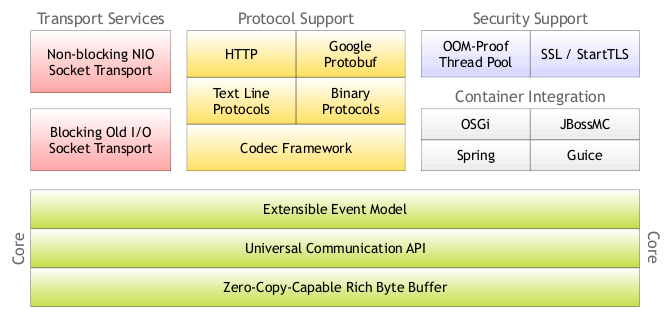
In this chapter, we will examine what core functionalities are provided in Netty and how they constitute a complete network application development stack on top of the core. Please keep this diagram in mind as you read this chapter.
2.1. Rich Buffer Data Structure
Netty uses its own buffer API instead of NIO ByteBuffer to represent a sequence of bytes. This approach has significant advantage over using ByteBuffer. Netty's new buffer type, ChannelBuffer has been designed from ground up to address the problems of ByteBuffer and to meet the daily needs of network application developers. To list a few cool features:
You can define your buffer type if necessary.
Transparent zero copy is achieved by built-in composite buffer type.
A dynamic buffer type is provided out-of-the-box, whose capacity is expanded on demand, just like
StringBuffer.There's no need to call
flip()anymore.It is often faster than
ByteBuffer.
For more information, please refer to the org.jboss.netty.buffer package description.
2.2. Universal Asynchronous I/O API
Traditional I/O APIs in Java provided different types and methods for different transport types. For example,java.net.Socket and java.net.DatagramSocket do not have any common super type and therefore they have very different ways to perform socket I/O.
This mismatch makes porting a network application from one transport to the other tedious and difficult. The lack of portability between transports becomes a problem when you need to support more transports not rewriting the network layer of the application. Logically, many protocols can run on more than one transport such as TCP/IP, UDP/IP, SCTP, and serial port communication.
To make the matter worse, Java New I/O (NIO) API introduced the incompatibility with the old blocking I/O (OIO) API, and so will NIO.2 (AIO). Because all these APIs are different from each other in design and performance characteristics, you are often forced to determine which API your application will depend on before you even begin the implementation phase.
For instance, you might want to start with OIO because the number of clients you are going to serve will be very small and writing a socket server using OIO is much easier than using NIO. However, you are going to be in trouble when your business grows up exponentially and your server starts to serve tens of thousand clients simultaneously. You could start with NIO, but it might take much longer time to implement due to the complexity of the NIO Selector API, hindering rapid development.
Netty has a universal asynchronous I/O interface called Channel, which abstracts away all operations required to point-to-point communication. That is, once you wrote your application on one Netty transport, your application can run on other Netty transports. Netty provides a number of essential transports via one universal API:
NIO-based TCP/IP transport (See
org.jboss.netty.channel.socket.nio),OIO-based TCP/IP transport (See
org.jboss.netty.channel.socket.oio),OIO-based UDP/IP transport, and
Local transport (See
org.jboss.netty.channel.local).
Switching from one transport from the other usually takes just a couple lines of changes such as choosing a different ChannelFactory implementation.
Also, you are even able to take advantage of a new transport which is not written yet, serial port communication transport for instance, again by replacing just a couple lines of constructor calls. Moreover, you can write your own transport by extending the core API because it is highly extensible.
2.3. Event Model based on the Interceptor Chain Pattern
Well-defined and extensible event model is a must for an event-driven application. Netty does have a well-defined event model focused on I/O. It also allows you to implement your own event type without breaking the existing code at all because each event type is distinguished from each other by strict type hierarchy. This is another differentiator against other frameworks. Many NIO frameworks have no or very limited notion of event model; they often break the existing code when you try to add a new custom event type, or just do not allow extension.
A ChannelEvent is handled by a list of ChannelHandlers in a ChannelPipeline. The pipeline implements an advanced form of the Intercepting Filter pattern to give a user full control over how an event is handled and how the handlers in the pipeline interact with each other. For example, you can define what to do when a data is read from a socket:
public class MyReadHandler implementsSimpleChannelHandler{
public void messageReceived(ChannelHandlerContextctx,MessageEventevt) {
Object message = evt.getMessage();
// Do something with the received message.
... // And forward the event to the next handler.
ctx.sendUpstream(evt);
}
}
You can also define what to do when other handler requested a write operation:
public class MyWriteHandler implementsSimpleChannelHandler{
public void writeRequested(ChannelHandlerContextctx,MessageEventevt) {
Object message = evt.getMessage();
// Do something with the message to be written.
... // And forward the event to the next handler.
ctx.sendDownstream(evt);
}
}
For more information about the event model, please refer to the API documentation of ChannelEvent andChannelPipeline.
2.4. Advanced Components for More Rapid Development
On top of the core components mentioned above, that already enable the implementation of all types of network applications, Netty provides a set of advanced features to accelerate the development pace even more.
2.4.1. Codec framework
As demonstrated in Section 1.8, “ Speaking in POJO instead of ChannelBuffer ”, it is always a good idea to separate a protocol codec from a business logic. However, there are some complications when implementing this idea from scratch. You have to deal with the fragmentation of messages. Some protocols are multi-layered (i.e. built on top of other lower level protocol). Some are too complicated to be implemented in a single state machine.
Consequently, a good network application framework should provide an extensible, reusable, unit-testable, and multi-layered codec framework that generates maintainable user codec.
Netty provides a number of basic and advanced codecs built on top of its core to address most issues you will encounter when you write a protocol codec regardless if it is simple or not, binary or text - simply whatever.
2.4.2. SSL / TLS Support
Unlike old blocking I/O, it is a non-trivial task to support SSL in NIO. You can't simply wrap a stream to encrypt or decrypt data but you have to use javax.net.ssl.SSLEngine. SSLEngine is a state machine which is as complex as SSL is. You have to manage all possible states such as cipher suite and encryption key negotiation (or re-negotiation), certificate exchange and validation. Moreover, SSLEngine is not even completely thread-safe unlike usual expectation.
In Netty, SslHandler takes care of all the gory details and pitfalls of SSLEngine. All you need to do is to configure and insert the SslHandler to your ChannelPipeline. It also allows you to implement advanced features likeStartTLS very easily.
2.4.3. HTTP Implementation
HTTP is definitely the most popular protocol in the Internet. There are already a number of HTTP implementations such as a Servlet container. Then why does Netty have HTTP on top of its core?
Netty's HTTP support is very different from the existing HTTP libraries. It gives you complete control over how HTTP messages are exchanged in a low level. Because it is basically the combination of HTTP codec and HTTP message classes, there is no restriction such as enforced thread model. That is, you can write your own HTTP client or server that works exactly the way you want. You have full control over thread model, connection life cycle, chunked encoding, and as much as what HTTP specification allows you to do.
Thanks to its highly customizable nature, you can write a very efficient HTTP server such as:
Chat server that requires persistent connections and server push technology (e.g. Comet)
Media streaming server that needs to keep the connection open until the whole media is streamed (e.g. 2 hours of movie)
File server that allows the upload of large files without memory pressure (e.g. uploading 1GB per request)
Scalable mash-up client that connects to tens of thousand 3rd party web services asynchronously
2.4.4. Google Protocol Buffer Integration
Google Protocol Buffers are an ideal solution for the rapid implementation of a highly efficient binary protocol that evolves over time. With ProtobufEncoder and ProtobufDecoder, you can turn the message classes generated by Google Protocol Buffers Compiler (protoc) into Netty codec. Please take a look into the 'LocalTime' examplethat shows how easily you can create a high-performing binary protocol client and server from the sample protocol definition.
2.5. Summary
In this chapter, we reviewed the overall architecture of Netty from the feature-wise standpoint. Netty has simple yet powerful architecture. It is composed of three components - buffer, channel, and event model - and all advanced features are built on top of the three core components. Once you understood how these three work together, it should not be difficult to understand more advanced features which were covered briefly in this chapter.
You might still have an unanswered question about what the overall architecture looks exactly like and how each feature work together. If so, it is a good idea to talk to us to improve this guide.
netty Architectural Overview --reference的更多相关文章
- CHAPTER 1 Architectural Overview of Oracle Database 11g
Which SGA structures are required, and which are optional? The database buffer cache, log buffer, an ...
- netty Getting Started--reference
reference from:http://docs.jboss.org/netty/3.1/guide/html/start.html 1.1. Before Getting Started 1.2 ...
- User guide for Netty 4.x
Table of Contents Preface The Solution Getting Started Before Getting Started Writing a Discard Serv ...
- Java Netty 4.x 用户指南
问题 今天,我们使用通用的应用程序或者类库来实现互相通讯,比如,我们经常使用一个 HTTP 客户端库来从 web 服务器上获取信息,或者通过 web 服务来执行一个远程的调用. 然而,有时候一个通用的 ...
- 《Netty in action》 读书笔记
声明:这篇文章是记录读书过程中的知识点,并加以归纳总结,成文.文中图片.代码出自<Netty in action>. 1. 为什么用Netty? 每个框架的流行,都一定有它出众的地方.Ne ...
- Java Reference & ReferenceQueue一览
Overview The java.lang.ref package provides more flexible types of references than are otherwise ava ...
- Reference counted objects
Reference counted objects · netty/netty Wiki https://github.com/netty/netty/wiki/Reference-counted-o ...
- WSL quick overview
简介 WSL,是Windows Subsystem for Linux的缩写,字面意义上理解就是WIndows下的Linux子系统.WSL 由Microsoft Windows内核团队创建,目前如果最 ...
- Netty4.0 用户指南
原文链接http://netty.io/wiki/user-guide-for-4.x.html 前言 Nowadays we use general purpose applications or ...
随机推荐
- Android自定义属性时format选项可以取用的值
1. reference:参考某一资源ID. (1)属性定义: <declare-styleable name="名称"> <attr format=" ...
- Oracle Kill Session – FRM-40501
FRM-40501: ORACLE error: unable to reserve record for update or delete frm-40501:oracle 错误:无法保留用于更新或 ...
- 安装Sublime Text 3插件
按 Ctrl+` 或者如下图调出Console 粘贴以下代码到底部命令行并回车: import urllib.request,os; pf = 'Package Control.sublime-pac ...
- VJP1456 最小总代价(状压)
链接 这题卡了一天 刚开始没考虑第一个传的和最后一个传的 感觉挺简单 啪啪的敲完 居然还过了17组数据.. 正解:dp数组一维保存状态 一维保存当前传到了谁 再枚举是由谁传过来的 这样可以保证正确性 ...
- ArrayList Iterator remove java.lang.UnsupportedOperationException
在使用Arrays.asList()后调用add,remove这些method时出现 java.lang.UnsupportedOperationException异常.这是由于Arrays.asLi ...
- CodeForces 450
A - Jzzhu and Children Time Limit:1000MS Memory Limit:262144KB 64bit IO Format:%I64d & % ...
- 【转】NI语法 JNI参考 JNI函数大全
原文网址:http://blog.sina.com.cn/s/blog_5de73d0b0101chk1.html 一.对照表 Java类型 本地类型 描述boolean ...
- ArcGIS for Android示例解析之高亮要素-----HighlightFeatures
转自:http://blog.csdn.net/wozaifeiyang0/article/details/7323606 HighlightFeatures 要素高亮化功能,相信有其他gis开发经营 ...
- spilt用法简介
//获取墓位位置 string MWFLMC = "和平区祥和园D组A碑11排"; //得到字符数组 ]; //分割字符数组 sArray1 = MWFLMC.Split(] { ...
- 关于 Unity 中 ModelImporter.optimizeGameObjects
ModelImporter.optimizeGameObjects 能够优化骨骼动画,将无用的骨骼合并,效率测试官方给出的数据差距比较大( Unity CJ 干货分享:全新的Unity移动游 ...