
[LeetCode] 499. The Maze III 迷宫 III
There is a ball in a maze with empty spaces and walls. The ball can go through empty spaces by rolling up (u), down (d), left (l) or right (r), but it won't stop rolling until hitting a wall. When the ball stops, it could choose the next direction. There is also a hole in this maze. The ball will drop into the hole if it rolls on to the hole.
Given the ball position, the hole position and the maze, find out how the ball could drop into the hole by moving the shortest distance. The distance is defined by the number of empty spaces traveled by the ball from the start position (excluded) to the hole (included). Output the moving directions by using 'u', 'd', 'l' and 'r'. Since there could be several different shortest ways, you should output the lexicographically smallest way. If the ball cannot reach the hole, output "impossible".
The maze is represented by a binary 2D array. 1 means the wall and 0 means the empty space. You may assume that the borders of the maze are all walls. The ball and the hole coordinates are represented by row and column indexes.
Example 1
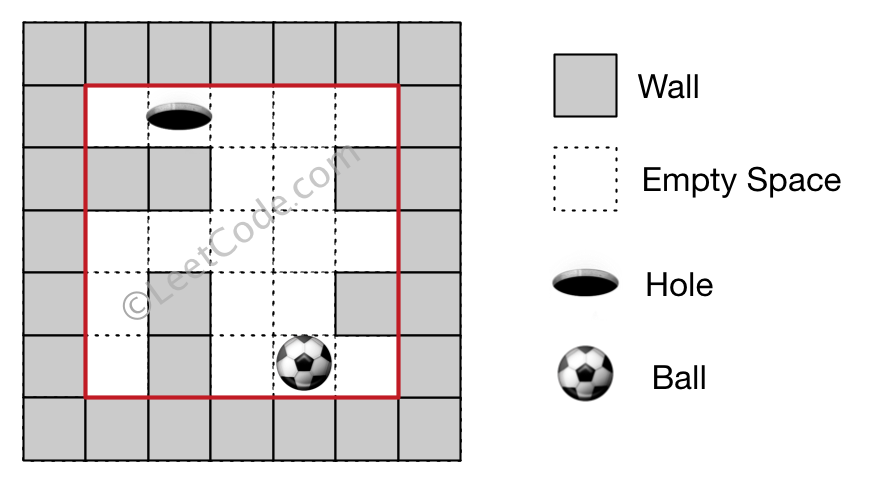
Input 1: a maze represented by a 2D array

0 0 0 0 0

1 1 0 0 1

0 0 0 0 0

0 1 0 0 1

0 1 0 0 0

Input 2: ball coordinate (rowBall, colBall) = (4, 3)

Input 3: hole coordinate (rowHole, colHole) = (0, 1)

Output: "lul"

Explanation: There are two shortest ways for the ball to drop into the hole.

The first way is left -> up -> left, represented by "lul".

The second way is up -> left, represented by 'ul'.

Both ways have shortest distance 6, but the first way is lexicographically smaller because 'l' < 'u'. So the output is "lul".
Example 2
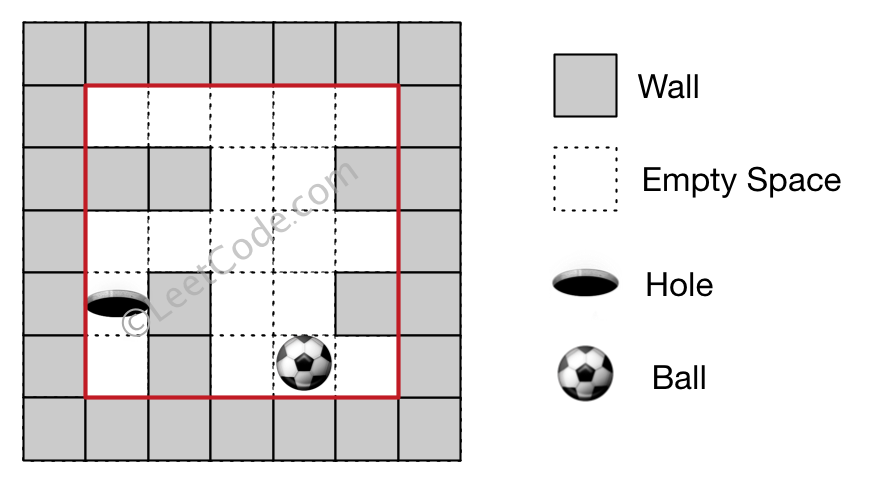
Input 1: a maze represented by a 2D array

0 0 0 0 0

1 1 0 0 1

0 0 0 0 0

0 1 0 0 1

0 1 0 0 0

Input 2: ball coordinate (rowBall, colBall) = (4, 3)

Input 3: hole coordinate (rowHole, colHole) = (3, 0)

Output: "impossible"

Explanation: The ball cannot reach the hole.
Note:
- There is only one ball and one hole in the maze.
- Both the ball and hole exist on an empty space, and they will not be at the same position initially.
- The given maze does not contain border (like the red rectangle in the example pictures), but you could assume the border of the maze are all walls.
- The maze contains at least 2 empty spaces, and the width and the height of the maze won't exceed 30.
490. The Maze 和 505. The Maze II 迷宫 II 的变形,在二维空间中放了洞,用u, r, d, l 这四个字母来分别表示上右下左,求让球掉入洞中的最小移动距离的移动方向字符串。在步数相等的情况下,返回按字母排序最小的答案。
解法1: BFS
解法2: DFS
Java:BFS,时间复杂度O(m * n * Max(m,n)),空间复杂度O(mn)
class Solution {

    class Point {

        int row, col, dist;

        public Point(int row, int col, int dist) {

            this.row = row;

            this.col = col;

            this.dist = dist;

        }

    }

    public String findShortestWay(int[][] maze, int[] ball, int[] hole) {

        if (maze == null || maze.length == 0) {

            return "";

        }

        int m = maze.length, n = maze[0].length;

        int[][] distance = new int[m][n];

        for (int i = 0; i < m; i++) {

            Arrays.fill(distance[i], Integer.MAX_VALUE);

        }

        distance[ball[0]][ball[1]] = 0;

        int[][] directions = {{-1, 0}, {1, 0}, {0, -1}, {0, 1}};

        String[] ways = {"u", "d", "l", "r"};

        Map<Integer, String> map = new HashMap<>();

        Queue<Point> queue = new LinkedList<>();

        queue.add(new Point(ball[0], ball[1], 0));

        findShortestWayByBFS(maze, queue, map, distance, hole, ways, directions);

        return map.containsKey(hole[0] * n + hole[1]) ? map.get(hole[0] * n + hole[1]) : "impossible";

    }

    public void findShortestWayByBFS(int[][] maze, Queue<Point> queue, Map<Integer, String> map, int[][] distance, int[] hole, String[] ways, int[][] directions) {

        int n = maze[0].length;

        while (!queue.isEmpty()) {

            Point curPoint = queue.remove();

            for (int i = 0; i < 4; i++) {

                int row = curPoint.row, col = curPoint.col, dist = curPoint.dist;

                String path = map.getOrDefault(row * n + col, "");

                while (isValid(row, col, maze, hole)) {

                    row += directions[i][0];

                    col += directions[i][1];

                    ++dist;

                }

                if (row != hole[0] || col != hole[1]) {

                    row -= directions[i][0];

                    col -= directions[i][1];

                    --dist;

                }

                path += ways[i];

                if (dist < distance[row][col]) {

                    distance[row][col] = dist;

                    map.put(row * n + col, path);

                    queue.add(new Point(row, col, dist));

                }

                else if (dist == distance[row][col] && path.compareTo(map.getOrDefault(row * n + col, "")) < 0) {

                    map.put(row * n + col, path);

                    queue.add(new Point(row, col, dist));

                }

            }

        }

    }

    public boolean isValid(int row, int col, int[][] maze, int[] hole) {

        return row >= 0 && row < maze.length && col >= 0 && col < maze[0].length && maze[row][col] == 0 && (row != hole[0] || col != hole[1]);

    }

}
Java:
public class Solution {

    public String findShortestWay(int[][] maze, int[] ball, int[] hole) {

        Queue<Point> queue = new LinkedList<>();

        int row = maze.length;

        int col = maze[0].length;

        Point[][] points = new Point[row][col];

        for (int i = 0; i < row; i++) {

            for (int j = 0; j < col; j++) {

                Point point = new Point(i, j);

                points[i][j] = point;

                if (i == hole[0] && j == hole[1]) {

                    point.path = "impossible";

                }

            }

        }

        int[] dirX = {0, -1, 1, 0}; // d, l, r, u

        int[] dirY = {1, 0, 0, -1};

        String[] dir = {"d", "l", "r", "u"};

        Point startPoint = points[ball[0]][ball[1]];

        startPoint.dis = 0;

        queue.add(startPoint);

        while (!queue.isEmpty()) {

            Point point = queue.poll();

            for (int i = 0; i < 4; i++) {

                int x = point.x;

                int y = point.y;

                int dis = point.dis;

                String path = point.path;

                boolean inHole = false;

                while (x >= 0 && x < row && y >= 0 && y < col && maze[x][y] == 0) {

                    x += dirX[i];

                    y += dirY[i];

                    dis++;

                    if (x == hole[0] && y == hole[1]) {

                        inHole = true;

                        break;

                    }

                }

                if (!inHole) {

                    x -= dirX[i];

                    y -= dirY[i];

                    dis--;

                }

                Point newPoint = points[x][y];

                if (newPoint.dis > dis) {

                    newPoint.dis = dis;

                    newPoint.path = String.join("", point.path, dir[i]);

                    if (!inHole) {

                        queue.add(newPoint);

                    }

                } else if (newPoint.dis == dis) {

                    boolean updated = false;

                    String newPath = String.join("", point.path, dir[i]);

                    for (int k = 0; k < newPoint.path.length() && k < newPath.length(); k++) {

                        if (newPoint.path.charAt(k) > newPath.charAt(k)) {

                            updated = true;

                            newPoint.path = newPath;

                            break;

                        }

                    }

                    if (!updated && newPoint.path.length() > newPath.length()) {

                        newPoint.path = newPath;

                    }

                }

            }

        }

        return points[hole[0]][hole[1]].path;

    }

}

class Point {

    int x;

    int y;

    String path;

    int dis;

    public Point(int x, int y) {

        this.x = x;

        this.y = y;

        this.path = "";

        this.dis = Integer.MAX_VALUE;

    }

}
C++:
class Solution {

public:

    string findShortestWay(vector<vector<int>>& maze, vector<int>& ball, vector<int>& hole) {

        int m = maze.size(), n = maze[0].size();

        vector<vector<int>> dists(m, vector<int>(n, INT_MAX));

        vector<vector<int>> dirs{{0,-1},{-1,0},{0,1},{1,0}};

        vector<char> way{'l','u','r','d'};

        queue<pair<int, int>> q;

        unordered_map<int, string> u;

        dists[ball[0]][ball[1]] = 0;

        q.push({ball[0], ball[1]});

        while (!q.empty()) {

            auto t = q.front(); q.pop();

            for (int i = 0; i < 4; ++i) {

                int x = t.first, y = t.second, dist = dists[x][y];

                string path = u[x * n + y];

                while (x >= 0 && x < m && y >= 0 && y < n && maze[x][y] == 0 && (x != hole[0] || y != hole[1])) {

                    x += dirs[i][0]; y += dirs[i][1]; ++dist;

                }

                if (x != hole[0] || y != hole[1]) {

                    x -= dirs[i][0]; y -= dirs[i][1]; --dist;

                }

                path.push_back(way[i]);

                if (dists[x][y] > dist) {

                    dists[x][y] = dist;

                    u[x * n + y] = path;

                    if (x != hole[0] || y != hole[1]) q.push({x, y});

                } else if (dists[x][y] == dist && u[x * n + y].compare(path) > 0) {

                    u[x * n + y] = path;

                    if (x != hole[0] || y != hole[1]) q.push({x, y});

                }

            }

        }

        string res = u[hole[0] * n + hole[1]];

        return res.empty() ? "impossible" : res;

    }

};
C++: DFS
class Solution {

public:

    vector<vector<int>> dirs{{0,-1},{-1,0},{0,1},{1,0}};

    vector<char> way{'l','u','r','d'};

    string findShortestWay(vector<vector<int>>& maze, vector<int>& ball, vector<int>& hole) {

        int m = maze.size(), n = maze[0].size();

        vector<vector<int>> dists(m, vector<int>(n, INT_MAX));

        unordered_map<int, string> u;

        dists[ball[0]][ball[1]] = 0;

        helper(maze, ball[0], ball[1], hole, dists, u);

        string res = u[hole[0] * n + hole[1]];

        return res.empty() ? "impossible" : res;

    }

    void helper(vector<vector<int>>& maze, int i, int j, vector<int>& hole, vector<vector<int>>& dists, unordered_map<int, string>& u) {

        if (i == hole[0] && j == hole[1]) return;

        int m = maze.size(), n = maze[0].size();

        for (int k = 0; k < 4; ++k) {

            int x = i, y = j, dist = dists[x][y];

            string path = u[x * n + y];

            while (x >= 0 && x < m && y >= 0 && y < n && maze[x][y] == 0 && (x != hole[0] || y != hole[1])) {

                x += dirs[k][0]; y += dirs[k][1]; ++dist;

            }

            if (x != hole[0] || y != hole[1]) {

                x -= dirs[k][0]; y -= dirs[k][1]; --dist;

            }

            path.push_back(way[k]);

            if (dists[x][y] > dist) {

                dists[x][y] = dist;

                u[x * n + y] = path;

                helper(maze, x, y, hole, dists, u);

            } else if (dists[x][y] == dist && u[x * n + y].compare(path) > 0) {

                u[x * n + y] = path;

                helper(maze, x, y, hole, dists, u);

            }

        }

    }

};
类似题目:
[LeetCode] 505. The Maze II 迷宫 II
All LeetCode Questions List 题目汇总
[LeetCode] 499. The Maze III 迷宫 III的更多相关文章
- [LeetCode] 505. The Maze II 迷宫 II
There is a ball in a maze with empty spaces and walls. The ball can go through empty spaces by rolli ...
- LeetCode 499. The Maze III
原题链接在这里:https://leetcode.com/problems/the-maze-iii/ 题目: There is a ball in a maze with empty spaces ...
- [LeetCode] 505. The Maze II 迷宫之二
There is a ball in a maze with empty spaces and walls. The ball can go through empty spaces by rolli ...
- 【LeetCode】556. Next Greater Element III 解题报告(Python)
[LeetCode]556. Next Greater Element III 解题报告(Python) 标签(空格分隔): LeetCode 作者: 负雪明烛 id: fuxuemingzhu 个人 ...
- 3299: [USACO2011 Open]Corn Maze玉米迷宫
3299: [USACO2011 Open]Corn Maze玉米迷宫 Time Limit: 10 Sec Memory Limit: 128 MBSubmit: 137 Solved: 59[ ...
- [LeetCode] The Maze III 迷宫之三
There is a ball in a maze with empty spaces and walls. The ball can go through empty spaces by rolli ...
- LC 499. The Maze III 【lock,hard】
There is a ball in a maze with empty spaces and walls. The ball can go through empty spaces by rolli ...
- [LeetCode] The Maze II 迷宫之二
There is a ball in a maze with empty spaces and walls. The ball can go through empty spaces by rolli ...
- [LeetCode] 490. The Maze 迷宫
There is a ball in a maze with empty spaces and walls. The ball can go through empty spaces by rolli ...
随机推荐
- 石子归并(区间dp 模板)
区间dp入门 #include<iostream> #include<cstdio> #include <cctype> #include<algorithm ...
- adb命令过滤w级别日志命令
adb logcat *:W 过滤某关键字日志 adb logcat *:W | find "woyihome" 过滤某关键字日志,生成txt文档 adb logcat *:W | ...
- Spark 缓存机制
Spark中的缓存机制:避免spark每次都重算RDD以及它的所有依赖,cache().persist(). checkpoint(). 1.cache():会被重复使用,但是不能太大的RDD,将其c ...
- LeetCode 801. Minimum Swaps To Make Sequences Increasing
原题链接在这里:https://leetcode.com/problems/minimum-swaps-to-make-sequences-increasing/ 题目: We have two in ...
- solidworks 学习 (四)
旋钮三维建模
- BZOJ 4197: [Noi2015]寿司晚宴 状压dp+质因数分解
挺神的一道题 ~ 由于两个人选的数字不能有互质的情况,所以说对于一个质因子来说,如果 1 选了,则 2 不能选任何整除该质因子的数. 然后,我们发现对于 1 ~ 500 的数字来说,只可能有一个大于 ...
- ShardingSphere初探1 -- 概览
知道这个框架是通过一期QQ课堂 https://shardingsphere.apache.org 官网 https://github.com/apache/incubator-shardingsph ...
- js中forEach,for in,for of循环的用法详解
一.一般的遍历数组的方法: var array = [1,2,3,4,5,6,7]; for (var i = 0; i < array.length; i) { console.log(i,a ...
- 原创:协同过滤之ALS
推荐系统的算法,在上个世纪90年代成型,最早应用于UserCF,基于用户的协同过滤算法,标志着推荐系统的形成.首先,要明白以下几个理论:①长尾理论②评判推荐系统的指标.之所以需要推荐系统,是要挖掘冷门 ...
- 一次修复linux的efi引导的集中方法总结记录
本文通过MetaWeblog自动发布,原文及更新链接:https://extendswind.top/posts/technical/grub_uefi_repair 起因:EFI分区被删除导致引导问 ...