
What's the difference between @Component, @Repository & @Service annotations in Spring?
@Component is equivalent to
<bean>@Service, @Controller , @Repository = {@Component + some more special functionality}
That mean Service,Controller and Repository are functionally the same.
The three annotations are used to separate "Layers" in your application,
- Controllers just do stuff like dispatching, forwarding, calling service methods etc.
- Service Hold business Logic, Calculations etc.
- Repository are the DAOs(Data Access Objects), they access the database directly.
Now you may ask why separate them:(I assume you know AOP-Aspect Oriented Programming)
Lets say you want to Monitors the Activity of the DAO Layer only. You will write an Aspect(A class) class that does some logging before and after every method of your DAO is invoked, you are able to do that using AOP as you have three distinct Layers and are not mixed.
So you can do logging of DAO "around", "before" or "after" the DAO methods. You could do that because you had a DAO in the first place. What you just achieved is Separation of concerns or tasks.
Imagine if there were only one annotation @Controller, then this component will have dispatching, business logic and accessing database all mixed, so dirty code!
Above mentioned is one very common scenario, there are many more use cases of why to use three annotations.
In Spring @Component, @Service, and @Controller. @Component are Stereotype annotations which is used for:
@Controller: where your request mapping from presentation page done i.e. Presentation layer won't go to any other file it goes directly to @Controller class and check for requested path in @RequestMapping annotation which written before method calls if necessary.
@Service: All business logic is here i.e. Data related calculations and all.This annotation of business layer in which our user not directly call persistence method so it will call this methods using this annotation. It will request @Repository as per user request
@Repository:This is Persistence layer(Data Access Layer) of application which used to get data from database. i.e. all the Database related operations are done by repository.
@Component - Annotate your other components (for example REST resource classes) with component stereotype.
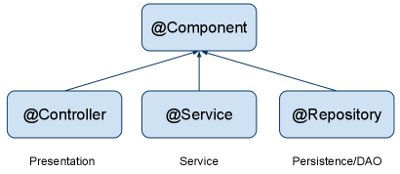
From Spring Documentation:
In Spring 2.0 and later, the @Repository annotation is a marker for any class that fulfills the role or stereotype (also known as Data Access Object or DAO) of a repository. Among the uses of this marker is the automatic translation of exceptions.
Spring 2.5 introduces further stereotype annotations: @Component, @Service, and @Controller. @Component is a generic stereotype for any Spring-managed component. @Repository, @Service, and @Controller are specializations of @Component for more specific use cases, for example, in the persistence, service, and presentation layers, respectively.
Therefore, you can annotate your component classes with @Component, but by annotating them with @Repository, @Service, or @Controller instead, your classes are more properly suited for processing by tools or associating with aspects. For example, these stereotype annotations make ideal targets for pointcuts.
Thus, if you are choosing between using @Component or @Service for your service layer, @Service is clearly the better choice. Similarly, as stated above, @Repository is already supported as a marker for automatic exception translation in your persistence layer.
| Annotation | Meaning                                             |

+------------+-----------------------------------------------------+

| @Component | generic stereotype for any Spring-managed component |

| @Repository| stereotype for persistence layer                    |

| @Service   | stereotype for service layer                        |

| @Controller| stereotype for presentation layer (spring-mvc)      |
Spring 2.5 introduces further stereotype annotations: @Component, @Service and @Controller. @Component serves as a generic stereotype for any Spring-managed component; whereas, @Repository, @Service, and @Controller serve as specializations of @Component for more specific use cases (e.g., in the persistence, service, and presentation layers, respectively). What this means is that you can annotate your component classes with @Component, but by annotating them with @Repository, @Service, or @Controller instead, your classes are more properly suited for processing by tools or associating with aspects. For example, these stereotype annotations make ideal targets for pointcuts. Of course, it is also possible that @Repository, @Service, and @Controller may carry additional semantics in future releases of the Spring Framework. Thus, if you are making a decision between using @Component or @Service for your service layer, @Service is clearly the better choice. Similarly, as stated above, @Repository is already supported as a marker for automatic exception translation in your persistence layer.
@Component – Indicates a auto scan component.

@Repository – Indicates DAO component in the persistence layer.

@Service – Indicates a Service component in the business layer.

@Controller – Indicates a controller component in the presentation layer.
reference :- http://static.springsource.org/spring/docs/3.0.0.M3/reference/html/ch04s12.html
http://stackoverflow.com/questions/25633477/security-configuration-with-spring-boot?rq=1
What's the difference between @Component, @Repository & @Service annotations in Spring?的更多相关文章
- [转]what’s the difference between @Component ,@Repository & @Service annotations in Spring
原文地址:https://www.cnblogs.com/softidea/p/6070314.html @Component is equivalent to <bean> @Servi ...
- 【转载】@Component, @Repository, @Service的区别
@Component, @Repository, @Service的区别 官网引用 引用spring的官方文档中的一段描述: 在Spring2.0之前的版本中,@Repository注解可以标记在任何 ...
- SpringAnnotation注解之@Component,@Repository,@Service,@Controller
@Component:组件,表示此写上了此注解的bean,作为一个组件存在于容器中.这样的话别的地方就可以使用@Resource这个注解来把这个组件作为一个资源来使用了.初始化bean的名字为类名首字 ...
- @Component @Repository @Service @Controller
Spring 2.5 中除了提供 @Component 注释外,还定义了几个拥有特殊语义的注释,它们分别是:@Repository.@Service 和 @Controller.在目前的 Spring ...
- @Component, @Repository, @Service的区别
注解 含义 @Component 最普通的组件,可以被注入到spring容器进行管理 @Repository 作用于持久层 @Service 作用于业务逻辑层 @Controller 作用于表现层(s ...
- @Component, @Repository, @Service,@Controller的区别
@Component, @Service, @Controller, @Repository是spring注解,注解后可以被spring框架所扫描并注入到spring容器来进行管理 @Componen ...
- 从头认识Spring-2.7 自己主动检測Bean(1)-@Component @Repository @Service @Controller
这一章节我们来讨论一下自己主动检測Bean. 1.domain 厨师类: package com.raylee.my_new_spring.my_new_spring.ch02.topic_1_19; ...
- @Component @Controller @Service @Repository@Resourse
@Component @Controller @Service @Repository@Resourse这些全部是Spring提供的注解. 其中@Component用来表示把一个类纳入spring容器 ...
- Spring注解详解@Repository、@Component、@Service 和 @Constroller
概述 注释配置相对于 XML 配置具有很多的优势: 它可以充分利用 Java 的反射机制获取类结构信息,这些信息可以有效减少配置的工作.如使用 JPA 注释配置 ORM 映射时,我们就不需要指定 PO ...
随机推荐
- Invalid App Store Icon. The App Store Icon in the asset catalog in 'xxx.app' can’t be transparent nor contain an alpha channel.
1.向appstore上传应用的时候,报了这样一个错误 ERROR ITMS-90717: "Invalid App Store Icon. The App Store Icon in th ...
- React + Dva + Antd + Umi 概况
Dva 由阿里架构师 sorrycc 带领 team 完成的一套前端框架,在作者的 github 里是这么描述它的:"dva 是 react 和 redux 的最佳实践". Ant ...
- 316. Remove Duplicate Letters (accumulate -> count of the difference elements in a vector)
Given a string which contains only lowercase letters, remove duplicate letters so that every letter ...
- kali linux之手动漏洞挖掘一
默认安装漏洞 phpmyadmin/setup默认安装 ubuntu/debian默认安装php5-cgi phpmyadmin/setup默认安装 使用?-d+allow_url_include%3 ...
- 关于C语言中printf函数“输出歧视”的问题
目录 关于C语言中printf函数"输出歧视"的问题 问题描述 探索问题原因 另一种研究方法 问题结论 关于C语言中printf函数"输出歧视"的问题 问题描述 ...
- luogu3703 [SDOI2017]树点涂色(线段树+树链剖分+动态树)
link 你谷的第一篇题解没用写LCT,然后没观察懂,但是自己YY了一种不用LCT的做法 我们考虑对于每个点,维护一个fa,代表以1为根时候这个点的父亲 再维护一个bel,由于一个颜色相同的段一定是一 ...
- K3 Wise 常用表【转载】
在后台数据库ICClassType表中,字段FID<0的是老单,FID>0的是新单.--事务类型select * from ICClassType where FT ...
- 用IDM下载博客图片
前言 写博客的人一定都会有一个图床,将图片存在那里.发现自己以前没有注意图片来源问题,随手就贴在博客上面了.现在有不少图片都挂了,换句话来说有可能自己目前用的图床不提供服务了,那所有的图片都有可能丢失 ...
- 洛谷 P2542 [AHOI2005]航线规划(Link-cut-tree)
题面 洛谷 bzoj 题解 离线处理+LCT 有点像星球大战 我们可以倒着做,断边变成连边 我们可以把边变成一个点 连边时,如果两个点本身不联通,就\(val\)赋为\(1\),并连接这条边 如果,两 ...
- CNN 卷积神经网络结构
cnn每一层会输出多个feature map, 每个Feature Map通过一种卷积滤波器提取输入的一种特征,每个feature map由多个神经元组成,假如某个feature map的shape是 ...