
Unet 项目部分代码学习
github地址:https://github.com/orobix/retina-unet
主程序:
###################################################

#

#   Script to:

#   - Load the images and extract the patches

#   - Define the neural network

#   - define the training

#

##################################################

import numpy as np

import configparser as ConfigParser

from keras.models import Model

from keras.layers import Input, concatenate, Conv2D, MaxPooling2D, UpSampling2D, Reshape, core, Dropout

from keras.optimizers import Adam

from keras.callbacks import ModelCheckpoint, LearningRateScheduler

from keras import backend as K

from keras.utils.vis_utils import plot_model as plot

from keras.optimizers import SGD

import sys

sys.path.insert(0, './lib/')

from help_functions import *

#function to obtain data for training/testing (validation)

from extract_patches import get_data_training

#Define the neural network

def get_unet(n_ch,patch_height,patch_width):

    inputs = Input(shape=(n_ch,patch_height,patch_width))

    conv1 = Conv2D(32, (3, 3), activation='relu', padding='same',data_format='channels_first')(inputs)

    conv1 = Dropout(0.2)(conv1)

    conv1 = Conv2D(32, (3, 3), activation='relu', padding='same',data_format='channels_first')(conv1)

    pool1 = MaxPooling2D((2, 2))(conv1)

    #

    conv2 = Conv2D(64, (3, 3), activation='relu', padding='same',data_format='channels_first')(pool1)

    conv2 = Dropout(0.2)(conv2)

    conv2 = Conv2D(64, (3, 3), activation='relu', padding='same',data_format='channels_first')(conv2)

    pool2 = MaxPooling2D((2, 2))(conv2)

    #

    conv3 = Conv2D(128, (3, 3), activation='relu', padding='same',data_format='channels_first')(pool2)

    conv3 = Dropout(0.2)(conv3)

    conv3 = Conv2D(128, (3, 3), activation='relu', padding='same',data_format='channels_first')(conv3)

    up1 = UpSampling2D(size=(2, 2))(conv3)

    up1 = concatenate([conv2,up1],axis=1)

    conv4 = Conv2D(64, (3, 3), activation='relu', padding='same',data_format='channels_first')(up1)

    conv4 = Dropout(0.2)(conv4)

    conv4 = Conv2D(64, (3, 3), activation='relu', padding='same',data_format='channels_first')(conv4)

    #

    up2 = UpSampling2D(size=(2, 2))(conv4)

    up2 = concatenate([conv1,up2], axis=1)

    conv5 = Conv2D(32, (3, 3), activation='relu', padding='same',data_format='channels_first')(up2)

    conv5 = Dropout(0.2)(conv5)

    conv5 = Conv2D(32, (3, 3), activation='relu', padding='same',data_format='channels_first')(conv5)

    #

    conv6 = Conv2D(2, (1, 1), activation='relu',padding='same',data_format='channels_first')(conv5)

    conv6 = core.Reshape((2,patch_height*patch_width))(conv6)

    conv6 = core.Permute((2,1))(conv6)

    ############

    conv7 = core.Activation('softmax')(conv6)

    model = Model(inputs=inputs, outputs=conv7)

    # sgd = SGD(lr=0.01, decay=1e-6, momentum=0.3, nesterov=False)

    model.compile(optimizer='sgd', loss='categorical_crossentropy',metrics=['accuracy'])

    return model

#Define the neural network gnet

#you need change function call "get_unet" to "get_gnet" in line 166 before use this network

def get_gnet(n_ch,patch_height,patch_width):

    inputs = Input((n_ch, patch_height, patch_width))

    conv1 = Convolution2D(32, 3, 3, activation='relu', border_mode='same')(inputs)

    conv1 = Dropout(0.2)(conv1)

    conv1 = Convolution2D(32, 3, 3, activation='relu', border_mode='same')(conv1)

    up1 = UpSampling2D(size=(2, 2))(conv1)

    #

    conv2 = Convolution2D(16, 3, 3, activation='relu', border_mode='same')(up1)

    conv2 = Dropout(0.2)(conv2)

    conv2 = Convolution2D(16, 3, 3, activation='relu', border_mode='same')(conv2)

    pool1 = MaxPooling2D(pool_size=(2, 2))(conv2)

    #

    conv3 = Convolution2D(32, 3, 3, activation='relu', border_mode='same')(pool1)

    conv3 = Dropout(0.2)(conv3)

    conv3 = Convolution2D(32, 3, 3, activation='relu', border_mode='same')(conv3)

    pool2 = MaxPooling2D(pool_size=(2, 2))(conv3)

    #

    conv4 = Convolution2D(64, 3, 3, activation='relu', border_mode='same')(pool2)

    conv4 = Dropout(0.2)(conv4)

    conv4 = Convolution2D(64, 3, 3, activation='relu', border_mode='same')(conv4)

    pool3 = MaxPooling2D(pool_size=(2, 2))(conv4)

    #

    conv5 = Convolution2D(128, 3, 3, activation='relu', border_mode='same')(pool3)

    conv5 = Dropout(0.2)(conv5)

    conv5 = Convolution2D(128, 3, 3, activation='relu', border_mode='same')(conv5)

    #

    up2 = merge([UpSampling2D(size=(2, 2))(conv5), conv4], mode='concat', concat_axis=1)

    conv6 = Convolution2D(64, 3, 3, activation='relu', border_mode='same')(up2)

    conv6 = Dropout(0.2)(conv6)

    conv6 = Convolution2D(64, 3, 3, activation='relu', border_mode='same')(conv6)

    #

    up3 = merge([UpSampling2D(size=(2, 2))(conv6), conv3], mode='concat', concat_axis=1)

    conv7 = Convolution2D(32, 3, 3, activation='relu', border_mode='same')(up3)

    conv7 = Dropout(0.2)(conv7)

    conv7 = Convolution2D(32, 3, 3, activation='relu', border_mode='same')(conv7)

    #

    up4 = merge([UpSampling2D(size=(2, 2))(conv7), conv2], mode='concat', concat_axis=1)

    conv8 = Convolution2D(16, 3, 3, activation='relu', border_mode='same')(up4)

    conv8 = Dropout(0.2)(conv8)

    conv8 = Convolution2D(16, 3, 3, activation='relu', border_mode='same')(conv8)

    #

    pool4 = MaxPooling2D(pool_size=(2, 2))(conv8)

    conv9 = Convolution2D(32, 3, 3, activation='relu', border_mode='same')(pool4)

    conv9 = Dropout(0.2)(conv9)

    conv9 = Convolution2D(32, 3, 3, activation='relu', border_mode='same')(conv9)

    #

    conv10 = Convolution2D(2, 1, 1, activation='relu', border_mode='same')(conv9)

    conv10 = core.Reshape((2,patch_height*patch_width))(conv10)

    conv10 = core.Permute((2,1))(conv10)

    ############

    conv10 = core.Activation('softmax')(conv10)

    model = Model(input=inputs, output=conv10)

    # sgd = SGD(lr=0.01, decay=1e-6, momentum=0.3, nesterov=False)

    model.compile(optimizer='sgd', loss='categorical_crossentropy',metrics=['accuracy'])

    return model

#========= Load settings from Config file

config = ConfigParser.RawConfigParser()

config.read('configuration.txt')

#patch to the datasets

path_data = config.get('data paths', 'path_local')

#Experiment name

name_experiment = config.get('experiment name', 'name')

#training settings

N_epochs = int(config.get('training settings', 'N_epochs'))

batch_size = int(config.get('training settings', 'batch_size'))

#============ Load the data and divided in patches

patches_imgs_train, patches_masks_train = get_data_training(

    DRIVE_train_imgs_original = path_data + config.get('data paths', 'train_imgs_original'),

    DRIVE_train_groudTruth = path_data + config.get('data paths', 'train_groundTruth'),  #masks

    patch_height = int(config.get('data attributes', 'patch_height')),

    patch_width = int(config.get('data attributes', 'patch_width')),

    N_subimgs = int(config.get('training settings', 'N_subimgs')),

    inside_FOV = config.getboolean('training settings', 'inside_FOV') #select the patches only inside the FOV  (default == True)

)

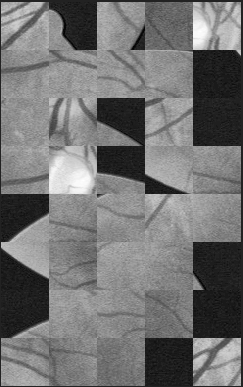
#========= Save a sample of what you're feeding to the neural network ==========

N_sample = min(patches_imgs_train.shape[0],40)#这里规定,要显示的图片最多不超过40张

visualize(group_images(patches_imgs_train[0:N_sample,:,:,:],5),'./'+name_experiment+'/'+"sample_input_imgs")#.show()

visualize(group_images(patches_masks_train[0:N_sample,:,:,:],5),'./'+name_experiment+'/'+"sample_input_masks")#.show()

#显示的结果会在下面贴出来

#=========== Construct and save the model arcitecture =====

n_ch = patches_imgs_train.shape[1]#得到每个patch的通道数

patch_height = patches_imgs_train.shape[2]#得到每个patch的高

patch_width = patches_imgs_train.shape[3]#得到每个patch的宽

model = get_unet(n_ch, patch_height, patch_width)  #the U-net model

print ("Check: final output of the network:")

print (model.output_shape)

plot(model, to_file='./'+name_experiment+'/'+name_experiment + '_model.png')   #check how the model looks like

json_string = model.to_json()#model.to_json:返回代表模型的JSON字符串,仅包含网络结构,不包含权值。可以从JSON字符串中重构原模型:

open('./'+name_experiment+'/'+name_experiment +'_architecture.json', 'w').write(json_string)

#============  Training ==================================

checkpointer = ModelCheckpoint(filepath='./'+name_experiment+'/'+name_experiment +'_best_weights.h5', verbose=1, monitor='val_loss', mode='auto', save_best_only=True) #save at each epoch if the validation decreased

# def step_decay(epoch):

#     lrate = 0.01 #the initial learning rate (by default in keras)

#     if epoch==100:

#         return 0.005

#     else:

#         return lrate

#

# lrate_drop = LearningRateScheduler(step_decay)

patches_masks_train = masks_Unet(patches_masks_train)  #reduce memory consumption

model.fit(patches_imgs_train, patches_masks_train, nb_epoch=N_epochs, batch_size=batch_size, verbose=2, shuffle=True, validation_split=0.1, callbacks=[checkpointer])

#========== Save and test the last model ===================

model.save_weights('./'+name_experiment+'/'+name_experiment +'_last_weights.h5', overwrite=True)

#test the model

# score = model.evaluate(patches_imgs_test, masks_Unet(patches_masks_test), verbose=0)

# print('Test score:', score[0])

# print('Test accuracy:', score[1])
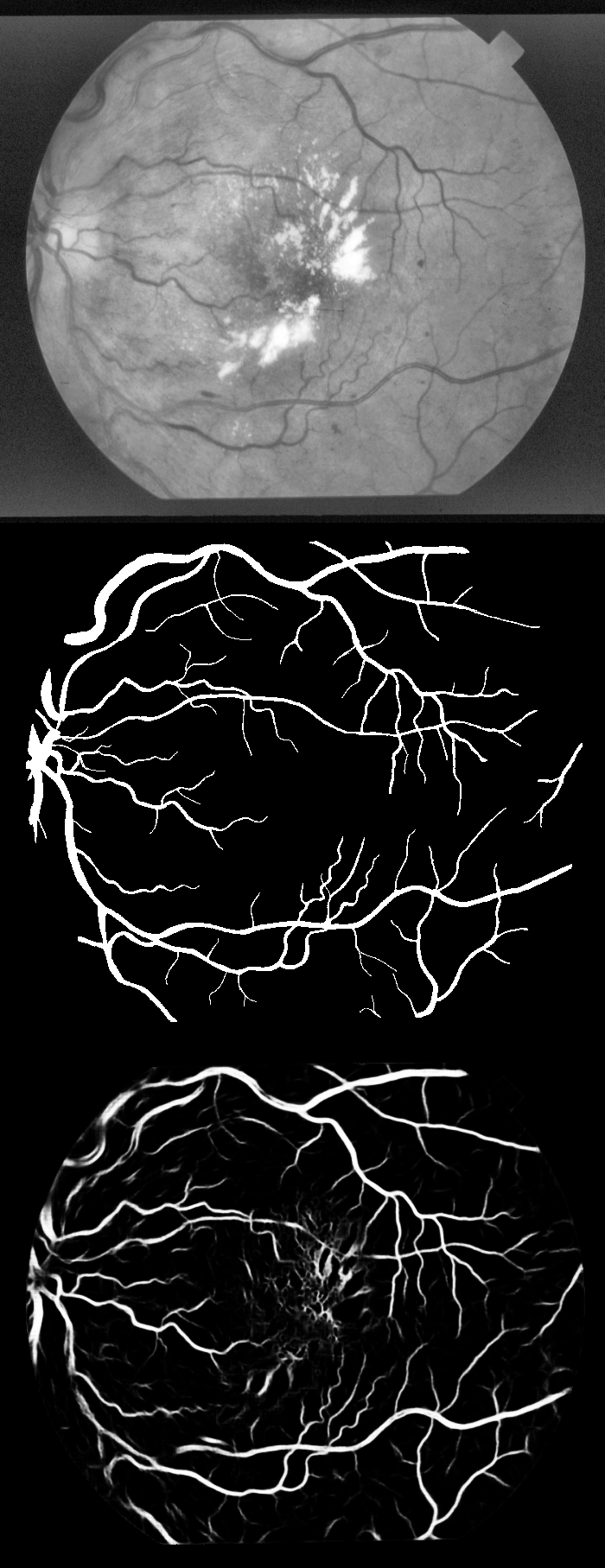
实验结果显示:上中下分别为原图-groundTruth-预测图
Unet 项目部分代码学习的更多相关文章
- R2CNN项目部分代码学习
首先放出大佬的项目地址:https://github.com/yangxue0827/R2CNN_FPN_Tensorflow 那么从输入的数据开始吧,输入的数据要求为tfrecord格式的数据集,好 ...
- FCN 项目部分代码学习
下面代码由搭档注释,保存下来用作参考. github项目地址:https://github.com/shekkizh/FCN.tensorflowfrom __future__ import prin ...
- CTPN项目部分代码学习
上次拜读了CTPN论文,趁热打铁,今天就从网上找到CTPN 的tensorflow代码实现一下,这里放出大佬的github项目地址:https://github.com/eragonruan/text ...
- JAVAEE——BOS物流项目02:学习计划、动态添加选项卡、ztree、项目底层代码构建
1 学习计划 1.jQuery easyUI中动态添加选项卡 2.jquery ztree插件使用 n 下载ztree n 基于标准json数据构造ztree n 基于简单json数据构造ztree( ...
- Android开源项目SlidingMenu本学习笔记(两)
我们已经出台SlidingMenu使用:Android开源项目SlidingMenu本学习笔记(一个),接下来再深入学习下.依据滑出项的Menu切换到相应的页面 文件夹结构: watermark/2/ ...
- IDEA 学习笔记之 Java项目开发深入学习(1)
Java项目开发深入学习(1): 定义编译输出路径: 继承以上工程配置 重新定义新的项目编译路径 添加source目录:点击添加,再点击移除: 编译项目: 常用快捷键总结: Ctrl+Space 代码 ...
- 201671010447 杨露露 实验十四 团队项目评审&课程学习总结
项目 内容 这个作业属于哪个课程 2016计算机科学与工程学院软件工程(西北师范大学) 这个作业的要求在哪里 实验十四 团队项目评审&课程学习总结 作业学习目标 总结这学期软件工程学习获得 一 ...
- 实验十四 团队项目评审&课程学习总结
项目 内容 这个作业属于哪个课程 2016计算机科学与工程学院软件工程(西北师范大学) 这个作业的要求在哪里 实验十四 团队项目评审&课程学习总结 团队名称 快活帮 作业学习目标 (1)掌握软 ...
- 201671010449 杨天超 实验十四 团队项目评审&课程学习总结
项目 内容 这个作业属于哪个课程 任课教师博客主页链接 这个作业的要求在哪里 作业链接地址 作业学习目标 1.掌握软件评审流程及内容 2.个人总结 实验一问题解答 实验一问题链接:https://ww ...
随机推荐
- JS 如何将 HTML 页面导出为多页 PDF
参考链接:https://blog.csdn.net/pwc1996/article/details/70141383
- linux syscall 详解【转】
转自:https://blog.csdn.net/feixin620/article/details/78416560 引言:分析Android源码的过程中,要想从上至下完全明白一行代码,往往涉及ap ...
- jquery获取、设置、删除cookie
获取cookie: function getCookie(cname) { var name = cname + "="; var ca = document.cookie.spl ...
- CF 1138F 超级有意思的一道交互题QVQ
题意 有一张有向图,由一条长度为 T 的链和一个长度为 C 环组成,但是你并不知道 T 和 C 是多少 图的出发点在链的一段,终点在链的另一端,同时终点与一个环相连,大概有点内向树感觉 现在有 10 ...
- git下载指定的版本
1.查看提交历史 sudo git log 打印如下内容: commit 2e3c19d412ab6a99bb51f338f71537a720a9c706 Author: huangbaog ...
- pwnable.kr simple login writeup
这道题是pwnable.kr Rookiss部分的simple login,需要我们去覆盖程序的ebp,eip,esp去改变程序的执行流程 主要逻辑是输入一个字符串,base64解码后看是否与题目 ...
- OpenStack实践系列④计算服务Nova
OpenStack实践系列④计算服务Nova 3.6 Nova控制节点的部署创建服务的凭证,完成下列步骤: 创建nova用户,并加入到service项目中,赋予admin权限 [root@node1 ...
- python bytes/str
http://eli.thegreenplace.net/2012/01/30/the-bytesstr-dichotomy-in-python-3/
- Light OJ 1020
简单推理题: #include<bits/stdc++.h> using namespace std; int main() { int T, n; string Name; cin &g ...
- [JavaScript]为JS处理二进制数据提供可能性的WEB API
写这篇博客的起源是在div.io上的一篇文章<你所不知道的JavaScript数组>by 小胡子哥下的评论中的讨论. 因为随着XHR2和现代浏览器的普及,在浏览器当中处理二进制不再向过去那 ...