
吴裕雄--天生自然 R语言开发学习:广义线性模型

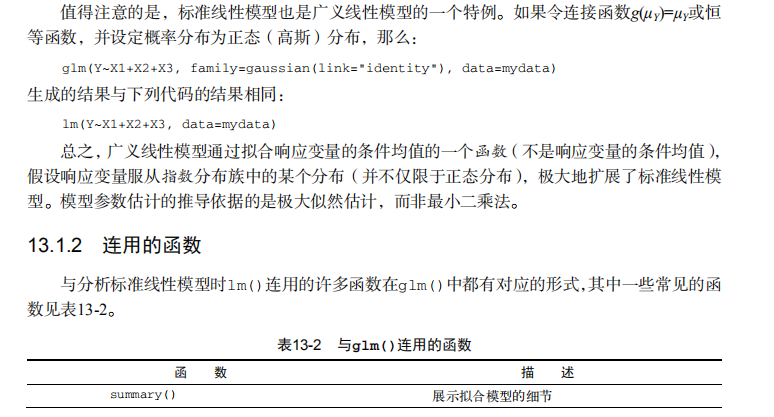
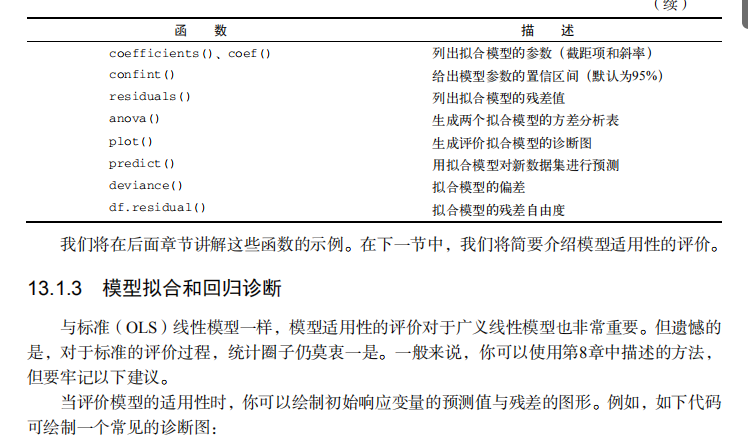







#----------------------------------------------#

# R in Action (2nd ed): Chapter 13             #

# Generalized linear models                    #

# requires packages AER, robust, gcc           #

# install.packages(c("AER", "robust", "gcc"))  #

#----------------------------------------------#

## Logistic Regression

# get summary statistics

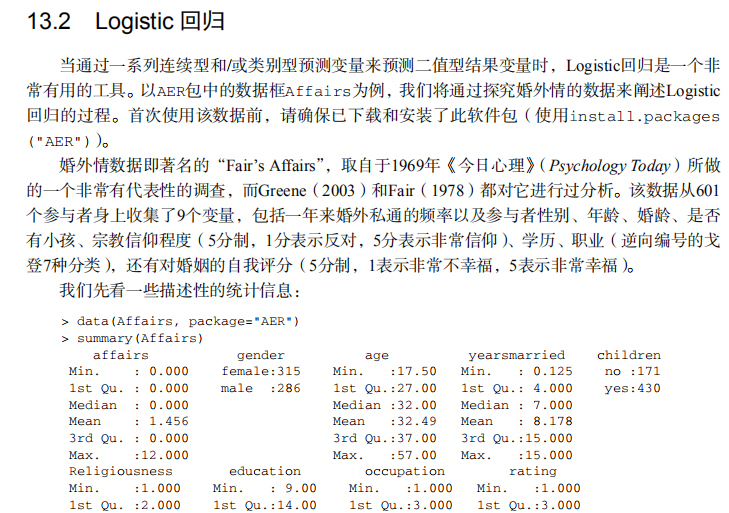
data(Affairs, package="AER")

summary(Affairs)

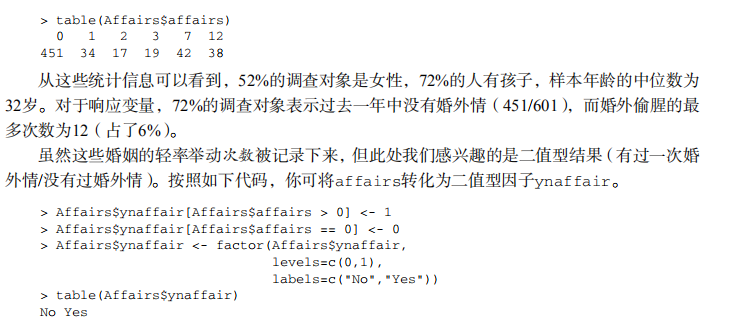
table(Affairs$affairs)

# create binary outcome variable

Affairs$ynaffair[Affairs$affairs > 0] <- 1

Affairs$ynaffair[Affairs$affairs == 0] <- 0

Affairs$ynaffair <- factor(Affairs$ynaffair,

                           levels=c(0,1),

                           labels=c("No","Yes"))

table(Affairs$ynaffair)

# fit full model

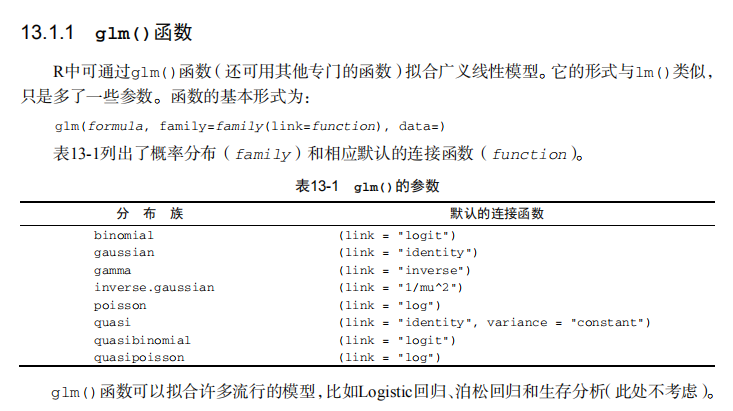
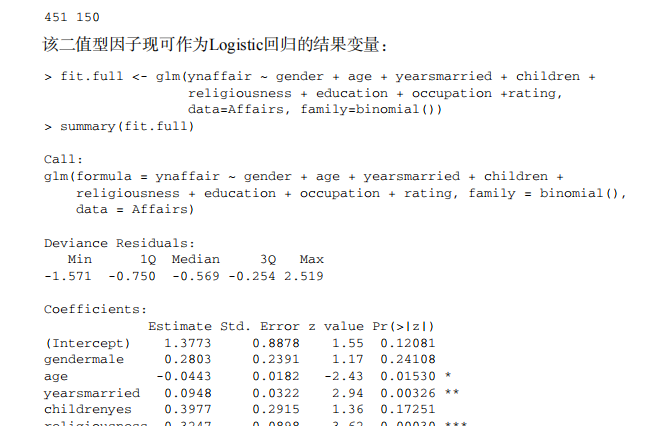
fit.full <- glm(ynaffair ~ gender + age + yearsmarried + children +

                  religiousness + education + occupation +rating,

                data=Affairs,family=binomial())

summary(fit.full)

# fit reduced model

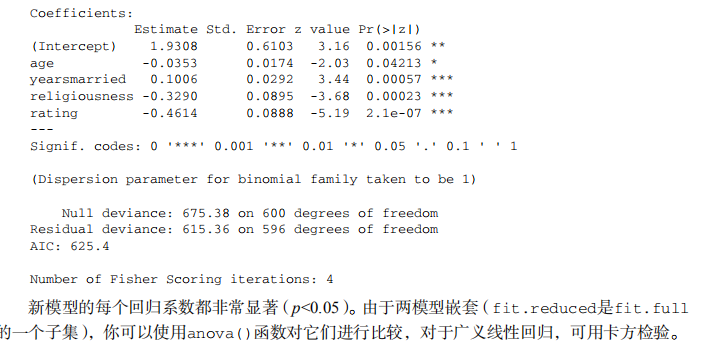
fit.reduced <- glm(ynaffair ~ age + yearsmarried + religiousness +

                     rating, data=Affairs, family=binomial())

summary(fit.reduced)

# compare models

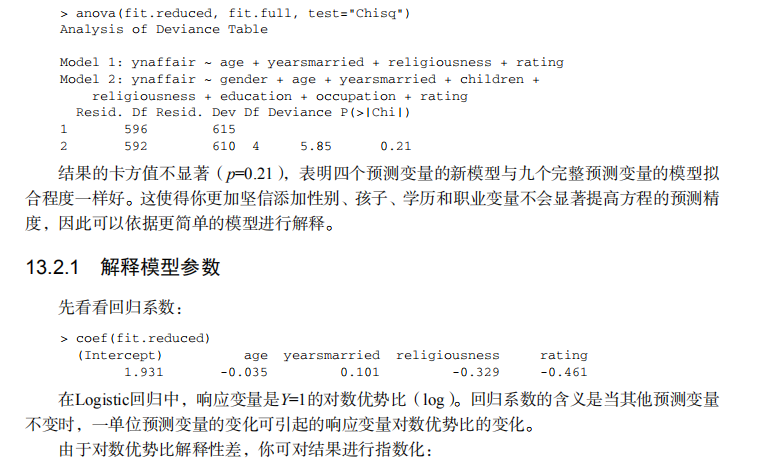
anova(fit.reduced, fit.full, test="Chisq")

# interpret coefficients

coef(fit.reduced)

exp(coef(fit.reduced))

# calculate probability of extramariatal affair by marital ratings

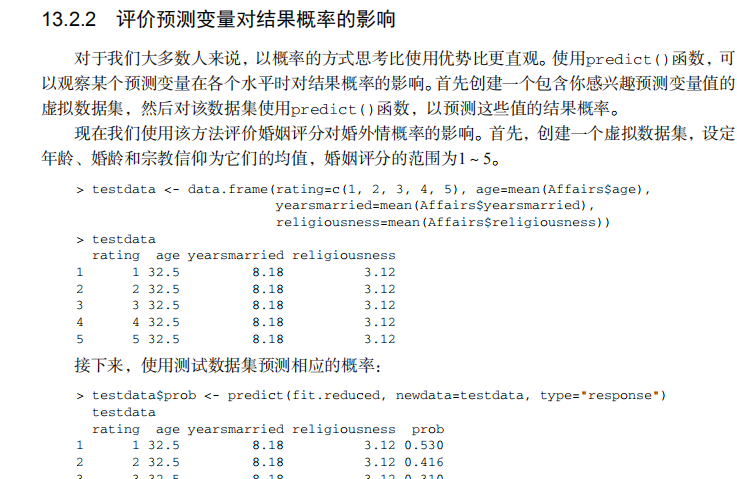
testdata <- data.frame(rating = c(1, 2, 3, 4, 5),

                       age = mean(Affairs$age),

                       yearsmarried = mean(Affairs$yearsmarried),

                       religiousness = mean(Affairs$religiousness))

testdata$prob <- predict(fit.reduced, newdata=testdata, type="response")

testdata

# calculate probabilites of extramariatal affair by age

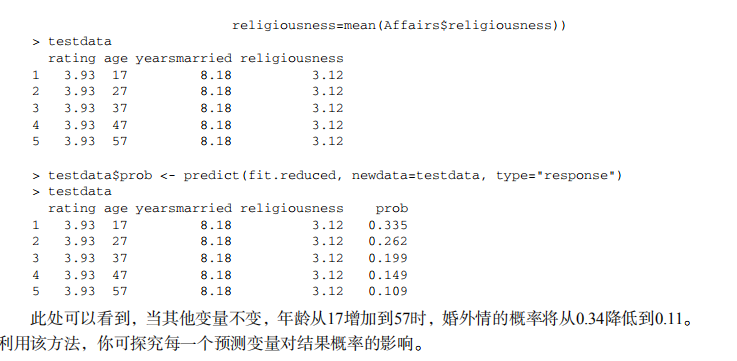
testdata <- data.frame(rating = mean(Affairs$rating),

                       age = seq(17, 57, 10),

                       yearsmarried = mean(Affairs$yearsmarried),

                       religiousness = mean(Affairs$religiousness))

testdata$prob <- predict(fit.reduced, newdata=testdata, type="response")

testdata

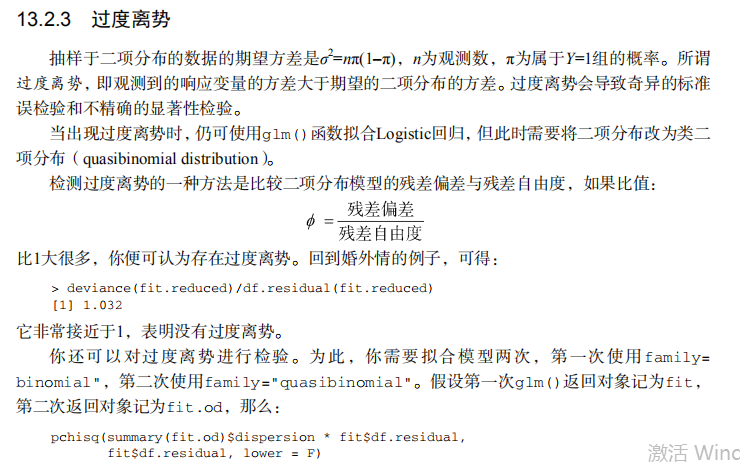
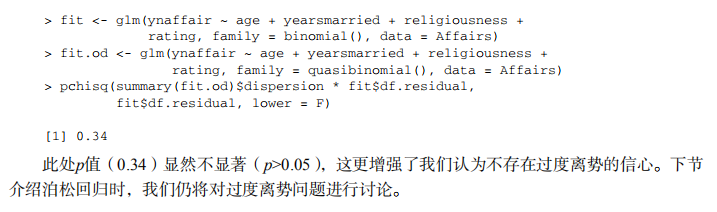
# evaluate overdispersion

fit <- glm(ynaffair ~ age + yearsmarried + religiousness +

             rating, family = binomial(), data = Affairs)

fit.od <- glm(ynaffair ~ age + yearsmarried + religiousness +

                rating, family = quasibinomial(), data = Affairs)

pchisq(summary(fit.od)$dispersion * fit$df.residual,

       fit$df.residual, lower = F)

## Poisson Regression

# look at dataset

data(breslow.dat, package="robust")

names(breslow.dat)

summary(breslow.dat[c(6, 7, 8, 10)])

# plot distribution of post-treatment seizure counts

opar <- par(no.readonly=TRUE)

par(mfrow=c(1, 2))

attach(breslow.dat)

hist(sumY, breaks=20, xlab="Seizure Count",

     main="Distribution of Seizures")

boxplot(sumY ~ Trt, xlab="Treatment", main="Group Comparisons")

par(opar)

# fit regression

fit <- glm(sumY ~ Base + Age + Trt, data=breslow.dat, family=poisson())

summary(fit)

# interpret model parameters

coef(fit)

exp(coef(fit))

# evaluate overdispersion

deviance(fit)/df.residual(fit)

library(qcc)

qcc.overdispersion.test(breslow.dat$sumY, type="poisson")

# fit model with quasipoisson

fit.od <- glm(sumY ~ Base + Age + Trt, data=breslow.dat,

              family=quasipoisson())

summary(fit.od)
吴裕雄--天生自然 R语言开发学习:广义线性模型的更多相关文章
- 吴裕雄--天生自然 R语言开发学习:R语言的安装与配置
下载R语言和开发工具RStudio安装包 先安装R
- 吴裕雄--天生自然 R语言开发学习:数据集和数据结构
数据集的概念 数据集通常是由数据构成的一个矩形数组,行表示观测,列表示变量.表2-1提供了一个假想的病例数据集. 不同的行业对于数据集的行和列叫法不同.统计学家称它们为观测(observation)和 ...
- 吴裕雄--天生自然 R语言开发学习:导入数据
2.3.6 导入 SPSS 数据 IBM SPSS数据集可以通过foreign包中的函数read.spss()导入到R中,也可以使用Hmisc 包中的spss.get()函数.函数spss.get() ...
- 吴裕雄--天生自然 R语言开发学习:使用键盘、带分隔符的文本文件输入数据
R可从键盘.文本文件.Microsoft Excel和Access.流行的统计软件.特殊格 式的文件.多种关系型数据库管理系统.专业数据库.网站和在线服务中导入数据. 使用键盘了.有两种常见的方式:用 ...
- 吴裕雄--天生自然 R语言开发学习:R语言的简单介绍和使用
假设我们正在研究生理发育问 题,并收集了10名婴儿在出生后一年内的月龄和体重数据(见表1-).我们感兴趣的是体重的分 布及体重和月龄的关系. 可以使用函数c()以向量的形式输入月龄和体重数据,此函 数 ...
- 吴裕雄--天生自然 R语言开发学习:基础知识
1.基础数据结构 1.1 向量 # 创建向量a a <- c(1,2,3) print(a) 1.2 矩阵 #创建矩阵 mymat <- matrix(c(1:10), nrow=2, n ...
- 吴裕雄--天生自然 R语言开发学习:图形初阶(续二)
# ----------------------------------------------------# # R in Action (2nd ed): Chapter 3 # # Gettin ...
- 吴裕雄--天生自然 R语言开发学习:图形初阶(续一)
# ----------------------------------------------------# # R in Action (2nd ed): Chapter 3 # # Gettin ...
- 吴裕雄--天生自然 R语言开发学习:图形初阶
# ----------------------------------------------------# # R in Action (2nd ed): Chapter 3 # # Gettin ...
- 吴裕雄--天生自然 R语言开发学习:基本图形(续二)
#---------------------------------------------------------------# # R in Action (2nd ed): Chapter 6 ...
随机推荐
- Android java项目中引用kotlin,混合开发工程配置
https://www.jianshu.com/p/9220227cdfb3 buildscript { ext.kotlin_version = '1.2.71' repositories { go ...
- Chrome使用频率最高的快捷键
标签 ctrl+T 打开新标签 ——— ctrl+W 关闭标签 ctrl+shift+T 打开上衣个被关闭的标签 ctrl+tab 标签向右切换 —— ctrl+shift+tab 标签向左切换 c ...
- luffy课程表的创建-支付宝API-购买服务器
课程组件 <template> <div class="course"> <Header></Header> <div cla ...
- ZJNU 2206 - 染色
开纵横两个结构体数组,记录连续涂了一整行或者一整列的情况 再开一个map,记录涂点 #include<iostream> #include<algorithm> #includ ...
- python基础,if判断
一.计算机基础知识: 1.计算机基本组成:主板+CPU+内存 (CPU:主频,核数(16) 内存:大小,型号,主频 显卡:显存,位宽) 2.计算机最低层:电子电路,只能识别0和1. 二.pyt ...
- linux查看显卡
查看 nvidia 显卡 $ lspci | grep -i nvidia 02:00.0 3D controller: nVidia Corporation Device 1023 (rev a1) ...
- 吴裕雄--天生自然 JAVA开发学习:异常处理
try { // 程序代码 }catch(ExceptionName e1) { //Catch 块 } import java.io.*; public class ExcepTest{ publi ...
- tmp == emg.经典+47
zw.Y3s3{ttqtf**9q+{xx//up qm+Y3#9t%sfsfqtf+&* hh-Y@15zq&zf51"qt3+x>y ====== 城隍庙 经典景点 ...
- python,PyAutoGUI,设置鼠标键盘自动操作
三个文件需在同一个文件夹下面,文件夹的位置无要求. 1.第一个文件,trial.py.python代码调用PyAutoGUI操作鼠标键盘,可以通过修改start_time和end_time来确定程序自 ...
- [LC] 131. Palindrome Partitioning
Given a string s, partition s such that every substring of the partition is a palindrome. Return all ...