
Tensorflow之CNN卷积层池化层padding规则
padding的规则
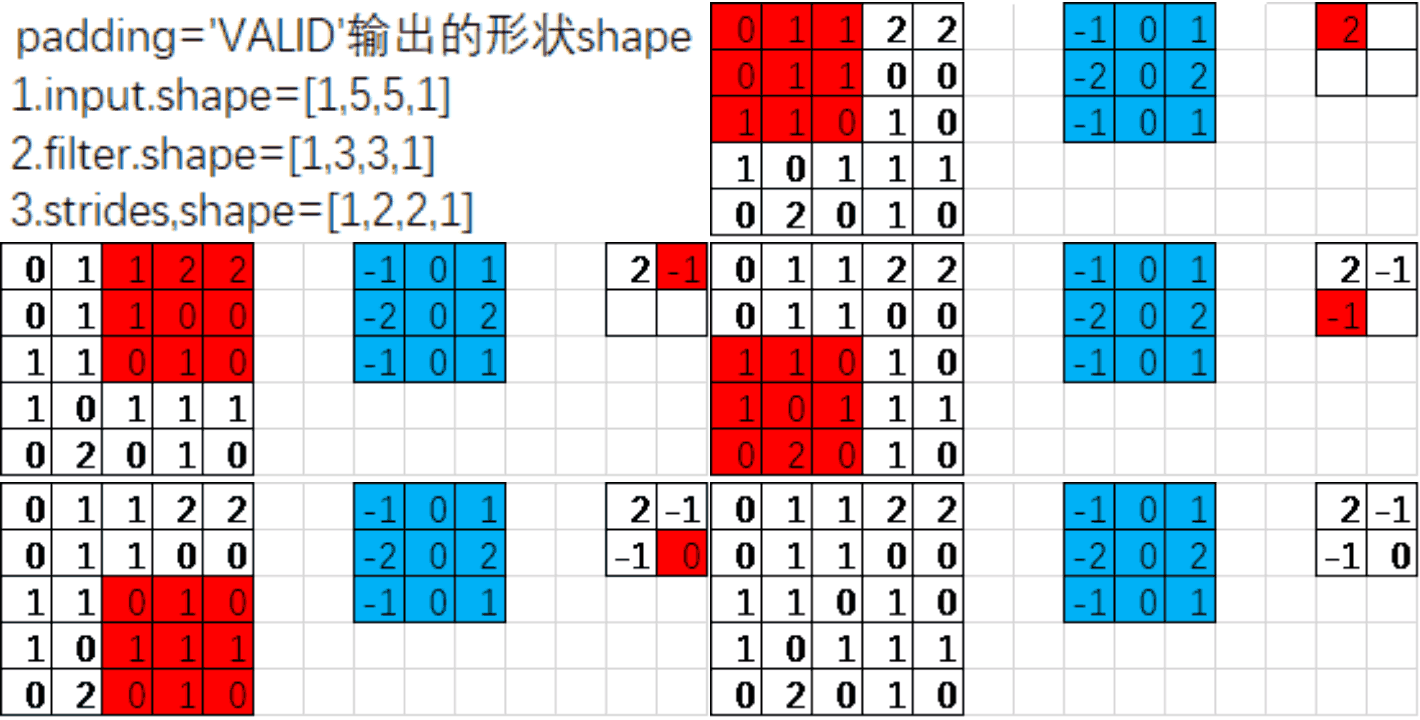
· padding=‘VALID’时,输出的宽度和高度的计算公式(下图gif为例)
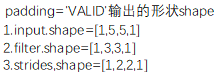
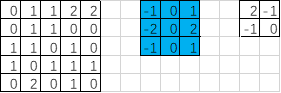
输出宽度:output_width = (in_width-filter_width+1)/strides_width =(5-3+1)/2=1.5【向上取整=2】
输出高度:output_height = (in_height-filter_height+1)/strides_height =(5-3+1)/2=1.5【向上取整=2】
输出的形状[1,2,2,1]
import tensorflow as tf

image = [0,1.0,1,2,2,0,1,1,0,0,1,1,0,1,0,1,0,1,1,1,0,2,0,1,0]

input = tf.Variable(tf.constant(image,shape=[1,5,5,1]))  ##1通道输入

fil1 = [-1.0,0,1,-2,0,2,-1,0,1]

filter = tf.Variable(tf.constant(fil1,shape=[3,3,1,1]))  ##1个卷积核对应1个featuremap输出

op = tf.nn.conv2d(input,filter,strides=[1,2,2,1],padding='VALID')  ##步长2,VALID不补0操作

init = tf.global_variables_initializer()

with tf.Session() as  sess:

    sess.run(init)

    # print('input:\n', sess.run(input))

    # print('filter:\n', sess.run(filter))

    print('op:\n',sess.run(op))

##输出结果

'''

 [[[[ 2.]

   [-1.]]

  [[-1.]

   [ 0.]]]]

'''
VALID步长2
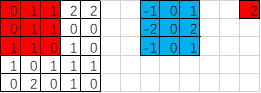
如果strides=[1,3,3,1]的情况又是如何呢?
输出宽度:output_width = (in_width-filter_width+1)/strides_width =(5-3+1)/3=1
输出高度:output_height = (in_height-filter_height+1)/strides_height =(5-3+1)/3=1
输出的形状[1,1,1,1],因此输出的结果只有一个
import tensorflow as tf

image = [0,1.0,1,2,2,0,1,1,0,0,1,1,0,1,0,1,0,1,1,1,0,2,0,1,0]

input = tf.Variable(tf.constant(image,shape=[1,5,5,1]))  ##1通道输入

fil1 = [-1.0,0,1,-2,0,2,-1,0,1]

filter = tf.Variable(tf.constant(fil1,shape=[3,3,1,1]))  ##1个卷积核对应1个featuremap输出

op = tf.nn.conv2d(input,filter,strides=[1,3,3,1],padding='VALID')  ##步长2,VALID不补0操作

init = tf.global_variables_initializer()

with tf.Session() as  sess:

    sess.run(init)

    # print('input:\n', sess.run(input))

    # print('filter:\n', sess.run(filter))

    print('op:\n',sess.run(op))

##输出结果

'''

op:

 [[[[ 2.]]]]

'''
VALID步长3
padding=‘SAME’时,输出的宽度和高度的计算公式
输出宽度:output_width = in_width/strides_width=5/2=2.5【向上取整3】
输出高度:output_height = in_height/strides_height=5/2=2.5【向上取整3】
则输出的形状:[1,3,3,1]
那么padding补0的规则又是如何的呢?【先确定输出形状,再计算补多少0】
pad_width = max((out_width-1)*strides_width+filter_width-in_width,0)=max((3-1)*2+3-5,0)=2
pad_height = max((out_height-1)*strides_height+filter_height-in_height,0)=max((3-1)*2+3-5,0)=2
pad_top = pad_height/2=1
pad_bottom = pad_height-pad_top=1
pad_left = pad_width/2=1
pad_right = pad_width-pad_left=1
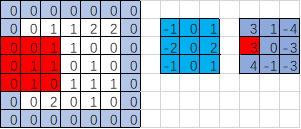
import tensorflow as tf

image = [0,1.0,1,2,2,0,1,1,0,0,1,1,0,1,0,1,0,1,1,1,0,2,0,1,0]

input = tf.Variable(tf.constant(image,shape=[1,5,5,1]))  ##1通道输入

fil1 = [-1.0,0,1,-2,0,2,-1,0,1]

filter = tf.Variable(tf.constant(fil1,shape=[3,3,1,1]))  ##1个卷积核对应1个featuremap输出

op = tf.nn.conv2d(input,filter,strides=[1,2,2,1],padding='SAME')  ##步长2,VALID不补0操作

init = tf.global_variables_initializer()

with tf.Session() as  sess:

    sess.run(init)

    # print('input:\n', sess.run(input))

    # print('filter:\n', sess.run(filter))

    print('op:\n',sess.run(op))

##输出结果

'''

op:

 [[[[ 3.]

   [ 1.]

   [-4.]]

  [[ 3.]

   [ 0.]

   [-3.]]

  [[ 4.]

   [-1.]

   [-3.]]]]

'''
SAME步长2
如果步长为3呢?补0的规则又如何?
输出宽度:output_width = in_width/strides_width=5/3=2
输出高度:output_height = in_height/strides_height=5/3=2
则输出的形状:[1,2,2,1]
那么padding补0的规则又是如何的呢?【先确定输出形状,再计算补多少0】
pad_width = max((out_width-1)*strides_width+filter_width-in_width,0)=max((2-1)*3+3-5,0)=1
pad_height = max((out_height-1)*strides_height+filter_height-in_height,0)=max((2-1)*3+3-5,0)=1
pad_top = pad_height/2=0【向下取整】
pad_bottom = pad_height-pad_top=1
pad_left = pad_width/2=0【向下取整】
pad_right = pad_width-pad_left=1
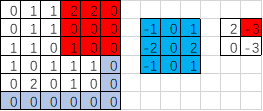
import tensorflow as tf

print(3/2)

image = [0,1.0,1,2,2,0,1,1,0,0,1,1,0,1,0,1,0,1,1,1,0,2,0,1,0]

input = tf.Variable(tf.constant(image,shape=[1,5,5,1]))  ##1通道输入

fil1 = [-1.0,0,1,-2,0,2,-1,0,1]

filter = tf.Variable(tf.constant(fil1,shape=[3,3,1,1]))  ##1个卷积核对应1个featuremap输出

op = tf.nn.conv2d(input,filter,strides=[1,3,3,1],padding='SAME')  ##步长2,VALID不补0操作

init = tf.global_variables_initializer()

with tf.Session() as  sess:

    sess.run(init)

    # print('input:\n', sess.run(input))

    # print('filter:\n', sess.run(filter))

    print('op:\n',sess.run(op))

##输出结果

'''

op:

 [[[[ 2.]

   [-3.]]

  [[ 0.]

   [-3.]]]]

'''
SAME步长3
Tensorflow之CNN卷积层池化层padding规则的更多相关文章
- tensorflow中的卷积和池化层(一)
在官方tutorial的帮助下,我们已经使用了最简单的CNN用于Mnist的问题,而其实在这个过程中,主要的问题在于如何设置CNN网络,这和Caffe等框架的原理是一样的,但是tf的设置似乎更加简洁. ...
- tensorflow的卷积和池化层(二):记实践之cifar10
在tensorflow中的卷积和池化层(一)和各种卷积类型Convolution这两篇博客中,主要讲解了卷积神经网络的核心层,同时也结合当下流行的Caffe和tf框架做了介绍,本篇博客将接着tenso ...
- CNN中卷积层 池化层反向传播
参考:https://blog.csdn.net/kyang624823/article/details/78633897 卷积层 池化层反向传播: 1,CNN的前向传播 a)对于卷积层,卷积核与输入 ...
- tensorflow 1.0 学习:池化层(pooling)和全连接层(dense)
池化层定义在 tensorflow/python/layers/pooling.py. 有最大值池化和均值池化. 1.tf.layers.max_pooling2d max_pooling2d( in ...
- CNN中的池化层的理解和实例
池化操作是利用一个矩阵窗口在输入张量上进行扫描,并且每个窗口中的值通过取最大.取平均或其它的一些操作来减少元素个数.池化窗口由ksize来指定,根据strides的长度来决定移动步长.如果stride ...
- 『TensorFlow』卷积层、池化层详解
一.前向计算和反向传播数学过程讲解
- 第十三节,使用带有全局平均池化层的CNN对CIFAR10数据集分类
这里使用的数据集仍然是CIFAR-10,由于之前写过一篇使用AlexNet对CIFAR数据集进行分类的文章,已经详细介绍了这个数据集,当时我们是直接把这些图片的数据文件下载下来,然后使用pickle进 ...
- tensorflow CNN 卷积神经网络中的卷积层和池化层的代码和效果图
tensorflow CNN 卷积神经网络中的卷积层和池化层的代码和效果图 因为很多 demo 都比较复杂,专门抽出这两个函数,写的 demo. 更多教程:http://www.tensorflown ...
- CNN卷积神经网络的卷积层、池化层的输出维度计算公式
卷积层Conv的输入:高为h.宽为w,卷积核的长宽均为kernel,填充为pad,步长为Stride(长宽可不同,分别计算即可),则卷积层的输出维度为: 其中上开下闭开中括号表示向下取整. MaxPo ...
随机推荐
- MyBatis中批量insert
在orcale和mybatis执行批量插入是不一样的. orcale如下:(这里要注意的是:useGeneratedKeys="false" ) 方式1:oracle批量插入使用 ...
- Win10遇到蓝屏错误CRITICAL_STRUCTURE_CORRUPTION如何解决
很多使用win10系统的用户,都曾经遇到过蓝屏故障.比如,最近有位win10用户在使用电脑时,就发现电脑突然出现了蓝屏,且提示错误CRITICAL_STRUCTURE_CORRUPTION,这是怎么回 ...
- 文本数据挖掘 Matrix67: The Aha Moments
转自:http://www.matrix67.com/blog/archives/5044 互联网时代的社会语言学:基于SNS的文本数据挖掘 今年上半年,我在人人网实习了一段时间,期间得到了很多宝贵的 ...
- IntelliTrace调试
当您进行调试时,IntelliTrace 将在后台收集有关托管应用程序的数据,其中包括来自许多框架组件(例如 ADO.NET.ASP.NET 和 System.XML)的信息.这些 IntelliTr ...
- php内置函数分析之array_fill_keys()
PHP_FUNCTION(array_fill_keys) { zval *keys, *val, *entry; if (zend_parse_parameters(ZEND_NUM_ARGS(), ...
- pymysql基本操作
https://www.cnblogs.com/woider/p/5926744.html https://www.runoob.com/python3/python3-mysql.html 注意: ...
- lambda匿名函数sorted排序函数filter过滤函数map映射函数
lambda函数:表示匿名函数,不需要def来声明,一句话就能搞定. 语法:函数名=lamda 参数:返回值 求10的10次方 f=lambda n:n**n print(f(10)) 注意: 函数名 ...
- 【leetcode】Smallest Rotation with Highest Score
题目如下: Given an array A, we may rotate it by a non-negative integer K so that the array becomes A[K], ...
- Java面试之基础篇(1)
1.一个".java"源文件中是否可以包括多个类(不是内部类)?有什么限制? 可以有多个类,但只能有一个public的类,并且public的类名必须与文件名相一致. 2.Java有 ...
- linux运维、架构之路-Kickstart无人值守
一.PXE介绍 PXE全名Pre-boot Execution Environment,预启动执行环境:通过网络接口启动计算机,不依赖本地存储设备或本地已安装的操作系统:Client ...