
POJ-3009 Curling 2.0 (DFS)
Description
On Planet MM-21, after their Olympic games this year, curling is getting popular. But the rules are somewhat different from ours. The game is played on an ice game board on which a square mesh is marked. They use only a single stone. The purpose of the game is to lead the stone from the start to the goal with the minimum number of moves.
Fig. 1 shows an example of a game board. Some squares may be occupied with blocks. There are two special squares namely the start and the goal, which are not occupied with blocks. (These two squares are distinct.) Once the stone begins to move, it will proceed until it hits a block. In order to bring the stone to the goal, you may have to stop the stone by hitting it against a block, and throw again.

Fig. 1: Example of board (S: start, G: goal)
The movement of the stone obeys the following rules:
- At the beginning, the stone stands still at the start square.
- The movements of the stone are restricted to x and y directions. Diagonal moves are prohibited.
- When
the stone stands still, you can make it moving by throwing it. You may
throw it to any direction unless it is blocked immediately(Fig. 2(a)). - Once thrown, the stone keeps moving to the same direction until one of the following occurs:
- The stone hits a block (Fig. 2(b), (c)).
- The stone stops at the square next to the block it hit.
- The block disappears.
- The stone gets out of the board.
- The game ends in failure.
- The stone reaches the goal square.
- The stone stops there and the game ends in success.
- The stone hits a block (Fig. 2(b), (c)).
- You
cannot throw the stone more than 10 times in a game. If the stone does
not reach the goal in 10 moves, the game ends in failure.
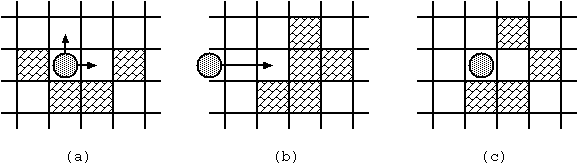
Fig. 2: Stone movements
Under
the rules, we would like to know whether the stone at the start can
reach the goal and, if yes, the minimum number of moves required.
With
the initial configuration shown in Fig. 1, 4 moves are required to
bring the stone from the start to the goal. The route is shown in Fig.
3(a). Notice when the stone reaches the goal, the board configuration
has changed as in Fig. 3(b).
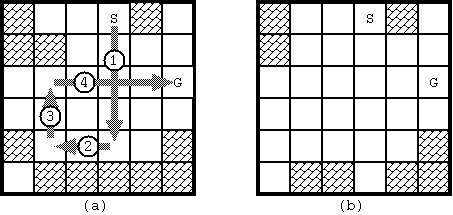
Fig. 3: The solution for Fig. D-1 and the final board configuration
Input
The
input is a sequence of datasets. The end of the input is indicated by a
line containing two zeros separated by a space. The number of datasets
never exceeds 100.
Each dataset is formatted as follows.
the width(=w) and the height(=h) of the board
First row of the board
...
h-th row of the board
The width and the height of the board satisfy: 2 <= w <= 20, 1 <= h <= 20.
Each line consists of w decimal numbers delimited by a space. The number describes the status of the corresponding square.
0 vacant square 1 block 2 start position 3 goal position
The dataset for Fig. D-1 is as follows:
6 6
1 0 0 2 1 0
1 1 0 0 0 0
0 0 0 0 0 3
0 0 0 0 0 0
1 0 0 0 0 1
0 1 1 1 1 1
Output
For
each dataset, print a line having a decimal integer indicating the
minimum number of moves along a route from the start to the goal. If
there are no such routes, print -1 instead. Each line should not have
any character other than this number.
Sample Input
2 1

3 2

6 6

1 0 0 2 1 0

1 1 0 0 0 0

0 0 0 0 0 3

0 0 0 0 0 0

1 0 0 0 0 1

0 1 1 1 1 1

6 1

1 1 2 1 1 3

6 1

1 0 2 1 1 3

12 1

2 0 1 1 1 1 1 1 1 1 1 3

13 1

2 0 1 1 1 1 1 1 1 1 1 1 3

0 0
Sample Output
1

4

-1

4

10

-1

题目大意:冰壶在冰上可以不停的滑下去,直到碰到障碍物,导致的结果是冰壶静止在障碍物的前一个位置并且障碍物消失。冰壶每静止一次就需要人力来“投掷”一次。一张图,0表示冰,1表示障碍物,问冰壶从起点到终点最少需要几次“投掷”。
题目分析:DFS。模拟这个过程就行了。

代码如下:
 # include<iostream>

 # include<cstdio>

 # include<queue>

 # include<cstring>

 # include<algorithm>

 using namespace std;

 int r,c,mp[][];

 int ans;

 void dfs(int x,int y,int k)

 {

     if(k>)

         return ;

     if(mp[x-][y]!=){

         for(int nx=x-;nx>=;--nx){

             if(mp[nx][y]==){

                 ans=min(ans,k+);

                 break ;

             }

             if(mp[nx][y]==){

                 mp[nx][y]=;

                 dfs(nx+,y,k+);

                 mp[nx][y]=;

                 break ;

             }

         }

     }

     if(mp[x+][y]!=){

         for(int nx=x+;nx<r;++nx){

             if(mp[nx][y]==){

                 ans=min(ans,k+);

                 break ;

             }

             if(mp[nx][y]==){

                 mp[nx][y]=;

                 dfs(nx-,y,k+);

                 mp[nx][y]=;

                 break ;

             }

         }

     }

     if(mp[x][y-]!=){

         for(int ny=y-;ny>=;--ny){

             if(mp[x][ny]==){

                 ans=min(ans,k+);

                 break;

             }

             if(mp[x][ny]==){

                 mp[x][ny]=;

                 dfs(x,ny+,k+);

                 mp[x][ny]=;

                 break;

             }

         }

     }

     if(mp[x][y+]!=){

         for(int ny=y+;ny<c;++ny){

             if(mp[x][ny]==){

                 ans=min(ans,k+);

                 break;

             }

             if(mp[x][ny]==){

                 mp[x][ny]=;

                 dfs(x,ny-,k+);

                 mp[x][ny]=;

                 break;

             }

         }

     }

 }

 int main()

 {

     //freopen("POJ-3009 Curling 2.0.txt","r",stdin);

     while(scanf("%d%d",&c,&r),r+c)

     {

         int sx,sy;

         for(int i=;i<r;++i){

             for(int j=;j<c;++j){

                 scanf("%d",&mp[i][j]);

                 if(mp[i][j]==){

                     sx=i,sy=j;

                     mp[i][j]=;

                 }

             }

         }

         ans=;

         dfs(sx,sy,);

         if(ans>)

             printf("-1\n");

         else

             printf("%d\n",ans);

     }

     return ;

 }
POJ-3009 Curling 2.0 (DFS)的更多相关文章
- poj 3009 Curling 2.0 (dfs )
Curling 2.0 Time Limit: 1000MS Memory Limit: 65536K Total Submissions: 11879 Accepted: 5028 Desc ...
- POJ3009:Curling 2.0(dfs)
http://poj.org/problem?id=3009 Description On Planet MM-21, after their Olympic games this year, cur ...
- POJ 3009 Curling 2.0 回溯,dfs 难度:0
http://poj.org/problem?id=3009 如果目前起点紧挨着终点,可以直接向终点滚(终点不算障碍) #include <cstdio> #include <cst ...
- POJ3009 Curling 2.0(DFS)
题目链接. 分析: 本题BFS A不了. 00100 00001 01020 00000 00010 00010 00010 00010 00030 对于这样的数据,本来应当是 5 步,但bfs却 4 ...
- POJ 3009 Curling 2.0 {深度优先搜索}
原题 $On Planet MM-21, after their Olympic games this year, curling is getting popular. But the rules ...
- 【POJ - 3009】Curling 2.0 (dfs+回溯)
-->Curling 2.0 直接上中文 Descriptions: 今年的奥运会之后,在行星mm-21上冰壶越来越受欢迎.但是规则和我们的有点不同.这个游戏是在一个冰游戏板上玩的,上面有一个正 ...
- POJ 3009 Curling 2.0【带回溯DFS】
POJ 3009 题意: 给出一个w*h的地图,其中0代表空地,1代表障碍物,2代表起点,3代表终点,每次行动可以走多个方格,每次只能向附近一格不是障碍物的方向行动,直到碰到障碍物才停下来,此时障碍物 ...
- POJ 3009-Curling 2.0(DFS)
Curling 2.0 Time Limit: 1000MS Memory Limit: 65536K Total Submissions: 12158 Accepted: 5125 Desc ...
- poj3009 Curling 2.0 (DFS按直线算步骤)
Curling 2.0 Time Limit: 1000MS Memory Limit: 65536K Total Submissions: 14563 Accepted: 6080 Desc ...
随机推荐
- MySQL Crash Course #19# Chapter 27. Globalization and Localization
Globalization and Localization When discussing multiple languages and characters sets, you will run ...
- c++第五天:默认初始化
1.算数类型.(整型和浮点型) 类型决定了数据所占的比特数以及该如何解释这些比特的内容. 练习2.1... 各种类型在计算机中所占的比特数不同,解释方法不同.有符号要花费一个比特存储符号,最大正值要比 ...
- Tomcat的work目录作用
Tomcat的work目录作用 很多网友喜欢把tomcat的work目录里的东西叫做缓存,其实那不是很恰当,work目录只是tomcat的工作目录,也就是tomcat把jsp转换为class文件的工作 ...
- 使用wireshark分析tcp/ip报文之报文头
以太网报文的结构如下: 其中,以太网的帧头: 14 Bytes:MAC目的地址48bit(6B),MAC源地址48bit(6B),Type域2B,一共14B. IP头部: TCP头部: http:// ...
- 开源项目托管GitHub
工具:本地HelloWorld源项目 msysgit(Windows) 实验步骤:一.在GitHub新建托管项目 在http://github.com注册账号20159214-sunnan. 完成注册 ...
- 20165310 java_blog_week2
2165310 <Java程序设计>第2周学习总结 教材学习内容总结 了解Java变量 重点学习Boolean变量和类型转换规则 学习数组定义.使用方式 区别: int [] a,b [] ...
- USACO 1.3 Wormholes - 搜索
Wormholes Farmer John's hobby of conducting high-energy physics experiments on weekends has backfire ...
- C# 图片和64位编码的转换
/* 将图片转换为64位编码 */ //找到文件夹 System.IO.DirectoryInfo dd = new System.IO.DirectoryInfo("C://qq" ...
- 【第十章】 springboot + logback
logback是boot默认的日志首选,个人觉得是最好的日志实现(比log4j好) 下边,在之前的代码基础上增加一个功能,该功能要实现mybatis的and or联查功能,并通过logback日志在控 ...
- HDU 5877 Weak Pair(树状数组+dfs+离散化)
http://acm.hdu.edu.cn/showproblem.php?pid=5877 题意: 给出一棵树,每个顶点都有权值,现在要你找出满足要求的点对(u,v)数,u是v的祖先并且a[u]*a ...