
High accuracy voltage regulator
High accuracy voltage regulator
Good morning everybody,
I want to make a accurate voltage regulator based on the Basic Stamp.
Total range 0-10 V and a resolution of eg 5 mV. So this means 2000 steps.
Maximum current around 250 mA.
I tried to do something with the AD5220 or PWM command but only 255 steps are available.
Someone who has a good idea ?
BR, Dries
You will need to use a high accuracy digital to analog converter like www.maxim-ic.com/quick_view2.cfm/qv_pk/2113.
There are plenty of others on the market. Anything that uses the SPI protocol for control and is 12 bit (0-4.095V) should work.
You will need some kind of power op-amp to take this voltage and amplify it precisely to 10V at 250mA. I can't help you with that,
perhaps someone else may have some ideas, but I'm sure some web searching will also give you ideas on that.
Here's one example of the sort of op-amp needed: focus.ti.com/lit/ds/symlink/opa547.pdf
If you only need to source current and not sink it as well,
you could get by with a garden-variety op amp and a pass transistor. Here's the basic topology:
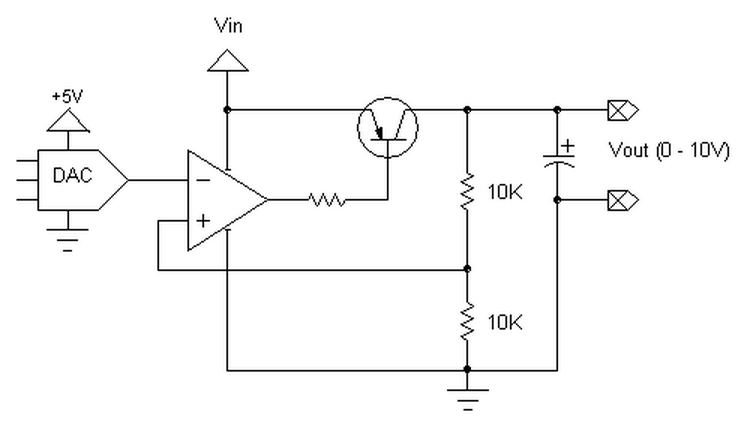
Aside from the two voltage divider resistors being equal,
I have no idea what component values to recommend.
You would have to experiment to get the best stability.
I guess I should qualify what I mean by "garden-variety op amp",
since there are some minimum requirements:
1) The input common mode range has to include ground, and
2) the output high voltage should be capable of reaching Vin.
Here is another circuit, similar to Phil's,
except it uses an NPN transistor with the output taken from the emitter
instead of a PNP with output taken from the collector.
This circuit uses one of the two DAC outputs of the TLV5618 12 bit DAC.
The power supply has to at least 3 or 4 Volts above the desired output,
because of overhead of the LM358 op-amp plus the overhead of the transistor.
There are better choices for the output transistor and op-amp if you have constraints on the input power supply.
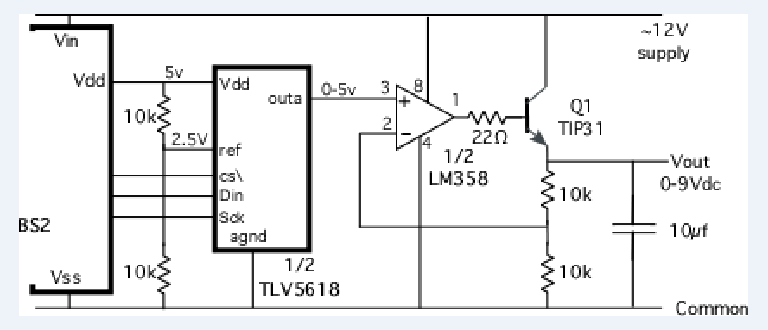
In terms of circuit configurations, in Phil's circuit with the PNP, the transistor common emitter gain is inside the feedback loop,
which makes it harder to stabilize and it will require a relatively large output capacitor.
The NPN follower gain is x1, which makes it easier to stabilize with a small capacitor.,
and base current contributes to the output current.
But the PNP circuit is the best if you need to operate very close to the power supply rail.
Another option, if you really don't need to get down to zero volts,
is to use a standard voltage regulator controlled by a digital potentiometer.
Those usually have a minimum voltage of something like 1.25 volts.
The circuit itself can regulate down to low voltages.
For precision, you will need to put in an adjustment trimmer, either at the reference side or at the feedback side.
-- 12-turn adjustment trimmer of 1 kOhm between the two 10 kOhm fixed resistors.
Adjust the output to 0.0025 volts per bit. That is 4 bit steps for each 10 millivolts at the output. 4000 steps to 10.0 volts.
-- The 5 volt supply may not be a good enough reference for a precision application.
Change the reference to a 2.5 volt precision reference (e.g. LM385-2.5) in place of the lower 10 kOhms on the ADC ref input.
The adjustment trimmer is still needed on the feedback node, between the two 10k resistors.
-- To get up to 10.00 volts, it will probably take a 13 or 14 volt supply to the LM358 and TIP31.
The Stamp could operate off a different supply. Or you could buy a rail-to-rail op amp and a higher gain transistor.
High accuracy voltage regulator的更多相关文章
- MOSFET enhances voltage regulator's overcurrent protection
The classic LM317 adjustable-output linear voltage regulator offers a relatively high, if package-de ...
- Digital variable resistor compensates voltage regulator
A variable resistor that integrates a programmable, temperature-indexed look-up table can compensate ...
- LT1072 -- Wide-range voltage regulator automatically selects operating mode
The circuit in Figure 1 delivers programming voltages to an EEPROM under the control of an external ...
- OpAmp Voltage Follower/Regulator
LDO Regulator High accuracy voltage regulator Vout = 2.5V * (1 + ( 5.6 / 6.8 ) ) = 4.55V Recently th ...
- Linux regulator framework(1) - 概述【转】
转自蜗窝科技:http://www.wowotech.net/pm_subsystem/regulator_framework_overview.html 1. 前言 Regulator,中文名翻译为 ...
- Linux电源管理-Linux regulator framework概述
前言 1. 什么是regulator? regulator翻译为"调节器",分为voltage regulator(电压调节器)和current(电流调节器).一般电源 ...
- LDO current regulator for power LED
LDO current regulator for power LED Challenge You've got a power LED? Great! Build a flash light! Wh ...
- Cascode MOSFET increases boost regulator's input- and output-voltage ranges
Targeting use in portable-system applications that require raising a battery's voltage to a higher l ...
- High-current supply uses standard three-terminal regulator
Voltage-regulator design for high output currents can be a critical and difficult task. Although vol ...
随机推荐
- CS229 笔记03
CS229 笔记03 局部加权线性回归 Non-Parametric Learning Algorithm (非参数学习方法) Number of parameters grows with the ...
- java学习第04天(语句、函数、数组)
(3)循环结构 格式: for(初始化表达式,循环条件表达式,循环后的操作变大时){ 执行语句,循环体: } 注: a. for循环里面的连个表达式运行的顺序,初始化表达式只读一次,判断循环条件,为真 ...
- if语句引起的bug
最近维护高手留下的api项目,客户端反馈一个bug过来,然后查找到可能出错的代码位置,是一个if语句,乍一看好像没什么问题,代码如下: if (company.UserId != userId || ...
- ZeroMQ安装说明
ZeroMQ安装说明 1. 安装 1.1.Linux zmq安装 安装过程参考地址:http://zeromq.org/intro:get-the-software的说明 安装步骤如下(在安装时参 ...
- 【题解】BZOJ 1901: Zju2112 Dynamic Rankings
题目传送门(权限题) 一道类似的非权限题 题意 N个数的序列,每次修改一个数或者询问区间里的第K小.可以离线. 简要做法 假如要求在线,可以树状数组套个线段树~ 但是这题是可以离线的,就可以乱搞整体二 ...
- PGP工作原理及其安全体制
现代信息社会里,当电子邮件广受欢迎的同时,其安全性问题也很突出.实际上,电子邮件的传递过程是邮件在网络上反复复制的过程,其网络传输路径不确定,很容易遭到不明身份者的窃取.篡改.冒用甚至恶意破坏,给收发 ...
- sonar Lint ----code bad smell
类名注释报黄: 去掉这段黄做法:alt+enter 本文参考: http://www.cnblogs.com/xxoome/p/6677170.html
- Python 协程检测Kubernetes服务端口
一.需求分析 在上一篇文章,链接如下: https://www.cnblogs.com/xiao987334176/p/10237551.html 已经得到了需要的数据,现在需要对这些端口做检测,判断 ...
- SOA并不能解决高并发事务
传统SOA架构其实无法面对高并发事务. 这种方式不适合热点资源,也就是高并发场合. 虽然乐观锁短,但是容易产生脏数据. SOA是以服务这个方式对外提供功能,我们很显然喜欢在Service中加上JTA等 ...
- HTML布局思路
1.DIV+CSS布局 (1)按照由上到下,由里到外的方式 (2)样式由CSS去改变 代码: <style type="text/css"> * { margin:0p ...