
芯灵思Sinlinx A64 linux 通过设备树写LED驱动(附参考代码,未测试)
开发平台 芯灵思Sinlinx A64
内存: 1GB 存储: 4GB
详细参数 https://m.tb.cn/h.3wMaSKm
开发板交流群 641395230
全志A64设备树结构体
#include <linux/of.h> //设备树里的每个设备及每个设备子节点都用此结构体描述
struct device_node

{

    const char *name;

    const char *type;

    phandle phandle;

    const char *full_name;

    struct property *properties; //属性

    struct property *deadprops; /* removed properties */

    struct device_node *parent; //在设备子节点对象,指向属于的设备对象

    struct device_node *child; //在设备对象,指向子节点

    struct device_node *sibling; //指向同级的下一个对象.

    struct device_node *next; /* next device of same type */ //应是指向device_type是同样的对象

    struct device_node *allnext; /* next in list of all nodes */ ...

};
//下面函数用于获取设备树里的设备节点及设备子节点
extern struct device_node *of_find_node_by_name(struct device_node *from, const char *name);
//通过名字查找相应的设备节点
static inline int of_get_child_count(const struct device_node *np);
//获取指定设备的子节点个数
extern struct device_node *of_find_node_by_path(const char *path);
//通过路径来获取设备节点,可用于获取设备子节点
extern struct device_node *of_find_node_by_type(struct device_node *from, const char *type); //通过指定的device_type来获取设备节点
//下面函数用于获取设备节点或设备子节点的属性
static inline int of_property_read_u32(const struct device_node *np, const char *propname, u32 *out_value)

extern int of_property_read_u32_index(const struct device_node *np, const char *propname, u32 index, u32 *out_value);

extern int of_property_read_u8_array(const struct device_node *np, const char *propname, u8 *out_values, size_t sz);

extern int of_property_read_u16_array(const struct device_node *np, const char *propname, u16 *out_values, size_t sz);

extern int of_property_read_u32_array(const struct device_node *np, const char *propname, u32 *out_values, size_t sz);

extern int of_property_read_u64(const struct device_node *np, const char *propname, u64 *out_value);

extern int of_property_read_string(struct device_node *np, const char *propname, const char **out_string)
首先增加节点,修改dtsi文件。
vim /lichee/linux-3.10/arch/arm64/boot/dts/sun50iw1p1-pinctrl.dtsi
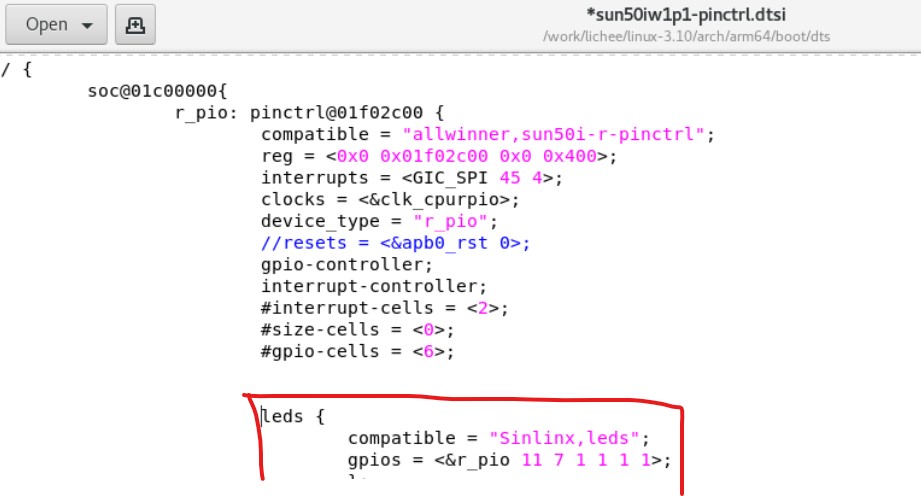

驱动代码:
    #include <linux/module.h>

    #include <linux/init.h>

    #include <linux/fs.h>

    #include <linux/device.h>

    #include <linux/slab.h>

    #include <linux/cdev.h>

    #include <asm/uaccess.h>

    #include <linux/io.h>

    #include <linux/of.h>

    #include <linux/of_gpio.h>

    #include <linux/gpio.h>

    #include <linux/sys_config.h>

    #define MY_DEVICE_NAME "my_led_device"

    // 获取到设备树中到节点

    static int gpio = -1;

    int get_irqno_from_node(void)

    {

        struct gpio_config config;

        struct device_node *np = of_find_node_by_path("/leds");

        if(np){

            printk("find node ok\n");

        }

        else{

            printk("find node failed\n");

        }

        gpio = of_get_named_gpio_flags(nd, "gpios", i, (enum of_gpio_flags *)&config);// 从设备树中读取gpios的GPIO配置编号和标志

        if(!gpio_is_valid(gpio)){

            //判断该 GPIO 编号是否有效,有效gpio_request 则申请占用该 GPIO。如果初始化过程出错,需要调用 gpio_free 来释放之前申请过且成功的 GPIO

            printk("gpio isn't valid\n");

            return -1;

        }

        if(gpio_request(gpio, "leds") < 0)

            printk("gpio request failed %d\n", gpio);

        gpio_direction_output(gpio, 1); //关灯

        return 0;

    }

    static int my_open (struct inode *node, struct file *filp)

    {

        if(gpio)

        {

            printk("open ok\n");

        }

        else

        {

            return -EINVAL;

        }

        return 0;

    }

    static ssize_t my_write (struct file *filp, const char __user *buf, size_t size, loff_t *off)

    {

        unsigned char val;

        copy_from_user(&val, buf, 1);

        printk(" gpl_dat address   0x%x\n",gpl_dat);

        if (val)

        {

            gpio_direction_output(gpio, 0); //关灯

            printk("led on\n");

        }

        else

        {

           gpio_direction_output(gpio, 1); //关灯

            printk("led off\n");

        }

        return 1;

    }

    static const struct file_operations my_led_fops = {

        //step 1 :定义file_operations结构体

        .open = my_open,

        .write = my_write,

    };

    //step 1 :

    static struct class *led_class;

    static struct cdev *pcdev;      //定义一个cdev指针

    static dev_t n_dev;            //第一个设备号(包含了主和次)

    static int __init led_device_init(void)

    {//step 2 :注册

        int ret = -1;

        pcdev = cdev_alloc();//分配cdev结构空间

        if(pcdev == NULL) {

            printk(KERN_EMERG" cdev_alloc  error\n");

            ret = -ENOMEM;   /* 分配失败 */

            return ret;

        }

        //2. 动态申请设备号

        ret = alloc_chrdev_region(&n_dev, 0 , 2, MY_DEVICE_NAME);

        if(ret < 0 ) {

            //释放前面成功的资源

            kfree(pcdev);                              /*释放cdev结构空间 */

            printk(KERN_EMERG"alloc_chrdev_region  error\n");

            return ret;

        }

        cdev_init(pcdev, &my_led_fops);     //初始化cdev结构           /* 建立cdev和file_operations之间的连接 */

        /*

            或这样初始化cdev结构

            pcdev->owner = THIS_MODULE;

            pcdev->ops = &my_led_fops;

        */

        ret = cdev_add(pcdev, n_dev, 2) ;// 向内核里面添加一个驱动,注册驱动

        if(ret < 0 ) {

            //释放前面成功的资源

            unregister_chrdev_region(n_dev,  2);       /*  释放前面申请的调和号*/

            kfree(pcdev);                               /* 释放cdev结构空间 */

            printk(KERN_EMERG"alloc_chrdev_region  error\n");

            return ret;

        }

        /*自动创建设备节点/dev/SinlinxA64_LED*/

        led_class = class_create(THIS_MODULE, "myled");

        device_create(led_class, NULL, n_dev, NULL, "SinlinxA64_LED");

        get_irqno_from_node();

        printk(KERN_EMERG"cdev ok\n");

        return 0;

    }

    static void __exit led_device_exit(void)

    {    //step 2 :注销

        //注销cdev结构

        cdev_del(pcdev);

        //释放设备号

        unregister_chrdev_region(n_dev, 2); /*起始设备号(主、次) 连续的次设备号数量*/

        //释放cdev结构空间

        kfree(pcdev);

        device_destroy(led_class, n_dev);

        class_destroy(led_class);

        gpio_free(gpio);

        printk(KERN_EMERG"cdev_del ok\n");

    }

    module_init(led_device_init);

    module_exit(led_device_exit);

    MODULE_LICENSE("GPL");
参考文章:https://blog.csdn.net/jklinux/article/details/82382066
芯灵思Sinlinx A64 linux 通过设备树写LED驱动(附参考代码,未测试)的更多相关文章
- 芯灵思Sinlinx A64 Linux&qt编译安装
开发平台 芯灵思Sinlinx A64 内存: 1GB 存储: 4GB 详细参数 https://m.tb.cn/h.3wMaSKm 开发板交流群 641395230 前提条件搭建好CentOS环境 ...
- 芯灵思Sinlinx A64开发板 Linux内核等待队列poll ---阻塞与非阻塞
开发平台 芯灵思Sinlinx A64 内存: 1GB 存储: 4GB 开发板详细参数 https://m.tb.cn/h.3wMaSKm 开发板交流群 641395230 阻塞:阻塞调用是指调用结果 ...
- 芯灵思Sinlinx A64开发板Linux内核定时器编程
开发平台 芯灵思Sinlinx A64 内存: 1GB 存储: 4GB 开发板详细参数 https://m.tb.cn/h.3wMaSKm 开发板交流群 641395230 Linux 内核定时器是内 ...
- 芯灵思Sinlinx A64 开发板移植SQLite3
开发平台 芯灵思Sinlinx A64 内存: 1GB 存储: 4GB 开发板详细参数 https://m.tb.cn/h.3wMaSKm 开发板交流群 641395230 首先到 http://ww ...
- 芯灵思Sinlinx A64开发板设置qt程序自启动
开发平台 芯灵思Sinlinx A64 内存: 1GB 存储: 4GB 开发板详细参数 https://m.tb.cn/h.3wMaSKm 对于开发板开机启动程序的设置可以这样做通过串口连接开发板 v ...
- Linux 获取设备树源文件(DTS)里描述的资源
Linux 获取设备树源文件(DTS)里的资源 韩大卫@吉林师范大学 在linux使用platform_driver_register() 注册 platform_driver 时, 需要在 plat ...
- Linux 获取设备树源文件(DTS)里的资源【转】
本文转载自:http://blog.csdn.net/keleming1/article/details/51036000 http://www.cnblogs.com/dyllove98/archi ...
- Linux dts 设备树详解(二) 动手编写设备树dts
Linux dts 设备树详解(一) 基础知识 Linux dts 设备树详解(二) 动手编写设备树dts 文章目录 前言 硬件结构 设备树dts文件 前言 在简单了解概念之后,我们可以开始尝试写一个 ...
- Linux dts 设备树详解(一) 基础知识
Linux dts 设备树详解(一) 基础知识 Linux dts 设备树详解(二) 动手编写设备树dts 文章目录 1 前言 2 概念 2.1 什么是设备树 dts(device tree)? 2. ...
随机推荐
- 用反射的形式将一个对象属性值赋值给另一个对象,省略点get/set方法的冗余代码
1.本例使用的是idea 首先需要在idea中安装lombok插件,省略getter和setter方法的书写 在maven项目中加入lombok依赖 <dependency> <gr ...
- PAT甲级 1001 A+B Format
题目链接:https://pintia.cn/problem-sets/994805342720868352/problems/994805528788582400 1001 A+B Format ( ...
- PAT B1020
PAT B1020 解决思路 :贪心法,每次选取单价最高的月饼. 先上一个自己错误的解法 #include <cstdio> #include <algorithm> usin ...
- Linux 操作系统目录结构
/ 根目录 # ls /bin boot dev etc home lib lib64 media mnt opt proc root run sbin srv sys tmp var bin - ...
- [RESTful] RESTful是什么,为什么要使用它
RESTful是什么? 本质:一种软件架构风格 核心:面向资源 解决的问题:降低开发的复杂性,提高系统的可伸缩性 设计概念和准则: 1.网络上所有的事物都可以被抽象为资源 2.每个资源都有唯一的资源标 ...
- SDN 软件定义网络----学习1
原文地址https://www.infoq.cn/article/sdn-and-cloud-network 1.1,什么是 SDN? 什么是 SDN?SDN 的官方解释上提出了 SDN 的三个特性: ...
- 2019-04-19-day036-协程与进程池
内容回顾 11:30 码云 :王老师检查作业+定期抽查 注册账号 考试的时间 threading.enumerate(),能够获取到当前正在运行的所有线程对象列表 守护线程 守护线程会等待所有的非守护 ...
- Minimum Spanning Trees
Kruskal’s algorithm always union the lightest link if two sets haven't been linked typedef struct { ...
- MySQL之UNION与UNION ALL
数据表中的数据如下: UNION: 可以获取books表与articles表中所有不同的title,如果两个表中title相同的只会显示一个. UNION ALL : 可以获取books表与arti ...
- 科学计算库Numpy(1)
Numpy 一,数据结构 数据类型: ndarray import numpy world_alchol = numpy.genfromtxt('world_alchol.txt',delimiter ...