
大数据处理算法--Bloom Filter布隆过滤
1. Bloom-Filter算法简介
Bloom-Filter,即布隆过滤器,1970年由Bloom中提出。它可以用于检索一个元素是否在一个集合中。
Bloom Filter(BF)是一种空间效率很高的随机数据结构,它利用位数组很简洁地表示一个集合,并能判断一个元素是否属于这个集合。它是一个判断元素是否存在集合的快速的概率算法。Bloom Filter有可能会出现错误判断,但不会漏掉判断。也就是Bloom Filter判断元素不再集合,那肯定不在。如果判断元素存在集合中,有一定的概率判断错误。因此,Bloom Filter不适合那些“零错误”的应用场合。而在能容忍低错误率的应用场合下,Bloom Filter比其他常见的算法(如hash,折半查找)极大节省了空间。
它的优点是空间效率和查询时间都远远超过一般的算法,缺点是有一定的误识别率和删除困难。
Bloom Filter的详细介绍:Bloom Filter
2、 Bloom-Filter的基本思想
Bloom-Filter算法的核心思想就是利用多个不同的Hash函数来解决“冲突”。
计算某元素x是否在一个集合中,首先能想到的方法就是将所有的已知元素保存起来构成一个集合R,然后用元素x跟这些R中的元素一一比较来判断是否存在于集合R中;我们可以采用链表等数据结构来实现。但是,随着集合R中元素的增加,其占用的内存将越来越大。试想,如果有几千万个不同网页需要下载,所需的内存将足以占用掉整个进程的内存地址空间。即使用MD5,UUID这些方法将URL转成固定的短小的字符串,内存占用也是相当巨大的。
于是,我们会想到用Hash table的数据结构,运用一个足够好的Hash函数将一个URL映射到二进制位数组(位图数组)中的某一位。如果该位已经被置为1,那么表示该URL已经存在。
Hash存在一个冲突(碰撞)的问题,用同一个Hash得到的两个URL的值有可能相同。为了减少冲突,我们可以多引入几个Hash,如果通过其中的一个Hash值我们得出某元素不在集合中,那么该元素肯定不在集合中。只有在所有的Hash函数告诉我们该元素在集合中时,才能确定该元素存在于集合中。这便是Bloom-Filter的基本思想。
原理要点:一是位数组, 而是k个独立hash函数。
1)位数组:
假设Bloom Filter使用一个m比特的数组来保存信息,初始状态时,Bloom Filter是一个包含m位的位数组,每一位都置为0,即BF整个数组的元素都设置为0。

2)添加元素,k个独立hash函数
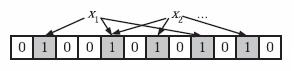
为了表达S={x1, x2,…,xn}这样一个n个元素的集合,Bloom Filter使用k个相互独立的哈希函数(Hash Function),它们分别将集合中的每个元素映射到{1,…,m}的范围中。
当我们往Bloom Filter中增加任意一个元素x时候,我们使用k个哈希函数得到k个哈希值,然后将数组中对应的比特位设置为1。即第i个哈希函数映射的位置hashi(x)就会被置为1(1≤i≤k)。
注意,如果一个位置多次被置为1,那么只有第一次会起作用,后面几次将没有任何效果。在下图中,k=3,且有两个哈希函数选中同一个位置(从左边数第五位,即第二个“1“处)。
3)判断元素是否存在集合
在判断y是否属于这个集合时,我们只需要对y使用k个哈希函数得到k个哈希值,如果所有hashi(y)的位置都是1(1≤i≤k),即k个位置都被设置为1了,那么我们就认为y是集合中的元素,否则就认为y不是集合中的元素。下图中y1就不是集合中的元素(因为y1有一处指向了“0”位)。y2或者属于这个集合,或者刚好是一个false positive。
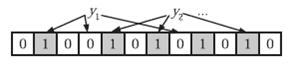
显然这 个判断并不保证查找的结果是100%正确的。
Bloom Filter的缺点:
1)Bloom Filter无法从Bloom Filter集合中删除一个元素。因为该元素对应的位会牵动到其他的元素。所以一个简单的改进就是 counting Bloom filter,用一个counter数组代替位数组,就可以支持删除了。 此外,Bloom Filter的hash函数选择会影响算法的效果。
2)还有一个比较重要的问题,如何根据输入元素个数n,确定位数组m的大小及hash函数个数,即hash函数选择会影响算法的效果。当hash函数个数k=(ln2)*(m/n)时错误率最小。在错误率不大于E的情况 下,m至少要等于n*lg(1/E) 才能表示任意n个元素的集合。但m还应该更大些,因为还要保证bit数组里至少一半为0,则m应 该>=nlg(1/E)*lge ,大概就是nlg(1/E)1.44倍(lg表示以2为底的对数)。
举个例子我们假设错误率为0.01,则此时m应大概是n的13倍。这样k大概是8个。
注意:
这里m与n的单位不同,m是bit为单位,而n则是以元素个数为单位(准确的说是不同元素的个数)。通常单个元素的长度都是有很多bit的。所以使用bloom filter内存上通常都是节省的。
一般BF可以与一些key-value的数据库一起使用,来加快查询。由于BF所用的空间非常小,所有BF可以常驻内存。这样子的话,对于大部分不存在的元素,我们只需要访问内存中的BF就可以判断出来了,只有一小部分,我们需要访问在硬盘上的key-value数据库。从而大大地提高了效率。
一个Bloom Filter有以下参数:
| m | bit数组的宽度(bit数) |
| n | 加入其中的key的数量 |
| k | 使用的hash函数的个数 |
| f | False Positive的比率 |
Bloom Filter的f满足下列公式:
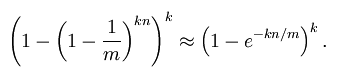
在给定m和n时,能够使f最小化的k值为:

此时给出的f为:

根据以上公式,对于任意给定的f,我们有:
3、 扩展 CounterBloom Filter
CounterBloom Filter
BloomFilter有个缺点,就是不支持删除操作,因为它不知道某一个位从属于哪些向量。那我们可以给Bloom Filter加上计数器,添加时增加计数器,删除时减少计数器。
但这样的Filter需要考虑附加的计数器大小,假如同个元素多次插入的话,计数器位数较少的情况下,就会出现溢出问题。如果对计数器设置上限值的话,会导致Cache Miss,但对某些应用来说,这并不是什么问题,如Web Sharing。
Compressed Bloom Filter
为了能在服务器之间更快地通过网络传输Bloom Filter,我们有方法能在已完成Bloom Filter之后,得到一些实际参数的情况下进行压缩。
将元素全部添加入Bloom Filter后,我们能得到真实的空间使用率,用这个值代入公式计算出一个比m小的值,重新构造Bloom Filter,对原先的哈希值进行求余处理,在误判率不变的情况下,使得其内存大小更合适。
4、 Bloom-Filter的应用
Bloom-Filter一般用于在大数据量的集合中判定某元素是否存在。例如邮件服务器中的垃圾邮件过滤器。在搜索引擎领域,Bloom-Filter最常用于网络蜘蛛(Spider)的URL过滤,网络蜘蛛通常有一个URL列表,保存着将要下载和已经下载的网页的URL,网络蜘蛛下载了一个网页,从网页中提取到新的URL后,需要判断该URL是否已经存在于列表中。此时,Bloom-Filter算法是最好的选择。
1.key-value 加快查询
一般Bloom-Filter可以与一些key-value的数据库一起使用,来加快查询。
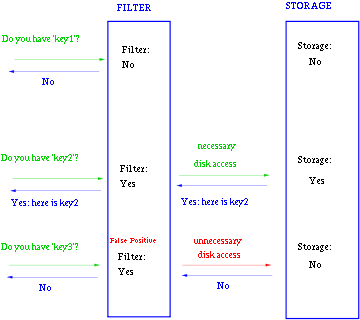
一般key-value存储系统的values存在硬盘,查询就是件费时的事。将Storage的数据都插入Filter,在Filter中查询都不存在时,那就不需要去Storage查询了。当False Position出现时,只是会导致一次多余的Storage查询。
由于Bloom-Filter所用的空间非常小,所有BF可以常驻内存。这样子的话,对于大部分不存在的元素,我们只需要访问内存中的Bloom-Filter就可以判断出来了,只有一小部分,我们需要访问在硬盘上的key-value数据库。从而大大地提高了效率。如图:
2 .Google的BigTable
Google的BigTable也使用了Bloom Filter,以减少不存在的行或列在磁盘上的查询,大大提高了数据库的查询操作的性能。
3. Proxy-Cache
在Internet Cache Protocol中的Proxy-Cache很多都是使用Bloom Filter存储URLs,除了高效的查询外,还能很方便得传输交换Cache信息。
4.网络应用
1)P2P网络中查找资源操作,可以对每条网络通路保存Bloom Filter,当命中时,则选择该通路访问。
2)广播消息时,可以检测某个IP是否已发包。
3)检测广播消息包的环路,将Bloom Filter保存在包里,每个节点将自己添加入Bloom Filter。
4)信息队列管理,使用Counter Bloom Filter管理信息流量。
5. 垃圾邮件地址过滤
像网易,QQ这样的公众电子邮件(email)提供商,总是需要过滤来自发送垃圾邮件的人(spamer)的垃圾邮件。
一个办法就是记录下那些发垃圾邮件的 email地址。由于那些发送者不停地在注册新的地址,全世界少说也有几十亿个发垃圾邮件的地址,将他们都存起来则需要大量的网络服务器。
如果用哈希表,每存储一亿个 email地址,就需要 1.6GB的内存(用哈希表实现的具体办法是将每一个 email地址对应成一个八字节的信息指纹,然后将这些信息指纹存入哈希表,由于哈希表的存储效率一般只有 50%,因此一个 email地址需要占用十六个字节。一亿个地址大约要 1.6GB,即十六亿字节的内存)。因此存贮几十亿个邮件地址可能需要上百 GB的内存。
而Bloom Filter只需要哈希表 1/8到 1/4 的大小就能解决同样的问题。
BloomFilter决不会漏掉任何一个在黑名单中的可疑地址。而至于误判问题,常见的补救办法是在建立一个小的白名单,存储那些可能别误判的邮件地址。
5、 Bloom-Filter的具体实现
c语言实现:
stdafx.h:
- #pragma once
- #include <stdio.h>
- #include "stdlib.h"
- #include <iostream>
- #include <time.h>
- using namespace std;
- #include "stdafx.h"
- #define ARRAY_SIZE 256 /*we get the 256 chars of each line*/
- #define SIZE 48000000 /* size should be 1/8 of max*/
- #define MAX 384000000/*the max bit space*/
- #define SETBIT(ch,n) ch[n/8]|=1<<(7-n%8)
- #define GETBIT(ch,n) (ch[n/8]&1<<(7-n%8))>>(7-n%8)
- unsigned int len(char *ch);/* functions to calculate the length of the url*/
- unsigned int RSHash(char* str, unsigned int len);/* functions to calculate the hash value of the url*/
- unsigned int JSHash(char* str, unsigned int len);/* functions to calculate the hash value of the url*/
- unsigned int PJWHash(char* str, unsigned int len);/* functions to calculate the hash value of the url*/
- unsigned int ELFHash(char* str, unsigned int len);/* functions to calculate the hash value of the url*/
- unsigned int BKDRHash(char* str, unsigned int len);/* functions to calculate the hash value of the url*/
- unsigned int SDBMHash(char* str, unsigned int len);/* functions to calculate the hash value of the url*/
- unsigned int DJBHash(char* str, unsigned int len);/* functions to calculate the hash value of the url*/
- unsigned int DEKHash(char* str, unsigned int len);/* functions to calculate the hash value of the url*/
- unsigned int BPHash(char* str, unsigned int len);/* functions to calculate the hash value of the url*/
- unsigned int FNVHash(char* str, unsigned int len);/* functions to calculate the hash value of the url*/
- unsigned int APHash(char* str, unsigned int len);/* functions to calculate the hash value of the url*/
- unsigned int HFLPHash(char* str,unsigned int len);/* functions to calculate the hash value of the url*/
- unsigned int HFHash(char* str,unsigned int len);/* functions to calculate the hash value of the url*/
- unsigned int StrHash( char* str,unsigned int len);/* functions to calculate the hash value of the url*/
- unsigned int TianlHash(char* str,unsigned int len);/* functions to calculate the hash value of the url*/
- int main()
- {
- int i,num,num2=0; /* the number to record the repeated urls and the total of it*/
- unsigned int tt=0;
- int flag; /*it helps to check weather the url has already existed */
- char buf[257]; /*it helps to print the start time of the program */
- time_t tmp = time(NULL);
- char file1[100],file2[100];
- FILE *fp1,*fp2;/*pointer to the file */
- char ch[ARRAY_SIZE];
- char *vector ;/* the bit space*/
- vector = (char *)calloc(SIZE,sizeof(char));
- printf("Please enter the file with repeated urls:\n");
- scanf("%s",&file1);
- if( (fp1 = fopen(file1,"rb")) == NULL) { /* open the goal file*/
- printf("Connot open the file %s!\n",file1);
- }
- printf("Please enter the file you want to save to:\n");
- scanf("%s",&file2);
- if( (fp2 = fopen(file2,"w")) == NULL) {
- printf("Connot open the file %s\n",file2);
- }
- strftime(buf,32,"%Y-%m-%d %H:%M:%S",localtime(&tmp));
- printf("%s\n",buf); /*print the system time*/
- for(i=0;i<SIZE;i++) {
- vector[i]=0; /*set 0*/
- }
- while(!feof(fp1)) { /* the check process*/
- fgets(ch,ARRAY_SIZE,fp1);
- flag=0;
- tt++;
- if( GETBIT(vector, HFLPHash(ch,len(ch))%MAX) ) {
- flag++;
- } else {
- SETBIT(vector,HFLPHash(ch,len(ch))%MAX );
- }
- if( GETBIT(vector, StrHash(ch,len(ch))%MAX) ) {
- flag++;
- } else {
- SETBIT(vector,StrHash(ch,len(ch))%MAX );
- }
- if( GETBIT(vector, HFHash(ch,len(ch))%MAX) ) {
- flag++;
- } else {
- SETBIT(vector,HFHash(ch,len(ch))%MAX );
- }
- if( GETBIT(vector, DEKHash(ch,len(ch))%MAX) ) {
- flag++;
- } else {
- SETBIT(vector,DEKHash(ch,len(ch))%MAX );
- }
- if( GETBIT(vector, TianlHash(ch,len(ch))%MAX) ) {
- flag++;
- } else {
- SETBIT(vector,TianlHash(ch,len(ch))%MAX );
- }
- if( GETBIT(vector, SDBMHash(ch,len(ch))%MAX) ) {
- flag++;
- } else {
- SETBIT(vector,SDBMHash(ch,len(ch))%MAX );
- }
- if(flag<6)
- num2++;
- else
- fputs(ch,fp2);
- /* printf(" %d",flag); */
- }
- /* the result*/
- printf("\nThere are %d urls!\n",tt);
- printf("\nThere are %d not repeated urls!\n",num2);
- printf("There are %d repeated urls!\n",tt-num2);
- fclose(fp1);
- fclose(fp2);
- return 0;
- }
- /*functions may be used in the main */
- unsigned int len(char *ch)
- {
- int m=0;
- while(ch[m]!='\0') {
- m++;
- }
- return m;
- }
- unsigned int RSHash(char* str, unsigned int len) {
- unsigned int b = 378551;
- unsigned int a = 63689;
- unsigned int hash = 0;
- unsigned int i = 0;
- for(i=0; i<len; str++, i++) {
- hash = hash*a + (*str);
- a = a*b;
- }
- return hash;
- }
- /* End Of RS Hash Function */
- unsigned int JSHash(char* str, unsigned int len)
- {
- unsigned int hash = 1315423911;
- unsigned int i = 0;
- for(i=0; i<len; str++, i++) {
- hash ^= ((hash<<5) + (*str) + (hash>>2));
- }
- return hash;
- }
- /* End Of JS Hash Function */
- unsigned int PJWHash(char* str, unsigned int len)
- {
- const unsigned int BitsInUnsignedInt = (unsigned int)(sizeof(unsigned int) * 8);
- const unsigned int ThreeQuarters = (unsigned int)((BitsInUnsignedInt * 3) / 4);
- const unsigned int OneEighth = (unsigned int)(BitsInUnsignedInt / 8);
- const unsigned int HighBits = (unsigned int)(0xFFFFFFFF) << (BitsInUnsignedInt - OneEighth);
- unsigned int hash = 0;
- unsigned int test = 0;
- unsigned int i = 0;
- for(i=0;i<len; str++, i++) {
- hash = (hash<<OneEighth) + (*str);
- if((test = hash & HighBits) != 0) {
- hash = ((hash ^(test >> ThreeQuarters)) & (~HighBits));
- }
- }
- return hash;
- }
- /* End Of P. J. Weinberger Hash Function */
- unsigned int ELFHash(char* str, unsigned int len)
- {
- unsigned int hash = 0;
- unsigned int x = 0;
- unsigned int i = 0;
- for(i = 0; i < len; str++, i++) {
- hash = (hash << 4) + (*str);
- if((x = hash & 0xF0000000L) != 0) {
- hash ^= (x >> 24);
- }
- hash &= ~x;
- }
- return hash;
- }
- /* End Of ELF Hash Function */
- unsigned int BKDRHash(char* str, unsigned int len)
- {
- unsigned int seed = 131; /* 31 131 1313 13131 131313 etc.. */
- unsigned int hash = 0;
- unsigned int i = 0;
- for(i = 0; i < len; str++, i++)
- {
- hash = (hash * seed) + (*str);
- }
- return hash;
- }
- /* End Of BKDR Hash Function */
- unsigned int SDBMHash(char* str, unsigned int len)
- {
- unsigned int hash = 0;
- unsigned int i = 0;
- for(i = 0; i < len; str++, i++) {
- hash = (*str) + (hash << 6) + (hash << 16) - hash;
- }
- return hash;
- }
- /* End Of SDBM Hash Function */
- unsigned int DJBHash(char* str, unsigned int len)
- {
- unsigned int hash = 5381;
- unsigned int i = 0;
- for(i = 0; i < len; str++, i++) {
- hash = ((hash << 5) + hash) + (*str);
- }
- return hash;
- }
- /* End Of DJB Hash Function */
- unsigned int DEKHash(char* str, unsigned int len)
- {
- unsigned int hash = len;
- unsigned int i = 0;
- for(i = 0; i < len; str++, i++) {
- hash = ((hash << 5) ^ (hash >> 27)) ^ (*str);
- }
- return hash;
- }
- /* End Of DEK Hash Function */
- unsigned int BPHash(char* str, unsigned int len)
- {
- unsigned int hash = 0;
- unsigned int i = 0;
- for(i = 0; i < len; str++, i++) {
- hash = hash << 7 ^ (*str);
- }
- return hash;
- }
- /* End Of BP Hash Function */
- unsigned int FNVHash(char* str, unsigned int len)
- {
- const unsigned int fnv_prime = 0x811C9DC5;
- unsigned int hash = 0;
- unsigned int i = 0;
- for(i = 0; i < len; str++, i++) {
- hash *= fnv_prime;
- hash ^= (*str);
- }
- return hash;
- }
- /* End Of FNV Hash Function */
- unsigned int APHash(char* str, unsigned int len)
- {
- unsigned int hash = 0xAAAAAAAA;
- unsigned int i = 0;
- for(i = 0; i < len; str++, i++) {
- hash ^= ((i & 1) == 0) ? ( (hash << 7) ^ (*str) * (hash >> 3)) :
- (~((hash << 11) + (*str) ^ (hash >> 5)));
- }
- return hash;
- }
- /* End Of AP Hash Function */
- unsigned int HFLPHash(char *str,unsigned int len)
- {
- unsigned int n=0;
- int i;
- char* b=(char *)&n;
- for(i=0;i<strlen(str);++i) {
- b[i%4]^=str[i];
- }
- return n%len;
- }
- /* End Of HFLP Hash Function*/
- unsigned int HFHash(char* str,unsigned int len)
- {
- int result=0;
- char* ptr=str;
- int c;
- int i=0;
- for (i=1;c=*ptr++;i++)
- result += c*3*i;
- if (result<0)
- result = -result;
- return result%len;
- }
- /*End Of HKHash Function */
- unsigned int StrHash( char *str,unsigned int len)
- {
- register unsigned int h;
- register unsigned char *p;
- for(h=0,p=(unsigned char *)str;*p;p++) {
- h=31*h+*p;
- }
- return h;
- }
- /*End Of StrHash Function*/
- unsigned int TianlHash(char *str,unsigned int len)
- {
- unsigned long urlHashValue=0;
- int ilength=strlen(str);
- int i;
- unsigned char ucChar;
- if(!ilength) {
- return 0;
- }
- if(ilength<=256) {
- urlHashValue=16777216*(ilength-1);
- } else {
- urlHashValue = 42781900080;
- }
- if(ilength<=96) {
- for(i=1;i<=ilength;i++) {
- ucChar=str[i-1];
- if(ucChar<='Z'&&ucChar>='A') {
- ucChar=ucChar+32;
- }
- urlHashValue+=(3*i*ucChar*ucChar+5*i*ucChar+7*i+11*ucChar)%1677216;
- }
- } else {
- for(i=1;i<=96;i++)
- {
- ucChar=str[i+ilength-96-1];
- if(ucChar<='Z'&&ucChar>='A')
- {
- ucChar=ucChar+32;
- }
- urlHashValue+=(3*i*ucChar*ucChar+5*i*ucChar+7*i+11*ucChar)%1677216;
- }
- }
- return urlHashValue;
- }
- /*End Of Tianl Hash Function*/
网上找到的php简单实现:
- <?php
- /**
- * Implements a Bloom Filter
- */
- class BloomFilter {
- /**
- * Size of the bit array
- *
- * @var int
- */
- protected $m;
- /**
- * Number of hash functions
- *
- * @var int
- */
- protected $k;
- /**
- * Number of elements in the filter
- *
- * @var int
- */
- protected $n;
- /**
- * The bitset holding the filter information
- *
- * @var array
- */
- protected $bitset;
- /**
- * 计算最优的hash函数个数:当hash函数个数k=(ln2)*(m/n)时错误率最小
- *
- * @param int $m bit数组的宽度(bit数)
- * @param int $n 加入布隆过滤器的key的数量
- * @return int
- */
- public static function getHashCount($m, $n) {
- return ceil(($m / $n) * log(2));
- }
- /**
- * Construct an instance of the Bloom filter
- *
- * @param int $m bit数组的宽度(bit数) Size of the bit array
- * @param int $k hash函数的个数 Number of different hash functions to use
- */
- public function __construct($m, $k) {
- $this->m = $m;
- $this->k = $k;
- $this->n = 0;
- /* Initialize the bit set */
- $this->bitset = array_fill(0, $this->m - 1, false);
- }
- /**
- * False Positive的比率:f = (1 – e-kn/m)k
- * Returns the probability for a false positive to occur, given the current number of items in the filter
- *
- * @return double
- */
- public function getFalsePositiveProbability() {
- $exp = (-1 * $this->k * $this->n) / $this->m;
- return pow(1 - exp($exp), $this->k);
- }
- /**
- * Adds a new item to the filter
- *
- * @param mixed Either a string holding a single item or an array of
- * string holding multiple items. In the latter case, all
- * items are added one by one internally.
- */
- public function add($key) {
- if (is_array($key)) {
- foreach ($key as $k) {
- $this->add($k);
- }
- return;
- }
- $this->n++;
- foreach ($this->getSlots($key) as $slot) {
- $this->bitset[$slot] = true;
- }
- }
- /**
- * Queries the Bloom filter for an element
- *
- * If this method return FALSE, it is 100% certain that the element has
- * not been added to the filter before. In contrast, if TRUE is returned,
- * the element *may* have been added to the filter previously. However with
- * a probability indicated by getFalsePositiveProbability() the element has
- * not been added to the filter with contains() still returning TRUE.
- *
- * @param mixed Either a string holding a single item or an array of
- * strings holding multiple items. In the latter case the
- * method returns TRUE if the filter contains all items.
- * @return boolean
- */
- public function contains($key) {
- if (is_array($key)) {
- foreach ($key as $k) {
- if ($this->contains($k) == false) {
- return false;
- }
- }
- return true;
- }
- foreach ($this->getSlots($key) as $slot) {
- if ($this->bitset[$slot] == false) {
- return false;
- }
- }
- return true;
- }
- /**
- * Hashes the argument to a number of positions in the bit set and returns the positions
- *
- * @param string Item
- * @return array Positions
- */
- protected function getSlots($key) {
- $slots = array();
- $hash = self::getHashCode($key);
- mt_srand($hash);
- for ($i = 0; $i < $this->k; $i++) {
- $slots[] = mt_rand(0, $this->m - 1);
- }
- return $slots;
- }
- /**
- * 使用CRC32产生一个32bit(位)的校验值。
- * 由于CRC32产生校验值时源数据块的每一bit(位)都会被计算,所以数据块中即使只有一位发生了变化,也会得到不同的CRC32值。
- * Generates a numeric hash for the given string
- *
- * Right now the CRC-32 algorithm is used. Alternatively one could e.g.
- * use Adler digests or mimick the behaviour of Java's hashCode() method.
- *
- * @param string Input for which the hash should be created
- * @return int Numeric hash
- */
- protected static function getHashCode($string) {
- return crc32($string);
- }
- }
- $items = array("first item", "second item", "third item");
- /* Add all items with one call to add() and make sure contains() finds
- * them all.
- */
- $filter = new BloomFilter(100, BloomFilter::getHashCount(100, 3));
- $filter->add($items);
- //var_dump($filter); exit;
- $items = array("firsttem", "seconditem", "thirditem");
- foreach ($items as $item) {
- var_dump(($filter->contains($item)));
- }
- /* Add all items with multiple calls to add() and make sure contains()
- * finds them all.
- */
- $filter = new BloomFilter(100, BloomFilter::getHashCount(100, 3));
- foreach ($items as $item) {
- $filter->add($item);
- }
- $items = array("fir sttem", "secondit em", "thir ditem");
- foreach ($items as $item) {
- var_dump(($filter->contains($item)));
- }
问题实例】 给你A,B两个文件,各存放50亿条URL,每条URL占用64字节,内存限制是4G,让你找出A,B文件共同的URL。如果是三个乃至n个文件呢?
根据这个问题我们来计算下内存的占用,4G=2^32大概是40亿*8大概是340亿bit,n=50亿,如果按出错率0.01算需要的大概是650亿个bit。 现在可用的是340亿,相差并不多,这样可能会使出错率上升些。另外如果这些urlip是一一对应的,就可以转换成ip,则大大简单了。
大数据处理算法--Bloom Filter布隆过滤的更多相关文章
- 海量数据处理算法—Bloom Filter
海量数据处理算法—Bloom Filter 1. Bloom-Filter算法简介 Bloom-Filter,即布隆过滤器,1970年由Bloom中提出.它可以用于检索一个元素是否在一个集合中. Bl ...
- 【转】海量数据处理算法-Bloom Filter
1. Bloom-Filter算法简介 Bloom Filter(BF)是一种空间效率很高的随机数据结构,它利用位数组很简洁地表示一个集合,并能判断一个元素是否属于这个集合.它是一个判断元素是否存在于 ...
- 【转】Bloom Filter布隆过滤器的概念和原理
转自:http://blog.csdn.net/jiaomeng/article/details/1495500 之前看数学之美丽,里面有提到布隆过滤器的过滤垃圾邮件,感觉到何其的牛,竟然有这么高效的 ...
- Bloom Filter 布隆过滤器
Bloom Filter 是由伯顿.布隆(Burton Bloom)在1970年提出的一种多hash函数映射的快速查找算法.它实际上是一个很长的二进制向量和一些列随机映射函数.应用在数据量很大的情况下 ...
- 海量信息库,查找是否存在(bloom filter布隆过滤器)
Bloom Filter(布隆过滤器) 布隆过滤器用于测试某一元素是否存在于给定的集合中,是一种空间利用率很高的随机数据结构(probabilistic data structure),存在一定的误识 ...
- Bloom Filter布隆过滤器原理和实现(1)
引子 <数学之美>介绍布隆过滤器非常经典: 在日常生活中,包括设计计算机软件时,经常要判断一个元素是否在一个集合中.比如: 在字处理软件中,需要检查一个英语单词是否拼写正确(也就是要判断它 ...
- Bloom Filter(布隆过滤器)的概念和原理
Bloom filter 适用范围:可以用来实现数据字典,进行数据的判重,或者集合求交集 基本原理及要点: 对于原理来说很简单,位数组+k个独立hash函数.将hash函数对应的值的位数组置1,查找时 ...
- 海量数据处理之Bloom Filter详解
前言 : 即可能误判 不会漏判 一.什么是Bloom Filter Bloom Filter是一种空间效率很高的随机数据结构,它的原理是,当一个元素被加入集合时,通过K个Hash函 ...
- 浅谈布隆过滤器Bloom Filter
先从一道面试题开始: 给A,B两个文件,各存放50亿条URL,每条URL占用64字节,内存限制是4G,让你找出A,B文件共同的URL. 这个问题的本质在于判断一个元素是否在一个集合中.哈希表以O(1) ...
随机推荐
- js的各种验证
验证手机号格式是否正确 // 判断是否为手机号 isPoneAvailable: function (pone) { var myreg = /^[1][3,4,5,7,8][0-9]{9}$/; i ...
- centos下查看端口占用情况,杀死进程
第一种:我们知道端口号用下面这种方法 有时候我们知道某个服务端口正在后台运行,想关掉它.比如说我tomcat是8080端口,在后台运行.怎么关掉它呢? 根据端口查看这个进程的pid netstat - ...
- cdqz2017-test10-柚的策略(期望DP & 组合数学)
根据期望的可加性,我们可以算出每一位客人的期望等待时间,将他们累加 即 每一位客人所有可能情况的时间之和 / n! 设S= 每一位客人所有可能情况的时间之和 如果有f(i,p)种方案使客人i是恰好第p ...
- Linux 命令详解(六)Linux 守护进程的启动方法
Linux 守护进程的启动方法 http://www.ruanyifeng.com/blog/2016/02/linux-daemon.html
- Ajax提交请求模板
function methodName() { var params = { }; var url = ''; jQuery.ajax({ type: 'POST', contentType: 'ap ...
- webx roadmap
SpringExt 自定义Spring Schema的例子 基于Spring可扩展Schema提供自定义配置支持 使用SpringExt扩展Webx的示例 扩展点和捐献 一个namespace下可以声 ...
- Simple Sort
题目描述 You are given an unsorted array of integer numbers. Your task is to sort this array and kill po ...
- (原创 开源)AppWidge的使用—桌面便利贴
Android平台的一大特色就是支持桌面插件——AppWidget. 且不说,AppWidget是否会影响系统的流畅性,AppWidget确实是满足了用户个性化和快捷操作的需要. 常见的AppWidg ...
- 【Gradle】Gradle环境配置
Windows环境 下载 作者下载的是gradle-4.1-all.zip,下载地址:http://services.gradle.org/distributions 环境配置 GRADLE_HOME ...
- python - 用类写装饰器
这里用到了__call__的class内置参数 #类装饰器: class zsq(): #本质是定义一个参数,让装饰的主题传递至__call__方法内部 def __init__(self,obj): ...