
[转]文件IO详解(二)---文件描述符(fd)和inode号的关系

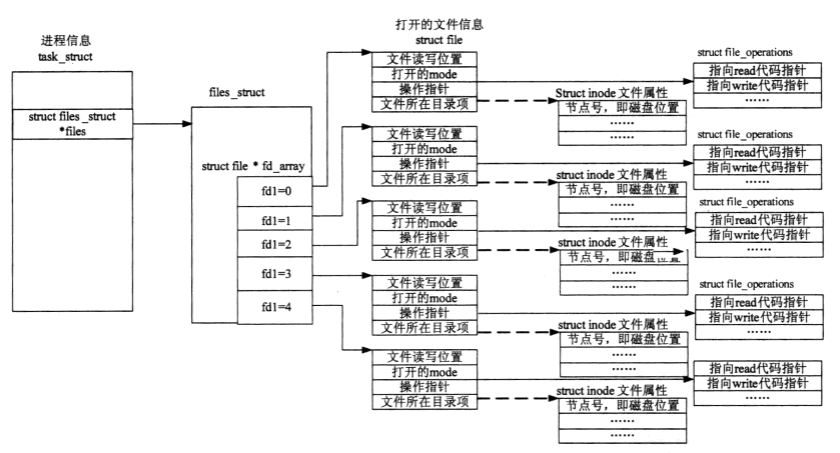
13.13 Duplicating Descriptors
You can duplicate a file descriptor, or allocate another file descriptor that refers to the same open file as the original. Duplicate descriptors share one file position and one set of file status flags (see File Status Flags), but each has its own set of file descriptor flags (see Descriptor Flags).
The major use of duplicating a file descriptor is to implement redirection of input or output: that is, to change the file or pipe that a particular file descriptor corresponds to.
You can perform this operation using the fcntl function with the F_DUPFD command, but there are also convenient functions dup and dup2 for duplicating descriptors.
The fcntl function and flags are declared in fcntl.h, while prototypes for dup and dup2 are in the header file unistd.h.
- Function: int dup (int old)
-
Preliminary: | MT-Safe | AS-Safe | AC-Safe | See POSIX Safety Concepts.
This function copies descriptor old to the first available descriptor number (the first number not currently open). It is equivalent to
fcntl (old, F_DUPFD, 0).
- Function: int dup2 (int old, int new)
-
Preliminary: | MT-Safe | AS-Safe | AC-Safe | See POSIX Safety Concepts.
This function copies the descriptor old to descriptor number new.
If old is an invalid descriptor, then
dup2does nothing; it does not close new. Otherwise, the new duplicate of old replaces any previous meaning of descriptor new, as if new were closed first.If old and new are different numbers, and old is a valid descriptor number, then
dup2is equivalent to:close (new);
fcntl (old, F_DUPFD, new)However,
dup2does this atomically; there is no instant in the middle of callingdup2at which new is closed and not yet a duplicate of old.
- Macro: int F_DUPFD
-
This macro is used as the command argument to
fcntl, to copy the file descriptor given as the first argument.The form of the call in this case is:
fcntl (old, F_DUPFD, next-filedes)
The next-filedes argument is of type
intand specifies that the file descriptor returned should be the next available one greater than or equal to this value.The return value from
fcntlwith this command is normally the value of the new file descriptor. A return value of -1 indicates an error. The followingerrnoerror conditions are defined for this command:EBADF-
The old argument is invalid.
EINVAL-
The next-filedes argument is invalid.
EMFILE-
There are no more file descriptors available—your program is already using the maximum. In BSD and GNU, the maximum is controlled by a resource limit that can be changed; see Limits on Resources, for more information about the
RLIMIT_NOFILElimit.
ENFILEis not a possible error code fordup2becausedup2does not create a new opening of a file; duplicate descriptors do not count toward the limit whichENFILEindicates.EMFILEis possible because it refers to the limit on distinct descriptor numbers in use in one process.
Here is an example showing how to use dup2 to do redirection. Typically, redirection of the standard streams (like stdin) is done by a shell or shell-like program before calling one of the exec functions (see Executing a File) to execute a new program in a child process. When the new program is executed, it creates and initializes the standard streams to point to the corresponding file descriptors, before its main function is invoked.
So, to redirect standard input to a file, the shell could do something like:
pid = fork ();

if (pid == 0)

  {

    char *filename;

    char *program;

    int file;

    …

    file = TEMP_FAILURE_RETRY (open (filename, O_RDONLY));

    dup2 (file, STDIN_FILENO);

    TEMP_FAILURE_RETRY (close (file));

    execv (program, NULL);

  }
There is also a more detailed example showing how to implement redirection in the context of a pipeline of processes in Launching Jobs.
[转]文件IO详解(二)---文件描述符(fd)和inode号的关系的更多相关文章
- 17、文件IO详解及实例
上篇文章已经讲过了文件系统的一些基本的概念,这里首先对文件IO进行详细的学习,文件IO也称为系统调用IO,是操作系统为"用户态"运行的进程和硬件交互提供的一组接口,即操作系统内核留 ...
- 文件IO详解(四)---标准输入、标准输出和标准错误
每个进程都会默认打开3个文件描述符,即0.1.2.其中0代表标准输入流.1代表标准输出流.2代表标准错误流.通常标准输入流对应着键盘的设备文件.标准输出流和错误流对应着显示器的设备文件.在编程中通常使 ...
- 网卡驱动-BD详解(缓存描述符 Buffer Description)
DMA介绍(BD的引入) 网络设备的核心处理模块是一个被称作 DMA(Direct Memory Access)的控制器,DMA 模块能够协助处理器处理数据收发.对于数据发送来说,它能够将组织好的数据 ...
- linux系统初始化——sysinit文件写法详解
sysinit文件写法详解 sysinit文件是linux初始化文件系统时执行的第一个脚本文件.它主要做在各个运行级别中进行初始化工作,包括: 启动交换分区;检查磁盘;设置主机名;检查并挂载文件系统; ...
- 【详解】Linux的文件描述符fd与文件指针FILE*互相转换
使用系统调用的时候用文件描述符(file descriptor,简称fd)的时候比较多,但是操作比较原始.C库函数在I/O上提供了一些方便的包装(比如格式化I/O.重定向),但是对细节的控制不够. 如 ...
- Uploadify 上传文件插件详解
Uploadify 上传文件插件详解 Uploadify是JQuery的一个上传插件,实现的效果非常不错,带进度显示.不过官方提供的实例时php版本的,本文将详细介绍Uploadify在Aspnet中 ...
- Scrapy框架——介绍、安装、命令行创建,启动、项目目录结构介绍、Spiders文件夹详解(包括去重规则)、Selectors解析页面、Items、pipelines(自定义pipeline)、下载中间件(Downloader Middleware)、爬虫中间件、信号
一 介绍 Scrapy一个开源和协作的框架,其最初是为了页面抓取 (更确切来说, 网络抓取 )所设计的,使用它可以以快速.简单.可扩展的方式从网站中提取所需的数据.但目前Scrapy的用途十分广泛,可 ...
- 史上最全的maven pom.xml文件教程详解
<project xmlns="http://maven.apache.org/POM/4.0.0" xmlns:xsi="http://www.w3.org/20 ...
- C++文件读写详解(ofstream,ifstream,fstream)
C++文件读写详解(ofstream,ifstream,fstream) 这里主要是讨论fstream的内容: #include <fstream> ofstream //文件写操作 内存 ...
随机推荐
- 解析Java finally
以下用几个简单的例子介绍一下finally的用法: 例子1 public class Test { public static void main(String[] args) { System.ou ...
- mysql8忘记root密码修改密码(mac)
0.在/etc/my.cnf修改验证方式 [mysqld] default_authentication_plugin=mysql_native_password 1.切换root权限: sudo s ...
- vue中 表头th 合并单元格,且表格列数不定的动态渲染方法
吐槽 今天,在vue中遇到 复杂表格的渲染 ,需要合并表头的单元格,且合并单元格的那列还是动态数据,也就是说你不知道会有多少组要合并起来,哎,我也有点说不清楚,废话不多说了,看代码把: 代码示例 da ...
- Java中IO流讲解(一)
一.概念 IO流用来处理设备之间的数据传输 Java对数据的操作是通过流的方式 Java用于操作流的类都在IO包中 流按流向分为两种:输入流,输出流 流按操作类型分为两种: 字节流 : 字节流可以操作 ...
- tomcat 下catalina.out 日志乱码问题处理
问题: 项目部署到Linux服务器之后,控制台 catalina.out 文件输出的中文为乱码: 解决办法: 方法一:修改tomcat下的模板编码 bin/catalina.sh 文件添加如下配置:J ...
- kali2018利用ss和ProxyChains实现任意应用代理
第一步:配置ss 第二步:配置proxychain vim /etc/proxychains.conf 第三步:使用proxychains 终端输入: proxychains firefox 通过代理 ...
- 【容器人必看】你一定要来 ECUG Con 2018 的三个理由!
引领国内云领域风向的高端峰会 ECUG Con 2018,即将在 12 月 22-23 日 深圳南山 全新启程!如果你的工作和容器内容相关联,如果你的兴趣和容器技术有交集,如果你是「容器人」,那么这就 ...
- 洛谷P2522 - [HAOI2011]Problem b
Portal Description 进行\(T(T\leq10^5)\)次询问,每次给出\(x_1,x_2,y_1,y_2\)和\(d\)(均不超过\(10^5\)),求\(\sum_{i=x_1} ...
- 刷题总结——road(ssoi)
题目: 题目背景 SOURCE:NOIP2016-RZZ-1 题目描述 有 N 个城市,这些城市通过 M 条无向边互相连通,每条边有一个权值 Ci ,表示这条边的长度为 2^(Ci) ,没有两条边的长 ...
- oracle连接封装方法
public static void updateSqlOracle(String sqlstr,String linkIP,String username,String password) thro ...