
Python3 BP神经网络
转自麦子学院
 """

 network.py

 ~~~~~~~~~~

 A module to implement the stochastic gradient descent learning

 algorithm for a feedforward neural network.  Gradients are calculated

 using backpropagation.  Note that I have focused on making the code

 simple, easily readable, and easily modifiable.  It is not optimized,

 and omits many desirable features.

 """

 #### Libraries

 # Standard library

 import random

 # Third-party libraries

 import numpy as np

 class Network(object):

     def __init__(self, sizes):

         """The list ``sizes`` contains the number of neurons in the

         respective layers of the network.  For example, if the list

         was [2, 3, 1] then it would be a three-layer network, with the

         first layer containing 2 neurons, the second layer 3 neurons,

         and the third layer 1 neuron.  The biases and weights for the

         network are initialized randomly, using a Gaussian

         distribution with mean 0, and variance 1.  Note that the first

         layer is assumed to be an input layer, and by convention we

         won't set any biases for those neurons, since biases are only

         ever used in computing the outputs from later layers."""

         self.num_layers = len(sizes)

         self.sizes = sizes

         self.biases = [np.random.randn(y, 1) for y in sizes[1:]]

         self.weights = [np.random.randn(y, x)

                         for x, y in zip(sizes[:-1], sizes[1:])]

     def feedforward(self, a):

         """Return the output of the network if ``a`` is input."""

         for b, w in zip(self.biases, self.weights):

             a = sigmoid(np.dot(w, a)+b)

         return a

     def SGD(self, training_data, epochs, mini_batch_size, eta,

             test_data=None):

         """Train the neural network using mini-batch stochastic

         gradient descent.  The ``training_data`` is a list of tuples

         ``(x, y)`` representing the training inputs and the desired

         outputs.  The other non-optional parameters are

         self-explanatory.  If ``test_data`` is provided then the

         network will be evaluated against the test data after each

         epoch, and partial progress printed out.  This is useful for

         tracking progress, but slows things down substantially."""

         if test_data: n_test = len(test_data)

         n = len(training_data)

         for j in range(epochs):

             random.shuffle(training_data)

             mini_batches = [

                 training_data[k:k+mini_batch_size]

                 for k in range(0, n, mini_batch_size)]

             for mini_batch in mini_batches:

                 self.update_mini_batch(mini_batch, eta)

             if test_data:

                 print ("Epoch {0}: {1} / {2}".format(

                     j, self.evaluate(test_data), n_test))

             else:

                 print ("Epoch {0} complete".format(j))

     def update_mini_batch(self, mini_batch, eta):

         """Update the network's weights and biases by applying

         gradient descent using backpropagation to a single mini batch.

         The ``mini_batch`` is a list of tuples ``(x, y)``, and ``eta``

         is the learning rate."""

         nabla_b = [np.zeros(b.shape) for b in self.biases]

         nabla_w = [np.zeros(w.shape) for w in self.weights]

         #一个一个的进行训练  跟吴恩达的Mini-Batch 不一样

         for x, y in mini_batch:

             delta_nabla_b, delta_nabla_w = self.backprop(x, y)

             nabla_b = [nb+dnb for nb, dnb in zip(nabla_b, delta_nabla_b)]

             nabla_w = [nw+dnw for nw, dnw in zip(nabla_w, delta_nabla_w)]

         self.weights = [w-(eta/len(mini_batch))*nw

                         for w, nw in zip(self.weights, nabla_w)]

         self.biases = [b-(eta/len(mini_batch))*nb

                        for b, nb in zip(self.biases, nabla_b)]

     def backprop(self, x, y):

         """Return a tuple ``(nabla_b, nabla_w)`` representing the

         gradient for the cost function C_x.  ``nabla_b`` and

         ``nabla_w`` are layer-by-layer lists of numpy arrays, similar

         to ``self.biases`` and ``self.weights``."""

         nabla_b = [np.zeros(b.shape) for b in self.biases]

         nabla_w = [np.zeros(w.shape) for w in self.weights]

         # feedforward

         activation = x

         activations = [x] # list to store all the activations, layer by layer

         zs = [] # list to store all the z vectors, layer by layer

         for b, w in zip(self.biases, self.weights):

             z = np.dot(w, activation)+b

             zs.append(z)

             activation = sigmoid(z)

             activations.append(activation)

         # backward pass

         delta = self.cost_derivative(activations[-1], y) * \

             sigmoid_prime(zs[-1])

         nabla_b[-1] = delta

         nabla_w[-1] = np.dot(delta, activations[-2].transpose())

         # Note that the variable l in the loop below is used a little

         # differently to the notation in Chapter 2 of the book.  Here,

         # l = 1 means the last layer of neurons, l = 2 is the

         # second-last layer, and so on.  It's a renumbering of the

         # scheme in the book, used here to take advantage of the fact

         # that Python can use negative indices in lists.

         for l in range(2, self.num_layers):

             z = zs[-l]

             sp = sigmoid_prime(z)

             delta = np.dot(self.weights[-l+1].transpose(), delta) * sp

             nabla_b[-l] = delta

             nabla_w[-l] = np.dot(delta, activations[-l-1].transpose())

         return (nabla_b, nabla_w)

     def evaluate(self, test_data):

         """Return the number of test inputs for which the neural

         network outputs the correct result. Note that the neural

         network's output is assumed to be the index of whichever

         neuron in the final layer has the highest activation."""

         test_results = [(np.argmax(self.feedforward(x)), y)

                         for (x, y) in test_data]

         return sum(int(x == y) for (x, y) in test_results)

     def cost_derivative(self, output_activations, y):

         """Return the vector of partial derivatives \partial C_x /

         \partial a for the output activations."""

         return (output_activations-y)

 #### Miscellaneous functions

 def sigmoid(z):

     """The sigmoid function."""

     return 1.0/(1.0+np.exp(-z))

 def sigmoid_prime(z):

     """Derivative of the sigmoid function."""

     return sigmoid(z)*(1-sigmoid(z))
该算法比我之前写的神经网络算法准确率高,但是在测试过程中发现有错误,各个地方的注释我是没看明白,与理论结合不是很好。本人在他的基础上进行了改进,提高了算法的扩展程度,自己也亲测了改进后的代码,效果杠杠的。
 # -*- coding: utf-8 -*-

 """

 Created on Thu Jan 18 15:27:24 2018

 @author: markli

 """

 import numpy as np;

 import random;

 def tanh(x):

     return np.tanh(x);

 def tanh_derivative(x):

     return 1.0 - np.tanh(x)*np.tanh(x);

 def logistic(x):

     return 1/(1 + np.exp(-x));

 def logistic_derivative(x):

     return logistic(x)*(1-logistic(x));

 def ReLU(x,a=1):

     return max(0,a * x);

 def ReLU_derivative(x,a=1):

     return 0 if x < 0 else a;

 class NeuralNetwork:

     '''

     Z = W * x + b

     A = sigmod(Z)

     Z 净输入

     x 样本集合 n * m n 个特征 m 个样本数量

     b 偏移量

     W 权重

     A 净输出

     '''

     def __init__(self,layers,active_function=[logistic],active_function_der=[logistic_derivative],learn_rate=0.9):

         """

         初始化神经网络

         layer中存放每层的神经元数量,layer的长度即为网络的层数

         active_function 为每一层指定一个激活函数,若长度为1则表示所有层使用同一个激活函数

         active_function_der 激活函数的导数

         learn_rate 学习速率

         """

         self.weights = [np.random.randn(x,y) for x,y in zip(layers[1:],layers[:-1])];

         self.biases = [np.random.randn(x,1) for x in layers[1:]];

         self.size = len(layers);

         self.rate = learn_rate;

         self.sigmoids = [];

         self.sigmoids_der = [];

         for i in range(len(layers)-1):

             if(len(active_function) == self.size-1):

                 self.sigmoids = active_function;

             else:

                 self.sigmoids.append(active_function[0]);

             if(len(active_function_der)== self.size-1):

                 self.sigmoids_der = active_function_der;

             else:

                 self.sigmoids_der.append(active_function_der[0]);

     def fit(self,TrainData,epochs=1000,mini_batch_size=32):

         """

         运用后向传播算法学习神经网络模型

         TrainData 是(X,Y)值对

         X 输入特征矩阵 m*n 维 n 个特征,m个样本

         Y 输入实际值 t*m 维 t个类别标签,m个样本

         epochs 迭代次数

         mini_batch_size mini_batch 一次的大小,不使用则mini_batch_size = 1

         """

         n = len(TrainData);

         for i in range(epochs):

             random.shuffle(TrainData)

             mini_batches = [

                 TrainData[k:k+mini_batch_size]

                 for k in range(0, n, mini_batch_size)];

             for mini_batch in mini_batches:

                 self.BP(mini_batch, self.rate);

     def predict(self, x):

         """前向传播"""

         i = 0;

         for b, w in zip(self.biases, self.weights):

             x = self.sigmoids[i](np.dot(w, x)+b);

             i = i + 1;

         return x

     def BP(self,mini_batch,rate):

         """

         BP 神经网络算法

         """

         size = len(mini_batch);

         nabla_b = [np.zeros(b.shape) for b in self.biases]; #存放每次训练b的变化量

         nabla_w = [np.zeros(w.shape) for w in self.weights]; #存放每次训练w的变化量

         #一个一个的进行训练

         for x, y in mini_batch:

             delta_nabla_b, delta_nabla_w = self.backprop(x, y);

             nabla_b = [nb+dnb for nb, dnb in zip(nabla_b, delta_nabla_b)]; #累加每次训练b的变化量

             nabla_w = [nw+dnw for nw, dnw in zip(nabla_w, delta_nabla_w)]; #累加每次训练w的变化量

         self.weights = [w-(rate/size)*nw

                         for w, nw in zip(self.weights, nabla_w)];

         self.biases = [b-(rate/size)*nb

                        for b, nb in zip(self.biases, nabla_b)];

     def backprop(self, x, y):

         """

         x 是一维 的行向量

         y 是一维行向量

         """

         nabla_b = [np.zeros(b.shape) for b in self.biases];

         nabla_w = [np.zeros(w.shape) for w in self.weights];

         # feedforward

         activation = np.atleast_2d(x).reshape((len(x),1)); #转换为列向量

         activations = [activation]; # 存放每层a

         zs = []; # 存放每z值

         i = 0;

         for b, w in zip(self.biases, self.weights):

             z = np.dot(w, activation)+b;

             zs.append(z);

             activation = self.sigmoids[i](z);

             activations.append(activation);

             i = i + 1;

         # backward pass

         y = np.atleast_2d(y).reshape((len(y),1)); #将y转化为列向量

         #delta cost对z的偏导数

         delta = self.cost_der(activations[-1], y) * \

             self.sigmoids_der[-1](zs[-1]);

         nabla_b[-1] = delta;

         nabla_w[-1] = np.dot(delta, np.transpose(activations[-2]));

         #从后往前遍历每一层,从倒数第2层开始

         for l in range(2, self.size):

             z = zs[-l]; #当前层的z

             sp = self.sigmoids_der[-l](z); #对z的偏导数值

             delta = np.multiply(np.dot(np.transpose(self.weights[-l+1]), delta), sp); #求出当前层的误差

             nabla_b[-l] = delta;

             nabla_w[-l] = np.dot(delta, np.transpose(activations[-l-1]));

         return (nabla_b, nabla_w)

     """

     损失函数

     cost_der 差的平方损失函数对a 的导数

     cost_cross_entropy_der 交叉熵损失函数对a的导数

     """

     def cost_der(self,a,y):

         return a - y;

     def cost_cross_entropy_der(self,a,y):

         return (a-y)/(a * (1-a));
以上是BP神经网络算法源码,下面给出一个数字识别程序,用来测试上述代码的正确性。
 import numpy as np

 from sklearn.datasets import load_digits

 from sklearn.metrics import confusion_matrix, classification_report

 from sklearn.preprocessing import LabelBinarizer

 from network_mark import  NeuralNetwork

 from sklearn.cross_validation import train_test_split

 digits = load_digits();

 X = digits.data;

 y = digits.target;

 X -= X.min(); # normalize the values to bring them into the range 0-1

 X /= X.max();

 nn = NeuralNetwork([64,100,10]);

 X_train, X_test, y_train, y_test = train_test_split(X, y);

 labels_train = LabelBinarizer().fit_transform(y_train);

 labels_test = LabelBinarizer().fit_transform(y_test);

 # X_train.shape (1347,64)

 #y_train.shape(1347)

 #labels_train.shape (1347,10)

 #labels_test.shape(450,10)

 print ("start fitting");

 Data = [(x,y) for x,y in zip(X_train,labels_train)];

 #print(Data);

 nn.fit(Data,epochs=500,mini_batch_size=32);

 result = nn.predict(X_test.T);

 predictions = [np.argmax(result[:,y]) for y in range(result.shape[1])];

 print(predictions);

 #for i in range(result.shape[1]):

 #    y = result[:,i];

 #    predictions.append(np.argmax(y));

 ##print(np.atleast_2d(predictions).shape);

 print (confusion_matrix(y_test,predictions));

 print (classification_report(y_test,predictions));
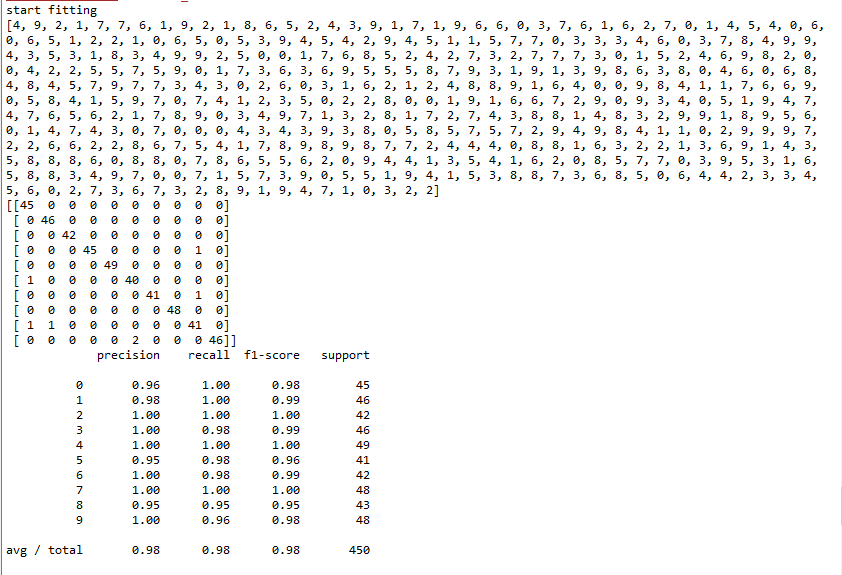
最后是测试结果,效果很客观。
Python3 BP神经网络的更多相关文章
- Python实现bp神经网络识别MNIST数据集
title: "Python实现bp神经网络识别MNIST数据集" date: 2018-06-18T14:01:49+08:00 tags: [""] cat ...
- python手写bp神经网络实现人脸性别识别1.0
写在前面:本实验用到的图片均来自google图片,侵删! 实验介绍 用python手写一个简单bp神经网络,实现人脸的性别识别.由于本人的机器配置比较差,所以无法使用网上很红的人脸大数据数据集(如lf ...
- BP神经网络反向传播之计算过程分解(详细版)
摘要:本文先从梯度下降法的理论推导开始,说明梯度下降法为什么能够求得函数的局部极小值.通过两个小例子,说明梯度下降法求解极限值实现过程.在通过分解BP神经网络,详细说明梯度下降法在神经网络的运算过程, ...
- BP神经网络原理及python实现
[废话外传]:终于要讲神经网络了,这个让我踏进机器学习大门,让我读研,改变我人生命运的四个字!话说那么一天,我在乱点百度,看到了这样的内容: 看到这么高大上,这么牛逼的定义,怎么能不让我这个技术宅男心 ...
- BP神经网络
秋招刚结束,这俩月没事就学习下斯坦福大学公开课,想学习一下深度学习(这年头不会DL,都不敢说自己懂机器学习),目前学到了神经网络部分,学习起来有点吃力,把之前学的BP(back-progagation ...
- 数据挖掘系列(9)——BP神经网络算法与实践
神经网络曾经很火,有过一段低迷期,现在因为深度学习的原因继续火起来了.神经网络有很多种:前向传输网络.反向传输网络.递归神经网络.卷积神经网络等.本文介绍基本的反向传输神经网络(Backpropaga ...
- BP神经网络推导过程详解
BP算法是一种最有效的多层神经网络学习方法,其主要特点是信号前向传递,而误差后向传播,通过不断调节网络权重值,使得网络的最终输出与期望输出尽可能接近,以达到训练的目的. 一.多层神经网络结构及其描述 ...
- 极简反传(BP)神经网络
一.两层神经网络(感知机) import numpy as np '''极简两层反传(BP)神经网络''' # 样本 X = np.array([[0,0,1],[0,1,1],[1,0,1],[1, ...
- BP神经网络
BP神经网络基本原理 BP神经网络是一种单向传播的多层前向网络,具有三层或多层以上的神经网络结构,其中包含输入层.隐含层和输出层的三层网络应用最为普遍. 网络中的上下层之间实现全连接,而每层神经元之 ...
随机推荐
- ubuntu系统问题解决集
1.解决ubuntu 14 system setttings失效的问题 sudo apt-get install unity-control-center 2. 支持root用户登录 修改以下配置文件 ...
- np.random.rand均匀分布随机数和np.random.randn正态分布随机数函数使用方法
np.random.rand用法 觉得有用的话,欢迎一起讨论相互学习~Follow Me 生成特定形状下[0,1)下的均匀分布随机数 np.random.rand(a1,a2,a3...)生成形状为( ...
- Sparrow.Chart.Wpf控件的动态调用
最近需要在Wpf程序中显示曲线,感觉Sparrow.Chart.Wpf控件不错(http://sparrowtoolkit.codeplex.com/),完全开源的一个控件支持,可以通过nuget下载 ...
- bzoj千题计划234:bzoj3802: Vocabulary
http://www.lydsy.com/JudgeOnline/problem.php?id=3802 dp[i][0/1/2/3] 表示前i个字母,第1.2个字符串,第2.3个字符串的关系分别为 ...
- [iOS]Xcode+GitHub远程代码托管(GIT, SVN)
先来看看什么是代码远程托管: 其实就是将我们的代码上传到GitHub的服务器上, 供别人下载, 当然了也可以在团队开发的时候, 使用GitHub进行代码合并工作, 下面我们进入正题 (已经有远程仓库的 ...
- Zookeeper笔记之quota
一.节点配额概述 zookeeper中可以往节点存放数据,但是一般来说存放数据总是要有个度量的对吧,不然空间就那么大,如果某个节点将空间全占用了其它节点没得用了,所以zookeeper提供了一个对节点 ...
- 在Windows 2008上安装Windows Mobile设备中心
我在windows2008系统上安装Microsoft Windows Mobile Device Center v6.1时,老是弹出对话框提示缺少一个Windows Mobile设备中心所需要的Wi ...
- Android Studio之代码提示快捷键冲突设置
1.原代码提示快捷键为:Ctrl+空格,与Windows输入法冲突,所以将代码提示快捷键设置为:Ctrl+反斜杠.
- Go语言之Windows 10开发工具LiteIDE初步使用
Intel Core i5-8250U,Windows 10家庭中文版,go version go1.11 windows/amd64,LiteIDE X34.1 在RUNOOB.COM的Go语言教程 ...
- webapck编译打包stylus文件
先安装css-loader.stylus.stylus-loader npm install --save-dev css-loader npm install --save-dev stylus n ...