
.21-浅析webpack源码之事件流this-compilation
上一节生成Compilation实例后,添加了一些属性,随后触发this-compilation事件流,如下:
Compiler.prototype.newCompilation = (params) => {

    // new Compilation()

    const compilation = this.createCompilation();

    compilation.fileTimestamps = this.fileTimestamps;

    compilation.contextTimestamps = this.contextTimestamps;

    compilation.name = this.name;

    compilation.records = this.records;

    compilation.compilationDependencies = params.compilationDependencies;

    // Go!

    this.applyPlugins("this-compilation", compilation, params);

    this.applyPlugins("compilation", compilation, params);

    return compilation;

}
事件流的名字this-compilation我想了半天也不懂啥意思,从其内容来看其实也只算是一个预编译,叫pre-compilation似乎更好。
总之先不管那么多,继续跑流程,流程图如下:
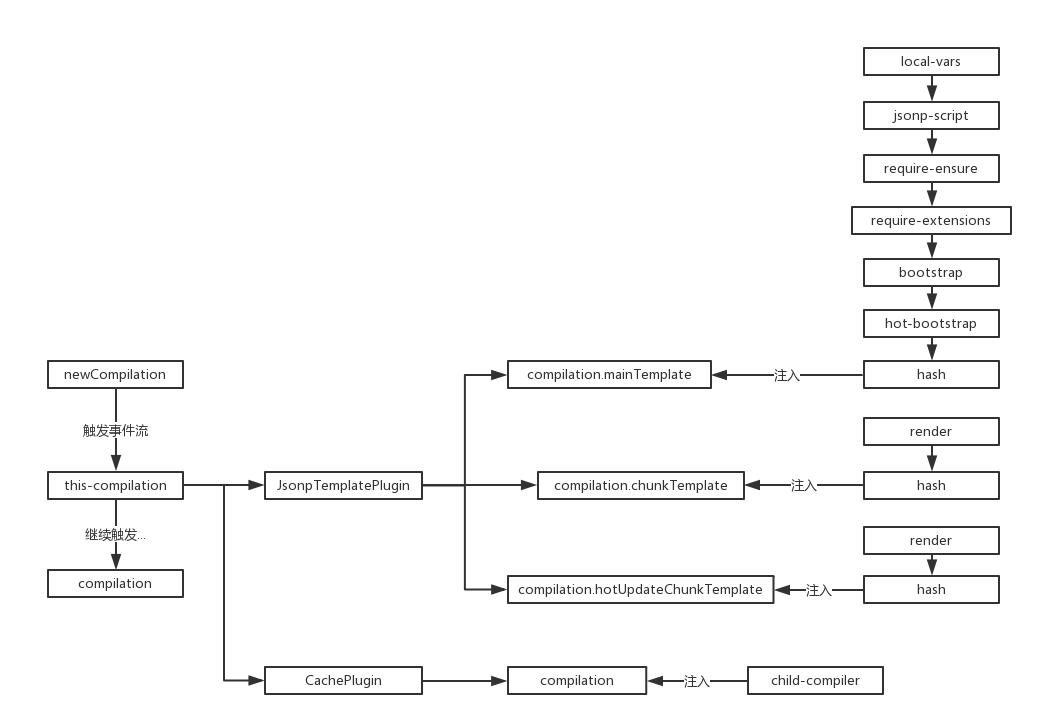
this-compilation事件流的plugin来源有两个地方,分别是:
// JsonpTemplatePlugin

class JsonpTemplatePlugin {

    apply(compiler) {

        compiler.plugin("this-compilation", (compilation) => {

            compilation.mainTemplate.apply(new JsonpMainTemplatePlugin());

            compilation.chunkTemplate.apply(new JsonpChunkTemplatePlugin());

            compilation.hotUpdateChunkTemplate.apply(new JsonpHotUpdateChunkTemplatePlugin());

        });

    }

}

// CachePlugin

compiler.plugin("this-compilation", compilation => {

    // TODO remove notCacheable for webpack 4

    if (!compilation.notCacheable) {

        compilation.cache = cache;

        compilation.plugin("child-compiler", (childCompiler, compilerName, compilerIndex) => { /**/ });

    } else if (this.watching) {

        compilation.warnings.push(

            new Error(`CachePlugin - Cache cannot be used because of: ${compilation.notCacheable}`)

        );

    }

});
两者都出现在WebpackOptionsApply模块中,依次看具体内容。
JsonpTemplatePlugin
这里依次在上节中提到的Compilation几个属性上加载插件(Tapable),首先是:
compilation.mainTemplate.apply(new JsonpMainTemplatePlugin());
该插件源码整理如下:
"use strict";

const Template = require("./Template");

class JsonpMainTemplatePlugin {

    apply(mainTemplate) {

        // this.plugin("startup", (source, chunk, hash) => { /**/ });

        // this.plugin("render", (bootstrapSource, chunk, hash, moduleTemplate, dependencyTemplates) => { /**/ });

        // this.plugin("local-vars", (source, chunk, hash) => { /**/ });

        // this.plugin("require", (source, chunk, hash) => { /**/ });

        // this.plugin("module-obj", (source, chunk, hash, varModuleId) => { /**/ });

        // this.plugin("require-extensions", (source, chunk, hash) => { /**/ });

        mainTemplate.plugin("local-vars", function(source, chunk) { /**/ });

        mainTemplate.plugin("jsonp-script", function(_, chunk, hash) { /**/ });

        mainTemplate.plugin("require-ensure", function(_, chunk, hash) { /**/ });

        mainTemplate.plugin("require-extensions", function(source, chunk) { /**/ });

        mainTemplate.plugin("bootstrap", function(source, chunk, hash) { /**/ });

        mainTemplate.plugin("hot-bootstrap", function(source, chunk, hash) { /**/ });

        mainTemplate.plugin("hash", function(hash) { /**/ });

    }

}

module.exports = JsonpMainTemplatePlugin;
可见,这里只是注入对应的事件流,这里我在注释同时给出了该属性初始化时的plugin,可以对比一下,只有local-vars是重复的。
既然没有任何的apply操作,就暂时先跳过。
然后是第二个:
compilation.chunkTemplate.apply(new JsonpChunkTemplatePlugin());
源码如下:
"use strict";

const ConcatSource = require("webpack-sources").ConcatSource;

class JsonpChunkTemplatePlugin {

    apply(chunkTemplate) {

        chunkTemplate.plugin("render", function(modules, chunk) { /**/ });

        chunkTemplate.plugin("hash", function(hash) { /**/ });

    }

}

module.exports = JsonpChunkTemplatePlugin;
同样只是注入事件流,该属性在初始化没有做操作,所有事件流只有这两。
第三个:
compilation.hotUpdateChunkTemplate.apply(new JsonpHotUpdateChunkTemplatePlugin());
"use strict";

const ConcatSource = require("webpack-sources").ConcatSource;

class JsonpHotUpdateChunkTemplatePlugin {

    apply(hotUpdateChunkTemplate) {

        hotUpdateChunkTemplate.plugin("render", function(modulesSource, modules, removedModules, hash, id) { /**/ });

        hotUpdateChunkTemplate.plugin("hash", function(hash) { /**/ });

    }

}

module.exports = JsonpHotUpdateChunkTemplatePlugin;
与上面那个类似。
该模块注入完结。
CachePlugin
该插件注入了多个事件流,直接上与this-compilation事件流相关的代码:
compiler.plugin("this-compilation", compilation => {

    // TODO remove notCacheable for webpack 4

    // 这个属性我从头到尾找不到哪出现的

    // 反正注释说webpack4会将其移除

    if (!compilation.notCacheable) {

        // cache => {}

        compilation.cache = cache;

        // 注入事件流

        compilation.plugin("child-compiler", (childCompiler, compilerName, compilerIndex) => { /**/ });

    }

    // 不可能到达的else

    else if (this.watching) {

        compilation.warnings.push(

            new Error(`CachePlugin - Cache cannot be used because of: ${compilation.notCacheable}`)

        );

    }

});
果然是只是注入事件流,这里的notCacheable不知道在哪定义的,也不知道如何修改。
总之this-compilation也并不是编译,只是为一些辅助模块注入事件流。
.21-浅析webpack源码之事件流this-compilation的更多相关文章
- .34-浅析webpack源码之事件流make(3)
新年好呀~过个年光打游戏,function都写不顺溜了. 上一节的代码到这里了: // NormalModuleFactory的resolver事件流 this.plugin("resolv ...
- .23-浅析webpack源码之事件流compilation(1)
正式开始跑编译,依次解析,首先是: compiler.apply( new JsonpTemplatePlugin(options.output), // start new FunctionModu ...
- .27-浅析webpack源码之事件流make(2)
上一节跑到了NormalModuleFactory模块,调用了原型方法create后,依次触发了before-rsolve.factory.resolver事件流,这节从resolver事件流开始讲. ...
- .26-浅析webpack源码之事件流make(1)
compilation事件流中,依然只是针对细节步骤做事件流注入,代码流程如图: // apply => this-compilation // apply => compilation ...
- .24-浅析webpack源码之事件流compilation(2)
下一个compilation来源于以下代码: compiler.apply(new EntryOptionPlugin()); compiler.applyPluginsBailResult(&quo ...
- .22-浅析webpack源码之事件流compilation总览
呃,终于到了这地方-- newCompilation(params) { // ... this.applyPlugins("this-compilation", compilat ...
- .25-浅析webpack源码之事件流compilation(3)
这一节跑下一批plugin. compiler.apply( new EnsureChunkConditionsPlugin(), new RemoveParentModulesPlugin(), n ...
- .37-浅析webpack源码之事件流make(4)
赶紧完结这个系列咯,webpack4都已经出正式版了. 之前的代码搜索到js文件的对应loader,并添加到了对象中返回,流程如下: this.plugin("factory", ...
- 浅析libuv源码-node事件轮询解析(3)
好像博客有观众,那每一篇都画个图吧! 本节简图如下. 上一篇其实啥也没讲,不过node本身就是这么复杂,走流程就要走全套.就像曾经看webpack源码,读了300行代码最后就为了取package.js ...
随机推荐
- 16位CRC校验_Delphi
unit Modbus_main; {$mode objfpc}{$H+} interface uses Classes, SysUtils, FileUtil, Forms, Controls, G ...
- UniGUI的 TUniPageControl控件动态拖动tabsheet的实现方法
https://blog.csdn.net/shuiying/article/details/54932518 实现可以用鼠标动态拖动tabsheet,共三个步骤: 1.在ServerModule中, ...
- 分形之龙形曲线(Dragon Curve)
龙形曲线(Dragon Curve)又叫分形龙,是一种自相似碎形曲线的统称,因形似龙的蜿蜒盘曲而得名. 一种简单的生成分形龙的方式是:拿着一条细长的纸带,把它朝下的一头拿上来,与上面的一头并到一起.用 ...
- Linux-压缩与归档
压缩:gzip/gunzip.bzip2/bunzip2.xz/unxz 归档:tar ####归档+压缩:zip 1. gzip, gunzip, zcat - compress or expand ...
- Strust2总结
1. JavaEE软件三层结构和MVC的区别? JavaEE软件三层机构是由sun公司提供JavaEE开发规范的:Web层(表现层).业务逻辑层.数据持久层.[其中WEB层会使用前端控制器模式] MV ...
- API网关【gateway 】- 1
最近在公司进行API网关重写,公司内采用serverMesh进行服务注册,调用,这里结合之前学习对API网关服务进行简单的总结与分析. 网关的单节点场景: 网关的多节点场景: 这里的多节点是根据模块进 ...
- CSS选择器之兄弟选择器(~和+)
今天在改以以前人家写的网页的样式的时候,碰到这个选择器,‘~’,当时我是懵逼的,傻傻分不清 ‘+’ 跟 ‘~’的区别,虽然我知道他们都是兄弟选择器. 后来网上查了下,也许是我查找的方式不对,没有找到我 ...
- 【xsy1130】tree 树形dp+期望dp
题目写得不清不楚的... 题目大意:给你一棵$n$个节点的树,你会随机选择其中一个点作为根,随后随机每个点深度遍历其孩子的顺序. 下面给你一个点集$S$,问你遍历完$S$中所有点的期望时间,点集S中的 ...
- 如何使用gradle打jar包
1.进入工程目录,输入./gradlew,如显示"... build success" 则表示当前目录下gradle可用:如当前目录下无gradle,则在线下载 .. 2.输入./ ...
- [Umbraco] macro(宏)在umbraco中的作用
macro在umbraco中是一个核心的应用,它是模板页中用于动态加载内容的标签(模板指令),宏可以是基于XSLT文件创建,亦可以是基于ASP.NET用户控件创建 在develop下的Macros中创 ...