
tensorflow 模型前向传播 保存ckpt tensorbard查看 ckpt转pb pb 转snpe dlc 实例
参考:
TensorFlow 自定义模型导出:将 .ckpt 格式转化为 .pb 格式
TensorFlow 模型保存与恢复
tensorflow 模型前向传播 保存ckpt tensorbard查看 ckpt转pb pb 转snpe dlc 实例
log文件
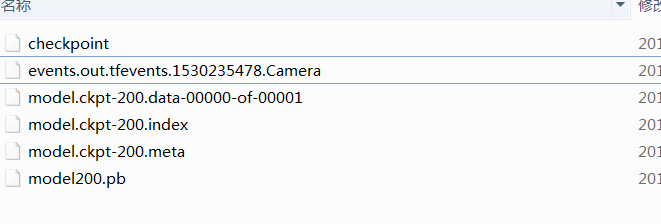
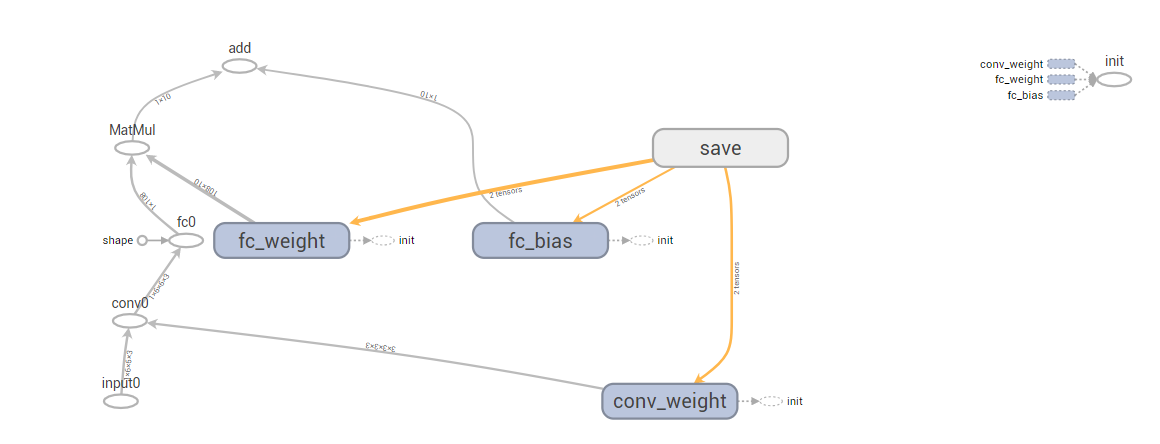
输入节点 图像高度 图像宽度 图像通道数
input0 6,6,3
输出节点
--out_node add
snpe-tensorflow-to-dlc --graph ./simple_snpe_log/model200.pb -i input0 6,6,3 --out_node add
#coding:utf-8

#http://blog.csdn.net/zhuiqiuk/article/details/53376283

#http://blog.csdn.net/gan_player/article/details/77586489

from __future__ import absolute_import, unicode_literals

import tensorflow as tf

import shutil

import os.path

from tensorflow.python.framework import graph_util

import mxnet as mx

import numpy as np

import random

import cv2

from time import sleep

from easydict import EasyDict as edict

import logging

import math

import tensorflow as tf

import numpy as np

def FullyConnected(input, fc_weight, fc_bias, name):

    fc = tf.matmul(input, fc_weight) + fc_bias

    return fc

def inference(body, name_class,outchannel):

    wkernel = 3

    inchannel = body.get_shape()[3].value

    conv_weight = np.arange(wkernel * wkernel * inchannel * outchannel,dtype=np.float32).reshape((outchannel,inchannel,wkernel,wkernel))

    conv_weight =  conv_weight / (outchannel*inchannel*wkernel*wkernel)

    print("conv_weight ", conv_weight)

    conv_weight = conv_weight.transpose(2,3,1,0)

    conv_weight = tf.Variable(conv_weight, dtype=np.float32, name = "conv_weight")

    body = tf.nn.conv2d(body, conv_weight, strides=[1, 1, 1, 1], padding='SAME', name = "conv0")

    conv = body

    conv_shape = body.get_shape()

    dim = conv_shape[1].value * conv_shape[2].value * conv_shape[3].value

    body = tf.reshape(body, [1, dim], name = "fc0")

    fc_weight = np.ones((dim, name_class))

    fc_bias = np.zeros((1, name_class))

    fc_weight = tf.Variable(fc_weight, dtype=np.float32, name="fc_weight")

    fc_bias = tf.Variable(fc_bias, dtype=np.float32, name="fc_bias")

    # tf.constant(100,dtype=np.float32, shape=(body.get_shape()[1] * body.get_shape()[2]  * body.get_shape()[3], name_class])

    # fc_bias = tf.constant(10, dtype=np.float32, shape=(1, name_class])

    body = FullyConnected(body, fc_weight, fc_bias, "fc0")

    return conv, body

export_dir = "simple_snpe_log"

def saveckpt():

    height = 6

    width = 6

    inchannel = 3

    outchannel = 3

    graph = tf.get_default_graph()

    with tf.Graph().as_default():

        input_image = tf.placeholder("float", [1, height, width, inchannel], name = "input0")

        conv, logdit = inference(input_image,10,outchannel)

        init = tf.global_variables_initializer()

        with tf.Session() as sess:

            sess.run(init)

            img = np.arange(height * width * inchannel, dtype=np.float32).reshape((1,inchannel,height,width)) \

                  / (1 * inchannel * height * width) * 255.0 - 127.5

            print("img",img)

            img = img.transpose(0,2,3,1)

            import time

            since = time.time()

            fc = sess.run(logdit,{input_image:img})

            conv = sess.run(conv, {input_image: img})

            time_elapsed = time.time() - since

            print("tf inference time ", str(time_elapsed))

            print("conv", conv.transpose(0, 2, 3, 1))

            print("fc", fc)

            #np.savetxt("tfconv.txt",fc)

            #print( "fc", fc.transpose(0,3,2,1))

            #np.savetxt("tfrelu.txt",fc.transpose(0,3,2,1)[0][0])

            # #save ckpt

            export_dir = "simple_snpe_log"

            saver = tf.train.Saver()

            step = 200

            # if os.path.exists(export_dir):

            #     os.system("rm -rf " + export_dir)

            if not os.path.isdir(export_dir): # Create the log directory if it doesn't exist

                os.makedirs(export_dir)

            checkpoint_file = os.path.join(export_dir, 'model.ckpt')

            saver.save(sess, checkpoint_file, global_step=step)

def LoadModelToTensorBoard():

    graph = tf.get_default_graph()

    checkpoint_file = os.path.join(export_dir, 'model.ckpt-200.meta')

    saver = tf.train.import_meta_graph(checkpoint_file)

    print(saver)

    summary_write = tf.summary.FileWriter(export_dir , graph)

    print(summary_write)

def ckptToPb():

    checkpoint_file = os.path.join(export_dir, 'model.ckpt-200.meta')

    ckpt = tf.train.get_checkpoint_state(export_dir)

    print("model ", ckpt.model_checkpoint_path)

    saver = tf.train.import_meta_graph(ckpt.model_checkpoint_path +'.meta')

    graph = tf.get_default_graph()

    with tf.Session() as sess:

        saver.restore(sess,ckpt.model_checkpoint_path)

        height = 6

        width = 6

        input_image = tf.get_default_graph().get_tensor_by_name("input0:0")

        fc0_output = tf.get_default_graph().get_tensor_by_name("add:0")

        sess.run(tf.global_variables_initializer())

        output_graph_def = tf.graph_util.convert_variables_to_constants(

            sess, graph.as_graph_def(), ['add'])

        model_name = os.path.join(export_dir, 'model200.pb')

        with tf.gfile.GFile(model_name, "wb") as f:

            f.write(output_graph_def.SerializeToString())

def PbTest():

    with tf.Graph().as_default():

        output_graph_def = tf.GraphDef()

        output_graph_path = os.path.join(export_dir,'model200.pb')

        with open(output_graph_path, "rb") as f:

            output_graph_def.ParseFromString(f.read())

            tf.import_graph_def(output_graph_def, name="")

        with tf.Session() as sess:

            tf.initialize_all_variables().run()

            height = 6

            width = 6

            inchannel = 3

            outchannel = 3

            input_image = tf.get_default_graph().get_tensor_by_name("input0:0")

            fc0_output = tf.get_default_graph().get_tensor_by_name("add:0")

            conv = tf.get_default_graph().get_tensor_by_name("conv0:0")

            img = np.arange(height * width * inchannel, dtype=np.float32).reshape((1,inchannel,height,width)) \

                  / (1 * inchannel * height * width) * 255.0 - 127.5

            print("img",img)

            img = img.transpose(0,2,3,1)

            import time

            since = time.time()

            fc0_output = sess.run(fc0_output,{input_image:img})

            conv = sess.run(conv, {input_image: img})

            time_elapsed = time.time() - since

            print("tf inference time ", str(time_elapsed))

            print("conv", conv.transpose(0, 2, 3, 1))

            print("fc0_output", fc0_output)

if __name__ == '__main__':

    saveckpt() #1

    LoadModelToTensorBoard()#2

    ckptToPb()#3

    PbTest()#
tensorflow 模型前向传播 保存ckpt tensorbard查看 ckpt转pb pb 转snpe dlc 实例的更多相关文章
- Tensorflow模型加载与保存、Tensorboard简单使用
先上代码: from __future__ import absolute_import from __future__ import division from __future__ import ...
- TensorFlow模型加载与保存
我们经常遇到训练时间很长,使用起来就是Weight和Bias.那么如何将训练和测试分开操作呢? TF给出了模型的加载与保存操作,看了网上都是很简单的使用了一下,这里给出一个神经网络的小程序去测试. 本 ...
- 利用tensorflow实现前向传播
import tensorflow as tf w1 = tf.Variable(tf.random_normal((2, 3), stddev=1, seed=1))w2 = tf.Variable ...
- Tensorflow笔记——神经网络图像识别(一)前反向传播,神经网络八股
第一讲:人工智能概述 第三讲:Tensorflow框架 前向传播: 反向传播: 总的代码: #coding:utf-8 #1.导入模块,生成模拟数据集 import t ...
- tensorflow模型的保存与恢复,以及ckpt到pb的转化
转自 https://www.cnblogs.com/zerotoinfinity/p/10242849.html 一.模型的保存 使用tensorflow训练模型的过程中,需要适时对模型进行保存,以 ...
- tensorflow模型持久化保存和加载
模型文件的保存 tensorflow将模型保持到本地会生成4个文件: meta文件:保存了网络的图结构,包含变量.op.集合等信息 ckpt文件: 二进制文件,保存了网络中所有权重.偏置等变量数值,分 ...
- Tensorflow模型变量保存
Tensorflow:模型变量保存 觉得有用的话,欢迎一起讨论相互学习~Follow Me 参考文献Tensorflow实战Google深度学习框架 实验平台: Tensorflow1.4.0 pyt ...
- tensorflow模型持久化保存和加载--深度学习-神经网络
模型文件的保存 tensorflow将模型保持到本地会生成4个文件: meta文件:保存了网络的图结构,包含变量.op.集合等信息 ckpt文件: 二进制文件,保存了网络中所有权重.偏置等变量数值,分 ...
- 超详细的Tensorflow模型的保存和加载(理论与实战详解)
1.Tensorflow的模型到底是什么样的? Tensorflow模型主要包含网络的设计(图)和训练好的各参数的值等.所以,Tensorflow模型有两个主要的文件: a) Meta graph: ...
随机推荐
- 什么是UML?分哪两类?
统一建模语言(UML是 Unified Modeling Language的缩写)是用来对软件密集系统进行可视化建模的一种语言.UML为面向对象开发系统的产品进行说明.可视化.和编制文档的一种标准语言 ...
- (原创)谈谈boost.asio的异步发送
在上一篇博文中提到asio的异步发送稍微复杂一点,有必要单独拿出来说说.asio异步发送复杂的地方在于: 不能连续调用异步发送接口async_write,因为async_write内部是不断调用asy ...
- WinEdt 6+SumatraPDF -- 实现TeX文档和PDF文件正反向搜索
这几天试用了新出不久的WinEdt 6,结合PDF文件的阅读器SumatraPDF,感觉实现TeX文档和PDF文件之间的正反向搜索十分便利,故此向大家特别推荐! CTeX v2.8版本的一项重要功能是 ...
- python2/3 中删除字典中value为空的键值对方法
python2 data_info = { 'account': 1, 'remark': 2, 'sort': '', 'weight': '', } for key in data_info.ke ...
- ubuntu 解压命令
ubuntu解压命令.tar解包:tar xvf FileName.tar打包:tar cvf FileName.tar DirName(注:tar是打包,不是压缩!)———————————————. ...
- Mybatis的mapper注册
既然 MyBatis 的行为已经由上述元素配置完了,我们现在就要定义 SQL 映射语句了.但是首先我们需要告诉 MyBatis 到哪里去找到这些语句. Java 在自动查找这方面没有提供一个很好的方法 ...
- 基于jQuery点击缩略图右侧滑出大图特效
基于jQuery点击缩略图右侧滑出大图特效是一款基于strip.pkgd插件实现的点击左侧缩略图右侧滑出大图切换代码.效果图如下: 在线预览 源码下载 实现的代码. html代码: <div ...
- tomcat 远程命令执行漏洞复现
影响范围 Apache Tomcat 7.0.0 - 7.0.81 不受影响的版本 Apache Tomcat 8.x Apache Tomcat 9.x 漏洞分析 在Tomcat安装目录下的配置文件 ...
- 解决mysql group by和count同时使用的问题
例如这样一个表,我想统计email和passwords都不相同的记录的条数 CREATE TABLE IF NOT EXISTS `test_users` ( `email_id` ) unsigne ...
- RDD、DataFrame和DataSet
简述 RDD.DataFrame和DataSet是容易产生混淆的概念,必须对其相互之间对比,才可以知道其中异同:DataFrame多了数据的结构信息,即schema.RDD是分布式的 Java对象的集 ...