
201771010118 马昕璐 《面向对象设计 java》第十七周实验总结
1、实验目的与要求
(1) 掌握线程同步的概念及实现技术;
(2) 线程综合编程练习
2、实验内容和步骤
实验1:测试程序并进行代码注释。
测试程序1:
l 在Elipse环境下调试教材651页程序14-7,结合程序运行结果理解程序;
l 掌握利用锁对象和条件对象实现的多线程同步技术。
package synch;

import java.util.*;
import java.util.concurrent.locks.*;

/**
 * A bank with a number of bank accounts that uses locks for serializing access.
 * @version 1.30 2004-08-01
 * @author Cay Horstmann
 */
public class Bank
{
   private final double[] accounts;
   private Lock bankLock;
   private Condition sufficientFunds;

   /**
    * Constructs the bank.
    * @param n the number of accounts
    * @param initialBalance the initial balance for each account
    */
   public Bank(int n, double initialBalance)
   {
      accounts = new double[n];
      Arrays.fill(accounts, initialBalance);
      bankLock = new ReentrantLock();
      sufficientFunds = bankLock.newCondition();
   }

   /**
    * Transfers money from one account to another.
    * @param from the account to transfer from
    * @param to the account to transfer to
    * @param amount the amount to transfer
    */
   public void transfer(int from, int to, double amount) throws InterruptedException
   //通过锁对象生成条件对象
   {
      bankLock.lock();//加锁
      try
      {
         while (accounts[from] < amount)
            sufficientFunds.await();//条件对象如果被注释会出现死锁现象不能实现线程的有效调用
         System.out.print(Thread.currentThread());
         accounts[from] -= amount;
         System.out.printf(" %10.2f from %d to %d", amount, from, to);
         accounts[to] += amount;
         System.out.printf(" Total Balance: %10.2f%n", getTotalBalance());
         sufficientFunds.signalAll();
      }
      finally
      {
         bankLock.unlock();
      }
   }

   /**
    * Gets the sum of all account balances.
    * @return the total balance
    */
   public double getTotalBalance()
   {
      bankLock.lock();
      try
      {
         double sum = 0;

         for (double a : accounts)
            sum += a;

         return sum;
      }
      finally
      {
         bankLock.unlock();
      }
   }

   /**
    * Gets the number of accounts in the bank.
    * @return the number of accounts
    */
   public int size()
   {
      return accounts.length;
   }
}
package synch;

/**
 * This program shows how multiple threads can safely access a data structure.
 * @version 1.31 2015-06-21
 * @author Cay Horstmann
 */
public class SynchBankTest
{
   public static final int NACCOUNTS = 100;
   public static final double INITIAL_BALANCE = 1000;
   public static final double MAX_AMOUNT = 1000;
   public static final int DELAY = 10;

   public static void main(String[] args)
   {
      Bank bank = new Bank(NACCOUNTS, INITIAL_BALANCE);
      for (int i = 0; i < NACCOUNTS; i++)
      {
         int fromAccount = i;
         Runnable r = () -> {
            try
            {
               while (true)
               {
                  int toAccount = (int) (bank.size() * Math.random());
                  double amount = MAX_AMOUNT * Math.random();
                  bank.transfer(fromAccount, toAccount, amount);
                  Thread.sleep((int) (DELAY * Math.random()));
               }
            }
            catch (InterruptedException e)
            {
            }
         };
         Thread t = new Thread(r);
         t.start();
      }
   }
}
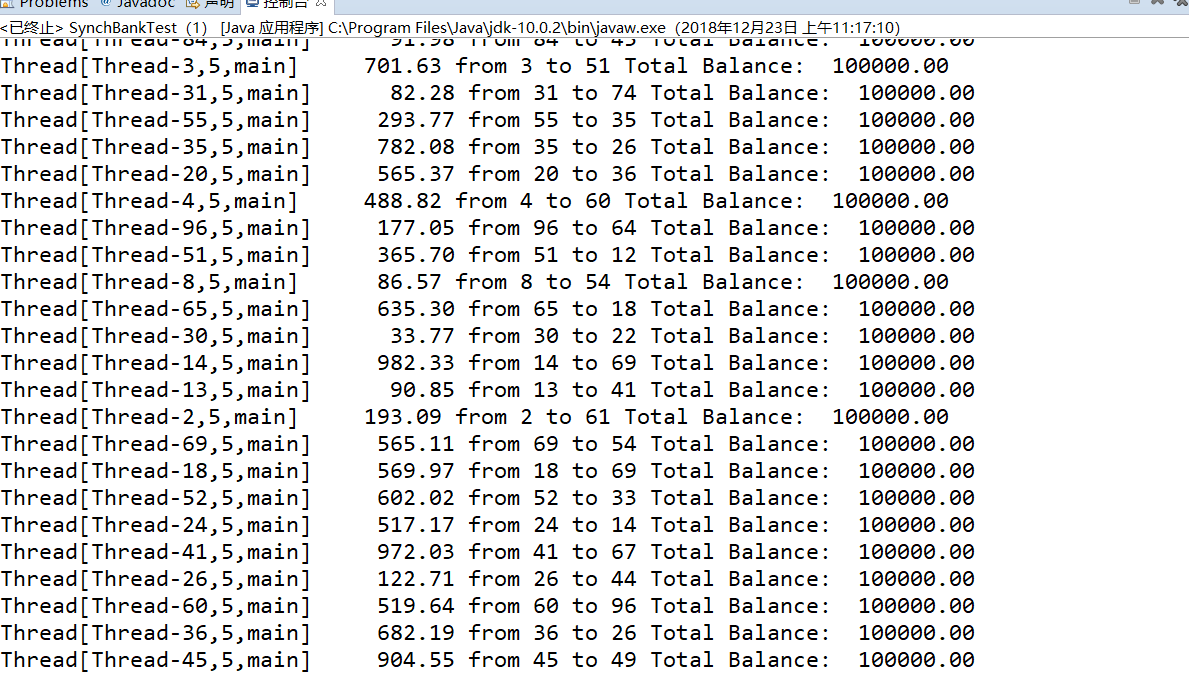
实验结果如下:
测试程序2:
l 在Elipse环境下调试教材655页程序14-8,结合程序运行结果理解程序;
l 掌握synchronized在多线程同步中的应用。
package synch2;

import java.util.*;

/**
 * A bank with a number of bank accounts that uses synchronization primitives.
 * @version 1.30 2004-08-01
 * @author Cay Horstmann
 */
public class Bank
{
   private final double[] accounts;

   /**
    * Constructs the bank.
    * @param n the number of accounts
    * @param initialBalance the initial balance for each account
    */
   public Bank(int n, double initialBalance)
   {
      accounts = new double[n];
      Arrays.fill(accounts, initialBalance);
   }

   /**
    * Transfers money from one account to another.
    * @param from the account to transfer from
    * @param to the account to transfer to
    * @param amount the amount to transfer
    */
   public synchronized void transfer(int from, int to, double amount) throws InterruptedException
   {
      while (accounts[from] < amount)
         wait();
    //在其他线程调用此对象的 notify() 方法或 notifyAll() 方法前,导致当前线程等待
      System.out.print(Thread.currentThread());
      accounts[from] -= amount;
      System.out.printf(" %10.2f from %d to %d", amount, from, to);
      accounts[to] += amount;
      System.out.printf(" Total Balance: %10.2f%n", getTotalBalance());
      notifyAll();//唤醒在此对象监视器上等待的所有线程
   }

   /**
    * Gets the sum of all account balances.
    * @return the total balance
    */
   public synchronized double getTotalBalance()
   {
      double sum = 0;

      for (double a : accounts)
         sum += a;

      return sum;
   }

   /**
    * Gets the number of accounts in the bank.
    * @return the number of accounts
    */
   public int size()
   {
      return accounts.length;
   }
}
package synch2;

/**
 * This program shows how multiple threads can safely access a data structure,
 * using synchronized methods.
 * @version 1.31 2015-06-21
 * @author Cay Horstmann
 */
public class SynchBankTest2
{
   public static final int NACCOUNTS = 100;
   public static final double INITIAL_BALANCE = 1000;
   public static final double MAX_AMOUNT = 1000;
   public static final int DELAY = 10;

   public static void main(String[] args)
   {
      Bank bank = new Bank(NACCOUNTS, INITIAL_BALANCE);
      for (int i = 0; i < NACCOUNTS; i++)
      {
         int fromAccount = i;
         Runnable r = () -> {
            try
            {
               while (true)
               {
                  int toAccount = (int) (bank.size() * Math.random());
                  double amount = MAX_AMOUNT * Math.random();
                  bank.transfer(fromAccount, toAccount, amount);
                  Thread.sleep((int) (DELAY * Math.random()));
               }
            }
            catch (InterruptedException e)
            {
            }
         };
         Thread t = new Thread(r);
         t.start();
      }
   }
}
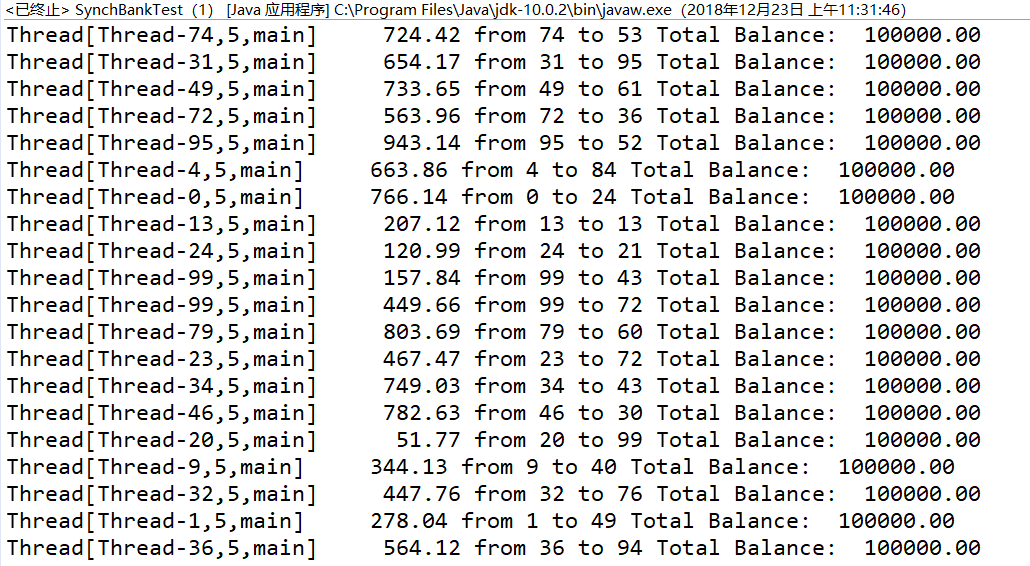
实验结果如图所示:
测试程序3:
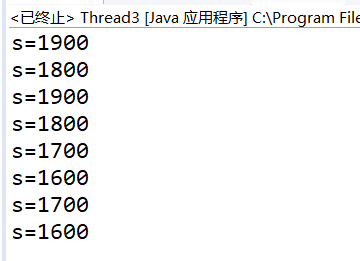
l 在Elipse环境下运行以下程序,结合程序运行结果分析程序存在问题;
l 尝试解决程序中存在问题。
|
class Cbank { private static int s=2000; public static void sub(int m) { int temp=s; temp=temp-m; try { Thread.sleep((int)(1000*Math.random())); } catch (InterruptedException e) { } s=temp; System.out.println("s="+s); } }
class Customer extends Thread { public void run() { for( int i=1; i<=4; i++) Cbank.sub(100); } } public class Thread3 { public static void main(String args[]) { Customer customer1 = new Customer(); Customer customer2 = new Customer(); customer1.start(); customer2.start(); } } |
class Cbank
{
private static int s=2000;
public static void sub(int m)
{
int temp=s;
temp=temp-m;
try {
Thread.sleep((int)(1000*Math.random()));
}
catch (InterruptedException e) { }
s=temp;
System.out.println("s="+s);
}
}
class Customer extends Thread
{
public void run()
{
for( int i=1; i<=4; i++)
Cbank.sub(100);
}
}
public class Thread3
{
public static void main(String args[])
{
Customer customer1 = new Customer();
Customer customer2 = new Customer();
customer1.start();
customer2.start();
}
}
实验结果如下:
实验2 编程练习
利用多线程及同步方法,编写一个程序模拟火车票售票系统,共3个窗口,卖10张票,程序输出结果类似(程序输出不唯一,可以是其他类似结果)。
Thread-0窗口售:第1张票
Thread-0窗口售:第2张票
Thread-1窗口售:第3张票
Thread-2窗口售:第4张票
Thread-2窗口售:第5张票
Thread-1窗口售:第6张票
Thread-0窗口售:第7张票
Thread-2窗口售:第8张票
Thread-1窗口售:第9张票
Thread-0窗口售:第10张票
public class Demo {
        public static void main(String[] args) {
            Mythread mythread = new Mythread();
            Thread t1 = new Thread(mythread);
            Thread t2 = new Thread(mythread);
            Thread t3= new Thread(mythread);
            t1.start();
            t2.start();
            t3.start();
        }
        }
        class Mythread implements Runnable{
            int t=1;
            boolean flag=true;
            @Override
            public void run() {
                while(flag) {
                        try {
                            Thread.sleep(500);
                        } catch (InterruptedException e) {
                            // TODO Auto-generated catch block
                            e.printStackTrace();
                        }
                        synchronized (this) {
                            if(t<=10) {
                            System.out.println(Thread.currentThread().getName()+"窗口售:第"+t+"张票");
                            t++;
                        }
                        if(t>10) {
                            flag=false;
                        }
                        }

                    }

                }

            }

实验总结:在这周的理论学习部分中,我们学习了关于解决线程并发执行中的问题,实验中掌握了利用锁对象和条件对象实现的多线程同步技术。在一学期的java学习中我收获了很多,对学长及老师的教导与帮助深表感谢。
201771010118 马昕璐 《面向对象设计 java》第十七周实验总结的更多相关文章
- 201771010118马昕璐《面向对象程序设计java》第八周学习总结
第一部分:理论知识学习部分 1.接口 在Java程序设计语言中,接口不是类,而是对类的一组需求描述,由常量和一组抽象方法组成.Java为了克服单继承的缺点,Java使用了接口,一个类可以实现一个或多个 ...
- 201771010123汪慧和《面向对象程序设计JAVA》第九周实验总结
一.理论部分 1.异常 (1)异常处理的任务就是将控制权从错误产生的地方转移给能够处理这种情况的错误处理器. (2)程序中可能出现的错误和问题:a.用户输入错误.b.设备错误.c.物理限制.d.代码错 ...
- 201771010118 马昕璐《面向对象程序设计java》第十二周学习总结
第一部分:理论知识学习部分 用户界面:用户与计算机系统(各种程序)交互的接口 图形用户界面:以图形方式呈现的用户界面 AET:Java 的抽象窗口工具箱包含在java.awt包中,它提供了许多用来设计 ...
- 201771010118 马昕璐 《面向对象程序设计(java)》第十三周学习总结
第一部分:理论知识学习部分 事件处理基础 1.事件源(event source):能够产生事件的对象都可以成为事件源.一个事件源是一个能够注册监听器并向监听器发送事件对象的对象. 2.事件监听器(ev ...
- 201771010118 马昕璐《面向对象程序设计java》第十周学习总结
第一部分:理论知识学习部分 泛型:也称参数化类型(parameterized type)就是在定义类.接口和方法时,通过类型参数 指示将要处理的对象类型. 泛型程序设计(Generic program ...
- 201871010115——马北《面向对象程序设计JAVA》第二周学习总结
项目 内容 这个作业属于哪个课程 https://www.cnblogs.com/nwnu-daizh/ 这个作业的要求在哪里 https://www.cnblogs.com/nwnu-daizh/p ...
- 201771010134杨其菊《面向对象程序设计java》第九周学习总结
第九周学习总结 第一部分:理论知识 异常.断言和调试.日志 1.捕获 ...
- 201871010124 王生涛《面向对象程序设计JAVA》第一周学习总结
项目 内容 这个作业属于哪个课程 https://www.cnblogs.com/nwnu-daizh/ 这个作业的要求在哪里 https://edu.cnblogs.com/campus/xbsf/ ...
- 马昕璐 201771010118《面向对象程序设计(java)》第十八周学习总结
实验十八 总复习 实验时间 2018-12-30 1.实验目的与要求 (1) 综合掌握java基本程序结构: (2) 综合掌握java面向对象程序设计特点: (3) 综合掌握java GUI 程序设 ...
随机推荐
- SimpleDateFormat日期格式解析
先看一个代码示例: import java.text.SimpleDateFormat; import java.util.Date; public class test{ public static ...
- Shiro权限管理
1.简介 Apache Shiro是Java的一个安全框架,对比Spring Security,没有Spring Security功能强大,但在实际工作时可能并不需要那么复杂,所以使用小而简单的Shi ...
- nginx跨域问题记录
现象:访问 toolbox.chinasoft.com 提示如下:Access to Font at 'https://images.chinasoft.com/static-toolbox/styl ...
- CSS 左右两边底部对齐
https://demo.cssworld.cn/4/3-2.php <style type="text/css"> .parent{ width:500px; tex ...
- Bootstrap-datepicker3官方文档中文翻译---Keyboard support/键盘支持(原文链接 http://bootstrap-datepicker.readthedocs.io/en/latest/index.html)
本日期控件包含了键盘导航. “focused date” 在键盘导航期间一直会被保持追踪并且高亮显示(就想鼠标悬停的时候一样),当一个日期被切换(译者注:选中状态的切换)时或者控件隐藏时清除. up ...
- 关于Integer比较问题
public class Test { public static void main(String[] args) { Integer a=127; Integer b=127; System.ou ...
- JSP随记
JSP简介: JSP全名为Java Server Pages,中文名叫java服务器页面,其根本是一个简化的Servlet设计,它是由Sun公司倡导.许多公司参与一起建立的一种动态网页技术标准. Se ...
- 3. ORACLE DATAGUARD 进程
欢迎指正与讨论. 3.1 主库 LNS LNS:一般理解为log network serviceLNS 进程负责将主库redo传输到备库.在11gR1及之前版本进程命名为LNSn,其负责ASYNC和S ...
- Spark2.0.0内存管理
来源:http://spark.apache.org/docs/2.0.0/configuration.html spark中的内存使用主要分为两类:执行和存储.执行内存指的是用于shuffles.j ...
- [原创][Synth 8-2543] port connections cannot be mixed ordered and named ["*_Top.v":1151]
Vivado综合错误: [Synth 8-2543] port connections cannot be mixed ordered and named ["*_Top.v":1 ...