
POJ 2553 The Bottom of a Graph (Tarjan)
| Time Limit: 3000MS | Memory Limit: 65536K | |
| Total Submissions: 11981 | Accepted: 4931 |
Description
Let n be a positive integer, and let p=(e1,...,en) be a sequence of length n of edges ei∈E such that ei=(vi,vi+1) for a sequence of vertices (v1,...,vn+1). Then p is called a path from vertex v1to vertex vn+1 in G and we say that vn+1 is reachable from v1, writing (v1→vn+1).
Here are some new definitions. A node v in a graph G=(V,E) is called a sink, if for every node w in G that is reachable from v, v is also reachable from w. The bottom of a graph is the subset of all nodes that are sinks, i.e., bottom(G)={v∈V|∀w∈V:(v→w)⇒(w→v)}. You have to calculate the bottom of certain graphs.
Input
Output
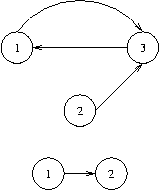
Sample Input
3 3

1 3 2 3 3 1

2 1

1 2

0
Sample Output
1 3

2
思路:
终于过了。。。。
因为模板错误,让我痛不欲生。
这题完成缩点之后,找出没有出度的点就行了。
http://www.cnblogs.com/ZGQblogs/p/9104381.html
我的模板会在此更新,感谢感谢!
我的上一篇博客里面的代码(POJ 1236)的确是错的,这个里面的代码应该就没问题了。。
代码
#include<iostream>

#include<cstdio>

#include<vector>

#include<stack>

#include<cstring>

using namespace std;

int n,m;

int book[50008];

int low[50008],num[50008],cnt=1,index;

int color[50008];

bool flag[50008];

vector<int>u[50008];

stack<int>st;

int sig=0;

void Tarjan(int t)

{

    num[t]=low[t]=++index;

    st.push(t);

    book[t]=true;

    int siz=u[t].size();

    for(int i=0;i<siz;i++){

        if(!num[u[t][i]]){

            Tarjan(u[t][i]);

            low[t]=min(low[t],low[u[t][i]]);

        }

        else if(book[u[t][i]]){low[t]=min(low[t],low[u[t][i]]);}

    }

    if(num[t]==low[t]){

        sig++;

        while(1){

            cnt=st.top();

            st.pop();

            color[cnt]=sig;

            book[cnt]=0;

            if(cnt==t){break;}

        }

    }

}

bool init()

{

    scanf("%d",&n);

    for(int i=1;i<=n;i++){

        u[i].clear();

    }

    while(!st.empty()){

        st.pop();

    }

    memset(book,0,sizeof(book));

    memset(low,0,sizeof(low));

    memset(flag,0,sizeof(flag));

    memset(color,0,sizeof(color));

    memset(num,0,sizeof(num));

    index=0;

    if(n==0){return false;}

    scanf("%d",&m);

    int x,y;

    for(int i=1;i<=m;i++){

        scanf("%d%d",&x,&y);

        u[x].push_back(y);

    }

    return true;

}

void solve()

{

    int siz;

    int tle=0;

    for(int i=1;i<=n;i++){

        siz=u[i].size();

        for(int j=0;j<siz;j++){

            if(color[u[i][j]]!=color[i]){flag[color[i]]=true;}

        }

    }

    for(int i=1;i<=n;i++){

        if(!flag[color[i]]){

            tle++?printf(" %d",i):printf("%d",i);

        }

    }

    printf("\n");

}

int main()

{

    while(init()){

        for(int i=1;i<=n;i++){

            if(!num[i]){Tarjan(i);cnt++;}

        }

        solve();

    }

}
POJ 2553 The Bottom of a Graph (Tarjan)的更多相关文章
- POJ 2553 The Bottom of a Graph Tarjan找环缩点(题解解释输入)
Description We will use the following (standard) definitions from graph theory. Let V be a nonempty ...
- POJ 2553 The Bottom of a Graph TarJan算法题解
本题分两步: 1 使用Tarjan算法求全部最大子强连通图.而且标志出来 2 然后遍历这些节点看是否有出射的边,没有的顶点所在的子强连通图的全部点,都是解集. Tarjan算法就是模板算法了. 这里使 ...
- [poj 2553]The Bottom of a Graph[Tarjan强连通分量]
题意: 求出度为0的强连通分量. 思路: 缩点 具体有两种实现: 1.遍历所有边, 边的两端点不在同一强连通分量的话, 将出发点所在强连通分量出度+1. #include <cstdio> ...
- POJ 2553 The Bottom of a Graph(强连通分量)
POJ 2553 The Bottom of a Graph 题目链接 题意:给定一个有向图,求出度为0的强连通分量 思路:缩点搞就可以 代码: #include <cstdio> #in ...
- poj 2553 The Bottom of a Graph(强连通分量+缩点)
题目地址:http://poj.org/problem?id=2553 The Bottom of a Graph Time Limit: 3000MS Memory Limit: 65536K ...
- poj 2553 The Bottom of a Graph【强连通分量求汇点个数】
The Bottom of a Graph Time Limit: 3000MS Memory Limit: 65536K Total Submissions: 9641 Accepted: ...
- POJ 2553 The Bottom of a Graph (强连通分量)
题目地址:POJ 2553 题目意思不好理解.题意是:G图中从v可达的全部点w,也都能够达到v,这种v称为sink.然后升序输出全部的sink. 对于一个强连通分量来说,全部的点都符合这一条件,可是假 ...
- poj 2553 The Bottom of a Graph : tarjan O(n) 存环中的点
/** problem: http://poj.org/problem?id=2553 将所有出度为0环中的点排序输出即可. **/ #include<stdio.h> #include& ...
- POJ 2553 The Bottom of a Graph 【scc tarjan】
图论之强连通复习开始- - 题目大意:给你一个有向图,要你求出这样的点集:从这个点出发能到达的点,一定能回到这个点 思路:强连通分量里的显然都可以互相到达 那就一起考虑,缩点后如果一个点有出边,一定不 ...
随机推荐
- DataSet 取值,DataSet行数,DataSet列数 从DataSet中取出特定值
1 DataSet.Table[0].Rows[ i ][ j ] 其中i 代表第 i 行数, j 代表第 j 列数 2 DataSet.Table[0].Rows[ i ].ItemArray[ j ...
- codeforces431C
k-Tree CodeForces - 431C Quite recently a creative student Lesha had a lecture on trees. After the l ...
- 【数学建模】day10-主成分分析
0. 关于主成分分析的详细理解以及理论推导,这篇blog中讲的很清楚. 主成分分析是一种常用手段.这应该与因子分析等区别开来,重点在于理解主成分分析的作用以及什么情况下使用主成分分析,本文重点讲解如何 ...
- sql练习题及经典题
https://blog.csdn.net/mrbcy/article/details/68965271 经典例题 19.查询选修“3-105”课程的成绩高于“109”号同学成绩的所有同学的记录. S ...
- controller修改response返回值
1.responseBodyAdvice2. aop3.过滤器.拦截器
- shiro注解和标签
Controller中注解: @RequiresAuthentication @RequiresGuest @RequiresPermissions("account:create" ...
- 【XSY2708】hack 网络流
题目描述 给你一个图,每条边有一个权值.要求你选一些边,满足对于每条从\(1\)到\(n\)的路径上(可以不是简单路径)有且仅有一条被选中的边.问你选择的边的边权和最小值. \(n\leq 100\) ...
- word 2013 题注、图注、插入图片自动修改大小、批量更新题注编号
1 .题注 图片下面的文字说明,如 图 1.1.1 2.图注 图的标题格式,可以右键修改段落为居中,选中图片,点下此格式快捷居中等其他格式 3. 题注插入 效果 如下 4.题注自动居中对齐 先点击图 ...
- Codeforces 346D Robot Control(01BFS)
题意 有一个 \(N\) 个点, \(M\) 条边的有向图, 初始有一个机器人在 \(1\) 号点. 每个时刻, 这个机器人会随机选择一条从该点出发地边并通过.当机器人到达点 \(N\) 时, 它就会 ...
- awk文本分析工具
Usage:awk [option] 'program' file ... awk [option] -f progfile file ... [optin]: -F fs 指定输入分隔符,fs可是字 ...