
【java】java自带的java.util.logging.Logger日志功能
偶然翻阅到一篇文章,注意到Java自带的Logger日志功能,特地来细细的看一看,记录一下。
1.Java自带的日志功能,默认的配置
①Logger的默认配置,位置在JRE安装目录下lib中的logging.properties中
②logging.properties日志文件内容如下:
############################################################

#      Default Logging Configuration File

#

# You can use a different file by specifying a filename

# with the java.util.logging.config.file system property.

# For example java -Djava.util.logging.config.file=myfile

############################################################

############################################################

#      Global properties

############################################################

# "handlers" specifies a comma separated list of log Handler

# classes.  These handlers will be installed during VM startup.

# Note that these classes must be on the system classpath.

# By default we only configure a ConsoleHandler, which will only

# show messages at the INFO and above levels.

handlers= java.util.logging.ConsoleHandler

# To also add the FileHandler, use the following line instead.

#handlers= java.util.logging.FileHandler, java.util.logging.ConsoleHandler

# Default global logging level.

# This specifies which kinds of events are logged across

# all loggers.  For any given facility this global level

# can be overriden by a facility specific level

# Note that the ConsoleHandler also has a separate level

# setting to limit messages printed to the console.

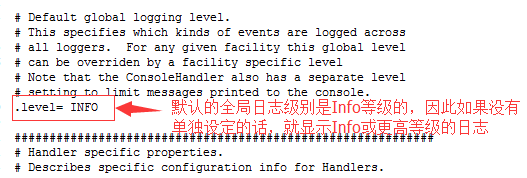
.level= INFO

############################################################

# Handler specific properties.

# Describes specific configuration info for Handlers.

############################################################

# default file output is in user's home directory.

java.util.logging.FileHandler.pattern = %h/java%u.log

java.util.logging.FileHandler.limit = 50000

java.util.logging.FileHandler.count = 1

java.util.logging.FileHandler.formatter = java.util.logging.XMLFormatter

# Limit the message that are printed on the console to INFO and above.

java.util.logging.ConsoleHandler.level = INFO

java.util.logging.ConsoleHandler.formatter = java.util.logging.SimpleFormatter

# Example to customize the SimpleFormatter output format

# to print one-line log message like this:

#     <level>: <log message> [<date/time>]

#

# java.util.logging.SimpleFormatter.format=%4$s: %5$s [%1$tc]%n

############################################################

# Facility specific properties.

# Provides extra control for each logger.

############################################################

# For example, set the com.xyz.foo logger to only log SEVERE

# messages:

com.xyz.foo.level = SEVERE
关于日志文件中,需要关注的第一点是:

需要关注的第二点是:
需要关注的第三点是:

需要关注的第四点是:

2.java.util.logging.Level类设定了日志级别类的设定
可以从API看出来,出了以下的Level各个级别,还有OFF和ALL两个级别。
如果设置为Level.INFO级别的话,日志只会显示INFO以及以上的级别。

3.Logger的简单使用
首先明确一点,java.util.logging.Logger的初始化方法
static Logger getLogger(String name)
name代表你的Logger名称,如果指定getLogeger相同名称,则仅会创建一个对象
static Logger getLogger(String name, String resourceBundleName)
name代表你的Logger名称,resourceBundleName代表本地化的Logger名称,也就是记录到本地磁盘的日志文件中,每一条Logger的名称
接下来,看看效果:
package com.sxd.util;

import java.util.logging.Level;

import java.util.logging.Logger;

import org.junit.Test;

/**

 * 测试Java自带的Log日志功能

 * @author sxd

 *

 */

public class TestLog {

    @Test

    public void test(){

        Logger log1 = Logger.getLogger("log-Test");

        log1.setLevel(Level.INFO);

        Logger log2 = Logger.getLogger("log-Test");

        System.out.println("log1和log2是否相等:"+(log1 == log2));    //true

        Logger log3 = Logger.getLogger("log-test");

        System.out.println("log1和log3是否相等:"+(log1 == log3));    //false

        log3.setLevel(Level.WARNING);

        log1.info("info级别打印:info级别的日志信息");

        log3.info("warning级别打印:info级别的日志信息");        //打印不出来

        log3.severe("warning级别打印:severe级别的日志信息");

    }

}
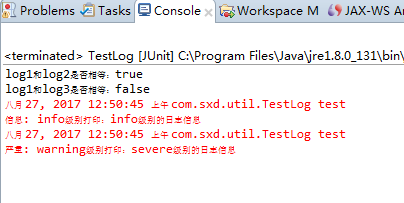
由此,可以证明,①设定的日志级别仅能打印到本级别以及高级别的日志信息;②同名的Logger仅会创建一个。
4.设定FileHandler,为日志本地化设定
package com.sxd.util;

import java.io.IOException;

import java.util.logging.ConsoleHandler;

import java.util.logging.FileHandler;

import java.util.logging.Level;

import java.util.logging.Logger;

import org.junit.Test;

/**

 * 测试Java自带的Log日志功能

 * @author sxd

 *

 */

public class TestLog {

    @Test

    public void test() throws SecurityException, IOException{

        Logger log1 = Logger.getLogger("log-Test");

        ConsoleHandler consoleHandler = new ConsoleHandler();

        consoleHandler.setLevel(Level.ALL);

        log1.addHandler(consoleHandler);

        FileHandler fileHandler = new FileHandler("d:/testLog%g.log");

        fileHandler.setLevel(Level.WARNING);

        log1.addHandler(fileHandler);

        log1.info("ALL级别打印:info级别的日志信息");

        log1.severe("warning级别打印:severe级别日志信息");

    }

}
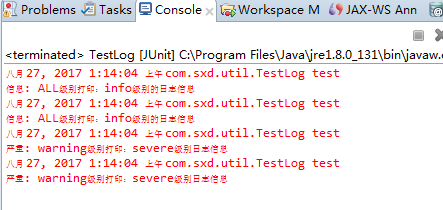
控制台:
【注意】这里控制台打印了两遍相同的日志,是因为,java默认的已经设定了一个ConsoleHandler,但是这个级别是INFO级别的。
而程序中有重新设定了一个新的ConsoleHandler,这个级别是ALL的,两个不一样,所以都执行了打印,所以打印了两遍一模一样的。
本地日志文件:
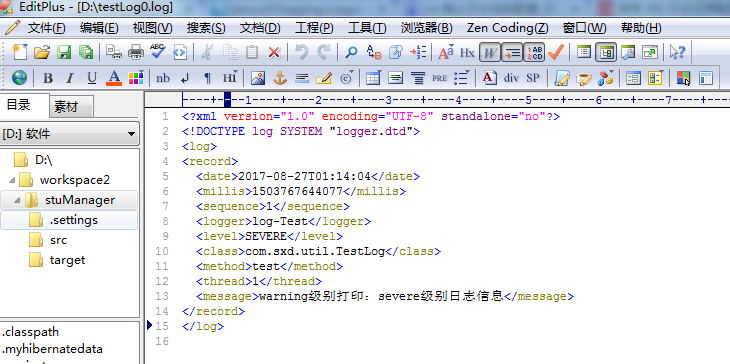
【注意】仅打印了一个日志,这个根据代码日志级别就可以理解。
关键日志文件是XML格式的内容,是因为上面解释了FileHandler的相关设置中,默认是XML格式

【注意2】FileHandler指定日志文件名称,有以下的规范:

5.为本地化的日志文件设置自定义的日志格式
java.util.logging.LogRecord;
java.util.logging.Formatter;
package com.sxd.util;

import java.io.IOException;

import java.util.logging.ConsoleHandler;

import java.util.logging.FileHandler;

import java.util.logging.Formatter;

import java.util.logging.Level;

import java.util.logging.LogRecord;

import java.util.logging.Logger;

import org.junit.Test;

/**

 * 测试Java自带的Log日志功能

 * @author sxd

 *

 */

public class TestLog {

    @Test

    public void test() throws SecurityException, IOException{

        Logger log1 = Logger.getLogger("log-Test");

        FileHandler fileHandler = new FileHandler("d:/testLog%g.log");

        fileHandler.setLevel(Level.WARNING);

        fileHandler.setFormatter(new MyFormatter());

        log1.addHandler(fileHandler);

        log1.severe("warning级别打印:severe级别日志信息");

    }

    class MyFormatter extends Formatter{

        @Override

        public String format(LogRecord record) {

            return record.getLoggerName()

                    + ">>"

                    +record.getLevel()

                    +">>"

                    +record.getMessage();

        }

    }

}
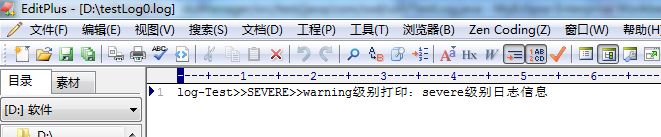
=======================================到这里,告一段落=========================================
【java】java自带的java.util.logging.Logger日志功能的更多相关文章
- java.lang.NoClassDefFoundError: Lcom/opensymphony/xwork2/util/logging/Logger tomcat6 启动错误
用tomcat6启动时,出现下面的错误Java.lang.NoClassDefFoundError: Lcom/opensymphony/xwork2/util/logging/Logger; Cau ...
- 通配置文件的方式控制java.util.logging.Logger日志输出
转自:http://zochen.iteye.com/blog/616151 简单的实现了下利用JDK中类java.util.logging.Logger来记录日志.主要在于仿照log4j方式用配置文 ...
- java.util.logging.Logger日志生成过程浅析 (转)
http://www.tuicool.com/articles/vy6Zrye ****************************************** java.util.logging ...
- Java日志组件1---Jdk自带Logger(java.util.logging.Logger)
最近在看日志的一些东西,发现利用JDK自带的log也可以简单的实现日志的输出,将日志写入文件的过程记录如下: 1.新建LogUtil.Java( 里面写了几个静态方法,为log设置等级.添加log控制 ...
- Java日志工具之java.util.logging.Logger
今天总结下JDK自带的日志工具Logger,虽然它一直默默无闻,但有时使用它却比较方便.更详细的信息可以查看JDK API手册,本文只是简单示例入门. 创建Logger 我们可以使用Logger的工厂 ...
- java.util.logging.Logger基础
1. 定义 java.util.logging.Logger是Java自带的日志类,可以记录程序运行中所产生的日志.通过查看所产生的日志文件,可以分析程序的运行状况,出现异常时,分析及定位异常. 2. ...
- 2.java.util.logging.Logger使用详解
一.java.util.logging.Logger简介 java.util.logging.Logger不是什么新鲜东西了,1.4就有了,可是因为log4j的存在,这个logger一直沉默着, 其实 ...
- java.util.logging.Logger使用详解 (转)
http://lavasoft.blog.51cto.com/62575/184492/ ************************************************* java. ...
- java.util.logging.Logger使用具体解释
java.util.logging.Logger不是什么新奇东西了,1.4就有了,但是由于log4j的存在,这个logger一直沉默着,事实上在一些測试性的代码中,jdk自带的logger比log4j ...
随机推荐
- edp 基于node.js和npm的前端开发平台
edp能做什么? 简洁的项目创建及包管理,多种工具进行本地调试,快速项目构建及代码检测,可扩展插件... 1. 安装 $ npm install -g edp 2. 包管理-导入依赖包 >edp ...
- qemu中的网络设置
https://www.cnblogs.com/hukey/p/6436211.html 这个链接里教你怎么操作kvm的各种网络模式,实际操作成
- JavaScript的团队编程规范
本规范是针对javascript函数式编程风格与公司严重依赖于jQuery进行编码的现实制定出来. 禁止使用eval,with与caller(ecma262 v5 的use strict要求).eva ...
- [学习笔记]Senparc.CO2NET 缓存使用笔记
>笔记1:如果需要调用远程的Redis,那么您需要2步 步骤1: 在项目的web.config文件中配置 <!-- Cache.Redis连接配置 --> <add key=& ...
- mysql的乐观锁和悲观锁
悲观锁与乐观锁是两种常见的资源并发锁设计思路,也是并发编程中一个非常基础的概念.本文将对这两种常见的锁机制在数据库数据上的实现进行比较系统的介绍. 悲观锁(Pessimistic Lock) 悲观锁的 ...
- 8.2 前端检索的敏感词过滤的Python实现(针对元搜索)
对于前端的搜索内容进行控制,比如敏感词过滤,同样使用socket,这里使用Python语言做一个demo.这里不得不感叹一句,socket真是太神奇了,可以跨语言把功能封装,为前端提供服务. 下面就是 ...
- powerdesign相关
1.安装程序和汉化放百度云了 2.打印错误处理 http://jingyan.baidu.com/article/c45ad29cd84e4b051753e2c3.html 3.导出sql http: ...
- spring in action 学习笔记十四:用纯注解的方式实现spring mvc
在讲用纯注解的方式实现springmvc之前先介绍一个类:AbstractAnnotationDispatcherServletInitializer.这个类的作用是:任何一个类继承AbstractA ...
- ubuntu14 简单安装ffmpeg
1.简单安装 sudo add-apt-repository ppa:kirillshkrogalev/ffmpeg-next sudo apt-get update sudo apt ...
- git的使用02
接下来我们要将文件交给仓库去托管 如何使用版本库