
Tensorflow之MNIST手写数字识别:分类问题(1)
一、MNIST数据集读取
one hot 独热编码
独热编码是一种稀疏向量,其中:一个向量设为1,其他元素均设为0.独热编码常用于表示拥有有限个可能值的字符串或标识符
优点: 1、将离散特征的取值扩展到了欧式空间,离散特征的某个取值就对应欧式空间的某个点
2、机器学习算法中,特征之间距离的计算或相似度的常用计算方法都是基于欧式空间的
3、将离散型特征使用one_hot编码,会让特征之间的距离计算更加合理
import tensorflow as tf

 #MNIST数据集读取

import tensorflow.examples.tutorials.mnist.input_data as input_data

mnist = input_data.read_data_sets("MNIST_data/",one_hot=True)

###输出结果###
#若不成功可手动到相关网站下载之后添加到文件夹中
#Extracting MNIST_data/train-images-idx3-ubyte.gz

#Extracting MNIST_data/train-labels-idx1-ubyte.gz

#Extracting MNIST_data/t10k-images-idx3-ubyte.gz

#Extracting MNIST_data/t10k-labels-idx1-ubyte.gz
二、了解MNIST手写数字识别数据集
#了解MNIST手写数字识别数据集

print('训练集 train 数量:',mnist.train.num_examples,

      ',验证集 validation 数量:',mnist.validation.num_examples,

      ',测试集 test 数量:',mnist.test.num_examples)

###输出结果###

#训练集 train 数量: 55000 ,验证集 validation 数量: 5000 ,测试集 test 数量: 10000
print(' train images shape:',mnist.train.images.shape,

      'labels shape:',mnist.train.labels.shape)

###输出### #train images shape: (55000, 784) labels shape: (55000, 10)

#28*28=784,10分类One Hot编码
三、可视化image
#可视化image

import matplotlib.pyplot as plt

def plot_image(image):

    plt.imshow(image.reshape(28,28),cmap='binary')

    plt.show()

plot_image(mnist.train.images[1])
输出结果:

#进一步了解reshape()

import numpy as np

int_array = np.array([i for i in range(64)])

print(int_array)
输出结果:
[ 0  1  2  3  4  5  6  7  8  9 10 11 12 13 14 15 16 17 18 19 20 21 22 23 24

 25 26 27 28 29 30 31 32 33 34 35 36 37 38 39 40 41 42 43 44 45 46 47 48 49

 50 51 52 53 54 55 56 57 58 59 60 61 62 63]
int_array.reshape(8,8)
输出结果:
array([[ 0,  1,  2,  3,  4,  5,  6,  7],

       [ 8,  9, 10, 11, 12, 13, 14, 15],

       [16, 17, 18, 19, 20, 21, 22, 23],

       [24, 25, 26, 27, 28, 29, 30, 31],

       [32, 33, 34, 35, 36, 37, 38, 39],

       [40, 41, 42, 43, 44, 45, 46, 47],

       [48, 49, 50, 51, 52, 53, 54, 55],

       [56, 57, 58, 59, 60, 61, 62, 63]])
#行优先,逐列排列

int_array.reshape(4,16)
输出结果:
array([[ 0,  1,  2,  3,  4,  5,  6,  7,  8,  9, 10, 11, 12, 13, 14, 15],

       [16, 17, 18, 19, 20, 21, 22, 23, 24, 25, 26, 27, 28, 29, 30, 31],

       [32, 33, 34, 35, 36, 37, 38, 39, 40, 41, 42, 43, 44, 45, 46, 47],

       [48, 49, 50, 51, 52, 53, 54, 55, 56, 57, 58, 59, 60, 61, 62, 63]])
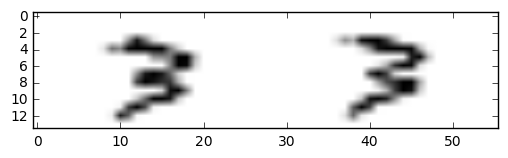
plt.imshow(mnist.train.images[20000].reshape(14,56),cmap='binary')

plt.show()
输出结果:
四、数据读取
1.采用独热编码,标签数据内容并不是直接输出值,而是输出编码
#标签数据与独热编码,

#内容并不是直接输出值,而是输出编码

mnist.train.labels[1]
输出结果:
array([ 0., 0., 0., 1., 0., 0., 0., 0., 0., 0.])
#非one_hot编码的标签值

mnist_no_one_hot = input_data.read_data_sets("MNIST_data/",one_hot=False)

print(mnist_no_one_hot.train.labels[0:10])      #onr_hot = False,直接返回值
输出结果:
Extracting MNIST_data/train-images-idx3-ubyte.gz

Extracting MNIST_data/train-labels-idx1-ubyte.gz

Extracting MNIST_data/t10k-images-idx3-ubyte.gz

Extracting MNIST_data/t10k-labels-idx1-ubyte.gz

[7 3 4 6 1 8 1 0 9 8]
2.读取验证集数据
#读取验证集数据

print('validation images:',mnist.validation.images.shape,'labels:',mnist.validation.labels.shape)
输出:
validation images: (5000, 784) labels: (5000, 10)
3.读取测试机数据
#读取测试机数据

print('tast images:',mnist.test.images.shape,'labels:',mnist.test.labels.shape)
输出结果:
tast images: (10000, 784) labels: (10000, 10)
4.一次批量读取多条数据
#一次批量读取多条数据

batch_image_xs,batch_labels_ys = mnist.train.next_batch(batch_size=10)        #next_batch()实现内部会对数据集先做shuffle

print(mnist.train.labels[0:10])

print("\n")

print(batch_labels_ys)
输出结果:
[[ 0.  0.  0.  1.  0.  0.  0.  0.  0.  0.]

 [ 0.  0.  0.  0.  0.  0.  1.  0.  0.  0.]

 [ 0.  0.  0.  0.  0.  0.  0.  1.  0.  0.]

 [ 0.  0.  0.  0.  0.  0.  0.  1.  0.  0.]

 [ 0.  0.  0.  0.  0.  0.  0.  1.  0.  0.]

 [ 0.  0.  0.  0.  0.  0.  0.  0.  0.  1.]

 [ 0.  0.  0.  0.  1.  0.  0.  0.  0.  0.]

 [ 0.  0.  0.  0.  0.  0.  0.  0.  1.  0.]

 [ 0.  0.  0.  0.  0.  0.  0.  0.  0.  1.]

 [ 0.  0.  0.  0.  0.  0.  0.  0.  0.  1.]]

[[ 0.  0.  0.  0.  0.  0.  1.  0.  0.  0.]

 [ 0.  0.  0.  0.  0.  1.  0.  0.  0.  0.]

 [ 0.  0.  0.  0.  0.  0.  0.  1.  0.  0.]

 [ 0.  1.  0.  0.  0.  0.  0.  0.  0.  0.]

 [ 0.  0.  0.  0.  0.  0.  0.  0.  0.  1.]

 [ 0.  0.  0.  1.  0.  0.  0.  0.  0.  0.]

 [ 0.  1.  0.  0.  0.  0.  0.  0.  0.  0.]

 [ 0.  0.  0.  0.  0.  0.  0.  0.  1.  0.]

 [ 1.  0.  0.  0.  0.  0.  0.  0.  0.  0.]

 [ 0.  0.  0.  0.  0.  0.  0.  1.  0.  0.]]
5.argmax()用法
argmax返回的是最大数的索引
import numpy as np

np.array(mnist.train.labels[1])

np.argmax(mnist.train.labels[1])     #argmax返回的是最大数的索引
#argmax详解

arr1 = np.array([1,3,2,5,7,0])

arr2 = np.array([[1,2,3],[3,2,1],[4,7,2],[8,3,2]])

print("arr1=",arr1)

print("arr2=",arr2)

argmax_1 = tf.argmax(arr1)

argmax_20 = tf.argmax(arr2,0)      #指定第二个参数为0,按第一维(行)的元素取值,即同列的每一行取值   以行为基准,每列取最大值的下标

argmax_21 = tf.argmax(arr2,1)       #指定第二个参数为1,则第二维(列)的元素取值,即同行的每一列取值   以列为基准,每行取最大值的下标

argmax_22 = tf.argmax(arr2,-1)     #指定第二个参数为-1,则第最后维的元素取值

with tf.Session() as sess:

    print(argmax_1.eval())

    print(argmax_20.eval())

    print(argmax_21.eval())

    print(argmax_22.eval())
输出结果:
arr1= [1 3 2 5 7 0]

arr2= [[1 2 3]

 [3 2 1]

 [4 7 2]

 [8 3 2]]

4

[3 2 0]

[2 0 1 0]

[2 0 1 0]
五、可视化
#定义可视化函数

import matplotlib.pyplot as plt

import numpy as np

def plot_images_labels_prediction(images,labels,prediction,index,num=10):  #参数: 图形列表,标签列表,预测值列表,从第index个开始显示,缺省一次显示10幅

    fig = plt.gcf()             #获取当前图表,Get Current Figure

    fig.set_size_inches(10,12)    #1英寸等于2.45cm

    if num > 25 :      #最多显示25个子图

        num = 25

    for i in range(0,num):

        ax = plt.subplot(5,5,i+1)   #获取当前要处理的子图

        ax.imshow(np.reshape(images[index],(28,28)), cmap = 'binary')              #显示第index个图像

        title = "labels="+str(np.argmax(labels[index]))              #构建该图上要显示的title信息

        if len(prediction)>0:

            title += ",predict="+str(prediction[index])

        ax.set_title(title,fontsize=10)    #显示图上的title信息

        ax.set_xticks([])           #不显示坐标轴

        ax.set_yticks([])

        index += 1

    plt.show()

#可视化预测结果

# plot_images_labels_prediction(mnist.test.images,mnist.test.labels,prediction_result,10,10)

plot_images_labels_prediction(mnist.test.images,mnist.test.labels,prediction_result,10,25)
六、评估与应用
#评估模型

#完成训练后,在测试集上评估模型的准确率

accu_test = sess.run(accuracy,feed_dict={x:mnist.test.images,y:mnist.test.labels})

print("Test Accuracy:",accu_test)

#完成训练后,在验证集上评估模型的准确率

accu_validation = sess.run(accuracy,feed_dict={x:mnist.validation.images,y:mnist.validation.labels})

print("Test Accuracy:",accu_validation)

#完成训练后,在训练集上评估模型的准确率

accu_train = sess.run(accuracy,feed_dict={x:mnist.train.images,y:mnist.train.labels})

print("Test Accuracy:",accu_train)
#应用模型

#在建立模型并进行训练后,若认为准确率可以接受,则可以使用此模型进行预测

#由于pred预测结果是one_hot编码格式,所以需要转换成0~9数字

prediction_result = sess.run(tf.argmax(pred,1),feed_dict={x:mnist.test.images})

#查看预测结果中的前10项

prediction_result[0:10]
七、tf.random_normal()介绍
#tf.random_normal()介绍

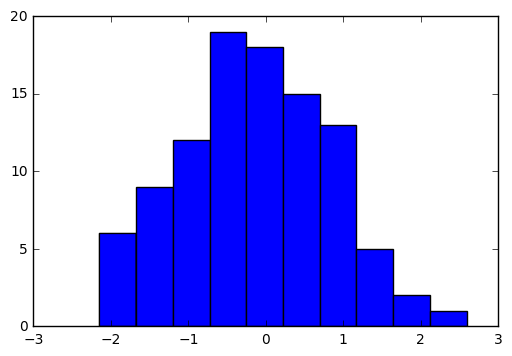
norm = tf.random_normal([100])    #生成100个随机数

with tf.Session() as sess:

    norm_data = norm.eval()

print(norm_data[:10])

import matplotlib.pyplot as plt

plt.hist(norm_data)

plt.show()
输出结果:
[-1.20503342 -0.40912333  1.02314627  0.91239542 -0.44498116  1.46095467

  1.71958613 -0.02297023 -0.04446657 -1.58943892]
———网易云课堂《深度学习应用开发Tensorflow实践》学习记录
Tensorflow之MNIST手写数字识别:分类问题(1)的更多相关文章
- Android+TensorFlow+CNN+MNIST 手写数字识别实现
Android+TensorFlow+CNN+MNIST 手写数字识别实现 SkySeraph 2018 Email:skyseraph00#163.com 更多精彩请直接访问SkySeraph个人站 ...
- 基于tensorflow的MNIST手写数字识别(二)--入门篇
http://www.jianshu.com/p/4195577585e6 基于tensorflow的MNIST手写字识别(一)--白话卷积神经网络模型 基于tensorflow的MNIST手写数字识 ...
- 基于TensorFlow的MNIST手写数字识别-初级
一:MNIST数据集 下载地址 MNIST是一个包含很多手写数字图片的数据集,一共4个二进制压缩文件 分别是test set images,test set labels,training se ...
- Tensorflow实现MNIST手写数字识别
之前我们讲了神经网络的起源.单层神经网络.多层神经网络的搭建过程.搭建时要注意到的具体问题.以及解决这些问题的具体方法.本文将通过一个经典的案例:MNIST手写数字识别,以代码的形式来为大家梳理一遍神 ...
- Tensorflow之MNIST手写数字识别:分类问题(2)
整体代码: #数据读取 import tensorflow as tf import matplotlib.pyplot as plt import numpy as np from tensorfl ...
- 基于TensorFlow的MNIST手写数字识别-深入
构建多层卷积神经网络时需要多组W和偏移项b,我们封装2个方法来产生W和b 初级MNIST中用0初始化W和b,这里用噪声初始化进行对称打破,防止产生梯度0,同时用一个小的正值来初始化b避免dead ne ...
- TensorFlow——MNIST手写数字识别
MNIST手写数字识别 MNIST数据集介绍和下载:http://yann.lecun.com/exdb/mnist/ 一.数据集介绍: MNIST是一个入门级的计算机视觉数据集 下载下来的数据集 ...
- mnist手写数字识别——深度学习入门项目(tensorflow+keras+Sequential模型)
前言 今天记录一下深度学习的另外一个入门项目——<mnist数据集手写数字识别>,这是一个入门必备的学习案例,主要使用了tensorflow下的keras网络结构的Sequential模型 ...
- mnist 手写数字识别
mnist 手写数字识别三大步骤 1.定义分类模型2.训练模型3.评价模型 import tensorflow as tfimport input_datamnist = input_data.rea ...
随机推荐
- opensciencegrid - GridFTP 安装
最近配置一个GridFTP 用于测试其传输FTP性能, 在这里简单记录,备忘:使用本教程可以简单起一个GridFTP用于测试服务: 预配置环境: 测试系统:CentOS 7 1806 配置Yum仓库: ...
- Centos7.6 Apache 虚拟机禁止访问IP,允许访问多域名多个虚拟目录设置
存放配置文件路径 /etc/httpd/conf.d自定义命名,配置文件后缀格式确保 *.conf注:这是两个配置文件,也是两种方法. # 一个WEB目录# 禁止以IP地址形式访问<Virtua ...
- 利用Mac的功能键|如何在Mac上使用F键
Mac键盘的顶部是一组按键,这些按键的特征是F后跟1-12数字.这些键称为Mac功能键,使您可以通过按几个键来更改某些设置并快速访问Mac功能. 如果您是Mac的所有者,是时候学习这些键各自可以做什么 ...
- 面向对象程序设计(JAVA) 第12周学习指导及要求
2019面向对象程序设计(Java)第12周学习指导及要求 (2019.11.15-2019.11.18) 学习目标 (1) 掌握Vetor.Stack.Hashtable三个类的用途及常用API ...
- 201871010113-刘兴瑞《面向对象程序设计(java)》第十二周学习总结
项目 内容 这个作业属于哪个课程 <任课教师博客主页链接>https://www.cnblogs.com/nwnu-daizh/ 这个作业的要求在哪里 <作业链接地址>http ...
- misc-3-1
无后缀,用winhex发现是rar,添加后缀解压,依据是无后缀,丢到kali,是一个流量数据包 TCP追踪流在第五个数据包发现flag.rar 导出对象 选择HTTP 找到flag.rar 然后丢到你 ...
- ZOJ 3778 Talented Chief
http://acm.zju.edu.cn/onlinejudge/showProblem.do?problemCode=3778 题目 某人做菜很厉害,一分钟能同时完成最多m个菜的一道工序,输入菜的 ...
- Codeforces Round #594 (Div. 1)
Preface 这场CF真是细节多的爆炸,B,C,F都是大细节题,每道题都写了好久的说 CSP前的打的最后一场比赛了吧,瞬间凉意满满 希望CSP可以狗住冬令营啊(再狗不住真没了) A. Ivan th ...
- CRF keras代码实现
这份代码来自于苏剑林 # -*- coding:utf-8 -*- from keras.layers import Layer import keras.backend as K class CRF ...
- Jenkins 有关 Maven 的内容
Jenkins Maven 插件安装 在安装完 Jenkins 后,我们想添加新的项目 为 Maven 项目时,发现找不到这个选项. 原因是我们没有安装插件 Maven Integration. 在 ...