
利用python实现电影推荐
“协同过滤”是推荐系统中的常用技术,按照分析维度的不同可实现“基于用户”和“基于产品”的推荐。
以下是利用python实现电影推荐的具体方法,其中数据集源于《集体编程智慧》一书,后续的编程实现则完全是自己实现的(原书中的实现比较支离、难懂)。
这里我采用的是“基于产品”的推荐方法,因为一般情况下,产品的种类往往较少,而用户的数量往往非常多,“基于产品”的推荐程序可以很好的减小计算量。
其实基本的思想很简单:
首先读入数据,形成用户-电影矩阵,如图所示:矩阵中的数据为用户(横坐标)对特定电影(纵坐标)的评分。
其次根据用户-电影矩阵计算不同电影之间的相关系数(一般用person相关系数),形成电影-电影相关度矩阵。
其次根据电影-电影相关度矩阵,以及用户已有的评分,通过加权平均计算用户未评分电影的预估评分。例如用户对A电影评3分、B电影评4分、C电影未评分,而C电影与A电影、B电影的相关度分别为0.3和0.8,则C电影的预估评分为(0.3*3+0.8*4)/(0.3+0.8)。
最后对于每一位用户,提取其未评分的电影并按预估评分值倒序排列,提取前n位的电影作为推荐电影。
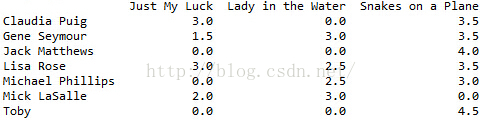
以下为程序源代码,大块的注释还是比较详细的,便于理解各个模块的作用。此外,程序用到了pandas和numpy库,实现起来会比较简洁,因为许多功能如计算相关系数、排序等功能在这些库中已有实现,直接拿来用即可。
import pandas as pd

import numpy as np

#read the data

data={'Lisa Rose': {'Lady in the Water': 2.5, 'Snakes on a Plane': 3.5,

 'Just My Luck': 3.0, 'Superman Returns': 3.5, 'You, Me and Dupree': 2.5},

'Gene Seymour': {'Lady in the Water': 3.0, 'Snakes on a Plane': 3.5,

 'Just My Luck': 1.5, 'The Night Listener': 3.0},

'Michael Phillips': {'Lady in the Water': 2.5, 'Snakes on a Plane': 3.0,

 'Superman Returns': 3.5, 'The Night Listener': 4.0},

'Claudia Puig': {'Snakes on a Plane': 3.5, 'Just My Luck': 3.0,

 'The Night Listener': 4.5, 'You, Me and Dupree': 2.5},

'Mick LaSalle': {'Just My Luck': 2.0, 'Lady in the Water': 3.0,'Superman Returns': 3.0, 'The Night Listener': 3.0, 'You, Me and Dupree': 2.0},

'Jack Matthews': {'Snakes on a Plane': 4.0, 'The Night Listener': 3.0, 'Superman Returns': 5.0, 'You, Me and Dupree': 3.5},

'Toby': {'Snakes on a Plane':4.5,'You, Me and Dupree':1.0,'Superman Returns':4.0}}

#clean&transform the data

data = pd.DataFrame(data)

#0 represents not been rated

data = data.fillna(0)

#each column represents a movie

mdata = data.T

#calculate the simularity of different movies, normalize the data into [0,1]

np.set_printoptions(3)

mcors = np.corrcoef(mdata, rowvar=0)

mcors = 0.5+mcors*0.5

mcors = pd.DataFrame(mcors, columns=mdata.columns, index=mdata.columns)

#calculate the score of every item of every user

#matrix:the user-movie matrix

#mcors:the movie-movie correlation matrix

#item:the movie id

#user:the user id

#score:score of movie for the specific user

def cal_score(matrix,mcors,item,user):

    totscore = 0

    totsims = 0

    score = 0

    if pd.isnull(matrix[item][user]) or matrix[item][user]==0:

        for mitem in matrix.columns:

            if matrix[mitem][user]==0:

                continue

            else:

                totscore += matrix[mitem][user]*mcors[item][mitem]

                totsims += mcors[item][mitem]

        score = totscore/totsims

    else:

        score = matrix[item][user]

    return score

#calculate the socre matrix

#matrix:the user-movie matrix

#mcors:the movie-movie correlation matrix

#score_matrix:score matrix of movie for different users

def cal_matscore(matrix,mcors):

    score_matrix = np.zeros(matrix.shape)

    score_matrix = pd.DataFrame(score_matrix, columns=matrix.columns, index=matrix.index)

    for mitem in score_matrix.columns:

        for muser in score_matrix.index:

            score_matrix[mitem][muser]  = cal_score(matrix,mcors,mitem,muser)

    return score_matrix

#give recommendations: depending on the score matrix

#matrix:the user-movie matrix

#score_matrix:score matrix of movie for different users

#user:the user id

#n:the number of recommendations

def recommend(matrix,score_matrix,user,n):

    user_ratings = matrix.ix[user]

    not_rated_item = user_ratings[user_ratings==0]

    recom_items = {}

    #recom_items={'a':1,'b':7,'c':3}

    for item in not_rated_item.index:

        recom_items[item] = score_matrix[item][user]

    recom_items = pd.Series(recom_items)

    recom_items = recom_items.sort_values(ascending=False)

    return recom_items[:n]

#main

score_matrix = cal_matscore(mdata,mcors)

for i in range(10):

    user = input(str(i)+' please input the name of user:')

    print recommend(mdata,score_matrix,user,2)
利用python实现电影推荐的更多相关文章
- 转利用python实现电影推荐
“协同过滤”是推荐系统中的常用技术,按照分析维度的不同可实现“基于用户”和“基于产品”的推荐. 以下是利用python实现电影推荐的具体方法,其中数据集源于<集体编程智慧>一书,后续的编程 ...
- 利用Surprise包进行电影推荐
Surprise(Simple Python Recommendation System Engine)是一款推荐系统库,是scikit系列中的一个.简单易用,同时支持多种推荐算法(基础算法.协同过滤 ...
- 【大数据 Spark】利用电影观看记录数据,进行电影推荐
利用电影观看记录数据,进行电影推荐. 目录 利用电影观看记录数据,进行电影推荐. 准备 1.任务描述: 2.数据下载 3.部分数据展示 实操 1.设置输入输出路径 2.配置spark 3.读取Rati ...
- 基于物品的协同过滤item-CF 之电影推荐 python
推荐算法有基于协同的Collaboration Filtering:包括 user Based和item Based:基于内容 : Content Based 协同过滤包括基于物品的协同过滤和基于用户 ...
- Python实现个性化推荐二
基于内容的推荐引擎是怎么工作的 基于内容的推荐系统,正如你的朋友和同事预期的那样,会考虑商品的实际属性,比如商品描述,商品名,价格等等.如果你以前从没接触过推荐系统,然后现在有人拿枪指着你的头,强迫你 ...
- 利用Python,四步掌握机器学习
为了理解和应用机器学习技术,你需要学习 Python 或者 R.这两者都是与 C.Java.PHP 相类似的编程语言.但是,因为 Python 与 R 都比较年轻,而且更加“远离”CPU,所以它们显得 ...
- 利用python 掌握机器学习的过程
转载:http://python.jobbole.com/84326/ 偶然看到的这篇文章,觉得对我挺有引导作用的.特此跟大家分享一下. 为了理解和应用机器学习技术,你需要学习 Python 或者 R ...
- 利用python进行数据分析--(阅读笔记一)
以此记录阅读和学习<利用Python进行数据分析>这本书中的觉得重要的点! 第一章:准备工作 1.一组新闻文章可以被处理为一张词频表,这张词频表可以用于情感分析. 2.大多数软件是由两部分 ...
- 《利用python进行数据分析》读书笔记 --第一、二章 准备与例子
http://www.cnblogs.com/batteryhp/p/4868348.html 第一章 准备工作 今天开始码这本书--<利用python进行数据分析>.R和python都得 ...
随机推荐
- <Matlab-3:追赶法(Doolittle分解)工具箱
function x=chase (d,e,f,b) % --------------------------------------------------------------- %the me ...
- jquery获取和设置值
1.html html() : 取得第一个匹配元素的html内容. html(value): 设置每一个匹配元素的html内容 2text text() : 取得所有匹配元素的内容,结果是由所有 ...
- leetcode-algorithms-30 Substring with Concatenation of All Words
leetcode-algorithms-30 Substring with Concatenation of All Words You are given a string, s, and a li ...
- 安卓——AlertDialog多样按钮
在xml 设计页面添加标签 <?xml version="1.0" encoding="utf-8"?> <LinearLayout xmln ...
- spring xml的配置
Spring xml文档头得配置 spring文档头一般是可以复制过来得,刚学习得时候一直看网上有没有配置,然后也没有找到,希望以下过程得学习可以给大家带来帮助!! 1 ...
- 前端基础之CSS的引入+HTML标签选择器+CSS操作属性
clear:left/ringt属性 CSS:语法形式上由选择器+以及一条或多条声明组成:选择器查找到指定的html标签后,使用css属性设置html标签的样式: ...
- PHP闭包函数
# 提到闭包就不得不想起匿名函数,也叫闭包函数(closures),貌似PHP闭包实现主要就是靠它.声明一个匿名函数是这样: $func = function() { }; //带结束符 # 可以看到 ...
- Dagger2不自动生成daggerXXXcomponent
在Fragment里面初始化dagger2创建对象时,不自动生成daggerXXXcomponent. 百思不得其解,后来发现是import android.app.Fragment;所以不自动生成. ...
- Ubuntu 下matlab 查看memory函数
%Copyright (c) 2012, Michael Hirsch%All rights reserved.%%Redistribution and use in source and binar ...
- gpu内存查看命令nvidia-smi
nvidia-smi nvidia-settings nvidia-xconfig