
Zabbix数据库表分区
zabbix的监控主机数量将近300,且运行了一年时间了,最近zabbix server服务监控历史数据等服务不断自身告警、查询性能也变得很低
关于历史数据的两个参数,在zabbix server的配置文件中
可以选择关闭housekeeper禁止自动定期清除历史记录数据,因为对于大数据的删除会直接影响zabbix的性能、或者调整相应参数
HousekeepingFrequency
取值范围:0-24
默认值:1
说明:housekeep执行频率,默认每小时回去删除一些过期数据。如果server重启,那么30分钟之后才执行一次,接下来,每隔一小时在执行一次。
MaxHousekeeperDelete
取值范围: 0-1000000
默认值:5000
housekeeping一次删除的数据不能大于MaxHousekeeperDelete
数据库优化
一、设置独立表空间(innodb_file_per_table=1) # 5.6版本以上自动开启 以上版本跳过这一段
1、清空history数据
[root@Zabbix-Server ~]# mysql -u zabbix -p

MariaDB [(none)]> use zabbix;

Reading table information for completion of table and column names

You can turn off this feature to get a quicker startup with -A

Database changed

MariaDB [zabbix]>

MariaDB [zabbix]> truncate table history;

Query OK,  rows affected (0.19 sec)

MariaDB [zabbix]> optimize table history;

+----------------+----------+----------+-------------------------------------------------------------------+

| Table          | Op       | Msg_type | Msg_text                                                          |

+----------------+----------+----------+-------------------------------------------------------------------+

| zabbix.history | optimize | note     | Table does not support optimize, doing recreate + analyze instead |

| zabbix.history | optimize | status   | OK                                                                |

+----------------+----------+----------+-------------------------------------------------------------------+

 rows in set (0.81 sec)

MariaDB [zabbix]> truncate table history_str;

Query OK,  rows affected (0.05 sec)

MariaDB [zabbix]>  truncate table history_uint;

Query OK,  rows affected (6.32 sec)
2、修改表结构
MariaDB [(none)]> use zabbix;

Reading table information for completion of table and column names

You can turn off this feature to get a quicker startup with -A

Database changed

MariaDB [zabbix]> Alter table history_text drop primary key, add index (id), drop index history_text_2, add index history_text_2 (itemid, id);

Query OK,  rows affected (1.11 sec)

Records:   Duplicates:   Warnings:

MariaDB [zabbix]> Alter table history_log drop primary key, add index (id), drop index history_log_2, add index history_log_2 (itemid, id);

Query OK,  rows affected (0.14 sec)

Records:   Duplicates:   Warnings:
修改完之后再按照官网上的过程创建四个存储过程:
3、将官方的四个分散代码拷贝至一个文件保存为sql,导入数据库;
cat /root/zabbix-partition.sql

DELIMITER $$

CREATE PROCEDURE `partition_create`(SCHEMANAME varchar(), TABLENAME varchar(), PARTITIONNAME varchar(), CLOCK int)

BEGIN

        /*

           SCHEMANAME = The DB schema in which to make changes

           TABLENAME = The table with partitions to potentially delete

           PARTITIONNAME = The name of the partition to create

        */

        /*

           Verify that the partition does not already exist

        */

        DECLARE RETROWS INT;

        SELECT COUNT() INTO RETROWS

        FROM information_schema.partitions

        WHERE table_schema = SCHEMANAME AND table_name = TABLENAME AND partition_description >= CLOCK;

        IF RETROWS =  THEN

                /*

                   1. Print a message indicating that a partition was created.

                   2. Create the SQL to create the partition.

                   3. Execute the SQL from #2.

                */

                SELECT CONCAT( "partition_create(", SCHEMANAME, ",", TABLENAME, ",", PARTITIONNAME, ",", CLOCK, ")" ) AS msg;

                SET @sql = CONCAT( 'ALTER TABLE ', SCHEMANAME, '.', TABLENAME, ' ADD PARTITION (PARTITION ', PARTITIONNAME, ' VALUES LESS THAN (', CLOCK, '));' );

                PREPARE STMT FROM @sql;

                EXECUTE STMT;

                DEALLOCATE PREPARE STMT;

        END IF;

END$$

DELIMITER ;

DELIMITER $$

CREATE PROCEDURE `partition_drop`(SCHEMANAME VARCHAR(), TABLENAME VARCHAR(), DELETE_BELOW_PARTITION_DATE BIGINT)

BEGIN

        /*

           SCHEMANAME = The DB schema in which to make changes

           TABLENAME = The table with partitions to potentially delete

           DELETE_BELOW_PARTITION_DATE = Delete any partitions with names that are dates older than this one (yyyy-mm-dd)

        */

        DECLARE done INT DEFAULT FALSE;

        DECLARE drop_part_name VARCHAR();

        /*

           Get a list of all the partitions that are older than the date

           in DELETE_BELOW_PARTITION_DATE.  All partitions are prefixed with

           a "p", so use SUBSTRING TO get rid of that character.

        */

        DECLARE myCursor CURSOR FOR

                SELECT partition_name

                FROM information_schema.partitions

                WHERE table_schema = SCHEMANAME AND table_name = TABLENAME AND CAST(SUBSTRING(partition_name FROM ) AS UNSIGNED) < DELETE_BELOW_PARTITION_DATE;

        DECLARE CONTINUE HANDLER FOR NOT FOUND SET done = TRUE;

        /*

           Create the basics for when we need to drop the partition.  Also, create

           @drop_partitions to hold a comma-delimited list of all partitions that

           should be deleted.

        */

        SET @alter_header = CONCAT("ALTER TABLE ", SCHEMANAME, ".", TABLENAME, " DROP PARTITION ");

        SET @drop_partitions = "";

        /*

           Start looping through all the partitions that are too old.

        */

        OPEN myCursor;

        read_loop: LOOP

                FETCH myCursor INTO drop_part_name;

                IF done THEN

                        LEAVE read_loop;

                END IF;

                SET @drop_partitions = IF(@drop_partitions = "", drop_part_name, CONCAT(@drop_partitions, ",", drop_part_name));

        END LOOP;

        IF @drop_partitions != "" THEN

                /*

                   1. Build the SQL to drop all the necessary partitions.

                   2. Run the SQL to drop the partitions.

                   3. Print out the table partitions that were deleted.

                */

                SET @full_sql = CONCAT(@alter_header, @drop_partitions, ";");

                PREPARE STMT FROM @full_sql;

                EXECUTE STMT;

                DEALLOCATE PREPARE STMT;

                SELECT CONCAT(SCHEMANAME, ".", TABLENAME) AS `table`, @drop_partitions AS `partitions_deleted`;

        ELSE

                /*

                   No partitions are being deleted, so print out "N/A" (Not applicable) to indicate

                   that no changes were made.

                */

                SELECT CONCAT(SCHEMANAME, ".", TABLENAME) AS `table`, "N/A" AS `partitions_deleted`;

        END IF;

END$$

DELIMITER ;

DELIMITER $$

CREATE PROCEDURE `partition_maintenance`(SCHEMA_NAME VARCHAR(), TABLE_NAME VARCHAR(), KEEP_DATA_DAYS INT, HOURLY_INTERVAL INT, CREATE_NEXT_INTERVALS INT)

BEGIN

        DECLARE OLDER_THAN_PARTITION_DATE VARCHAR();

        DECLARE PARTITION_NAME VARCHAR();

        DECLARE OLD_PARTITION_NAME VARCHAR();

        DECLARE LESS_THAN_TIMESTAMP INT;

        DECLARE CUR_TIME INT;

        CALL partition_verify(SCHEMA_NAME, TABLE_NAME, HOURLY_INTERVAL);

        SET CUR_TIME = UNIX_TIMESTAMP(DATE_FORMAT(NOW(), '%Y-%m-%d 00:00:00'));

        SET @__interval = ;

        create_loop: LOOP

                IF @__interval > CREATE_NEXT_INTERVALS THEN

                        LEAVE create_loop;

                END IF;

                SET LESS_THAN_TIMESTAMP = CUR_TIME + (HOURLY_INTERVAL * @__interval * );

                SET PARTITION_NAME = FROM_UNIXTIME(CUR_TIME + HOURLY_INTERVAL * (@__interval - ) * , 'p%Y%m%d%H00');

                IF(PARTITION_NAME != OLD_PARTITION_NAME) THEN

      CALL partition_create(SCHEMA_NAME, TABLE_NAME, PARTITION_NAME, LESS_THAN_TIMESTAMP);

    END IF;

                SET @__interval=@__interval+;

                SET OLD_PARTITION_NAME = PARTITION_NAME;

        END LOOP;

        SET OLDER_THAN_PARTITION_DATE=DATE_FORMAT(DATE_SUB(NOW(), INTERVAL KEEP_DATA_DAYS DAY), '%Y%m%d0000');

        CALL partition_drop(SCHEMA_NAME, TABLE_NAME, OLDER_THAN_PARTITION_DATE);

END$$

DELIMITER ;

DELIMITER $$

CREATE PROCEDURE `partition_verify`(SCHEMANAME VARCHAR(), TABLENAME VARCHAR(), HOURLYINTERVAL INT())

BEGIN

        DECLARE PARTITION_NAME VARCHAR();

        DECLARE RETROWS INT();

        DECLARE FUTURE_TIMESTAMP TIMESTAMP;

        /*

         * Check if any partitions exist for the given SCHEMANAME.TABLENAME.

         */

        SELECT COUNT() INTO RETROWS

        FROM information_schema.partitions

        WHERE table_schema = SCHEMANAME AND table_name = TABLENAME AND partition_name IS NULL;

        /*

         * If partitions do not exist, go ahead and partition the table

         */

        IF RETROWS =  THEN

                /*

                 * Take the current date at 00:00:00 and add HOURLYINTERVAL to it.  This is the timestamp below which we will store values.

                 * We begin partitioning based on the beginning of a day.  This is because we don't want to generate a random partition

                 * that won't necessarily fall in line with the desired partition naming (ie: if the hour interval is 24 hours, we could

                 * end up creating a partition now named "p201403270600" when all other partitions will be like "p201403280000").

                 */

                SET FUTURE_TIMESTAMP = TIMESTAMPADD(HOUR, HOURLYINTERVAL, CONCAT(CURDATE(), " ", '00:00:00'));

                SET PARTITION_NAME = DATE_FORMAT(CURDATE(), 'p%Y%m%d%H00');

                -- Create the partitioning query

                SET @__PARTITION_SQL = CONCAT("ALTER TABLE ", SCHEMANAME, ".", TABLENAME, " PARTITION BY RANGE(`clock`)");

                SET @__PARTITION_SQL = CONCAT(@__PARTITION_SQL, "(PARTITION ", PARTITION_NAME, " VALUES LESS THAN (", UNIX_TIMESTAMP(FUTURE_TIMESTAMP), "));");

                -- Run the partitioning query

                PREPARE STMT FROM @__PARTITION_SQL;

                EXECUTE STMT;

                DEALLOCATE PREPARE STMT;

        END IF;

END$$

DELIMITER ;
[root@Zabbix-Server ~]# mysql -u zabbix -p zabbix

Enter password:

Reading table information for completion of table and column names

You can turn off this feature to get a quicker startup with -A

Welcome to the MariaDB monitor.  Commands end with ; or \g.

Your MariaDB connection id is

Server version: 5.5.-MariaDB MariaDB Server

Copyright (c) , , Oracle, MariaDB Corporation Ab and others.

Type 'help;' or '\h' for help. Type '\c' to clear the current input statement.

MariaDB [zabbix]> use zabbix;

Database changed

MariaDB [zabbix]> source /root/zabbix-partition.sql;

Query OK,  rows affected (0.04 sec)

Query OK,  rows affected (0.00 sec)

Query OK,  rows affected (0.00 sec)

Query OK,  rows affected (0.00 sec)

MariaDB [zabbix]> CALL partition_maintenance('zabbix', 'history_log', , , );

+---------------------------------------------------------------+

| msg                                                           |

+---------------------------------------------------------------+

| partition_create(zabbix,history_log,p201801100000,) |

+---------------------------------------------------------------+

 row in set (0.18 sec)

+---------------------------------------------------------------+

| msg                                                           |

+---------------------------------------------------------------+

| partition_create(zabbix,history_log,p201801110000,) |

+---------------------------------------------------------------+

 row in set (0.48 sec)

+---------------------------------------------------------------+

| msg                                                           |

+---------------------------------------------------------------+

| partition_create(zabbix,history_log,p201801120000,) |

+---------------------------------------------------------------+

 row in set (0.67 sec)

+---------------------------------------------------------------+

| msg                                                           |

+---------------------------------------------------------------+

| partition_create(zabbix,history_log,p201801130000,) |

+---------------------------------------------------------------+

 row in set (1.02 sec)

+---------------------------------------------------------------+

| msg                                                           |

+---------------------------------------------------------------+

| partition_create(zabbix,history_log,p201801140000,) |

+---------------------------------------------------------------+

 row in set (1.22 sec)

+---------------------------------------------------------------+

| msg                                                           |

+---------------------------------------------------------------+

| partition_create(zabbix,history_log,p201801150000,) |

+---------------------------------------------------------------+

 row in set (1.44 sec)

+---------------------------------------------------------------+

| msg                                                           |

+---------------------------------------------------------------+

| partition_create(zabbix,history_log,p201801160000,) |

+---------------------------------------------------------------+

 row in set (1.64 sec)

+---------------------------------------------------------------+

| msg                                                           |

+---------------------------------------------------------------+

| partition_create(zabbix,history_log,p201801170000,) |

+---------------------------------------------------------------+

 row in set (1.85 sec)

+---------------------------------------------------------------+

| msg                                                           |

+---------------------------------------------------------------+

| partition_create(zabbix,history_log,p201801180000,) |

+---------------------------------------------------------------+

 row in set (2.04 sec)

+---------------------------------------------------------------+

| msg                                                           |

+---------------------------------------------------------------+

| partition_create(zabbix,history_log,p201801190000,) |

+---------------------------------------------------------------+

 row in set (2.23 sec)

+---------------------------------------------------------------+

| msg                                                           |

+---------------------------------------------------------------+

| partition_create(zabbix,history_log,p201801200000,) |

+---------------------------------------------------------------+

 row in set (2.42 sec)

+---------------------------------------------------------------+

| msg                                                           |

+---------------------------------------------------------------+

| partition_create(zabbix,history_log,p201801210000,) |

+---------------------------------------------------------------+

 row in set (2.62 sec)

+---------------------------------------------------------------+

| msg                                                           |

+---------------------------------------------------------------+

| partition_create(zabbix,history_log,p201801220000,) |

+---------------------------------------------------------------+

 row in set (2.85 sec)

+--------------------+--------------------+

| table              | partitions_deleted |

+--------------------+--------------------+

| zabbix.history_log | N/A                |

+--------------------+--------------------+

 row in set (3.10 sec)

Query OK,  rows affected,  warning (3.10 sec)
4、对想要分区的表进行表分区
DELIMITER $$

CREATE PROCEDURE `partition_maintenance_all`(SCHEMA_NAME VARCHAR())

BEGIN

                CALL partition_maintenance(SCHEMA_NAME, 'history', , , );

                CALL partition_maintenance(SCHEMA_NAME, 'history_log', , , );

                CALL partition_maintenance(SCHEMA_NAME, 'history_str', , , );

                CALL partition_maintenance(SCHEMA_NAME, 'history_text', , , );

                CALL partition_maintenance(SCHEMA_NAME, 'history_uint', , , );

                CALL partition_maintenance(SCHEMA_NAME, 'trends', , , );

                CALL partition_maintenance(SCHEMA_NAME, 'trends_uint', , , );

END$$

DELIMITER ;
以上代码部分的含义为(库名,表名,保存多少天的数据,每隔多久生成一个分区,本次生成多少分区)
mysql> source /root/partition_maintenance_all.sql;

Query OK,  rows affected (0.00 sec)

mysql> CALL partition_maintenance_all('zabbix');
5、Housekeeper 设置
Zabbix用户界面中的 "Administration" -> "部分提供了所有选项。确保在右上角的下拉列表中选择"Housekeeping" 您应该看到类似于以下的屏幕:
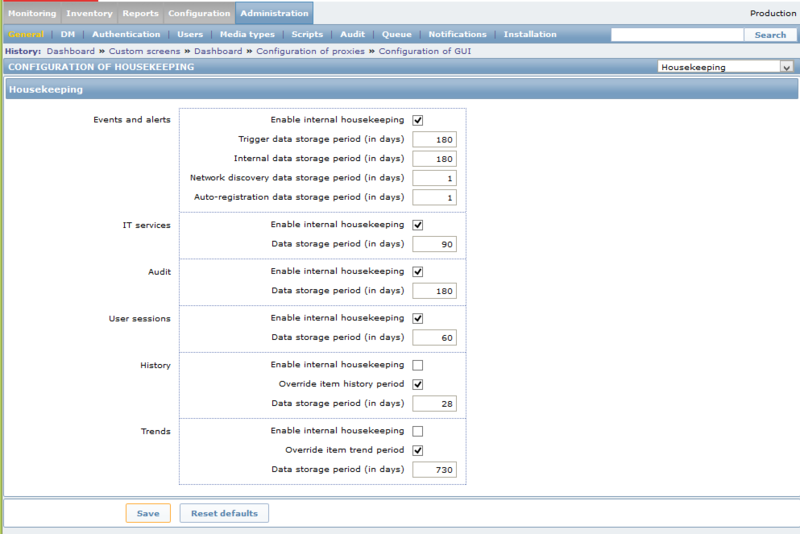
- 确保“历史”和“趋势”两个选项的“启用内部管理”复选框未被选中。
- 确保历史和趋势的检查标题为“覆盖项目<趋势/历史>期间”复选框。
- 将历史和趋势的“数据存储期限(天数)”框设置为您保留两者的时间。在上面给出的表分区中,正确的值是7和365。
6、加入计划任务
不要让数据库用完你的分区,上面示例是如何创建14天额外分区的,在第15天,数据库将无法粘贴历史/趋势数据,因此会发生数据丢失。
所以每隔一段时间(通过cron或其他方法)重新运行这些存储过程。通过这样做,分区将始终存在,可以插入数据。
#Q-2018-1/9
30 4 * * 1 /usr/bin/mysql -uzabbix -pzabbix -e "use zabbix;" -e "CALL partition_maintenance_all('zabbix');"
实际在生产环境中上述操作运行一段时间后,Zabbix server的log文件会报如下错误,events表主键重复、主键不能自动增长、导致zabbix不能告警
::213930.461 [Z3005] query failed: [] Duplicate entry '' for key 'PRIMARY' [insert into events (eventid,source,object,objectid,clock,ns,value) values (,,,,,,);
可以使用如下命令删除events记录
[root@Zabbix-Server zabbix]# mysql -u zabbix -pzabbix -e "use zabbix;" -e 'delete from events';
如果想要删除表的所有数据,truncate语句要比 delete 语句快。
因为 truncate 删除了表,然后根据表结构重新建立它,而 delete 删除的是记录,并没有尝试去修改表。
不过truncate命令虽然快,却不像delete命令那样对事务处理是安全的。
另外注意的是mysql数据库清空表默认是不回收空间的(对应步骤1)
回收表空间的命令
optimize table history

optimize table history_uint
针对MySQL的不同数据库存储引擎,在optimize使用清除碎片,回收闲置的数据库空间,把分散存储(fragmented)的数据和索引重新挪到一起(defragmentation),对I/O速度有好处。
当然optimize在对表进行操作的时候,会加锁,所以不宜经常在程序中调用。可以参考http://www.cnblogs.com/w787815/p/8433548.html
zabbix社区文档参考
https://www.zabbix.org/wiki/Docs/howto/mysql_partition
Zabbix数据库表分区的更多相关文章
- zabbix(4)数据库表分区优化
一.zabbix 数据库存储 zabbix-server将采集到的数据存储在数据库(mysql.oracle等),而数据存储的大小与每秒处理的数量量有关,因此数据存储取决于以下两个因数: (1)Req ...
- 千万级SQL Server数据库表分区的实现
千万级SQL Server数据库表分区的实现 2010-09-10 13:37 佚名 数据库 字号:T | T 一般在千万级的数据压力下,分区是一种比较好的提升性能方法.本文将介绍SQL Server ...
- 15.5 自学Zabbix之路15.5 Zabbix数据库表结构简单解析-其他 表
点击返回:自学Zabbix之路 自学Zabbix之路15.5 Zabbix数据库表结构简单解析-其他 表 1. Actions表 actions表记录了当触发器触发时,需要采用的动作. 2.Aler ...
- Oracle数据库表分区
一.Oracle数据库表分区概念和理解 1.1.已经存在的表没有方法可以直接转化为分区表. 1.2.不在分区字段上建立分区索引,在别的字段上建立索引相当于全局索引.效率 ...
- 自学Zabbix之路15.1 Zabbix数据库表结构简单解析-Hosts表、Hosts_groups表、Interface表
点击返回:自学Zabbix之路 点击返回:自学Zabbix4.0之路 点击返回:自学zabbix集锦 自学Zabbix之路15.1 Zabbix数据库表结构简单解析-Hosts表.Hosts_grou ...
- 自学Zabbix之路15.2 Zabbix数据库表结构简单解析-Items表
点击返回:自学Zabbix之路 点击返回:自学Zabbix4.0之路 点击返回:自学zabbix集锦 自学Zabbix之路15.2 Zabbix数据库表结构简单解析-Items表 Items表记录了i ...
- 自学Zabbix之路15.3 Zabbix数据库表结构简单解析-Triggers表、Applications表、 Mapplings表
点击返回:自学Zabbix之路 点击返回:自学Zabbix4.0之路 点击返回:自学zabbix集锦 自学Zabbix之路15.3 Zabbix数据库表结构简单解析-Triggers表.Applica ...
- 自学Zabbix之路15.4 Zabbix数据库表结构简单解析-Expressions表、Media表、 Events表
点击返回:自学Zabbix之路 点击返回:自学Zabbix4.0之路 点击返回:自学zabbix集锦 自学Zabbix之路15.4 Zabbix数据库表结构简单解析-Expressions表.Medi ...
- 自学Zabbix之路15.5 Zabbix数据库表结构简单解析-其他 表
点击返回:自学Zabbix之路 点击返回:自学Zabbix4.0之路 点击返回:自学zabbix集锦 自学Zabbix之路15.5 Zabbix数据库表结构简单解析-其他 表 1. Actions表 ...
随机推荐
- 从上帝视角看Java如何运行
JVM内存结构 可以看出JVM从宏观上可以分为 ‘内部’ 及 ‘外部’ 两个部分(便于记忆理解): ‘内部’包含:线程共享(公有)数据区 和 线程隔离(私有)数据区 ‘外部’包含:类加载子系统.垃 ...
- 在非主线程里面使用NSTimer创建和取消定时任务
为什么要在非主线程创建NSTimer 将 timer 添加到主线程的Runloop里面本身会增加线程负荷 如果主线程因为某些原因阻塞卡顿了,timer 定时任务触发的时间精度肯定也会受到影响 有些定时 ...
- Mac电脑之间的文件共享 - 偏门
文件共享是工作中经常要进行的. Mac用户之间可以通过AirDrop来共享文件.AirDrop要借助无线网络,而很多人都是将Mac做成个人热点供手机等Wifi连接,AirDrop时必须断开热点,不方便 ...
- 1053 Path of Equal Weight (30分)(并查集)
Given a non-empty tree with root R, and with weight Wi assigned to each tree node Ti. The weig ...
- 1034 Head of a Gang (30分)(dfs 利用map)
One way that the police finds the head of a gang is to check people's phone calls. If there is a pho ...
- Android如何快速打出100个渠道apk
测试1分钟900多个包 关键思路就是读文件,如图: Python快速打包脚本: #!/usr/bin/env python import zipfile prefix = 'channel_' cha ...
- springboot-mybatis-oracle学习笔记
前言 最近公司的项目是基于 oracle 数据库的,这里记录下 springboot+mybatis+oracle 的踩坑过程. 开发前准备 环境参数 开发工具:IDEA 基础工具:Maven+JDK ...
- django自定义404和500页面
from django.contrib import admin from django.urls import path urlpatterns = [ path('admin/', admin.s ...
- 37.4 net--TcpDemo2模拟用户登陆
package day35_net_网络编程.tcp传输.模拟用户登录; import java.io.*; import java.net.InetAddress; import java.net. ...
- JAVA debug 断点调试
更多调试参看 https://www.cnblogs.com/yjd_hycf_space/p/7483471.html 先编译好要调试的程序.1.设置断点 选定要设置断点的代码行,在行号的区域后面单 ...