
POJ 1273 - Drainage Ditches - [最大流模板题] - [EK算法模板][Dinic算法模板 - 邻接表型]
题目链接:http://poj.org/problem?id=1273
Description
Farmer John knows not only how many gallons of water each ditch can transport per minute but also the exact layout of the ditches, which feed out of the pond and into each other and stream in a potentially complex network.
Given all this information, determine the maximum rate at which water can be transported out of the pond and into the stream. For any given ditch, water flows in only one direction, but there might be a way that water can flow in a circle.
Input
Output
Sample Input
5 4

1 2 40

1 4 20

2 4 20

2 3 30

3 4 10
Sample Output
50
Source
 #include<cstdio>

 #include<cstring>

 #include<vector>

 #include<queue>

 #define MAX 203

 #define INF 0x3f3f3f3f

 using namespace std;

 int n,m;//n条边,m个点

 struct Edge{

     int u,v,c,f;

 };

 struct EdmondsKarp{

     vector<Edge> E;

     vector<int> G[MAX];

     int aug[MAX];//源点到i的可增广量

     int pre[MAX];//记录当前路径中点i的入弧编号

     void init(int n)

     {

         E.clear();

         for(int i=;i<n;i++) G[i].clear();

     }

     void addedge(int from,int to,int cap)

     {

         E.push_back((Edge){from,to,cap,});

         E.push_back((Edge){to,from,,});

         G[from].push_back(E.size()-);

         G[to].push_back(E.size()-);

     }

     int maxflow(int s,int t)

     {

         int flow=;

         while()

         {

             memset(aug,,sizeof(aug));

             queue<int> q;

             q.push(s);

             aug[s]=INF;

             while(!q.empty())

             {

                 int now=q.front(); q.pop();

                 for(int i=;i<G[now].size();i++)

                 {

                     Edge edge=E[G[now][i]];

                     if(!aug[edge.v] && edge.c>edge.f)

                     {

                         pre[edge.v]=G[now][i];

                         aug[edge.v]=min(aug[now],edge.c-edge.f);

                         q.push(edge.v);

                     }

                 }

                 if(aug[t]) break;

             }

             if(!aug[t]) break;

             for(int i=t;i!=s;i=E[(pre[i])].u)

             {

                 E[pre[i]].f+=aug[t];

                 E[pre[i]^].f-=aug[t];

             }

             flow+=aug[t];

         }

         return flow;

     }

 }EK;

 int main()

 {

     while(scanf("%d%d",&n,&m)!=EOF)

     {

         EK.init(m);

         for(int from,to,cap,i=;i<=n;i++)

         {

             scanf("%d%d%d",&from,&to,&cap);

             EK.addedge(from,to,cap);

         }

         printf("%d\n",EK.maxflow(,m));

     }

 }
注:
①代码第51行:“if(aug[t]) break;”语句,由于我们一次BFS只找到一条增广路径,所以aug[]数组每次BFS之前都进行初始化为零,因此一旦aug[t]不为零,那么必然我们已经找到了一条增广路径,这是就没必要继续进行BFS,直接跳出循环,节省时间。
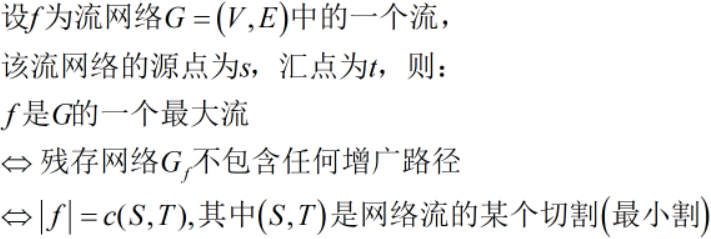
②代码第53行:“if(!aug[t]) break;”语句,这是在BFS循环外的判断语句,因为若是当我们进行完一遍BFS,未找到一条增广路径,那么根据最大流最小割定理,当前已经是最大流情况,所以立即跳出即可。
最大流最小割定理:
嗯,然后再补一个Dinic算法版的:
 #include<cstdio>

 #include<cstring>

 #include<vector>

 #include<queue>

 #define MAX 203

 #define INF 0x3f3f3f3f

 using namespace std;

 int n,m;//n条边,m个点

 struct Dinic

 {

     struct Edge{

         int u,v,c,f;

     };

     int s,t;

     vector<Edge> E;

     vector<int> G[MAX];

     bool vis[MAX]; //BFS使用

     int lev[MAX];//记录层次

     int cur[MAX]; //当前弧下标

     void init(int n)

     {

         E.clear();

         for(int i=;i<n;i++) G[i].clear();

     }

     void addedge(int from,int to,int cap)

     {

         E.push_back((Edge){from,to,cap,});

         E.push_back((Edge){to,from,,});

         G[from].push_back(E.size()-);

         G[to].push_back(E.size()-);

     }

     bool bfs()

     {

         memset(vis,,sizeof(vis));

         queue<int> q;

         q.push(s);

         lev[s]=;

         vis[s]=;

         while(!q.empty())

         {

             int now=q.front(); q.pop();

             for(int i=,_size=G[now].size();i<_size;i++)

             {

                 Edge edge=E[G[now][i]];

                 int nex=edge.v;

                 if(!vis[nex] && edge.c>edge.f)//属于残存网络的边

                 {

                     lev[nex]=lev[now]+;

                     q.push(nex);

                     vis[nex]=;

                 }

             }

         }

         return vis[t];

     }

     int dfs(int now,int aug)//now表示当前结点,aug表示目前为止的最小残量

     {

         if(now==t || aug==) return aug;//aug等于0时及时退出,此时相当于断路了

         int flow=,f;

         for(int& i=cur[now],_size=G[now].size();i<_size;i++)//从上次考虑的弧开始,注意要使用引用,同时修改cur[now]

         {

             Edge& edge=E[G[now][i]];

             int nex=edge.v;

             if(lev[now]+ == lev[nex] && (f=dfs(nex,min(aug,edge.c-edge.f)))>)

             {

                 edge.f+=f;

                 E[G[now][i]^].f-=f;

                 flow+=f;

                 aug-=f;

                 if(!aug) break;//aug等于0及时退出,当aug!=0,说明当前节点还存在另一个增广路分支

             }

         }

         return flow;

     }

     int maxflow(int s,int t)//主过程

     {

         int flow=;

         while(bfs())//不停地用bfs构造分层网络,然后用dfs沿着阻塞流增广

         {

             memset(cur,,sizeof(cur));

             flow+=dfs(s,INF);

         }

         return flow;

     }

 }dinic;

 int main()

 {

     while(scanf("%d%d",&n,&m)!=EOF)

     {

         dinic.init(m);

         for(int from,to,cap,i=;i<=n;i++)

         {

             scanf("%d%d%d",&from,&to,&cap);

             dinic.addedge(from,to,cap);

         }

         dinic.s=, dinic.t=m;

         printf("%d\n",dinic.maxflow(,m));

     }

 }
具体Dinic算法是个什么操作可以参见:王欣上《浅谈基于分层思想的网络流算法》.pdf
模板:
 #include<cstring>

 #include<vector>

 #include<queue>

 #define MAX 100

 #define INF 0x3f3f3f3f

 struct Edge{

     int u,v,c,f;

 };

 struct Dinic

 {

     int s,t;

     vector<Edge> E;

     vector<int> G[MAX];

     bool vis[MAX];

     int lev[MAX];

     int cur[MAX];

     void init(int l,int r)

     {

         E.clear();

         for(int i=l;i<=r;i++) G[i].clear();

     }

     void addedge(int from,int to,int cap)

     {

         E.push_back((Edge){from,to,cap,});

         E.push_back((Edge){to,from,,});

         int m=E.size();

         G[from].push_back(m-);

         G[to].push_back(m-);

     }

     bool bfs()

     {

         memset(vis,,sizeof(vis));

         queue<int> q;

         q.push(s);

         lev[s]=;

         vis[s]=;

         while(!q.empty())

         {

             int now=q.front(); q.pop();

             for(int i=,_size=G[now].size();i<_size;i++)

             {

                 Edge edge=E[G[now][i]];

                 int nex=edge.v;

                 if(!vis[nex] && edge.c>edge.f)

                 {

                     lev[nex]=lev[now]+;

                     q.push(nex);

                     vis[nex]=;

                 }

             }

         }

         return vis[t];

     }

     int dfs(int now,int aug)

     {

         if(now==t || aug==) return aug;

         int flow=,f;

         for(int& i=cur[now],_size=G[now].size();i<_size;i++)

         {

             Edge& edge=E[G[now][i]];

             int nex=edge.v;

             if(lev[now]+ == lev[nex] && (f=dfs(nex,min(aug,edge.c-edge.f)))>)

             {

                 edge.f+=f;

                 E[G[now][i]^].f-=f;

                 flow+=f;

                 aug-=f;

                 if(!aug) break;

             }

         }

         return flow;

     }

     int maxflow()

     {

         int flow=;

         while(bfs())

         {

             memset(cur,,sizeof(cur));

             flow+=dfs(s,INF);

         }

         return flow;

     }

 }dinic;
POJ 1273 - Drainage Ditches - [最大流模板题] - [EK算法模板][Dinic算法模板 - 邻接表型]的更多相关文章
- poj 1273 Drainage Ditches 最大流入门题
题目链接:http://poj.org/problem?id=1273 Every time it rains on Farmer John's fields, a pond forms over B ...
- Poj 1273 Drainage Ditches(最大流 Edmonds-Karp )
题目链接:poj1273 Drainage Ditches 呜呜,今天自学网络流,看了EK算法,学的晕晕的,留个简单模板题来作纪念... #include<cstdio> #include ...
- POJ 1273 Drainage Ditches | 最大流模板
#include<cstdio> #include<algorithm> #include<cstring> #include<queue> #defi ...
- POJ 1273 Drainage Ditches(最大流Dinic 模板)
#include<cstdio> #include<cstring> #include<algorithm> using namespace std; int n, ...
- POJ 1273 Drainage Ditches 最大流
这道题用dinic会超时 用E_K就没问题 注意输入数据有重边.POJ1273 dinic的复杂度为O(N*N*M)E_K的复杂度为O(N*M*M)对于这道题,复杂度是相同的. 然而dinic主要依靠 ...
- poj 1273 Drainage Ditches(最大流)
http://poj.org/problem?id=1273 Drainage Ditches Time Limit: 1000MS Memory Limit: 10000K Total Subm ...
- POJ 1273 Drainage Ditches (网络最大流)
http://poj.org/problem? id=1273 Drainage Ditches Time Limit: 1000MS Memory Limit: 10000K Total Sub ...
- POJ 1273 Drainage Ditches(网络流dinic算法模板)
POJ 1273给出M条边,N个点,求源点1到汇点N的最大流量. 本文主要就是附上dinic的模板,供以后参考. #include <iostream> #include <stdi ...
- 网络流最经典的入门题 各种网络流算法都能AC。 poj 1273 Drainage Ditches
Drainage Ditches 题目抽象:给你m条边u,v,c. n个定点,源点1,汇点n.求最大流. 最好的入门题,各种算法都可以拿来练习 (1): 一般增广路算法 ford() #in ...
随机推荐
- AndroidManifest详解
一,重要性AndroidManifest.xml是Android应用程序中最重要的文件之一.它是Android程序的全局配置文件,是每个 android程序中必须的文件.它位于我们开发的应用程序的根目 ...
- Simply Syntax(思维)
Simply Syntax Time Limit: 1000MS Memory Limit: 10000K Total Submissions: 5551 Accepted: 2481 Des ...
- web.xml 整合 SpringMVC
啦啦啦 <context-param> <param-name>defaultHtmlEscape</param-name> <param-value> ...
- CMD 切换管理员权限
方法一:鼠标右键 这个方法比较比较普通,点开开始找到cmd,右击鼠标“以管理员身份运行(A)”这样调用就是管理员的权限: 方法二:快捷模式 在点开win+R后,选择“以管理员身份运行”,然后确定:可以 ...
- JavaScript-this理解
javascript this可以绑定到:全局对象,自己定义的对象,用构造函数生成的对象,通过call或者apply更改绑定的对象 1.全局对象 function globalTest(nam ...
- AngularJS的初步学习(1)
AngularJS 是一个Javascript框架.它可通过 <script> 标签添加到 HTML 页面.AngularJS 通过 指令 扩展了 HTML,且通过 表达式绑定数据到 HT ...
- 【LeetCode OJ】Add Two Numbers
题目:You are given two linked lists representing two non-negative numbers. The digits are stored in re ...
- 【转载】6种.net分布式缓存解决方案
. 使用内置ASP.NET Cache (System.Web.Caching) : https://msdn.microsoft.com/en-us/library/system.web.cachi ...
- 【H5】使用h5实现复制粘贴功能
方案一 : 可满足大部分浏览器正常使用 <!DOCTYPE html> <html lang="en"> <head> <meta cha ...
- scanf printf sprintf fprintf
都是C语言中的函数,但C++保留了这些函数,在头文件iostream中声明了. 1 scanf(格式控制,输出列表) printf (格式控制,输出列表) 举例: #include <iostr ...