
Java 的swing.GroupLayout布局管理器的使用方法和实例(转)
The following builds a panel consisting of two labels in one column, followed by two textfields in the next column:
   JComponent panel = ...;

   GroupLayout layout = new GroupLayout(panel);

   panel.setLayout(layout);

   // Turn on automatically adding gaps between components

   layout.setAutoCreateGaps(true);

   // Turn on automatically creating gaps between components that touch

   // the edge of the container and the container.

   layout.setAutoCreateContainerGaps(true);

   // Create a sequential group for the horizontal axis.

   GroupLayout.SequentialGroup hGroup = layout.createSequentialGroup();

   // The sequential group in turn contains two parallel groups.

   // One parallel group contains the labels, the other the text fields.

   // Putting the labels in a parallel group along the horizontal axis

   // positions them at the same x location.

   //

   // Variable indentation is used to reinforce the level of grouping.

   hGroup.addGroup(layout.createParallelGroup().

            addComponent(label1).addComponent(label2));

   hGroup.addGroup(layout.createParallelGroup().

            addComponent(tf1).addComponent(tf2));

   layout.setHorizontalGroup(hGroup);

   // Create a sequential group for the vertical axis.

   GroupLayout.SequentialGroup vGroup = layout.createSequentialGroup();

   // The sequential group contains two parallel groups that align

   // the contents along the baseline. The first parallel group contains

   // the first label and text field, and the second parallel group contains

   // the second label and text field. By using a sequential group

   // the labels and text fields are positioned vertically after one another.

   vGroup.addGroup(layout.createParallelGroup(Alignment.BASELINE).

            addComponent(label1).addComponent(tf1));

   vGroup.addGroup(layout.createParallelGroup(Alignment.BASELINE).

            addComponent(label2).addComponent(tf2));

   layout.setVerticalGroup(vGroup);
GroupLayout 是一个 LayoutManager,它将组件按层次分组,以决定它们在 Container 中的位置。GroupLayout 主要供生成器使用,但也可以手工编码。分组由 Group 类的实例来完成。GroupLayout 支持两种组。串行组 (sequential group) 按顺序一个接一个地放置其子元素。并行组 (parallel group) 能够以四种方式对齐其子元素。
每个组可以包含任意数量的元素,其中元素有 Group、Component 或间隙 (gap)。间隙可被视为一个具有最小大小、首选大小和最大大小的不可见组件。此外,GroupLayout 还支持其值取自 LayoutStyle 的首选间隙。
GroupLayout是一个很重要的是额布局管理器,在jdk 1.6才加入,配合其它的管理器可以实现很好的界面。
GroupLayout必须要设置它的GroupLayout.setHorizontalGroup和GroupLayout.setVerticalGroup。
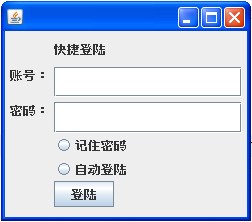
GroupLayout.setHorizontalGroup是指按照水平来确定,下面例子“账号”和“密码”是一个级别的,其它的组件也是一个级别的。详情请看代码
GroupLayout.setVerticalGroup。是按照垂直来确定的。他们的级别是按照Group去设置组件的优先级别,级别越高就显示越上面。
GroupLayout.setHorizontalGroup(SequentialGroup(ParallelGroup(component)));
大概就是按照这个顺序去添加,当然不是就这么简单设置,多个component添加到ParallelGroup,然后多个ParallelGroup添加到SequentialGroup里面,
然后就设置到GroupLayout
下面的实例,设置GroupLayout.setHorizontalGroup,就是把2和4添加到一个ParallelGroup.addComponent(component),其它1,3,5,6,7,8添加到另一个ParallelGroup,然后把这两个ParallelGroup按照顺序添加到SequentialGroup.addGrou(ParallelGroup);

import javax.swing.GroupLayout;

import javax.swing.GroupLayout.Alignment;

import javax.swing.JButton;

import javax.swing.JLabel;

import javax.swing.JPasswordField;

import javax.swing.JRadioButton;

import javax.swing.JTextField;

public class MyFrame extends javax.swing.JFrame {

    public static void main(String[] args) {

        MyFrame f = new MyFrame();

    }

    JLabel label1;

    JLabel label2;

    JLabel label3;

    JTextField tf;

    JPasswordField psf;

    JRadioButton rb1;

    JRadioButton rb2;

    JButton bt1;

    JButton bt2;

    public MyFrame() {

        this.setVisible(true);

        this.setSize(250, 220);

        this.setVisible(true);

        this.setLocation(400, 200);

        label1 = new JLabel("快捷登陆");

        label2 = new JLabel("账号:");

        label3 = new JLabel("密码:");

        tf = new JTextField();

        psf = new JPasswordField();

        rb1 = new JRadioButton("记住密码");

        rb2 = new JRadioButton("自动登陆");

        bt1 = new JButton("登陆");

        // 为指定的 Container 创建 GroupLayout

        GroupLayout layout = new GroupLayout(this.getContentPane());

        this.getContentPane().setLayout(layout);

        //创建GroupLayout的水平连续组,,越先加入的ParallelGroup,优先级级别越高。

        GroupLayout.SequentialGroup hGroup = layout.createSequentialGroup();

        hGroup.addGap(5);//添加间隔

        hGroup.addGroup(layout.createParallelGroup().addComponent(label2)

                .addComponent(label3));

        hGroup.addGap(5);

        hGroup.addGroup(layout.createParallelGroup().addComponent(label1)

                .addComponent(psf).addComponent(rb1).addComponent(rb2)

                .addComponent(tf).addComponent(bt1));

        hGroup.addGap(5);

        layout.setHorizontalGroup(hGroup);

        //创建GroupLayout的垂直连续组,,越先加入的ParallelGroup,优先级级别越高。

        GroupLayout.SequentialGroup vGroup = layout.createSequentialGroup();

        vGroup.addGap(10);

        vGroup.addGroup(layout.createParallelGroup().addComponent(label1));

        vGroup.addGap(10);

        vGroup.addGroup(layout.createParallelGroup().addComponent(label2)

                .addComponent(tf));

        vGroup.addGap(5);

        vGroup.addGroup(layout.createParallelGroup().addComponent(label3)

                .addComponent(psf));

        vGroup.addGroup(layout.createParallelGroup().addComponent(rb1));

        vGroup.addGroup(layout.createParallelGroup().addComponent(rb2));

        vGroup.addGroup(layout.createParallelGroup(Alignment.TRAILING)

                .addComponent(bt1));

        vGroup.addGap(10);

        //设置垂直组

        layout.setVerticalGroup(vGroup);

    }

}
http://www.cnblogs.com/taoweiji/archive/2012/12/10/2812221.html
Exception in thread "main" java.lang.IllegalStateException: javax.swing.JButton
    [..]
    is not attached to a vertical group
Add a vertical group and add the components to it.
From the JavaDocs:
GroupLayouttreats each axis independently. That is, there is a group representing the horizontal axis, and a group representing the vertical axis. The horizontal group is responsible for determining the minimum, preferred and maximum size along the horizontal axis as well as setting the x and width of the components contained in it. The vertical group is responsible for determining the minimum, preferred and maximum size along the vertical axis as well as setting the y and height of the components contained in it. EachComponentmust exist in both a horizontal and vertical group, otherwise anIllegalStateExceptionis thrown during layout, or when the minimum, preferred or maximum size is requested.
http://stackoverflow.com/questions/10472044/regarding-group-layout
GroupLayout gl_composite = new GroupLayout(composite);

91.        gl_composite.setHorizontalGroup(gl_composite.createParallelGroup(

92.                GroupLayout.LEADING).add(canvas, GroupLayout.DEFAULT_SIZE, 468,

93.                Short.MAX_VALUE).add(

94.                GroupLayout.TRAILING,

95.                gl_composite.createSequentialGroup().addContainerGap(125,

96.                        Short.MAX_VALUE).add(button_1).add(68).add(btnbutton)

97.                        .add(131)));

98.        gl_composite.setVerticalGroup(gl_composite.createParallelGroup(

99.                GroupLayout.LEADING).add(

100.                gl_composite.createSequentialGroup().add(canvas,

101.                        GroupLayout.DEFAULT_SIZE, 479, Short.MAX_VALUE).add(48)

102.                        .add(

103.                                gl_composite.createParallelGroup(

104.                                        GroupLayout.BASELINE).add(btnbutton)

105.                                        .add(button_1)).add(81)));
http://blog.csdn.net/captaingan/article/details/7086760
Java 的swing.GroupLayout布局管理器的使用方法和实例(转)的更多相关文章
- (转)Java 的swing.GroupLayout布局管理器的使用方法和实例
摘自http://www.cnblogs.com/lionden/archive/2012/12/11/grouplayout.html (转)Java 的swing.GroupLayout布局管理器 ...
- Java Swing 盒布局管理器
Swing 盒布局管理器 因为项目的原因,重新看看swing的东西,在想要将两个横向的容器纵向表示的时候,发现用盒布局 话不多说,直接代码 package ui; import javax.swing ...
- JAVA学习Swing章节流布局管理器简单学习
package com.swing; import java.awt.Container; import java.awt.FlowLayout; import javax.swing.JButton ...
- JAVA简单的网格布局管理器--JAVA基础
网格布局管理器: GridLayoutDemo.java: import java.awt.GridLayout;import javax.swing.JButton;import javax.swi ...
- 【java】浅析java组件中的布局管理器
这篇博文笔者介绍一下java组件中,常用的布局管理器.java组件中的布局方式有好几十种,所有的这些布局管理器都实现了java.awt.LayoutManager接口.接下来笔者介绍一下常用的5种布局 ...
- java图形用户界面边界布局管理器
总结:不同方向的组件,所用的板是不同的: package com.moc; //用布局写一个界面 ///运用边界布局 //2个按钮在北,2个按钮在南 //中央一个大按钮 //将同一方向的组件封装后布局 ...
- java 图形化界面 布局管理器
package Layout; import java.awt.*; import javax.swing.*; public class MyBorderLayout extends JFrame{ ...
- Java可视化编程,基于布局管理器的UI设计
在<事件驱动模型>讲述了如何将用户与功能实现代码联系到一起.怎么样便于用户理解和符合用户的使用习惯? 本篇还是就此问题作分析,站在用户角度上分析UI各组件倒底该如何设计呈现. 优秀的UI会 ...
- Swing——布局管理器
前言 在编写图形界面时,总是需要考虑的就是组件放在哪里,组件怎么大才合适.在Swing中就有现成的布局管理器帮我们做这些事情,我们不必写代码去一一安排.下面将介绍什么是布局管理器.Swing中常用布局 ...
随机推荐
- Transparency Tutorial with C# - Part 2
Download Compositing Mode demo project - 24 Kb Download Compositing Mode source - 26 Kb Download Com ...
- WASP_百度百科
WASP_百度百科 WASP
- Creating Contextual Menus创建上下文菜单
A contextual menu offers actions that affect a specific item or context frame in the UI. You can pro ...
- Linux lamp环境编译安装
1.安装准备: 1)httpd-2.0.52.tar.gz 2)mysql-4.1.12.tar.gz 3)libxml2-2.6.27.tar 4)freetype-2.1.10.tar 5)gd- ...
- mahout源码KMeansDriver分析之五CIMapper
接上文重点分析map操作: Vector probabilities = classifier.classify(value.get());// 第一行 Vector selections = pol ...
- Mutex(测量)
游标共享怎样使用Mutex kks 使用mutex以便保护对于下述基于parent cursor父游标和子游标child cursor的一系列操作 对于父游标parent cursor的操作: 基于发 ...
- zoj 3822 Domination(2014牡丹江区域赛D称号)
Domination Time Limit: 8 Seconds Memory Limit: 131072 KB Special Judge Edward is the headm ...
- 《Javascript高级程序设计》读书笔记之闭包
闭包 function createComparisonFunction(propertyName) { return function (object1, object2) { var value1 ...
- DRY
DRY(Don't Repeat Yourself )原则 凡是写过一些代码的程序猿都能够意识到应该避免重复的代码和逻辑.我们通过提取方法,提取抽象类等等措施来达到这一目的.我们总能时不时的听到类 ...
- linux设备驱动程序第四部分:从如何定位oops对代码的调试方法,驱动线
在一个我们谈到了如何编写一个简单的字符设备驱动程序,我们不是神,编写肯定会失败的代码,在这个过程中,我们需要继续写代码调试.在普通c应用.我们经常使用printf输出信息.或者使用gdb要调试程序,然 ...