
OAuth + Security - 6 - 自定义授权模式
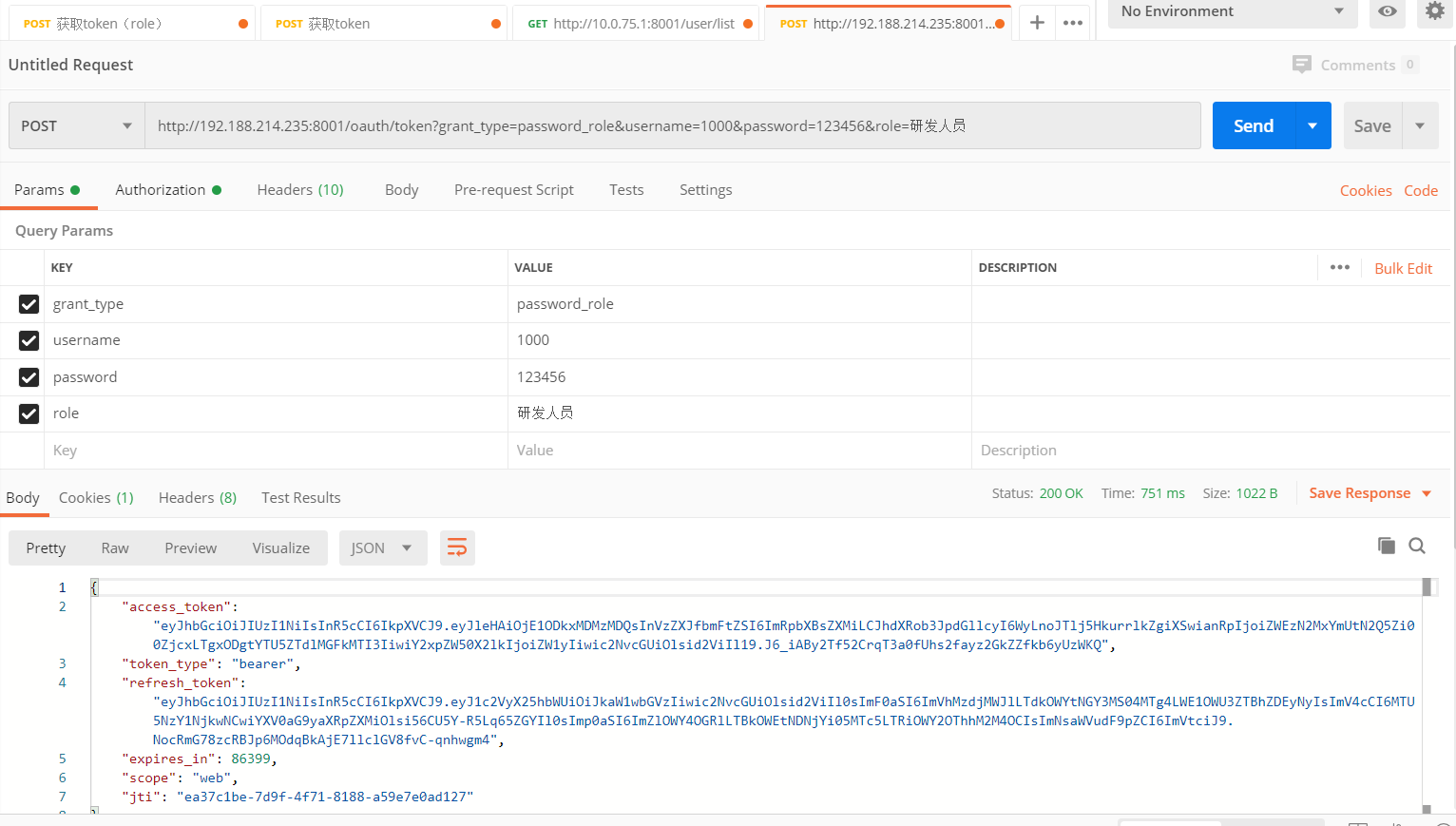
我们知道OAuth2的官方提供了四种令牌的获取,简化模式,授权码模式,密码模式,客户端模式。其中密码模式中仅仅支持我们通过用户名和密码的方式获取令牌,那么我们如何去实现一个我们自己的令牌获取的模式呢?下面我们将以用户名,密码,角色三个信息的方式来获取令牌。
在授权模式中,授权模式的核心接口是 TokenGranter ,他拥有一个抽象实现类 AbstractTokenGranter ,我们需要自定义新的 grant type ,就再写一个他的子类即可,如下:
public class AccountRoleTokenGranter extends AbstractTokenGranter {

    private static final String GRANT_TYPE = "password_role";

    // 获取用户信息的实现

    private UserRoleDetailServiceImpl userRoleDetailService;

    /**

     * 构造方法提供一些必要的注入的参数

     * 通过这些参数来完成我们父类的构建

     *

     * @param tokenServices         tokenServices

     * @param clientDetailsService  clientDetailsService

     * @param oAuth2RequestFactory  oAuth2RequestFactory

     * @param userRoleDetailService userDetailsService

     */

    public AccountRoleTokenGranter(AuthorizationServerTokenServices tokenServices,

                                   ClientDetailsService clientDetailsService,

                                   OAuth2RequestFactory oAuth2RequestFactory,

                                   UserRoleDetailServiceImpl userRoleDetailService) {

        super(tokenServices, clientDetailsService, oAuth2RequestFactory, GRANT_TYPE);

        this.userRoleDetailService = userRoleDetailService;

    }

    /**

     * 在这里查询我们用户,构建用户的授权信息

     *

     * @param client       客户端

     * @param tokenRequest tokenRequest

     * @return OAuth2Authentication

     */

    @Override

    protected OAuth2Authentication getOAuth2Authentication(ClientDetails client, TokenRequest tokenRequest) {

        Map<String, String> params = tokenRequest.getRequestParameters();

        String account = params.getOrDefault("username", "");

        String role = params.getOrDefault("role", "");

        // 获取用户信息

        UserDetails userDetails = userRoleDetailService.loadUserByAccountAndRole(account, role);

        if (ObjectUtil.isNull(userDetails)) {

            throw new UsernameNotFoundException("用户角色不存在");

        }

        // 构建用户授权信息

        Authentication user = new AccountRoleAuthenticationToken(userDetails.getUsername(),

                userDetails.getPassword(), userDetails.getAuthorities());

        return new OAuth2Authentication(tokenRequest.createOAuth2Request(client), user);

    }

}
配置用户信息获取实现类UserRoleDetailServiceImpl
@Service

public class UserRoleDetailServiceImpl {

    private UserService userService;

    private RoleService roleService;

    @Autowired

    public UserRoleDetailServiceImpl(UserService userService, RoleService roleService) {

        this.userService = userService;

        this.roleService = roleService;

    }

    public UserCredential loadUserByAccountAndRole(String account, String roles) throws UsernameNotFoundException {

        // 查询相应用户

        UserDetailDTO userCredential = userService.findByAccountAndRole(account, roles);

        if (ObjectUtils.isEmpty(userCredential)) {

            throw new UsernameNotFoundException("该账号角色不存在!");

        }

        Set<GrantedAuthority> grantedAuthorities = Sets.newHashSet();

        List<Role> roleResult = userService.findRoleByUserId(Integer.valueOf(userCredential.getUserId()));

        if (!roleResult.isEmpty()) {

            for (Role role : roleResult) {

                if (StrUtil.equalsIgnoreCase(role.getRoleName(), roles)) {

                    //角色必须是ROLE_开头,可以在数据库中设置

                    GrantedAuthority grantedAuthority = new SimpleGrantedAuthority(role.getRoleName());

                    grantedAuthorities.add(grantedAuthority);

                    //获取权限

                    List<MenuDTO> menuByRoleId = roleService.findMenuByRoleId(role.getRoleId());

                    if (!menuByRoleId.isEmpty()) {

                        for (MenuDTO menu : menuByRoleId) {

                            if (StringUtils.isNotBlank(menu.getPerms())) {

                                GrantedAuthority authority = new SimpleGrantedAuthority(menu.getPerms());

                                grantedAuthorities.add(authority);

                            }

                        }

                    }

                }

            }

        }

        UserCredential authUser = new UserCredential(account, userCredential.getPassword(), grantedAuthorities);

        BeanUtils.copyProperties(userCredential, authUser);

        return authUser;

    }

}

/**

 * 认证用户信息类

 *

 * @author zhongyj <1126834403@qq.com><br/>

 * @date 2020/2/25

 */

@Setter

@Getter

public class UserCredential extends User implements Serializable {

    private static final long serialVersionUID = 2554837818190360741L;

    public static final String DEFAULT_USER = "dimples";

    private boolean accountNonExpired = true;

    private boolean accountNonLocked = true;

    private boolean credentialsNonExpired = true;

    private boolean enabled = true;

    private Integer userId;

    private String userCode;

    private String account;

    private String username;

    private String status;

    private Date createDate;

    private Date modifyDate;

    public UserCredential(String username, String password, Collection<? extends GrantedAuthority> authorities) {

        super(username, password, authorities);

        this.account = username;

    }

    public UserCredential(String username, String password, boolean enabled, boolean accountNonExpired, boolean credentialsNonExpired, boolean accountNonLocked, Collection<? extends GrantedAuthority> authorities) {

        super(username, password, enabled, accountNonExpired, credentialsNonExpired, accountNonLocked, authorities);

    }

}
接下来就只需将其添加到Oauth2AuthorizationServerConfig 中
@Override

public void configure(AuthorizationServerEndpointsConfigurer endpoints) {

    endpoints

            // 配置token存储源

            .tokenStore(tokenStore())

            // 配置权限管理

            .authenticationManager(authenticationManager);

    endpoints.tokenGranter(tokenGranter(endpoints));

}

/**

 * 重点

 * 先获取已经有的五种授权,然后添加我们自己的进去

 *

 * @param endpoints AuthorizationServerEndpointsConfigurer

 * @return TokenGranter

 */

private TokenGranter tokenGranter(final AuthorizationServerEndpointsConfigurer endpoints) {

    List<TokenGranter> granters = new ArrayList<>(Collections.singletonList(endpoints.getTokenGranter()));

    granters.add(new AccountRoleTokenGranter(

            endpoints.getTokenServices(),

            endpoints.getClientDetailsService(),

            endpoints.getOAuth2RequestFactory(),

            userRoleDetailService));

    return new CompositeTokenGranter(granters);

}
参考资料:
OAuth + Security - 6 - 自定义授权模式的更多相关文章
- Spring Security OAuth2 微服务认证中心自定义授权模式扩展以及常见登录认证场景下的应用实战
一. 前言 [APP 移动端]Spring Security OAuth2 手机短信验证码模式 [微信小程序]Spring Security OAuth2 微信授权模式 [管理系统]Spring Se ...
- IdentityServer4 自定义授权模式
IdentityServer4除了提供常规的几种授权模式外(AuthorizationCode.ClientCredentials.Password.RefreshToken.DeviceCode), ...
- Asp.Net Core 中IdentityServer4 授权中心之自定义授权模式
一.前言 上一篇我分享了一篇关于 Asp.Net Core 中IdentityServer4 授权中心之应用实战 的文章,其中有不少博友给我提了问题,其中有一个博友问我的一个场景,我给他解答的还不够完 ...
- 转 - spring security oauth2 password授权模式
原贴地址: https://segmentfault.com/a/1190000012260914#articleHeader6 序 前面的一篇文章讲了spring security oauth2的c ...
- IdentityServer4 实现自定义 GrantType 授权模式
OAuth 2.0 默认四种授权模式(GrantType): 授权码模式(authorization_code) 简化模式(implicit) 密码模式(password) 客户端模式(client_ ...
- 【.NET Core项目实战-统一认证平台】第十四章 授权篇-自定义授权方式
[.NET Core项目实战-统一认证平台]开篇及目录索引 上篇文章我介绍了如何强制令牌过期的实现,相信大家对IdentityServer4的验证流程有了更深的了解,本篇我将介绍如何使用自定义的授权方 ...
- Spring Security OAuth2 Demo —— 隐式授权模式(Implicit)
本文可以转载,但请注明出处https://www.cnblogs.com/hellxz/p/oauth2_impilit_pattern.html 写在前面 在文章OAuth 2.0 概念及授权流程梳 ...
- Spring Security如何优雅的增加OAuth2协议授权模式
一.什么是OAuth2协议? OAuth 2.0 是一个关于授权的开放的网络协议,是目前最流行的授权机制. 数据的所有者告诉系统,同意授权第三方应用进入系统,获取这些数据.系统从而产生一个短期的进入令 ...
- SimpleSSO:使用Microsoft.Owin.Security.OAuth搭建OAuth2.0授权服务端
目录 前言 OAuth2.0简介 授权模式 (SimpleSSO示例) 使用Microsoft.Owin.Security.SimpleSSO模拟OpenID认证 通过authorization co ...
随机推荐
- sonar 安装,centos7配置优化
/etc/sysctl.conf /etc/systemd/system.conf /etc/security/limits.conf /proc/sys/fs/file-max /etc/secur ...
- 「雕爷学编程」Arduino动手做(11)——金属触摸模块
37款传感器和模块的提法,在网络上广泛流传,其实Arduino能够兼容的传感器模块肯定是不止37种的.鉴于本人手头积累了一些传感器与模块,依照实践出真知(动手试试)的理念,以学习和交流为目的,这里准备 ...
- 二、YARN
一.YARN 介绍 yarn 是下一代 MapReduce,即 MRv2,是在第一代 MapReduce 基础上演变而来的,主要是为了解决原始 Hadoop 扩展性较差,不支持多计算框架而提出的,通俗 ...
- mysql小白系列_10 mysql主从复制原理
1.如何解决主从复制延迟的问题? (1)主从复制原理 http://www.cnblogs.com/jenvid/p/8410922.html 1.salve执行slave start,salve服务 ...
- 【MySQL】剖析MySQL读写分离技术
主从技术的一个基本流程图: 如何实现主从复制的呢: MySQL Master(主节点) 1>当一个请求来时,首先由[mysqld]写入到我们的主[data]中 2>然后[mysqld]将 ...
- 一个茴字有三种写法——吐槽C#9.0的Records
最近是微软开了Build 2020大会,由于疫情原因,改成了在线举行,Build大会上,C#公布9.0版本. 我个人对于C#的更新向来都是喜闻乐见,乐于接受的,对于博客园上某些人天天嘲讽C#只会增加语 ...
- iOS开发判断手机号及其运营商
根据三大运营商出现的号段(号段来自百度百科) 判断是否是手机号 + (BOOL)isMobile:(NSString *)str { NSString *MOBILE = @"^1(3[0- ...
- web自动化之alert弹窗操作
from selenium import webdriver from selenium.webdriver.support.wait import WebDriverWait from seleni ...
- 4.Linux的目录结构
Linux的目录结构 (1)"/"目录 Linux文件系统的入口,也是出于最高一级的目录 (2)"/bin" 基础系统所需要的那些命令位于此目录.也是最小系统所 ...
- Order by 优化
写在前面 文章涉及到的 customer 表来源于案例库 sakila,下载地址为 http://downloads.mysql.com/docs/sakila-db.zip MySQL 排序方式 通 ...