
Kernel Methods for Deep Learning
@article{cho2009kernel,
title={Kernel Methods for Deep Learning},
author={Cho, Youngmin and Saul, Lawrence K},
pages={342--350},
year={2009}}
引
这篇文章介绍了一种新的核函数, 其启发来自于神经网络的运算.

其中\(\Theta(z)=\frac{1}{2}(1+\mathrm{sign}(z))\).
主要内容
主要性质, 公式(1)可以表示成:
\tag{2}
\]
其中:
\tag{3}
\]
\tag{4}
\]
特别的:

其证明如下:
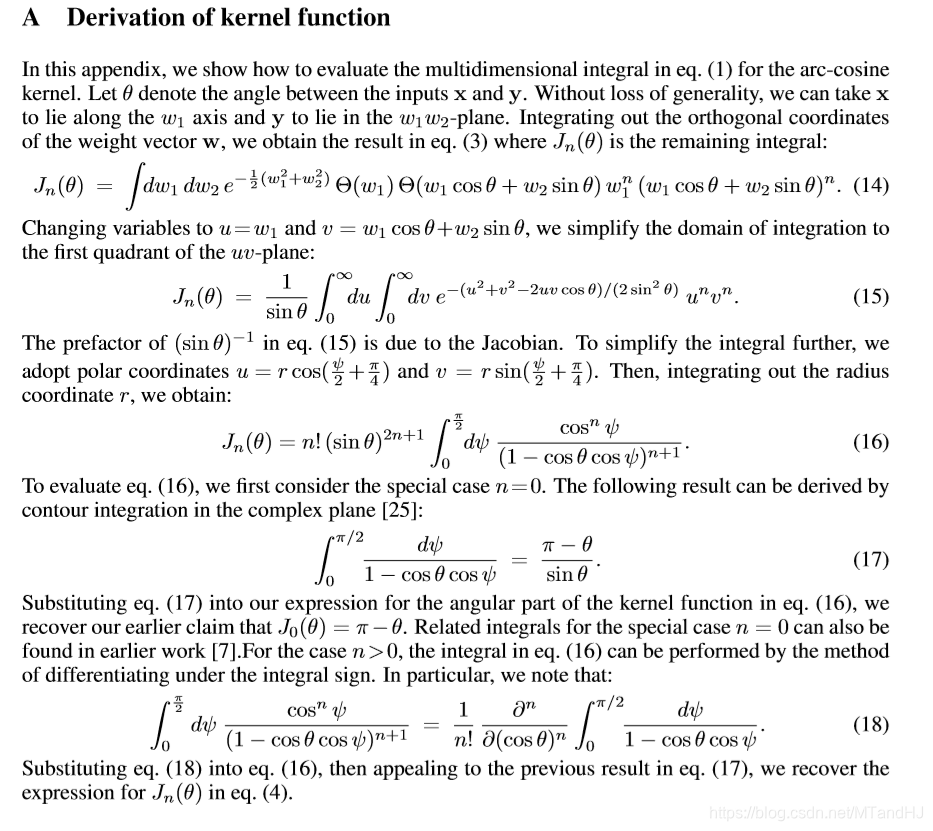
第(17)的证明我没有推, 因为 contour integration 暂时不了解.
细心的读者可能会发现, 最后的结果是\(\frac{\partial^n}{\partial(\cos \theta)^n}\), 注意对于一个函数\(f(\cos \theta)\), 我们可以令\(g(\theta) = f(\cos \theta)\)则:
\]
又
\]
便得结论.
与深度学习的联系
如果我们把注意力集中在某一层, 假设输入为\(\mathbf{x}\), 输出为:
\]
其中\(g(z) = \Theta(z) z^n\)是激活函数, 不同的n有如下的表现:
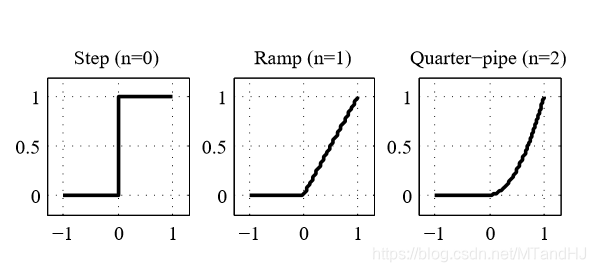
\(n=1\)便是我们熟悉的ReLU.
考虑俩个输入\(\mathbf{x},\mathbf{y}\)所对应的输出\(\mathbf{f}(\mathbf{x}),\mathbf{f}(\mathbf{y})\)的内积:
\]
如果每个权重\(W_{ij}\)都服从标准正态分布, 则:
\]
实验
实验失败了, 代码如下.
import numpy as np

import pandas as pd

import matplotlib.pyplot as plt

from sklearn.svm import NuSVC
"""

Arc_cosine kernel

"""

class Arc_cosine:

    def __init__(self, n=1):

        self.n = n

        self.own_kernel = self.kernels(n)

    def kernel0(self, x, y):

        norm_x = np.linalg.norm(x)

        norm_y = np.linalg.norm(y)

        cos_value = x @ y / (norm_x *

                             norm_y)

        angle = np.arccos(cos_value)

        return 1 - angle / np.pi

    def kernel1(self, x, y):

        norm_x = np.linalg.norm(x)

        norm_y = np.linalg.norm(y)

        cos_value = x @ y / (norm_x *

                    norm_y)

        angle = np.arccos(cos_value)

        sin_value = np.sin(angle)

        return (norm_x * norm_y) ** self.n * \

               (sin_value + (np.pi - angle) *

                cos_value) / np.pi

    def kernel2(self, x, y):

        norm_x = np.linalg.norm(x)

        norm_y = np.linalg.norm(y)

        cos_value = x @ y / (norm_x *

                             norm_y)

        angle = np.arccos(cos_value)

        sin_value = np.sin(angle)

        return (norm_x * norm_y) ** self.n * \

               3 * sin_value * cos_value + \

               (np.pi - angle) * (1 + 2 * cos_value ** 2)

    def kernels(self, n):

        if n is 0:

            return self.kernel0

        elif n is 1:

            return self.kernel1

        elif n is 2:

            return self.kernel2

        else:

            raise ValueError("No such kernel, n should be "

                             "0, 1 or 2")

    def kernel(self, X, Y):

        m = X.shape[0]

        n = Y.shape[0]

        C = np.zeros((m, n))

        for i in range(m):

            for j in range(n):

                C[i, j] = self.own_kernel(

                    X[i], Y[j]

                )

        return C

    def __call__(self, X, Y):

        return self.kernel(X, Y)
在俩个数据上进行SVM, 数据如下:
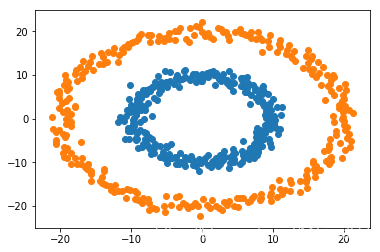
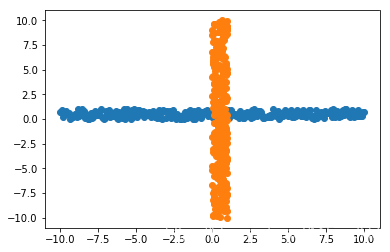
在SVM上跑:
'''

#生成圈圈数据

def generate_data(circle, r1, r2, nums=300):

    variance = 1

    rs1 = np.random.randn(nums) * variance + r1

    rs2 = np.random.randn(nums) * variance + r2

    angles = np.linspace(0, 2*np.pi, nums)

    data1 = (rs1 * np.sin(angles) + circle[0],

            rs1 * np.cos(angles) + circle[1])

    data2 = (rs2 * np.sin(angles) + circle[0],

            rs2 * np.cos(angles) + circle[1])

    df1 = pd.DataFrame({'x':data1[0], 'y': data1[1],

                        'label':np.ones(nums)})

    df2 = pd.DataFrame({'x':data2[0], 'y': data2[1],

                        'label':-np.ones(nums)})

    return df1, df2

'''

#生成十字数据

def generate_data(left, right, down, up,

                  circle=(0., 0.), nums=300):

    variance = 1

    y1 = np.random.rand(nums) * variance + circle[1]

    x2 = np.random.rand(nums) * variance + circle[0]

    x1 = np.linspace(left, right, nums)

    y2 = np.linspace(down, up, nums)

    df1 = pd.DataFrame(

        {'x': x1,

         'y': y1,

         'label':np.ones_like(x1)}

    )

    df2 = pd.DataFrame(

        {'x': x2,

         'y': y2,

         'label':-np.ones_like(x2)}

    )

    return df1, df2

def pre_test(left, right, func, nums=100):

    x1, y1 = left

    x2, y2 = right

    x = np.linspace(x1, x2, nums)

    y = np.linspace(y1, y2, nums)

    X,Y = np.meshgrid(x,y)

    m, n = X.shape

    Z = func(np.vstack((X.reshape(1, -1),

             Y.reshape(1, -1))).T).reshape(m, n)

    return X, Y, Z

df1, df2 = generate_data(-10, 10, -10, 10)

df = df1.append(df2)

classifer2 = NuSVC(kernel=Arc_cosine(n=1))

classifer2.fit(df.iloc[:, :2], df['label'])

X, Y, Z = pre_test((-10, -10), (10, 10), classifer2.predict)

plt.contourf(X, Y, Z)

plt.show()
预测结果均为:

而在一般的RBF上, 结果都是很好的:
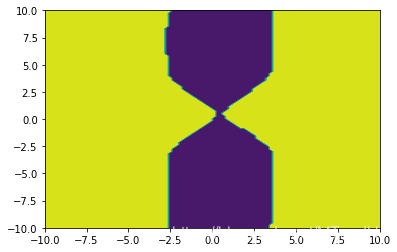
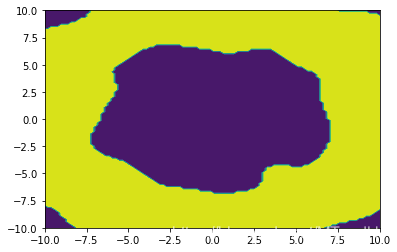
在多项式核上也ok:

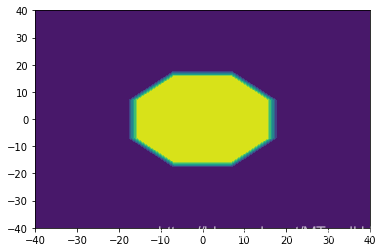
如果有人能发现代码中的错误,请务必指正.
Kernel Methods for Deep Learning的更多相关文章
- (转) Ensemble Methods for Deep Learning Neural Networks to Reduce Variance and Improve Performance
Ensemble Methods for Deep Learning Neural Networks to Reduce Variance and Improve Performance 2018-1 ...
- 深度学习的集成方法——Ensemble Methods for Deep Learning Neural Networks
本文主要参考Ensemble Methods for Deep Learning Neural Networks一文. 1. 前言 神经网络具有很高的方差,不易复现出结果,而且模型的结果对初始化参数异 ...
- Paper List ABOUT Deep Learning
Deep Learning 方向的部分 Paper ,自用.一 RNN 1 Recurrent neural network based language model RNN用在语言模型上的开山之作 ...
- Deep Learning方向的paper
转载 http://hi.baidu.com/chb_seaok/item/6307c0d0363170e73cc2cb65 个人阅读的Deep Learning方向的paper整理,分了几部分吧,但 ...
- Kernel Functions for Machine Learning Applications
In recent years, Kernel methods have received major attention, particularly due to the increased pop ...
- Deep Learning and the Triumph of Empiricism
Deep Learning and the Triumph of Empiricism By Zachary Chase Lipton, July 2015 Deep learning is now ...
- How To Improve Deep Learning Performance
如何提高深度学习性能 20 Tips, Tricks and Techniques That You Can Use ToFight Overfitting and Get Better Genera ...
- My deep learning reading list
My deep learning reading list 主要是顺着Bengio的PAMI review的文章找出来的.包括几本综述文章,将近100篇论文,各位山头们的Presentation.全部 ...
- Deep Learning关于Vision的Reading List
最近开始学习深度学习了,加油! 下文转载自:http://blog.sina.com.cn/s/blog_bda0d2f10101fpp4.html 主要是顺着Bengio的PAMI review的文 ...
随机推荐
- 12. Fedora 中文乱码问题
1. Rhythmbox(音乐播放器乱码) yum install python-mutagen mid3iconv -e GBK *.mp3 2. totem电影播放机播放列表乱码解决1).修改to ...
- 零基础学习java------day3-运算符 以及eclipse的使用
今日内容: 1. 算数运算符 2. 赋值运算符 3. 关系运算符 4. 逻辑运算符 5. 位运算符 6.三目运算符 一 运算符 运算:对常量和变量进行操作的过程称为运算 运算符:对常量和变量进行操作的 ...
- k8s StatefulSet控制器-独立存储
k8s-StatefulSet控制器-独立存储 1. StatefulSet控制器-独立存储 独享存储:StatefulSet的存储卷使用VolumeClaimTemplate创建,称为卷申请模板,当 ...
- c#中实现串口通信的几种方法
c#中实现串口通信的几种方法 通常,在C#中实现串口通信,我们有四种方法: 第一:通过MSCOMM控件这是最简单的,最方便的方法.可功能上很难做到控制自如,同时这个控件并不是系统本身所带,所以还得注册 ...
- Netty实现Socket
Netty实现Socket 从Java1.4开始, Java引入了non-blocking IO,简称NIO.NIO与传统socket最大的不同就是引入了Channel和多路复用selector的概念 ...
- Linux网络管理(一)之配置主机名与域名
Linux网络管理(一)之配置主机名与域名参考自:[1]修改主机名(/etc/hostname和/etc/hosts区别) https://blog.csdn.net/shmily_lsl/artic ...
- python做一个http接口测试框架
目录结构 project case#测试用例 suite#测试目录 logs#测试日志 papi#测试类 result#测试结果 setting.py#配置文件 1.日志类,用于测试时日志记录 pya ...
- centos 7 zookeeper 单体和集群搭建
1.操作相关命令 1.0 安装命令 wget :下载解压包 tar -xzvf :解压 1.1 创建节点 create / node : 创建一个名字为node的 空节点 creat ...
- Jenkins构建通知
目录 一.简介 二.推送到gitlab 三.邮件通知 自带配置 Email Extension 四.钉钉通知 五.脚本钉钉通知 六.HTTP请求通知 一.简介 类似于监控报警,jenkins在配置持续 ...
- EmmyLua 注解功能
前言 网上配置 EmmyLua 的方法很多,此处就不做赘述(因此前提是你已经安装配置完EmmyLua) 本文仅是对 EmmyLua插件 内 注解功能 用法的代码演示.因为网上大部分EmmyLua配置教 ...