
iOS Programming - Views(视图 - 基本绘制,变换,平移,旋转,反转,倾斜)
1. Views
A view (an object whose class is UIView or a subclass of UIView) knows how to draw itself into a rectangular area of the interface.
Your app has a visible interface thanks to views.
(eg: you can drag an interface widget, such as a UIButton, into a view in the nib editor;
when the app runs, the button appears, and works properly.
You can also manipulate views in powerful ways, in real time. Your code can do some or all of the
view’s drawing of itself)
A view is also a responder (UIView is a subclass of UIResponder).
This means that a view is subject to user interactions, such as taps and swipes.
A view can have subviews;
If a view is removed from the interface, its subviews are removed;
if a view is hidden (made invisible), its subviews are hidden;
if a view is moved, its subviews move with it; and other changes in a view are likewise
shared with its subviews.
A view may come from a nib, or you can create it in code.
On balance, neither approach is to be preferred over the other; it depends on your needs and inclinations and on the
overall architecture of your app.
2. The Window
The top of the view hierarchy is the app’s window.
It is an instance of UIWindow (or your own subclass), which is a UIView subclass.
Your app should have exactly one main window. It is created at launch time and is never destroyed or replaced.
It occupies the entire screen and forms the background, and is the ultimate superview of, all your other visible views.
The window must fill the device’s screen.
This is done by setting the window’s frame to the screen’s bounds as the window is instantiated.
Objective-C:
UIWindow* w = [[UIWindow alloc] initWithFrame:[[UIScreen mainScreen] bounds]];
Swift(iOS8):
let w = UIWindow(frame: UIScreen.mainScreen().bounds)
Swift(iOS9):
// it’s sufficient to instantiate UIWindow with no frame

let w = UIWindow()
You will typically not put any view content manually and directly inside your main window.
Instead, you’ll obtain a view controller and assign it to the main window’s root ViewController property.
This causes the view controller’s main view (its view) to be made the one and only immediate subview of
your main window, which is the main window’s root view.
All other views in your main window will be subviews of the root view. Thus,
the root view is the highest object in the view hierarchy that the user will usually see.
Your app’s interface is not visible until the window, which contains it, is made the app’s
key window. This is done by calling the UIWindow instance method makeKeyAndVisible.
When addSubview: is called, the view is placed last among its superview’s subviews;
thus it is drawn last, meaning that it appears frontmost.
(最后绘制的,出现在最前面)
// it is legal to cycle through it and remove each subview one at a time

for (UIView* v in view.subviews)

    [v removeFromSuperview];
3. Visibility and Opacity(可见性与不透明度)
A view can be made invisible by setting its hidden property to YES, and visible again
by setting it to NO.
A view can be assigned a background color through its backgroundColor property. A
color is a UIColor;
A view whose background color is nil (the default) has a transparent background.
A view can be made partially or completely transparent through its alpha property: 1.0
means opaque, 0.0 means transparent, and a value may be anywhere between them,
inclusive.
This affects subviews: if a superview has an alpha of 0.5, none of its subviews
can have an apparent opacity of more than 0.5, because whatever alpha value they have
will be drawn relative to 0.5.
A view that is completely transparent (or very close to it) is like a view whose hidden is
YES: it is invisible, along with its subviews, and cannot (normally) be touched.
eg:
if a view displays an image and has a background color and its alpha is less than 1, the background color
will seep through the image (背景色将渗入图像).
4. Frame
A view’s frame property, a CGRect, is the position of its rectangle within its superview.
By default, the superview’s coordinate system will have the origin at its top left,
with the x-coordinate growing positively rightward and the y-coordinate growing positively downward.
(等同于Cocos2d-x中的UI坐标系,原点在左上角)
Setting a view’s frame to a different CGRect value repositions the view, or resizes it, or both.
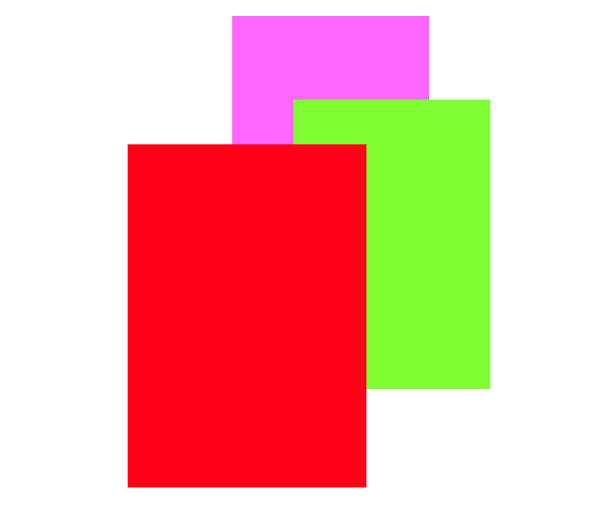
例: 画3个部分重叠的视图
Objective-C:
UIView* v1 = [[UIView alloc] initWithFrame:CGRectMake(, , , )];

v1.backgroundColor = [UIColor colorWithRed: green:. blue: alpha:];

UIView* v2 = [[UIView alloc] initWithFrame:CGRectMake(, , , )];

v2.backgroundColor = [UIColor colorWithRed:. green: blue: alpha:];

UIView* v3 = [[UIView alloc] initWithFrame:CGRectMake(, , , )];

v3.backgroundColor = [UIColor colorWithRed: green: blue: alpha:];

[mainview addSubview: v1];

[v1 addSubview: v2];

[mainview addSubview: v3];
Swift:
let v1 = UIView(frame:CGRectMake(, , , ))

v1.backgroundColor = UIColor(red: , green: 0.4, blue: , alpha: )

let v2 = UIView(frame:CGRectMake(, , , ))

v2.backgroundColor = UIColor(red: 0.5, green: , blue: , alpha: )

let v3 = UIView(frame:CGRectMake(, , , ))

v3.backgroundColor = UIColor(red: , green: , blue: , alpha: )

mainview.addSubview(v1)

v1.addSubview(v2)

mainview.addSubview(v3)
效果:
5. Bounds and Center(边框和中心)
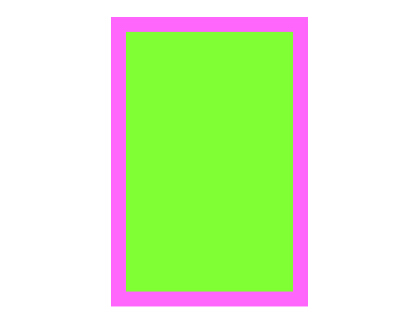
CGRectInset函数,画出视图边框
例1: 画一个带有粗边框的视图
UIView* v1 = [[UIView alloc] initWithFrame:CGRectMake(, , , )];

v1.backgroundColor = [UIColor colorWithRed: green:. blue: alpha:];

UIView* v2 = [[UIView alloc] initWithFrame:CGRectInset(v1.bounds, , )];

v2.backgroundColor = [UIColor colorWithRed:. green: blue: alpha:];

[mainview addSubview: v1];

[v1 addSubview: v2];
效果:
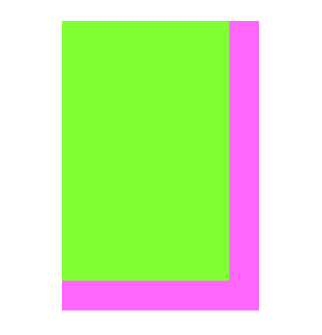
例2: 移动超视图(spuerview)的原点导致子视图(subview)位置发生变化
(本例中子视图向左上移动)
UIView* v1 = [[UIView alloc] initWithFrame:CGRectMake(, , , )];

v1.backgroundColor = [UIColor colorWithRed: green:. blue: alpha:];

UIView* v2 = [[UIView alloc] initWithFrame:CGRectInset(v1.bounds, , )];

v2.backgroundColor = [UIColor colorWithRed:. green: blue: alpha:];

[mainview addSubview: v1]

[v1 addSubview: v2];

CGRect r = v1.bounds;

r.origin.x += ;

r.origin.y += ;

v1.bounds = r;
效果:
6. Transform(变换)
旋转(rotation), 缩放(scaling), 平移(translation)
例1: 视图顺时针旋转45度角
UIView* v1 = [[UIView alloc] initWithFrame:CGRectMake(, , , )];

v1.backgroundColor = [UIColor colorWithRed: green:. blue: alpha:];

UIView* v2 = [[UIView alloc] initWithFrame:CGRectInset(v1.bounds, , )];

v2.backgroundColor = [UIColor colorWithRed:. green: blue: alpha:];

[mainview addSubview: v1];

[v1 addSubview: v2];

v1.transform = CGAffineTransformMakeRotation( * M_PI/180.0);
效果: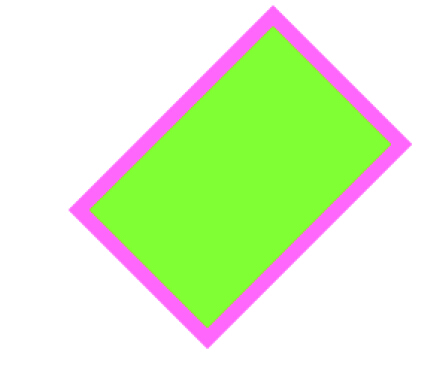
例2: 缩放变换
v1.transform = CGAffineTransformMakeScale(1.8, );
效果: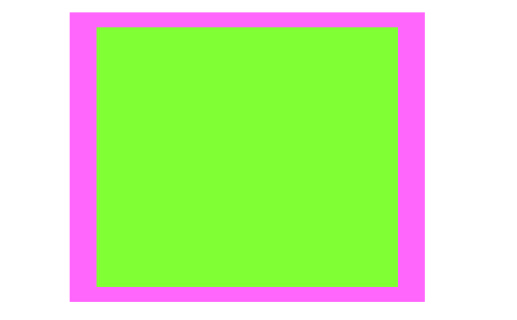
例3: 子视图先平移后旋转
UIView* v1 = [[UIView alloc] initWithFrame:CGRectMake(, , , )];

v1.backgroundColor = [UIColor colorWithRed: green:. blue: alpha:];

UIView* v2 = [[UIView alloc] initWithFrame:v1.bounds];

v2.backgroundColor = [UIColor colorWithRed:. green: blue: alpha:];

[mainview addSubview: v1];

[v1 addSubview: v2];

v2.transform = CGAffineTransformMakeTranslation(, );

v2.transform = CGAffineTransformRotate(v2.transform,  * M_PI/180.0);
效果: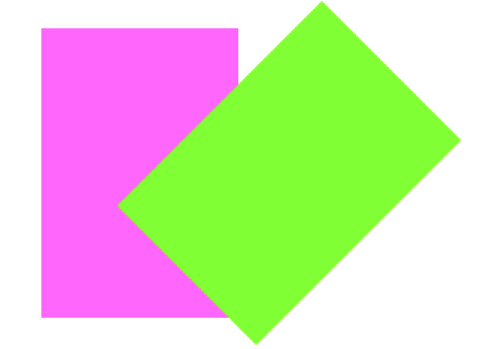
例4: 子视图先旋转后平移
v2.transform = CGAffineTransformMakeRotation( * M_PI/180.0);

v2.transform = CGAffineTransformTranslate(v2.transform, , );
效果:
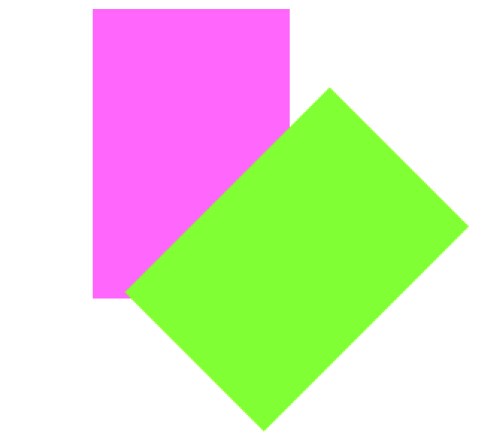
例5: 旋转平移后再反转(删除旋转)
CGAffineTransformConcat - 合并两个变换动作
CGAffineTransform r = CGAffineTransformMakeRotation( * M_PI/180.0);

CGAffineTransform t = CGAffineTransformMakeTranslation(, );

v2.transform = CGAffineTransformConcat(t,r);

v2.transform =

CGAffineTransformConcat(CGAffineTransformInvert(r), v2.transform);
效果:
例6: 倾斜
v1.transform = CGAffineTransformMake(, , -0.2, , , );
效果: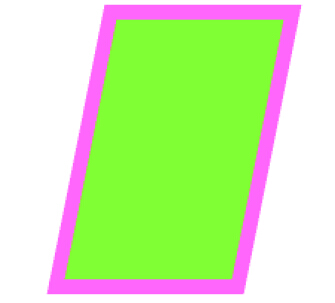
iOS Programming - Views(视图 - 基本绘制,变换,平移,旋转,反转,倾斜)的更多相关文章
- iOS Programming Views :Redrawing and UIScrollView
iOS Programming Views :Redrawing and UIScrollView 1.1 event You are going to see how views are red ...
- iOS Programming View and View Hierarchy 视图和视图等级
iOS Programming View and View Hierarchy 视图和视图等级 1.1(1)File → New → Project.. From the iOS section, ...
- Collection View Programming Guide for iOS---(一)----About iOS Collection Views
Next About iOS Collection Views 关于iOS Collection Views A collection view is a way to present an orde ...
- iOS Programming View Controllers 视图控制器
iOS Programming View Controllers 视图控制器 1.1 A view controller is an instance of a subclass of UIVi ...
- [ios学习笔记之视图、绘制和手势识别]
一 视图 二 绘制 三 手势 00:31 UIGestureRecognizer 抽象类 两步 1添加识别器(控制器或者视图来完成) 2手势识别后要做的事情 UIPanGestureRecognize ...
- Scene视图辅助线绘制
有时候需要在Scene视图中绘制一些辅助线,方便进行一些编辑的工作,可以通过如下类和函数完成: 绘制辅助线,相关类: Gizmos类:用于在Scene视图中绘制调试信息或辅助线,这些辅助线只有在Sce ...
- iOS核心动画高级技巧之图层变换和专用图层(二)
iOS核心动画高级技巧之CALayer(一) iOS核心动画高级技巧之图层变换和专用图层(二)iOS核心动画高级技巧之核心动画(三)iOS核心动画高级技巧之性能(四)iOS核心动画高级技巧之动画总结( ...
- iOS Programming State Restoration 状态存储
iOS Programming State Restoration 状态存储 If iOS ever needs more memory and your application is in the ...
- iOS Programming Introduction to Auto Layout 自动布局
iOS Programming Introduction to Auto Layout 自动布局 A single application that runs natively on both t ...
随机推荐
- python的str,unicode对象的encode和decode方法(转)
python的str,unicode对象的encode和decode方法(转) python的str,unicode对象的encode和decode方法 python中的str对象其实就是" ...
- 北方大学 ACM 多校训练赛 第七场 C Castle(LCA)
[题意]给你N个点,N条不同的边,Q次询问,求出u,v之间的最短路. [分析]题意很简单,就是求最短路,但是Q次啊,暴力DIJ?当然不行,观察到这个题边的数目和点的数目是相同的,也就是说这个图是由一棵 ...
- [BZOJ3456]城市规划(生成函数+多项式求逆+多项式求ln)
城市规划 时间限制:40s 空间限制:256MB 题目描述 刚刚解决完电力网络的问题, 阿狸又被领导的任务给难住了. 刚才说过, 阿狸的国家有n个城市, 现在国家需要在某些城市对之间建立一 ...
- POJ1067 取石子游戏 威佐夫博弈 博弈论
http://poj.org/problem?id=1067 有两堆石子,数量任意,可以不同.游戏开始由两个人轮流取石子.游戏规定,每次有两种不同的取法,一是可以在任意的一堆中取走任意多的石子:二是可 ...
- JZYZOJ1457 [NOIP2016]换教室 期望dp 动态规划 floyd算法 最短路
http://172.20.6.3/Problem_Show.asp?id=1457 我不知道为什么我倒着推期望只有80分,所以我妥协了,我对着题解写了个正的,我有罪. #include<cst ...
- Codeforces 961E 主席树
题意: 给出一个n个数的序列,求有几对(i,j)满足a[i]>=j&&a[j]>=i,(i,j)和(j,i)只能算一对. 考虑第i个数会有几个j(j<i)满足条件,首 ...
- 【计算几何】【圆反演】hdu6097 Mindis
给你一个中心在原点的圆,再给你俩在圆内且到原点距离相等的点P,Q,让你在圆上求一点D,最小化DP+DQ. http://blog.csdn.net/qq_34845082/article/detail ...
- bzoj 4627: [BeiJing2016]回转寿司
4627: [BeiJing2016]回转寿司 Description 酷爱日料的小Z经常光顾学校东门外的回转寿司店.在这里,一盘盘寿司通过传送带依次呈现在小Z眼前.不同的寿 司带给小Z的味觉感受是不 ...
- [Andrew Stankevich's Contest#21] Lempel-Ziv Compression
Time Limit: 20000/10000MS (Java/Others) Memory Limit: 128000/64000KB (Java/Others) Special Judge ...
- #Java Web累积#表格<table>中隐藏列做备用数据
初入JW,MyEclipse,JS文件中码砖时怎么连个提示都没有. 步骤1 JSP代码中,Table多出一列,如下列代码中的 Other,其中css文件中将col00的width设置为0px; < ...