
@RequestBody与serialize()、serializeArray()、拼接Json 妙用总结
@requestBody注解常用来处理content-type不是默认的application/x-www-form-urlcoded编码的内容,
比如说:application/json或者是application/xml等。一般情况下来说常用其来处理application/json类型。
jQuery序列化表单的方法总结
现在这里贴出案例中静态的html网页内容:
<!DOCTYPE html>
<html lang="en">
<head>
<meta charset="UTF-8">
<title>Title</title>
</head>
<body>
<form id="test_form">
账户:<input type="text" name="username" value="user"/><br>
密码:<input type="password" name="password" value="123"><br>
<input type="button" value="序列化为(Key=Value)格式Url"onclick="testJquerySerializeUrl()" id="serializeUrl"/>
<input type="button" value="序列化为json" onclick="testJquerySerializeArray()" id="serializeJson"/>
<input type="button" value="手动拼接为json" onclick="testAutoSetJsonData()" id="autoSetJson"/>
</form>
</body>
知识点一:表单序列化serialize()
不需要使用@RequestBody
方法介绍:
作用:序列表单内容为字符串。
参数: 无
Content-Type:application/x-www-form-urlencoded; charset=UTF-8
默认返回类型,不需要使用@RequestBody
案例代码:
<script>

    function testJquerySerializeUrl() {

		alert($("#test_form").serialize());

        console.log($("#test_form").serialize());

        $.ajax({

            url: "/SerializeUrl",

            type: "post",

            data: $("#test_form").serialize()

        })

    }

</script>
后台代码:
@RequestMapping("/SerializeUrl")

public void hello( user user){

   System.out.println(user);

}
测试结果:
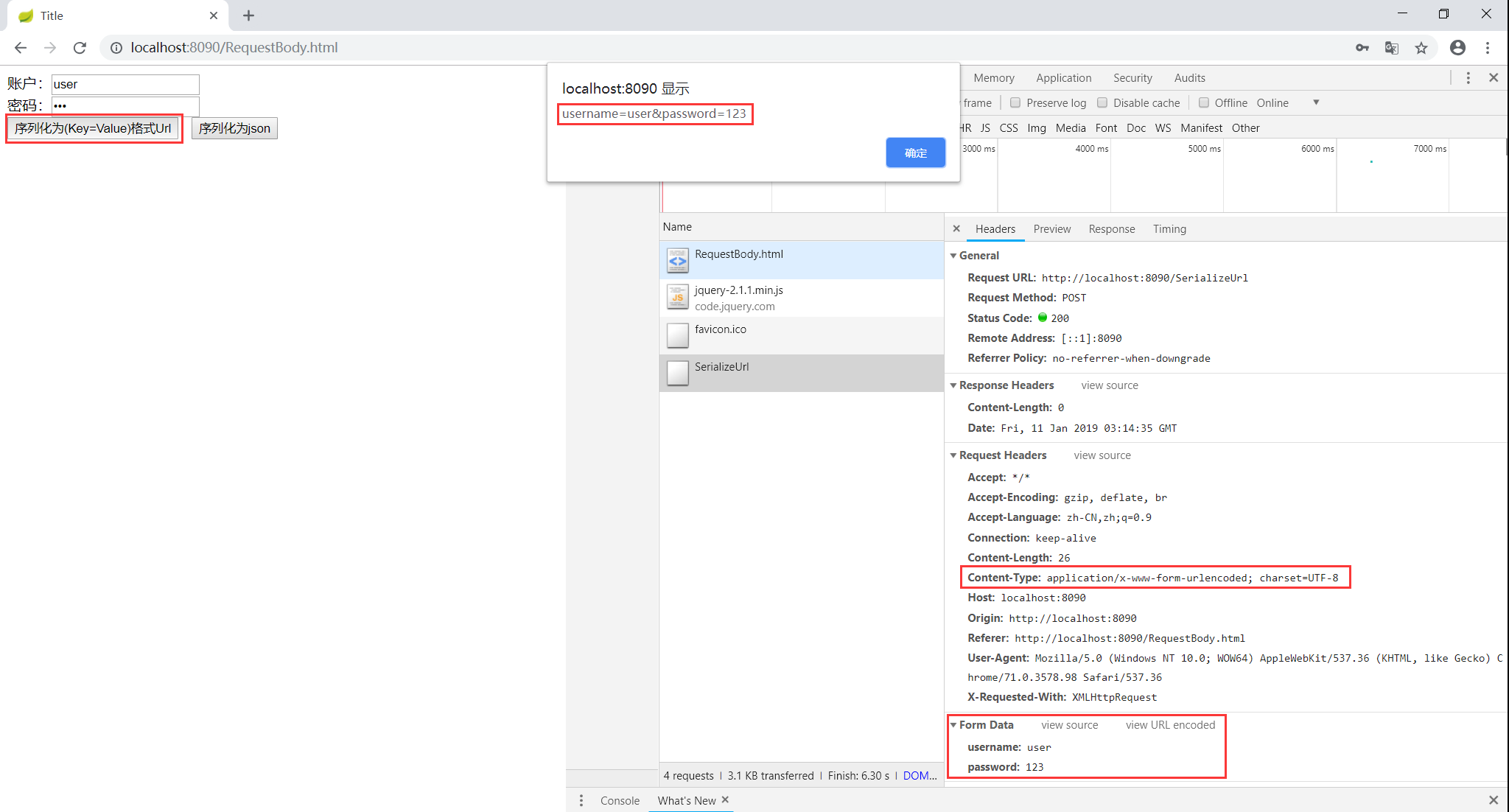
总结: ajax使用默认Content-Type:
application/x-www-form-urlencoded; charset=UTF-81.我们看到输出的结果为表单项中的各表单元素的name和value值
2.格式是以 KEY:VALUE 参数的形式
需要使用@RequestBody
作用:序列表单内容为字符串。
参数: 无
Content-Type:contentType: "application/json"
需要使用@RequestBody
案例:
<script>

    function testJquerySerializeUrl() {

		alert($("#test_form").serialize());

        console.log($("#test_form").serialize());

        $.ajax({

            url: "/SerializeUrl",

            type: "post",

            data: $("#test_form").serialize(),

    		contentType: "application/json"

        })

    }

</script>
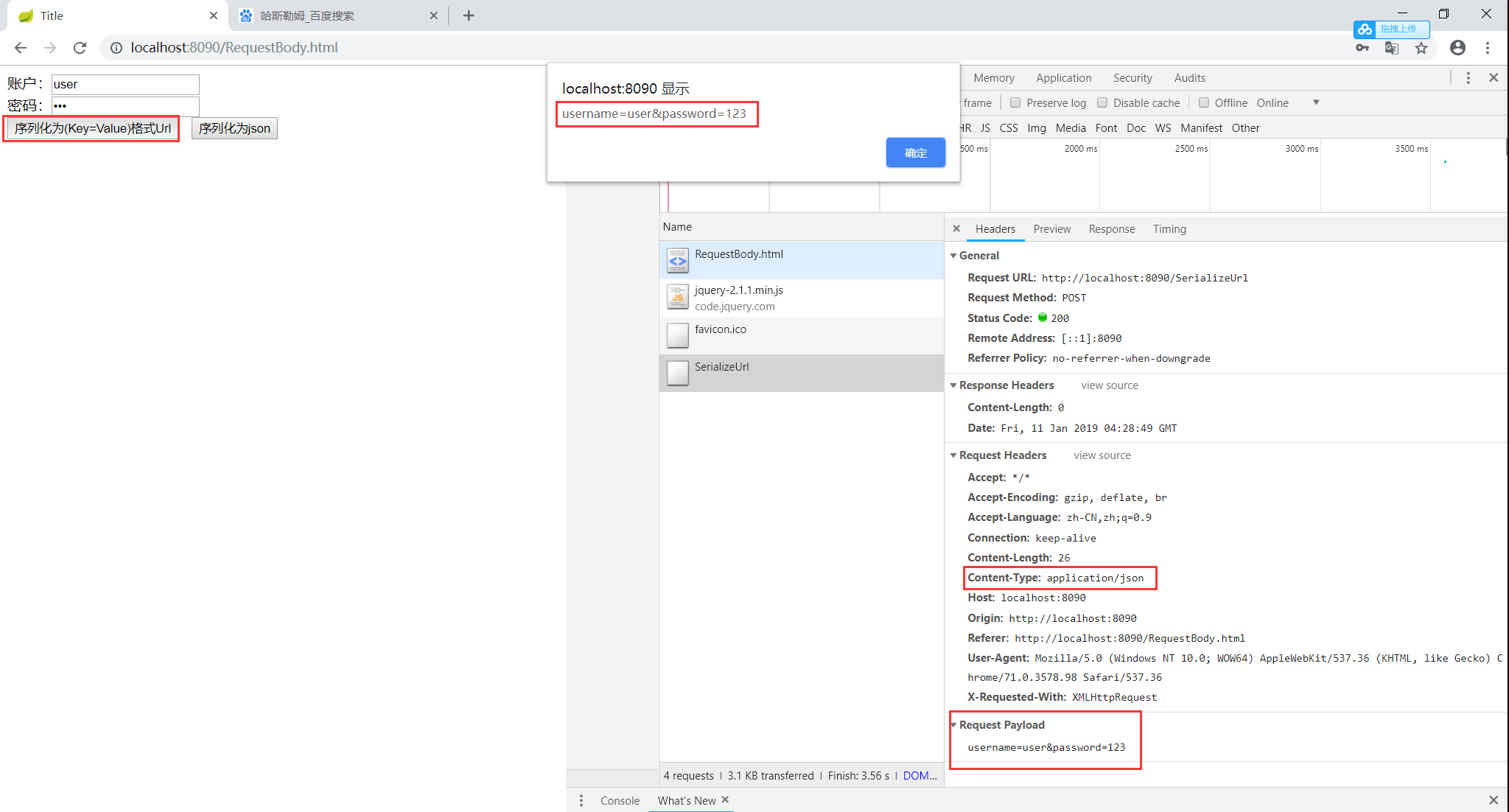
有上图可以看到请求体的值为:username=user&password=123,此时后台使用无法接收到传回的值的。需要重新组装表单序列化Url为Json串,然后通过JSON.stringify()将javascript值转成json字符串
<script>

    function testJquerySerializeUrl() {

        alert(JSON.stringify($("#test_form").serialize()));

        console.log($("#test_form").serialize());

        //重新组装表单序列化Url为Json串

        var jsonData = {}

        var serializeStr = $("#test_form").serialize();

        var array = serializeStr.split("&");

        $(array).each(function (i) {

            jsonData[array[i].split("=")[0]] = array[i].split("=")[1];

        })

        console.log(jsonData);

        $.ajax({

            url: "/SerializeUrl",

            type: "post",

            data: JSON.stringify(jsonData),

            contentType: "application/json"

        })

    }

</script>
后台代码:添加@RequestBody
@RequestMapping("/SerializeUrl")

public void SerializeUrl(@RequestBody user user){

    System.out.println(user);

}
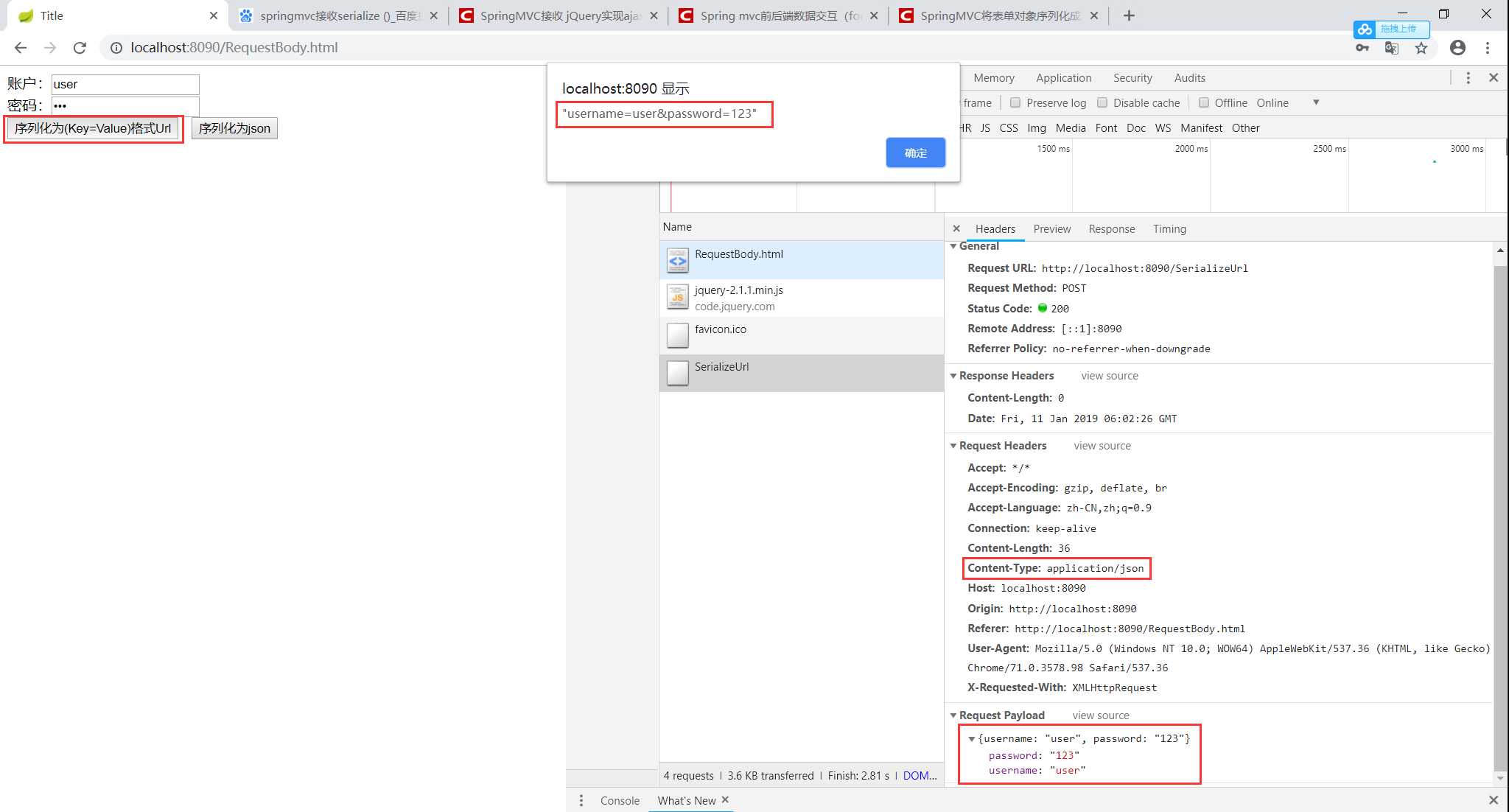
总结:ajax使用Content-Type:
contentType: "application/json"1.我们看到输出的结果为表单项中的各表单元素的name和value值
2.格式是以url参数的形式,第一个参数前面没有&符号
知识点二:表单序列化serializeArray()方法
不需要使用@RequestBody
方法介绍:
作用:序列化表格元素 (类似 '.serialize()' 方法) 返回 JSON 数据结构数据。
参数:无
返回值:返回的是JSON对象而非JSON字符串Content-Type:`application/x-www-form-urlencoded; charset=UTF-8
案例:
<script>

    function testJquerySerializeArray() {

        alert($("#test_form").serializeArray());

        console.log($("#test_form").serializeArray());

        $.ajax({

            url: "/SerializeArray",

            type: "post",

            data: $("#test_form").serializeArray(),

        })

    }

</script>
后台代码:
@RequestMapping("/SerializeArray")

public void SerializeArray(user user){

    System.out.println(user);

}
测试结果:
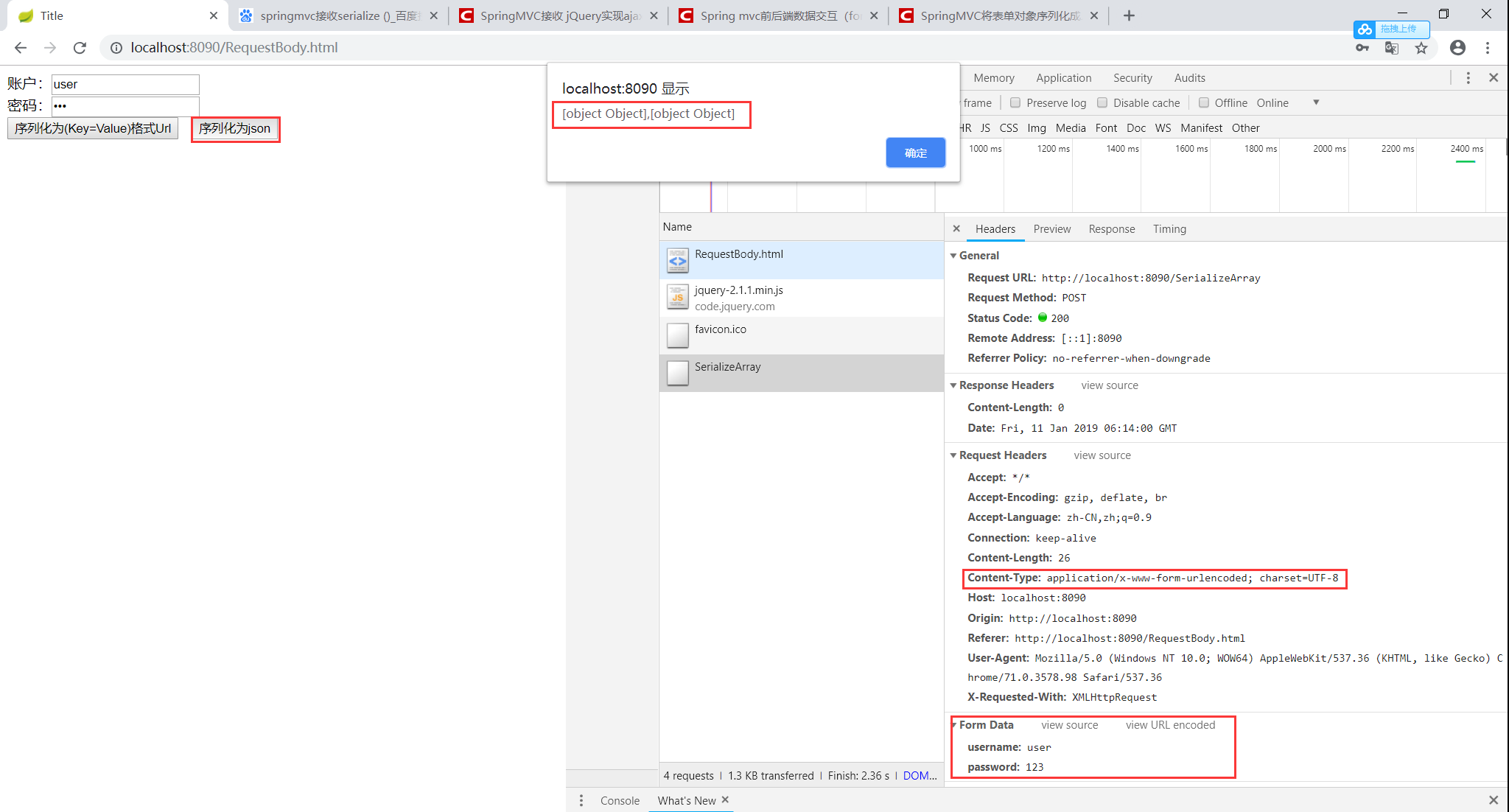
总结: ajax使用默认Content-Type:
application/x-www-form-urlencoded; charset=UTF-81.我们看到输出的结果为Json
[
{name: 'firstname', value: 'Hello'},
{name: 'lastname', value: 'World'},
{name: 'alias'}, // this one was empty
]
需要使用@RequestBody
案例:
<script>

    function testJquerySerializeArray() {

        alert($("#test_form").serializeArray());

        console.log($("#test_form").serializeArray());

        var jsonData = {};

        var serializeArray = $("#test_form").serializeArray();

        // 先转换成{"id": ["12","14"], "name": ["aaa","bbb"], "pwd":["pwd1","pwd2"]}这种形式

        $(serializeArray).each(function () {

            if (jsonData[this.name]) {

                if ($.isArray(jsonData[this.name])) {

                    jsonData[this.name].push(this.value);

                } else {

                    jsonData[this.name] = [jsonData[this.name], this.value];

                }

            } else {

                jsonData[this.name] = this.value;

            }

        });

        console.log(jsonData);

        $.ajax({

            url: "/SerializeArray",

            type: "post",

            data: JSON.stringify(jsonData),

            contentType: "application/json"

        })

    }

</script>
后台代码:添加@RequestBody
@RequestMapping("/SerializeArray")

public void SerializeArray(@RequestBody user user){

    System.out.println(user);

}
测试结果:
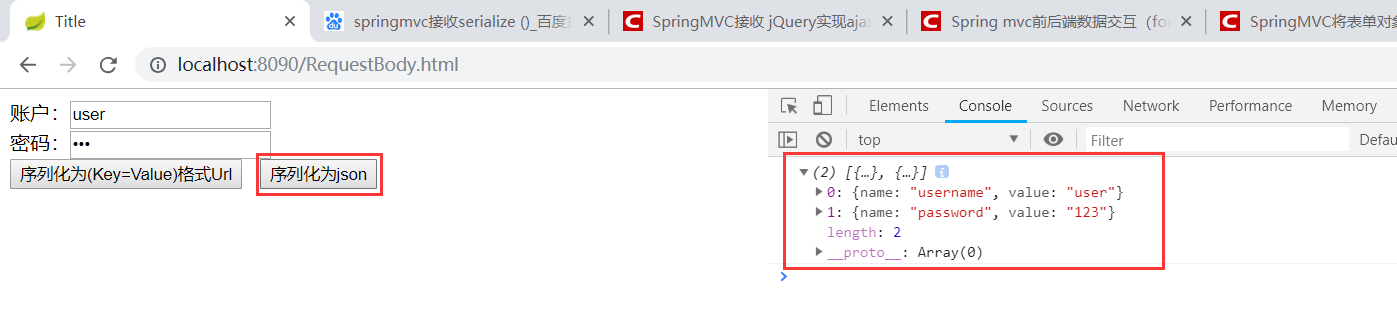
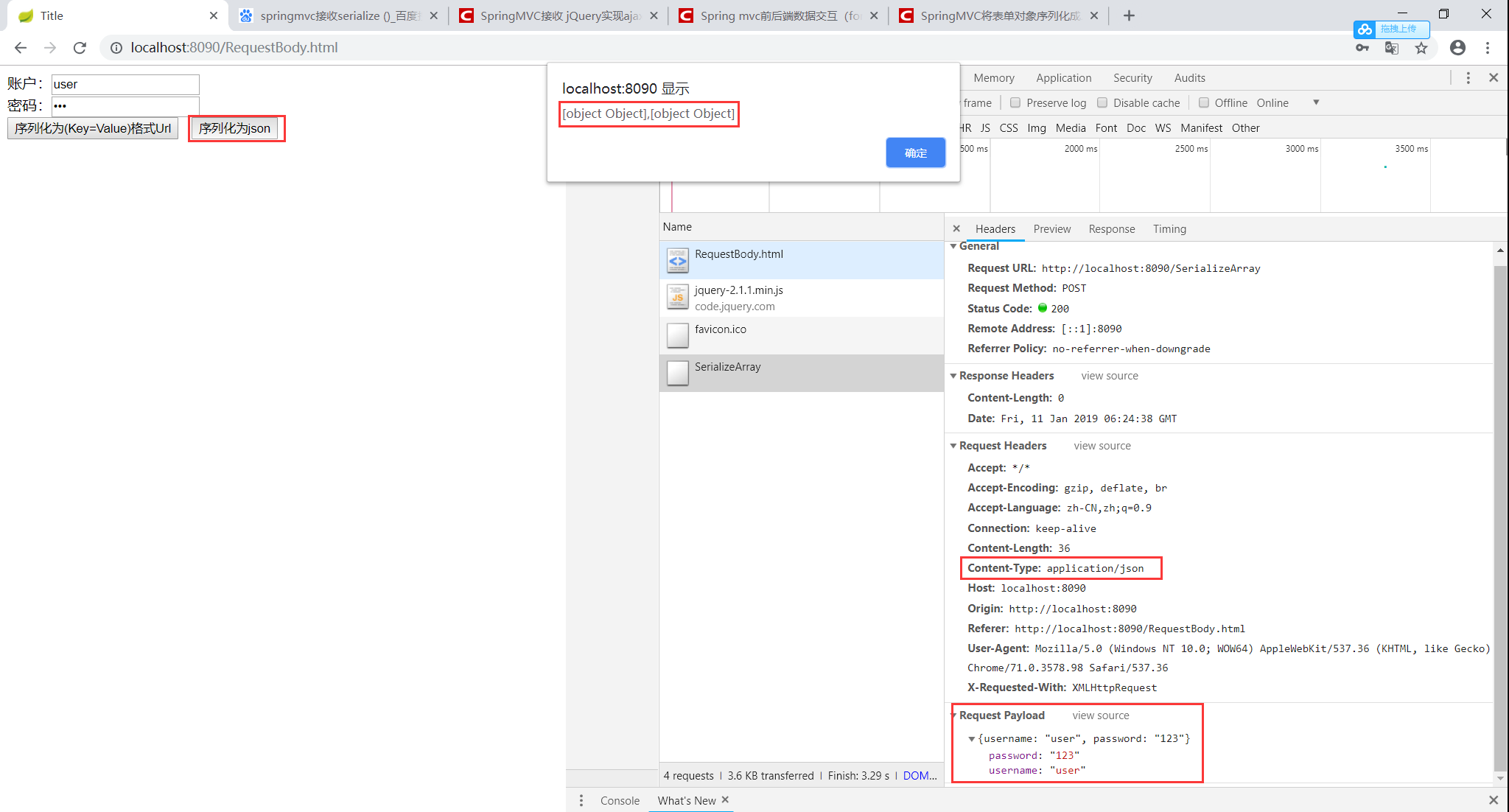
有上图可以看到console.log打印出来为一个json对象,此时使用@RequestBody后台无法接收。需要重新组装表单序列化json对象为Json串,然后通过JSON.stringify()将javascript值转成json字符串
总结:
1.我们看到调用方法返回的是json对象
2.可是用JSON.stringify()方法将json对象转化为json字符串
知识点三:拼接json串
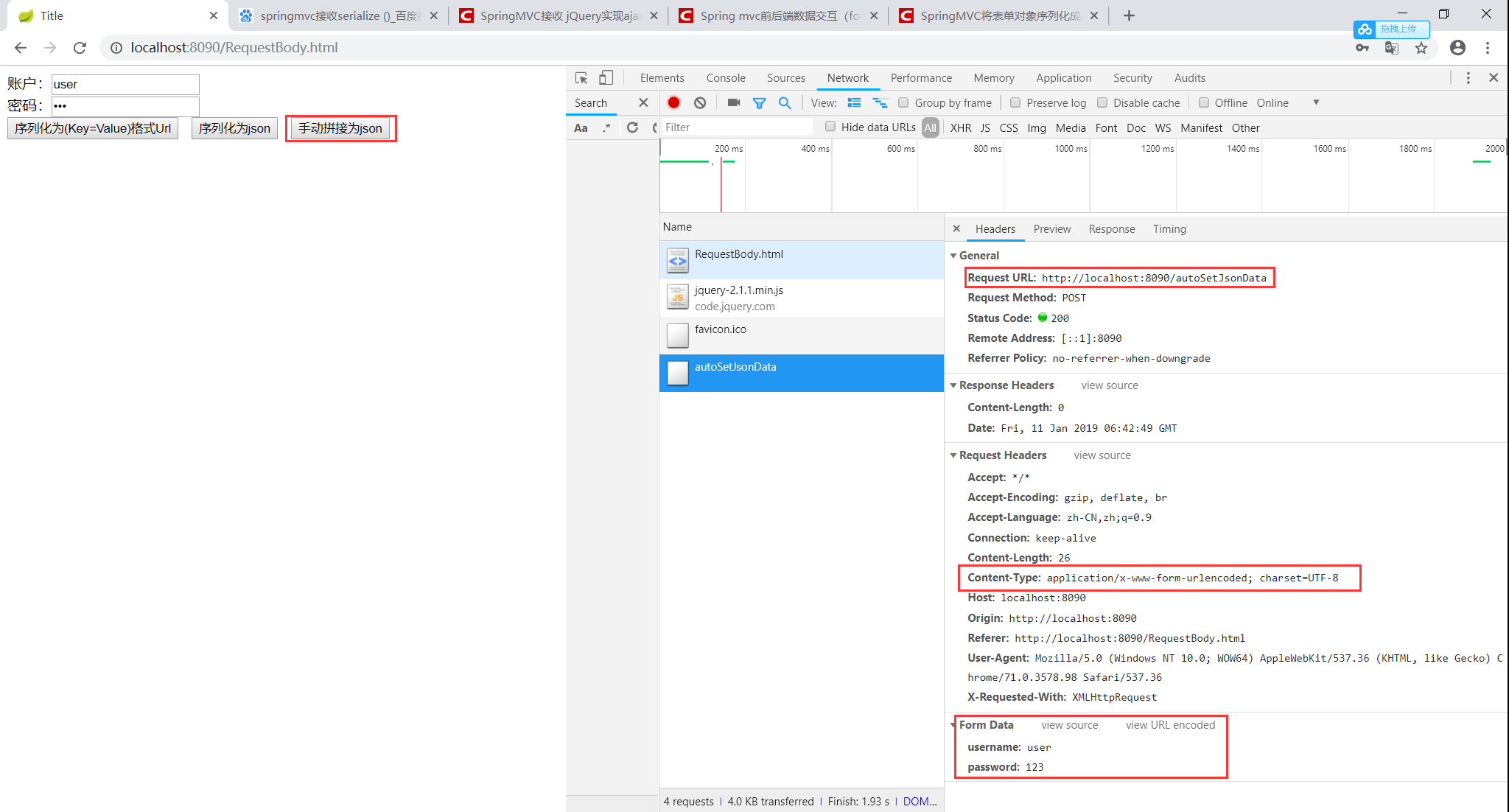
不需要使用@RequestBody
案例:
<script>

    function testAutoSetJsonData() {

        $.ajax({

            url:"/autoSetJsonData",

            type:"post",

            data:{

                username:"user",

                password:"123"

            }

        })

    }

</script>
后台代码:
@RequestMapping("/autoSetJsonData")

public void autoSetJsonData(user user){

    System.out.println(user);

}
测试结果:
需要使用@RequestBody
案例:
<script>

    function testAutoSetJsonData() {

        $.ajax({

            url:"/autoSetJsonData",

            type:"post",

            data:JSON.stringify({

                username:"user",

                password:"123"

            }),

            contentType: "application/json"

        })

    }

</script>
后台代码:添加@RequestBody
@RequestMapping("/autoSetJsonData")

public void autoSetJsonData(@RequestBody user user){

    System.out.println(user);

}
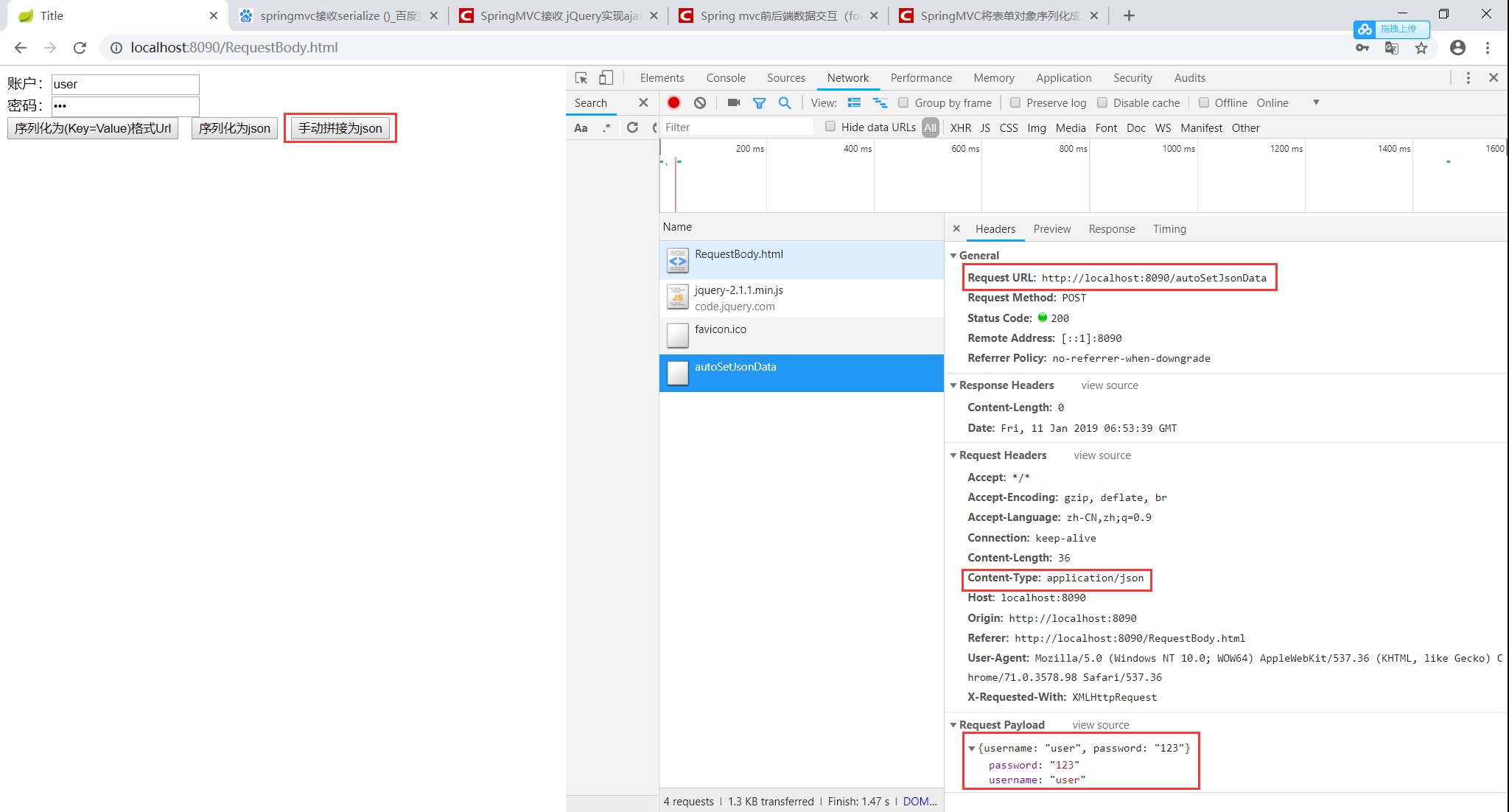
测试结果:
总结
拿好小本子记笔记了
@RequestBody接收的是一个Json对象的字符串,而不是一个Json对象/javascript值(重点)。所以为什么在使用
@RequestBody接收contentType:"application/json"的数据时,后台一直显示为null,是需要将data数据使用JSON.stringify()转换成json字符串,当然也可以使用字符串拼接的方式。
扩展:@RequestParam 用于默认 Content-Type:application/x-www-form-urlencoded; charset=UTF-8,接收Url指定的参数
相关博客连接:
jQuery序列化表单的方法总结(serialize()、serializeArray())
Github测试代码:
https://github.com/YoCiyy/springboot-helloworld
@RequestBody与serialize()、serializeArray()、拼接Json 妙用总结的更多相关文章
- jQuery序列化表单 serialize() serializeArray()
1.serialize()方法 描述:序列化表单内容为字符串,用于Ajax请求. 格式:var data = $(form).serialize(); 2.serializeArray()方法 描述: ...
- jQuery序列化表单 serialize() serializeArray()(非常重要)
https://m.2cto.com/kf/201412/361303.html 2014-12-15 1.serialize()方法 描述:序列化表单内容为字符串,用于Ajax请求. 格式:var ...
- IOS开发之——使用SBJson拼接Json字符串
SBJson包的下载地址在上一篇文章中. 能够使用NSDictionary中的键值对来拼接Json数据,很方便,也能够进行嵌套,直接上代码: //開始拼接Json字符串 NSDictionary *d ...
- 在SpringMVC中使用@RequestBody和@ResponseBody注解处理json时,报出HTTP Status 415的解决方案
我在使用SpringMVC的@RequestBody和@ResponseBody注解处理JSON数据的时候,总是出现415的错误,说是不支持所提交数据格式,我在页面中使用了JQuery的AJAX来发出 ...
- Atitit php序列化 php的serialize序列化和json序列化
Atitit php序列化 php的serialize序列化和json序列化 PHP 对不同类型的数据用不同的字母进行标示,Yahoo 开发网站提供的Using Serialized PHP with ...
- @RequestBody接收的是一个json对象
一直以为在SpringMVC环境中,@RequestBody接收的是一个json对象,调试代码时没有成功,后来才发现,其实 @RequestBody接收的是一个json字符串,而不是一个json对象. ...
- jQuery 序列化表单 serialize() serializeArray()
1.serialize()方法 格式:var data = $("form").serialize(); 功能:将表单内容序列化成一个字符串. 这样在ajax提交表单数据时,就不用 ...
- jQuery 序列化表单数据 serialize() serializeArray()
1.serialize()方法 格式:var data = $("form").serialize(); 功能:将表单内容序列化成一个字符串. 这样在ajax提交表单数据时,就不用 ...
- jQuery使用serialize(),serializeArray()方法取得表单数据+字符串和对象类型两种表单提交的方法
原始form表单值获取方式(手动): $.ajax({ type: "POST", url: "ajax.php", data: "Name=摘取天上 ...
随机推荐
- “全栈2019”Java第六十九章:内部类访问外部类成员详解
难度 初级 学习时间 10分钟 适合人群 零基础 开发语言 Java 开发环境 JDK v11 IntelliJ IDEA v2018.3 文章原文链接 "全栈2019"Java第 ...
- java 程序设计第一次作业
public class Join{ public static void main(String args[]){ String s1=new String("hello"); ...
- [Swift实际操作]八、实用进阶-(8)使用performSegue在故事板页面之间进行数据传递
本文将演示故事板页面之间的数据传递.首先在一个空白项目中,打开项目自带的故事板文件(Main.storyboard).故事板中已经拥有了一个视图控制器,点击选择该视图控制器.然后依此点击[Editor ...
- linux校验时间
一. 基本方法:date -s "2018-09-02 04:23:45"clock -w 把时间写入cmos(一个RAM芯片) hwclock 查看硬件时间 hwclock ...
- H5新手教程,小白来看看。
H5教程(一) 相信点进来看这篇文章的应该都是刚刚接触H5的新手,那么你真的是找到了一篇合适的文章. 1.学习前准备 既然想学习好H5,只是这样看是不够的,还需要动手练习,以及及时复习,所以我推荐几款 ...
- Django 学习资源
相关的分享: 开发者头条:http://toutiao.io/search?utf8=%E2%9C%93&q=django 极客头条及Django资讯:http://www.csdn.net/ ...
- 模块化之seaJs学习和使用
使用seaJs也有一阵子了,一直也想抽个时间写个这方面的博客,直到今天才写……也许写的不是很完善,但跟大伙分享也是一种乐趣,不对之处欢迎指出.[抱拳] 时间有限,我这里不过多介绍前端模块化,有兴趣可以 ...
- vue 浏览器滚动行为
import Vue from 'vue' import App from './App.vue' import VueRouter from 'vue-router' import {routes} ...
- springMVC的一些入门配置
1.springMVC的描述 1.1.SpringMVC是Spring框架内置的MVC的实现.SpringMVC就是一个Spring内置的MVC子框架. 1.2.SpringMVC的作用是实现页面和后 ...
- cookie session token详解
cookie session token详解 转自:http://www.cnblogs.com/moyand/ 发展史 1.很久很久以前,Web 基本上就是文档的浏览而已, 既然是浏览,作为服务器, ...