
Linux命令学习总结:rm命令
命令简介:
该命令用来删除Linux系统中的文件或目录。通常情况下rm不会删除目录,你必须通过指定参数-r或-R来删除目录。另外rm通常可以将该文件或目录恢复(注意,rm删除文件其实只是将指向数据块的索引点(information nodes)释放,只要不被覆盖,数据其实还在硬盘上。如果想要保证文件的内容无法复原,可以使用命令shred 。 另外一般还是要慎用rm -rf *这样的命令。
执行权限 :All User
指令所在路径:/bin/rm
命令语法:
rm [OPTION]... FILE...
命令参数:
|
参数 |
长参数 |
描叙 |
|
-f |
--force |
强制删除,忽略不存在的文件,从不给出提示。 |
|
-i |
--interactive |
交互模式删除文件,删除文件前给出提示。 |
|
-r |
--recursive |
递归的删除目录下面文件以及子目录下文件。 |
|
-R |
--recursive |
递归的删除目录下面文件以及子目录下文件。 |
|
-v |
--verbose |
显示运行时详细信息 |
|
--help |
显示命令在线帮助 |
|
|
--version |
显示命令版本信息 |
使用示例:
1:查看获取rm命令的帮助信息。
[root@DB-Server kerry]# man rm
RM(1) User Commands RM(1)
NAME
rm - remove files or directories
SYNOPSIS
rm [OPTION]... FILE...
DESCRIPTION
This manual page documents the GNU version of rm. rm removes each specified file. By default, it does not remove directories.
If a file is unwritable, the standard input is a tty, and the -f or --force option is not given, rm prompts the user for whether to remove the file. If
the response is not affirmative, the file is skipped.
OPTIONS
Remove (unlink) the FILE(s).
-f, --force
ignore nonexistent files, never prompt
-i, --interactive
prompt before any removal
--no-preserve-root do not treat 鈥?鈥?specially (the default)
--preserve-root
fail to operate recursively on 鈥?鈥?
-r, -R, --recursive
remove directories and their contents recursively
-v, --verbose
explain what is being done
--help display this help and exit
--version
output version information and exit
By default, rm does not remove directories. Use the --recursive (-r or -R) option to remove each listed directory, too, along with all of its contents.
To remove a file whose name starts with a 鈥?鈥? for example 鈥?foo鈥? use one of these commands:
rm -- -foo
rm ./-foo
Note that if you use rm to remove a file, it is usually possible to recover the contents of that file. If you want more assurance that the contents are
truly unrecoverable, consider using shred.
AUTHOR
Written by Paul Rubin, David MacKenzie, Richard Stallman, and Jim Meyering.
REPORTING BUGS
Report bugs to <bug-coreutils@gnu.org>.
COPYRIGHT
Copyright 漏 2006 Free Software Foundation, Inc.
This is free software. You may redistribute copies of it under the terms of the GNU General Public License <http://www.gnu.org/licenses/gpl.html>. There
is NO WARRANTY, to the extent permitted by law.
SEE ALSO
chattr(1), shred(1)
The full documentation for rm is maintained as a Texinfo manual. If the info and rm programs are properly installed at your site, the command
info rm
should give you access to the complete manual.
rm 5.97 June 2011 RM(1)
[root@DB-Server kerry]# rm --help
Usage: rm [OPTION]... FILE...
Remove (unlink) the FILE(s).
-f, --force ignore nonexistent files, never prompt
-i, --interactive prompt before any removal
--no-preserve-root do not treat `/' specially (the default)
--preserve-root fail to operate recursively on `/'
-r, -R, --recursive remove directories and their contents recursively
-v, --verbose explain what is being done
--help display this help and exit
--version output version information and exit
By default, rm does not remove directories. Use the --recursive (-r or -R)
option to remove each listed directory, too, along with all of its contents.
To remove a file whose name starts with a `-', for example `-foo',
use one of these commands:
rm -- -foo
rm ./-foo
Note that if you use rm to remove a file, it is usually possible to recover
the contents of that file. If you want more assurance that the contents are
truly unrecoverable, consider using shred.
Report bugs to bug-coreutils@gnu.org.
2:删除指定文件
如下所示,该目录下有20个文件,删除指定文件后,只剩下19个文件了。
[oracle@DB-Server bdump]$ ls -lrt | wc -l
20
[oracle@DB-Server bdump]$ rm gsp_lgwr_7826.trc
[oracle@DB-Server bdump]$ ls -lrt | wc -l
19
3:删除文件显示运行时详细信息
[oracle@DB-Server bdump]$ rm -v gsp_lgwr_4617.trc
removed `gsp_lgwr_4617.trc'
4:交互模式下删除文件
如下所示,输入y后就会删除文件,不想删除则数据n
[oracle@DB-Server bdump]$ rm -iv gsp_lgwr_5005.trc
rm: remove regular file `gsp_lgwr_5005.trc'? y
removed `gsp_lgwr_5005.trc'
[oracle@DB-Server bdump]$ rm -iv gsp_lgwr_7826.trc
rm: remove regular file `gsp_lgwr_7826.trc'? n
5: 递归删除某个目录下文件以及子目录
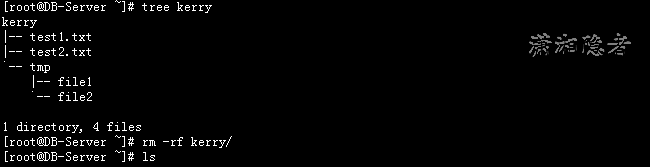
如下所示,kerry目录下有test1.txt、 test2.txt 文件,以及子目录tmp, 而子目录下又有文件file1、file2.
[root@DB-Server ~]# tree kerry
kerry
|-- test1.txt
|-- test2.txt
`-- tmp
|-- file1
`-- file2
1 directory, 4 files
[root@DB-Server ~]# rm -rf kerry/
6: 删除空目录
[root@DB-Server ~]# mkdir kerry
[root@DB-Server ~]# rm -r kerry/
rm: remove directory `kerry/'? y
7:删除目录bdump下的所有trc文件类型的文件。
[oracle@DB-Server bdump]$ ls
alert_GSP.log gsp_lgwr_20025.trc gsp_lgwr_5023.trc gsp_p000_4637.trc gsp_p000_4718.trc gsp_p000_5025.trc gsp_p001_4639.trc gsp_p001_4720.trc gsp_p001_5027.trc
gsp_lgwr_19915.trc gsp_lgwr_4719.trc gsp_lgwr_5089.trc gsp_p000_4682.trc gsp_p000_4739.trc gsp_p000_5043.trc gsp_p001_4684.trc gsp_p001_4741.trc gsp_p001_5045.trc
[oracle@DB-Server bdump]$ rm -v *.trc
removed `gsp_lgwr_19915.trc'
removed `gsp_lgwr_20025.trc'
removed `gsp_lgwr_4719.trc'
removed `gsp_lgwr_5023.trc'
removed `gsp_lgwr_5089.trc'
removed `gsp_p000_4637.trc'
removed `gsp_p000_4682.trc'
removed `gsp_p000_4718.trc'
removed `gsp_p000_4739.trc'
removed `gsp_p000_5025.trc'
removed `gsp_p000_5043.trc'
removed `gsp_p001_4639.trc'
removed `gsp_p001_4684.trc'
removed `gsp_p001_4720.trc'
removed `gsp_p001_4741.trc'
removed `gsp_p001_5027.trc'
removed `gsp_p001_5045.trc'
参考资料:
http://www.cnblogs.com/peida/archive/2012/10/26/2740521.html
Linux命令学习总结:rm命令的更多相关文章
- Linux初学习之 rm 命令
现在我们来仔细的学习一下linux的rm命令,这个命令顾名思义(我猜的,嘻嘻,是remove) 命令格式: rm [OPTION]... FILE... Remove (unlink) the FIL ...
- Linux 命令学习之rm
功能说明: rm 命令是对文件或目录进行删除操作. 语法:rm [-dfirv][--help][--version][文件或目录...] 补充说明:执行rm指令可删除文件或目录,如欲删除目录必须加上 ...
- linux每天一小步---rm命令详解
1 命令功能 rm命令用于删除文件或者目录,值得注意的是linux下的删除不弯曲等同于windows系统下的删除操作,linux系统下一旦删除了文件或者目录那么它将消失,而windows系统下我们还可 ...
- linux shell 学习笔记--内部命令学习
.基本命令 新手必须要掌握的初级命令 ls 基本的列出所有文件的命令.但是往往就是因为这个命令太简单,所以我们总是低估它.比如 ,用 -R 选项,这是递归选项,ls 将会以目录树的形式列出所有文件, ...
- LINUX基础学习之基础命令(4)和 文件的inode信息 --2019-11-28
一.inode是什么? 理解inode,要从文件储存说起. 文件储存在硬盘上,硬盘的最小存储单位叫做”扇区”(Sector).每个扇区储存512字节(相当于0.5KB). 操作系统读取硬盘的时候,不会 ...
- Linux基础学习之基础命令(1)--2019-11-14
查看命令路径其他方法: which 命令: which [options] [--] programname [...] -a:显示所有匹配的程序文件,而非第一个: --skip-alias:略过别名 ...
- Linux命令学习神器!命令看不懂直接给你解释!
大家都知道,Linux 系统有非常多的命令,而且每个命令又有非常多的用法,想要全部记住所有命令的所有用法,恐怕是一件不可能完成的任务. 一般情况下,我们学习一个命令时,要么直接百度去搜索它的用法,要么 ...
- linux每日命令(6):rm命令
rm是常用的命令,该命令的功能为删除一个目录中的一个或多个文件或目录,它也可以将某个目录及其下的所有文件及子目录均删除.对于链接文件,只是删除了链接,原有文件均保持不变. rm是一个危险的命令,使用的 ...
- Linux命令学习之xargs命令
xargs命令是给其他命令传递参数的一个过滤器,也是组合多个命令的一个工具.它擅长将标准输入数据转换成命令行参数,xargs能够处理管道或者stdin并将其转换成特定命令的命令参数.xargs也可以将 ...
- Linux命令学习笔记- vmstat命令实战详解
vmstat命令是最常见的Linux/Unix监控工具,可以展现给定时间间隔的服务器的状态值,包括服务器的CPU使用率,内存使用,虚拟内存交换情况,IO读写情况.这个命令是我查看Linux/Unix最 ...
随机推荐
- [Keras] mnist with cnn
典型的卷积神经网络. Keras傻瓜式读取数据:自动下载,自动解压,自动加载. # X_train: array([[[[ 0., 0., 0., ..., 0., 0., 0.], [ 0., 0. ...
- Spring 4 + Reactor Integration Example--转
原文地址:http://www.concretepage.com/spring-4/spring-4-reactor-integration-example Reactor is a framewor ...
- ubuntu super daemon设置
super daemon是一个在Linux下面全面管理自己服务设置的东东,他可以接管很多服务的设定,只需要在/etc/xinetd.d/下面放置好自己的配置文件就可以了,那么,具体应该怎么配置呢? ...
- 浅析.NET的反射特性
在.net框架体系内,反射特性较多的应用到.反射的相关定义分为两种. 自然解释:射是一种自然现象,表现为受刺激物对刺激物的逆反应:这是反射的字面解释,我们看一下计算机编程中的反射: 编程解释:通过 S ...
- Mybatis 入门 -- 最简单的引入和使用
参考:http://www.mybatis.org/mybatis-3/zh/getting-started.html 从今天开始学习官方文档. 1.项目搭建 项目结构: 首先,搭建一个maven项目 ...
- ODBC database driver for Go:Go语言通过ODBC 访问SQL server
Go语言通过ODBC 访问SQL server,这里需要用到go-odbc库,开源地址::https://github.com/weigj/go-odbc 一.驱动安装 在cmd中打开GOPATH: ...
- Net设计模式实例之简单工厂模式(Simple Factory Pattern)
一.简单工厂模式简介(Bref Introduction) 简单工厂模式(Simple Factory Pattern)的优点是,工厂类中包含了必要的逻辑判断,根据客户端的选择条件动态实例化相关的类, ...
- 【手记】F5调试报"由于缺少调试目标xxx无法开始调试xxx设置OutputPath和AssemblyName"
问题如图: 如果先点[生成]项目,再按F5调试就不会报错,但稍后修改代码后再次调试,会发现VS启动的是代码修改前的程序,也就是说,深一层的问题其实是调试时不会先生成,而是直接打开debug/relea ...
- SQL Server 中 EXEC 与 SP_EXECUTESQL 的区别
SQL Server 中 EXEC 与 SP_EXECUTESQL 的区别 MSSQL为我们提供了两种动态执行SQL语句的命令,分别是 EXEC 和 SP_EXECUTESQL ,我们先来看一下两种方 ...
- 无法为目标平台“Microsoft.Data.Tools.Schema.Sql.Sql120DatabaseSchemaProvider”创建扩展管理器
很久没写博客了,这段时间情绪不那么稳定,还是心态的问题... 就简单写个问题的解决方法吧,其实最近遇到的问题蛮多的,就拿这个解决过后又遇到的来写吧. 正如标题一样:VS2013 无法为目标平台“Mic ...