
oauth2.0密码模式详解
oauth2.0密码模式
欢迎关注博主公众号「Java大师」, 专注于分享Java领域干货文章http://www.javaman.cn/sb2/oauth-password
如果你高度信任某个应用,RFC 6749 也允许用户把用户名和密码,直接告诉该应用。该应用就使用你的密码,申请令牌,这种方式称为"密码式"(password)。
1、密码模式流程
第一步,A 网站要求用户提供 B 网站的用户名和密码。拿到以后,A 就直接向 B 请求令牌。
https://oauth.b.com/token?

  grant_type=password&

  username=USERNAME&

  password=PASSWORD&

  client_id=CLIENT_ID
上面 URL 中,grant_type参数是授权方式,这里的password表示"密码式",username和password是 B 的用户名和密码。
第二步,B 网站验证身份通过后,直接给出令牌。注意,这时不需要跳转,而是把令牌放在 JSON 数据里面,作为 HTTP 回应,A 因此拿到令牌。
这种方式需要用户给出自己的用户名/密码,显然风险很大,因此只适用于其他授权方式都无法采用的情况,而且必须是用户高度信任的应用。
2、密码模式实现代码
2.1 创建pom.xml
<?xml version="1.0" encoding="UTF-8"?>

<project xmlns="http://maven.apache.org/POM/4.0.0" xmlns:xsi="http://www.w3.org/2001/XMLSchema-instance"

         xsi:schemaLocation="http://maven.apache.org/POM/4.0.0 https://maven.apache.org/xsd/maven-4.0.0.xsd">

    <modelVersion>4.0.0</modelVersion>

    <parent>

        <groupId>org.springframework.boot</groupId>

        <artifactId>spring-boot-starter-parent</artifactId>

        <version>2.2.6.RELEASE</version>

        <relativePath/> <!-- lookup parent from repository -->

    </parent>

    <groupId>com.dashi</groupId>

    <artifactId>springsecurity-oauth</artifactId>

    <version>0.0.1-SNAPSHOT</version>

    <name>springsecurity-oauth</name>

    <description>Demo project for Spring Boot</description>

    <properties>

        <java.version>1.8</java.version>

        <spring-cloud.version>Greenwich.SR5</spring-cloud.version>

    </properties>

    <dependencies>

        <dependency>

            <groupId>org.springframework.cloud</groupId>

            <artifactId>spring-cloud-starter-oauth2</artifactId>

        </dependency>

        <!--security依赖-->

        <dependency>

            <groupId>org.springframework.cloud</groupId>

            <artifactId>spring-cloud-starter-security</artifactId>

        </dependency>

        <!--boot依赖-->

        <dependency>

            <groupId>org.springframework.boot</groupId>

            <artifactId>spring-boot-starter</artifactId>

        </dependency>

        <!--boot依赖-->

        <dependency>

            <groupId>org.springframework.boot</groupId>

            <artifactId>spring-boot-starter-web</artifactId>

        </dependency>

        <!--test依赖-->

        <dependency>

            <groupId>org.springframework.boot</groupId>

            <artifactId>spring-boot-starter-test</artifactId>

            <scope>test</scope>

        </dependency>

    </dependencies>

    <build>

        <plugins>

            <plugin>

                <groupId>org.springframework.boot</groupId>

                <artifactId>spring-boot-maven-plugin</artifactId>

            </plugin>

        </plugins>

    </build>

    <dependencyManagement>

        <dependencies>

            <dependency>

                <groupId>org.springframework.cloud</groupId>

                <artifactId>spring-cloud-dependencies</artifactId>

                <version>${spring-cloud.version}</version>

                <type>pom</type>

                <scope>import</scope>

            </dependency>

        </dependencies>

    </dependencyManagement>

</project>
2.2 创建springsecurity配置文件
package com.dashi.springsecurityoauth.config;

import org.springframework.context.annotation.Bean;

import org.springframework.context.annotation.Configuration;

import org.springframework.security.config.annotation.web.builders.HttpSecurity;

import org.springframework.security.config.annotation.web.configuration.EnableWebSecurity;

import org.springframework.security.config.annotation.web.configuration.WebSecurityConfigurerAdapter;

import org.springframework.security.crypto.bcrypt.BCryptPasswordEncoder;

import org.springframework.security.crypto.password.PasswordEncoder;

@Configuration

@EnableWebSecurity

public class SecurityConfig extends WebSecurityConfigurerAdapter {

    @Bean

    public PasswordEncoder passwordEncoder(){

        return new BCryptPasswordEncoder();

    }

    @Bean

    public AuthenticationManager authenticationManager() throws Exception {

        return super.authenticationManager();

    }

}
2.3 创建UserService实现UserDetailService接口
package com.dashi.springsecurityoauth.model;

import org.springframework.security.core.GrantedAuthority;

import org.springframework.security.core.userdetails.UserDetails;

import java.util.Collection;

import java.util.List;

public class User implements UserDetails {

    private String username;

    private String password;

    private List<GrantedAuthority> authorities;

    public User(String username, String password, List<GrantedAuthority> authorities) {

        this.username = username;

        this.password = password;

        this.authorities = authorities;

    }

    @Override

    public Collection<? extends GrantedAuthority> getAuthorities() {

        return this.authorities;

    }

    @Override

    public String getPassword() {

        return this.password;

    }

    @Override

    public String getUsername() {

        return this.username;

    }

    @Override

    public boolean isAccountNonExpired() {

        return true;

    }

    @Override

    public boolean isAccountNonLocked() {

        return true;

    }

    @Override

    public boolean isCredentialsNonExpired() {

        return true;

    }

    @Override

    public boolean isEnabled() {

        return true;

    }

}
2.4 创建认证服务
package com.dashi.springsecurityoauth.config;

import com.dashi.springsecurityoauth.service.UserService;

import org.springframework.beans.factory.annotation.Autowired;

import org.springframework.beans.factory.annotation.Qualifier;

import org.springframework.context.annotation.Configuration;

import org.springframework.security.authentication.AuthenticationManager;

import org.springframework.security.crypto.password.PasswordEncoder;

import org.springframework.security.oauth2.config.annotation.configurers.ClientDetailsServiceConfigurer;

import org.springframework.security.oauth2.config.annotation.web.configuration.AuthorizationServerConfigurerAdapter;

import org.springframework.security.oauth2.config.annotation.web.configuration.EnableAuthorizationServer;

import org.springframework.security.oauth2.config.annotation.web.configurers.AuthorizationServerEndpointsConfigurer;

import org.springframework.security.oauth2.provider.token.TokenStore;

@Configuration

@EnableAuthorizationServer

public class AuthorizationServerConfig extends AuthorizationServerConfigurerAdapter {

    @Autowired

    private PasswordEncoder passwordEncoder;

    @Autowired

    private AuthenticationManager authenticationManager;

    @Autowired

    private UserService userService;

    /**

     * 密码模式采用AuthorizationServerEndpointsConfigurer配置

     * @param endpoints

     * @throws Exception

     */

    @Override

    public void configure(AuthorizationServerEndpointsConfigurer endpoints) throws Exception {

        endpoints.authenticationManager(authenticationManager)

                .userDetailsService(userService);

    }

    /**

     * @param clients

     * @throws Exception

     */

    @Override

    public void configure(ClientDetailsServiceConfigurer clients) throws Exception {

        clients.inMemory()

                .withClient("admin")

                .secret(passwordEncoder.encode("112233"))

                .accessTokenValiditySeconds(3600)

                .redirectUris("http://www.baidu.com")

                .scopes("all")

                //密码模式

                .authorizedGrantTypes("password");

    }

}
2.5 创建资源服务
package com.dashi.springsecurityoauth.config;

import org.springframework.context.annotation.Configuration;

import org.springframework.security.config.annotation.web.builders.HttpSecurity;

import org.springframework.security.oauth2.config.annotation.web.configuration.EnableResourceServer;

import org.springframework.security.oauth2.config.annotation.web.configuration.ResourceServerConfigurerAdapter;

@Configuration

@EnableResourceServer

public class ResourceServerConfig extends ResourceServerConfigurerAdapter {

    @Override

    public void configure(HttpSecurity http) throws Exception {

        http.authorizeRequests()

                .anyRequest()

                .authenticated()

                .and()

                .requestMatchers()

          		//以/user开头的地址根据token访问资源

                .antMatchers("/user/**");

    }

}
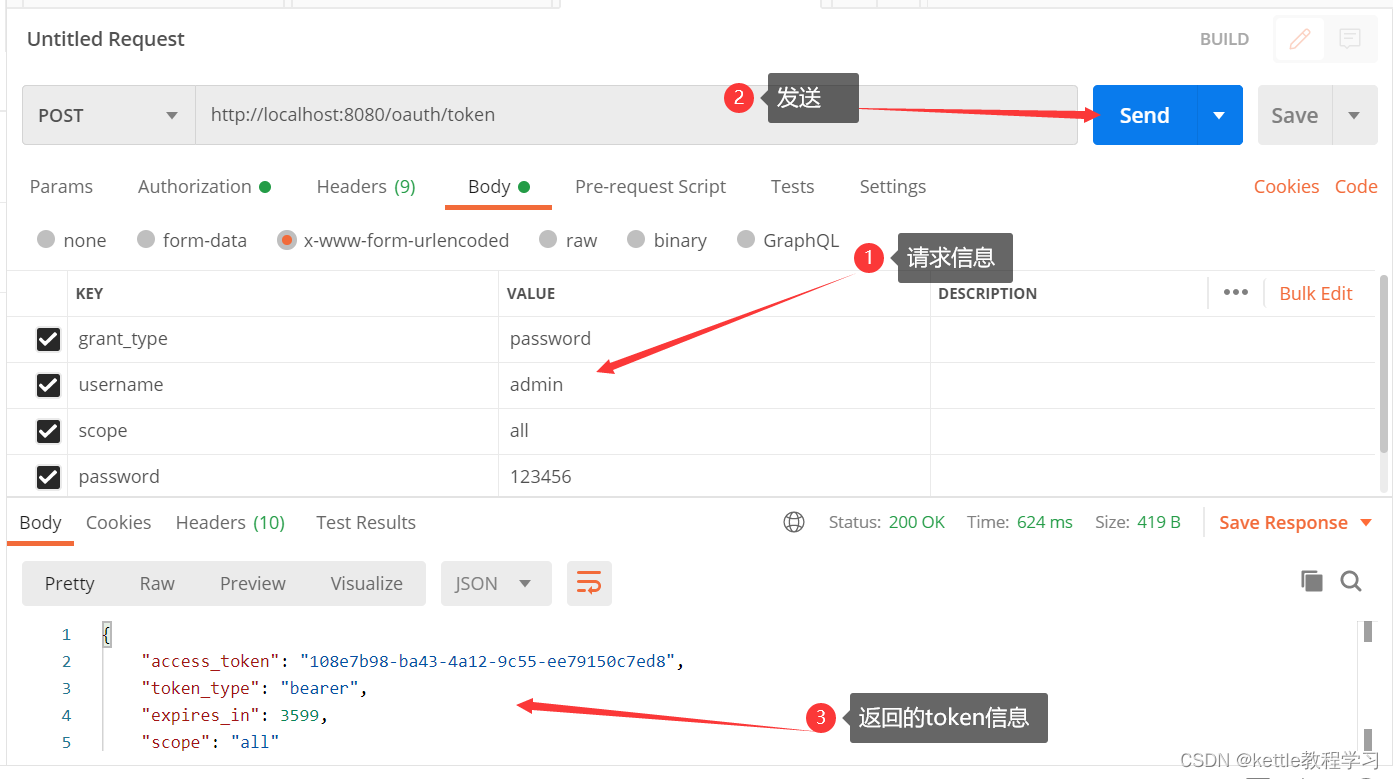
2.6 打开postman,填入下面内容获取token
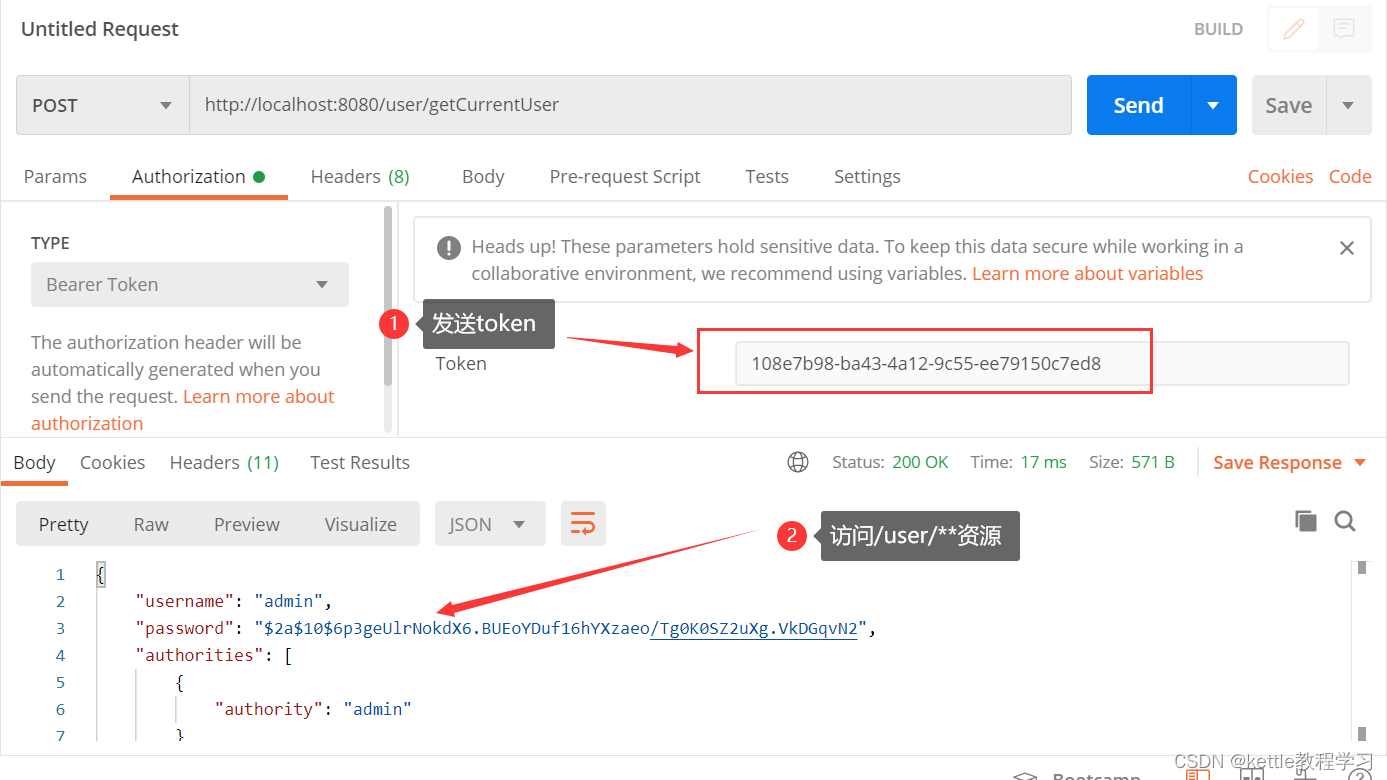
2.7 通过token访问授保护的资源
oauth2.0密码模式详解的更多相关文章
- IdentityServer4+OAuth2.0+OpenId Connect 详解
一 Oauth 2.0 1 定义 OAuth(开放授权)是一个开放标准,允许用户让第三方应用访问该用户在某一网站上存储的私密的资源(如照片,视频,联系人列表),而无需将用户名和密码提供给第三方应用. ...
- IdentityServer4:IdentityServer4+API+Client+User实践OAuth2.0密码模式(2)
一.密码模式实操 仍然使用第一节的代码:做如下改动: 1.授权服务端 前面我们使用项目:Practice.IdentityServer作为授权服务器 修改项目的Config.cs类: 添加测试用户,并 ...
- webapi之owin的oauth2.0密码模式_01概述
一般在webapi接口中,为了防止接口被随意调用,都会验证用户身份. 然而不能每次调用接口都需要用户输入用户名密码来验证,这时就需要授权颁发令牌了,持有令牌就可以访问接口,接口也能验证令牌身份. 简单 ...
- OAuth 2.0 授权认证详解
一.认识 OAuth 2.0 1.1 OAuth 2.0 应用场景 OAuth 2.0 标准目前被广泛应用在第三方登录场景中,以下是虚拟出来的角色,阐述 OAuth2 能帮我们干什么,引用阮一峰这篇理 ...
- Apache2.2+Tomcat7.0整合配置详解
一.简单介绍 Apache.Tomcat Apache HTTP Server(简称 Apache),是 Apache 软件基金协会的一个开放源码的网页服务器,可以在 Windows.Unix.Lin ...
- DES加密模式详解
DES加密模式详解 http://www.cnblogs.com/Lawson/archive/2012/05/20/2510781.html http://www.blogjava.net/wayn ...
- 转 OAuth 2.0授权协议详解
http://www.jb51.net/article/54948.htm 作者:阮一峰 字体:[增加 减小] 类型:转载 时间:2014-09-10我要评论 这篇文章主要介绍了OAuth 2.0授权 ...
- redis5.0.3配置文件详解
Redis最新版本5.0.3配置文件详解 单位 #当你需要为某个配置项指定内存大小的时候,必须要带上单位, #通常的格式就是 1k 5gb 4m 等: #1k => 1000 bytes #1k ...
- rabbitmq五种模式详解(含实现代码)
一.五种模式详解 1.简单模式(Queue模式) 当生产端发送消息到交换机,交换机根据消息属性发送到队列,消费者监听绑定队列实现消息的接收和消费逻辑编写.简单模式下,强调的一个队列queue只被一个消 ...
随机推荐
- TCP Wrappers
TCP Wrappers 是 RHEL 7 系统中默认启用的一款流量监控程序,它能够根据来访主机的地址与本机的目标服务程序作出允许或拒绝的操作.换句话说,Linux 系统中其实有两个层面的防火墙,第一 ...
- 「CTSC2006」歌唱王国
概率生成函数\(g(x)=\sum_{i\geq 0}t_ix^i\),\(t_i\)表示结果为\(i\)的概率 令\(f(x)\)表示i位表示串结束时长度为i的概率,\(G(x)\)表示i位表示串长 ...
- Mysql Json函数创建 (二)
本节中列出的功能由组件元素组成JSON值. JSON_ARRAY([val[, val] ...]) 计算(可能为空)值列表,并返回包含这些值的JSON数组. mysql> SELECT JSO ...
- 解决sublime代码不提示的问题
如果想让sublime在你输入标签的过程中给你提示,需要按要求开启以下功能. 1.开启代码自动提示功能
- Springcloud-微服务
1.什么是微服务? 通过阅读马丁弗勒关于描述微服务的文章(https://martinfowler.com/articles/microservices.html),在此特作仅用作个人理解的关于微服务 ...
- DNS域名解析之反向解析and主从域名服务器 (今天大小便正常,未来可期)
DNS解析之反向解析和域名主从服务器 反向解析:根据IP地址查找对应的域名 yum -y install bind 安装软件包 查看需要修改的配置文件所在路径 rpm -qc bind 查询bind软 ...
- 最好的Java开发工具---IDEA
IntelliJ IDEA工具的使用 1. 常见的Java集成开发工具 Eclipse IBM团队研发的一个开源的非常好用的集成开发环境.寓意:吞并Sun公司.不过Sun最终被Oracle公司收购了. ...
- 在Linux中设置php变量的方法
默认情况下已经安装好了PHP环境,并且知道安装好后的PHP文件路径,然后可以通过以下的方式设置PHP变量,快速执行PHP命令运行PHP文件. 环境:centos 第一步:vi ~/.bash_prof ...
- MySQL数据备份/导出 创建用户及其删除
Mysql DCL 创建用户 create user '用户名'@'localhost(本机访问)/%(通配符任何ip地址都可访问本机) 分配权限 grant 权限 on 数据库.表名 to '用户名 ...
- kubernetes集群之Pod说能不能让我体面的消亡呀?
kubernetes集群之Pod说能不能让我体面的消亡呀? 由于 Pod 所代表的是在集群中节点上运行的进程,当不再需要这些进程时允许其体面地终止. 1.如果 preStop 回调所需要的时间长于默认 ...