
POJ 2828 Buy Tickets 线段树 倒序插入 节点空位预留(思路巧妙)
| Time Limit: 4000MS | Memory Limit: 65536K | |
| Total Submissions: 19725 | Accepted: 9756 |
Description
Railway tickets were difficult to buy around the Lunar New Year in China, so we must get up early and join a long queue…
The Lunar New Year was approaching, but unluckily the Little Cat still had schedules going here and there. Now, he had to travel by train to Mianyang, Sichuan Province for the winter camp selection of the national team of Olympiad in Informatics.
It was one o’clock a.m. and dark outside. Chill wind from the northwest did not scare off the people in the queue. The cold night gave the Little Cat a shiver. Why not find a problem to think about? That was none the less better than freezing to death!
People kept jumping the queue. Since it was too dark around, such moves would not be discovered even by the people adjacent to the queue-jumpers. “If every person in the queue is assigned an integral value and all the information about those who have jumped
the queue and where they stand after queue-jumping is given, can I find out the final order of people in the queue?” Thought the Little Cat.
Input
There will be several test cases in the input. Each test case consists of
N + 1 lines where N (1 ≤ N ≤ 200,000) is given in the first line of the test case. The next
N lines contain the pairs of values Posi and Vali in the increasing order of
i (1 ≤ i ≤ N). For each i, the ranges and meanings of
Posi and Vali are as follows:
- Posi ∈ [0, i − 1] — The i-th person came to the queue and stood right behind the
Posi-th person in the queue. The booking office was considered the 0th person and the person at the front of the queue was considered the first person in the queue. - Vali ∈ [0, 32767] — The i-th person was assigned the value
Vali.
There no blank lines between test cases. Proceed to the end of input.
Output
For each test cases, output a single line of space-separated integers which are the values of people in the order they stand in the queue.
Sample Input
4

0 77

1 51

1 33

2 69

4

0 20523

1 19243

1 3890

0 31492
Sample Output
77 33 69 51

31492 20523 3890 19243
Hint
The figure below shows how the Little Cat found out the final order of people in the queue described in the first test case of the sample input.
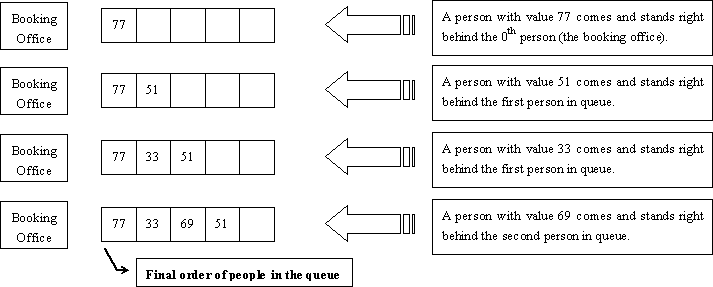
思路:线段树 倒序插入 更新节点时,左右子树要区分,如果左子树的空位大于等于现在要插入的位置,说明前面的空位没有占去。否则,进入右子树,而进入右子树时,空位变成了pos减去所有左子树的空位。即便左子树有空位但也不能插入,因为该数还没有插入,必须预留空位。
代码:
#include<iostream>

#include<string>

#include<algorithm>

#include<cstdio>

#include<cstring>

#include<cstdlib>

#include<cmath>

using namespace std;

#define lson l,mid,rt<<1

#define rson mid+1,r,rt<<1|1

const int maxn=200005;

int sum[maxn<<2],res[maxn<<2];

int data[maxn],location[maxn];

bool flag=false;

void pushup(int rt) {

    sum[rt]=sum[rt<<1]+sum[rt<<1|1];

}

void build(int l, int r, int rt) {

    sum[rt]=r-l+1;

    if(l==r) return;

    int mid=(l+r)>>1;

    build(lson);

    build(rson);

}

void update(int pos, int val, int l, int r, int rt) {

    if(l==r) {

        res[rt]=val;sum[rt]--;return;

    }

    int mid=(l+r)>>1;

    if(pos<=sum[rt<<1]) update(pos,val,lson);

    else update(pos-sum[rt<<1],val,rson);//要预留空位

    pushup(rt);

}

void show(int l, int r, int rt) {

    if(l==r) {

        if(flag==false) printf("%d",res[rt]),flag=true;

        else printf(" %d",res[rt]);

        return;

    }

    int mid=(l+r)>>1;

    show(lson);

    show(rson);

}

int main() {

    int n;

    while(~scanf("%d",&n)) {

        for(int i=0;i<n;++i) {

            scanf("%d%d",&location[i],&data[i]);

        }

        build(1,n,1);

        for(int i=n-1;i>=0;--i) {

            update(location[i]+1,data[i],1,n,1);

        }

        flag=false;

        show(1,n,1);

        printf("\n");

    }

    return 0;

}
POJ 2828 Buy Tickets 线段树 倒序插入 节点空位预留(思路巧妙)的更多相关文章
- poj 2828 Buy Tickets (线段树(排队插入后输出序列))
http://poj.org/problem?id=2828 Buy Tickets Time Limit: 4000MS Memory Limit: 65536K Total Submissio ...
- POJ 2828 Buy Tickets (线段树 or 树状数组+二分)
题目链接:http://poj.org/problem?id=2828 题意就是给你n个人,然后每个人按顺序插队,问你最终的顺序是怎么样的. 反过来做就很容易了,从最后一个人开始推,最后一个人位置很容 ...
- POJ 2828 Buy Tickets | 线段树的喵用
题意: 给你n次插队操作,每次两个数,pos,w,意为在pos后插入一个权值为w的数; 最后输出1~n的权值 题解: 首先可以发现,最后一次插入的位置是准确的位置 所以这个就变成了若干个子问题, 所以 ...
- POJ 2828 Buy Tickets(线段树·插队)
题意 n个人排队 每一个人都有个属性值 依次输入n个pos[i] val[i] 表示第i个人直接插到当前第pos[i]个人后面 他的属性值为val[i] 要求最后依次输出队中各个人的属性 ...
- POJ 2828 Buy Tickets(线段树单点)
https://vjudge.net/problem/POJ-2828 题目意思:有n个数,进行n次操作,每次操作有两个数pos, ans.pos的意思是把ans放到第pos 位置的后面,pos后面的 ...
- poj 2828 Buy Tickets (线段树)
题目:http://poj.org/problem?id=2828 题意:有n个人插队,给定插队的先后顺序和插在哪个位置还有每个人的val,求插队结束后队伍各位置的val. 线段树里比较简单的题目了, ...
- POJ - 2828 Buy Tickets (段树单点更新)
Description Railway tickets were difficult to buy around the Lunar New Year in China, so we must get ...
- POJ 2828 Buy Tickets(单点更新) 详细题解和思路
题意:给n个人插队,输出最后的队伍情况(题意写的有些粗糙) 思路:第一点:在最后的队伍中,我们唯一能确定的是最后一个人一定能排到指定位置.那么,倒数第二个是在最后一个基础上确定位置的,这样一层一层的倒 ...
- POJ 2828 Buy Tickets(排队问题,线段树应用)
POJ 2828 Buy Tickets(排队问题,线段树应用) ACM 题目地址:POJ 2828 Buy Tickets 题意: 排队买票时候插队. 给出一些数对,分别代表某个人的想要插入的位 ...
随机推荐
- 快速部署Telegraf & Influxdb
是什么? Telegraf 是一个用 Go 编写的代理程序,可收集系统和服务的统计数据,并写入到 InfluxDB 数据库.Telegraf 具有内存占用小的特点,通过插件系统开发人员可轻松添加支持其 ...
- jquery的2.0.3版本源码系列(7):3043行-3183行,deferred延迟对象,对异步的统一管理
目录 part1 deferred延迟对象 part2 when辅助方法 网盘源代码 链接: https://pan.baidu.com/s/1skAj8Jj 密码: izta part1 defe ...
- django 实现同一个ip十分钟内只能注册一次
很多小伙伴都会有这样的问题,说一个ip地址十分钟内之内注册一次,用来防止用户来重复注册带来不必要的麻烦 逻辑: 取ip,在数据库找ip是否存在,存在判断当前时间和ip上次访问时间之差,小于600不能注 ...
- Ruby on Rails---Active Admin使用(一)
概述 Active Admin提供了一个友好的后台管理界面,将CRUD等操作可视化,操作极其方便 安装 1. 添加gem gem "devise", :github => ' ...
- 如何用java创建一个jdbc程序
第一个jdbc程序 JDBC简介 Java数据库连接(Java Database Connectivity,JDBC),是一种用于执行SQL语句的Java API,它由一组用Java编程语言编写的类和 ...
- 为Lua5.3编写C模块简单示例
为Lua5.3编写C模块简单示例 一.编译安装Lua5.3 MSVC 命令行安装脚本: @echo off md bin md lib md include cd src cl /c /nologo ...
- Problem P
题意:FJ养牛,他想知道中间的牛是那一头: 思路:这道题有点水,思路就不写了 #include #include #include #define maxn 10005 using namespace ...
- Problem V
Problem Description The aspiring Roy the Robber has seen a lot of American movies, and knows that th ...
- (纪念第一道完全自己想的树DP)CodeForces 219D Choosing Capital for Treeland
Choosing Capital for Treeland time limit per test 3 seconds memory limit per test 256 megabytes inpu ...
- 2015-2016 ACM-ICPC, NEERC, Southern Subregional Contest I Lottery
LotteryCrawling in process... Crawling failed Time Limit:2000MS Memory Limit:524288KB 64bit ...