
201771010128王玉兰《面向对象程序设计(Java)》第十周学习总结
第一部分:理论知识部分总结:
(1) 定义简单泛型类:
A:泛型:也称参数化类型(parameterizedtype),就是在定义类、接口和方法时,通过类型参数指 示将要处理的对象类型。
B:泛型程序设计(Genericprogramming):编写 代码可以被很多不同类型的对象所重用。
C: 一个泛型类(genericclass)就是具有一个或多 个类型变量的类,即创建用类型作为参数的类。
(2)泛型方法(可以定义在普通类中,也可以定义在泛型类中)除了泛型类外,还可以只单独定义一个方法作 为泛型方法,用于指定方法参数或者返回值为 泛型类型,留待方法调用时确定。
(3):泛型变量的限定:定义泛型变量的上界用extends,下界用super.
A:上下界的说明:a: extends关键字所声明的上界既可以是一个类, 也可以是一个接口;b;一个类型变量或通配符可以有多个限定,限定类 型用“&”分割。
c: 通过使用super关键字可以固定泛型参数的类型为某种 类型或者其超类;
d: 当程序希望为一个方法的参数限定类型时,通常可以使 用下限通配符.
(4)通配符类型 :通配符 –“?”符号表明参数的类型可以是任何一种类 型,它和参数T的含义是有区别的。T表示一种 未知类型,而“?”表示任何一种类型。这种 通配符一般有以下三种用法:
–单独的?,用于表示任何类型。
–? extends type,表示带有上界。
–? super type,表示带有下界。
第二部分:实验
1、实验目的与要求
(1) 理解泛型概念;
(2) 掌握泛型类的定义与使用;
(3) 掌握泛型方法的声明与使用;
(4) 掌握泛型接口的定义与实现;
(5)了解泛型程序设计,理解其用途。
2、实验内容和步骤
实验1: 导入第8章示例程序,测试程序并进行代码注释。
测试程序1:
l 编辑、调试、运行教材311、312页 代码,结合程序运行结果理解程序;
l 在泛型类定义及使用代码处添加注释;
l 掌握泛型类的定义及使用。
package pair1;

/**

 * @version 1.00 2004-05-10

 * @author Cay Horstmann

 */

public class Pair<T> //Pair类引入一个类型变量T

{

   private T first;//类定义中的类型变量指定方法的返回类型以及域和局部变量的类型

   private T second;

   public Pair() { first = null; second = null; }

   public Pair(T first, T second) { this.first = first;  this.second = second; }

   public T getFirst() { return first; }

   public T getSecond() { return second; }

   public void setFirst(T newValue) { first = newValue; }

   public void setSecond(T newValue) { second = newValue; }

}
package pair1;

/**

 * @version 1.01 2012-01-26

 * @author Cay Horstmann

 */

public class PairTest1

{

   public static void main(String[] args)

   {

      String[] words = { "Mary", "had", "a", "little", "lamb" };//初始化一个String对象数组

      Pair<String> mm = ArrayAlg.minmax(words);//通过类名ArrayAlg调用minmax方法

      System.out.println("min = " + mm.getFirst());

      System.out.println("max = " + mm.getSecond());

   }

}

class ArrayAlg//泛型类

{

   /**

    * Gets the minimum and maximum of an array of strings.

    * @param a an array of strings

    * @return a pair with the min and max value, or null if a is null or empty

    */

   public static Pair<String> minmax(String[] a)//实例化以后的pair类对象

   {

      if (a == null || a.length == 0) return null;

      String min = a[0];

      String max = a[0];

      for (int i = 1; i < a.length; i++)

      {

         if (min.compareTo(a[i]) > 0) min = a[i];

         if (max.compareTo(a[i]) < 0) max = a[i];

      }

      return new Pair<>(min, max);//带参数的构造器

   }

}

测试程序2:
l 编辑、调试运行教材315页 PairTest2,结合程序运行结果理解程序;
l 在泛型程序设计代码处添加相关注释;
l 掌握泛型方法、泛型变量限定的定义及用途。
package pair2;

import java.time.LocalDate;

import pair1.Pair;

/**

 * @version 1.02 2015-06-21

 * @author Cay Horstmann

 */

public class PairTest2

{

   public static void main(String[] args)

   {

      LocalDate[] birthdays =

         {

            LocalDate.of(1906, 12, 9), // G. Hopper

            LocalDate.of(1815, 12, 10), // A. Lovelace

            LocalDate.of(1903, 12, 3), // J. von Neumann

            LocalDate.of(1910, 6, 22), // K. Zuse

         };

      Pair<LocalDate> mm = ArrayAlg.minmax(birthdays);//通过类名调用minmax 方法

      System.out.println("min = " + mm.getFirst());

      System.out.println("max = " + mm.getSecond());

   }

}

class ArrayAlg

{

   /**

      Gets the minimum and maximum of an array of objects of type T.

      @param a an array of objects of type T

      @return a pair with the min and max value, or null if a is

      null or empty

   */

   public static <T extends Comparable> Pair<T> minmax(T[] a) //extends表示上界约束的泛型方法

   {

      if (a == null || a.length == 0) return null;//a.length 是数组的一个属性

      T min = a[0];

      T max = a[0];

      for (int i = 1; i < a.length; i++)

      {

         if (min.compareTo(a[i]) > 0) min = a[i];

         if (max.compareTo(a[i]) < 0) max = a[i];

      }

      return new Pair<>(min, max);

   }

}

测试程序3:
l 用调试运行教材335页 PairTest3,结合程序运行结果理解程序;
l 了解通配符类型的定义及用途。
package pair3;

import pair1.Pair;

/**

 * @version 1.01 2012-01-26

 * @author Cay Horstmann

 */

public class PairTest3

{

   public static void main(String[] args)

   {

      Manager ceo = new Manager("Gus Greedy", 800000, 2003, 12, 15);//创建了Manager对象

     Manager cfo = new Manager("Sid Sneaky", 600000, 2003, 12, 15);

     Pair<Manager> buddies = new Pair<Manager>(ceo, cfo);  //实例化pair对象

      printBuddies(buddies);

      ceo.setBonus(1000000);//更改器

      cfo.setBonus(500000);

      Manager[] managers = { ceo, cfo };

      Pair<Employee> result = new Pair<Employee>();//尖括号里既可以用Manager,也可以用Employee

      minmaxBonus(managers, result);

      System.out.println("first: " + result.getFirst().getName()

         + ", second: " + result.getSecond().getName());

      maxminBonus(managers, result);

      System.out.println("first: " + result.getFirst().getName()

         + ", second: " + result.getSecond().getName());

   }

   public static void printBuddies(Pair<? extends Employee> p)//?是通配符,extends表示带有上界

   {

      Employee first = p.getFirst();//访问器方法

      Employee second = p.getSecond();

      System.out.println(first.getName() + " and " + second.getName() + " are buddies.");

   }

   public static void minmaxBonus(Manager[] a, Pair<? super Manager> result)

   {

      if (a.length == 0) return;

      Manager min = a[0];

      Manager max = a[0];

      for (int i = 1; i < a.length; i++)

      {

         if (min.getBonus() > a[i].getBonus()) min = a[i];//访问器方法

         if (max.getBonus() < a[i].getBonus()) max = a[i];

      }

      result.setFirst(min);

      result.setSecond(max);

   }

   public static void maxminBonus(Manager[] a, Pair<? super Manager> result)//super表示带有下界的泛型方法

   {

      minmaxBonus(a, result);

      PairAlg.swapHelper(result); // OK--swapHelper captures wildcard type

   }

   // Can't write public static <T super manager> . . .

}

class PairAlg//泛型类

{

   public static boolean hasNulls(Pair<?> p)

   {

      return p.getFirst() == null || p.getSecond() == null;

   }

   public static void swap(Pair<?> p) { swapHelper(p); }
public static <T> void swapHelper(Pair<T> p)
//限定泛型类Pair类型变量的下界为p;
{ T t = p.getFirst();
 p.setFirst(p.getSecond());
p.setSecond(t); } }

实验2:编程练习:
编程练习1:实验九编程题总结
l 实验九编程练习1总结(从程序总体结构说明、模块说明,目前程序设计存在的困难与问题三个方面阐述)。
import java.io.BufferedReader;

import java.io.File;

import java.io.FileInputStream;

import java.io.FileNotFoundException;

import java.io.IOException;

import java.io.InputStreamReader;

import java.util.ArrayList;

import java.util.Arrays;

import java.util.Scanner;

import java.util.Collections;//对集合进行排序、查找、修改等;

public class Test {

    private static ArrayList<Citizen> citizenlist;

    public static void main(String[] args) {

        citizenlist = new ArrayList<>();

        Scanner scanner = new Scanner(System.in);

        File file = new File("E:/java/身份证号.txt");

        //异常捕获

        try {

            FileInputStream fis = new FileInputStream(file);

            BufferedReader in = new BufferedReader(new InputStreamReader(fis));

            String temp = null;

            while ((temp = in.readLine()) != null) {

                Scanner linescanner = new Scanner(temp);

                linescanner.useDelimiter(" ");

                String name = linescanner.next();

                String id = linescanner.next();

                String sex = linescanner.next();

                String age = linescanner.next();

                String birthplace = linescanner.nextLine();

                Citizen citizen = new Citizen();

                citizen.setName(name);

                citizen.setId(id);

                citizen.setSex(sex);

                // 将字符串转换成10进制数

                int ag = Integer.parseInt(age);

                citizen.setage(ag);

                citizen.setBirthplace(birthplace);

                citizenlist.add(citizen);

            }

        } catch (FileNotFoundException e) {

            System.out.println("信息文件找不到");

            e.printStackTrace();

        } catch (IOException e) {

            System.out.println("信息文件读取错误");

            e.printStackTrace();

        }

        boolean isTrue = true;

        while (isTrue) {

            System.out.println("1.按姓名字典序输出人员信息");

            System.out.println("2.查询最大年龄的人员信息、查询最小年龄人员信息");

            System.out.println("3.查询人员中是否查询人员中是否有你的同乡");

            System.out.println("4.输入你的年龄,查询文件中年龄与你最近人的姓名、身份证号、年龄、性别和出生地");

            System.out.println("5.退出");

            int nextInt = scanner.nextInt();

            switch (nextInt) {

            case 1:

                Collections.sort(citizenlist);

                System.out.println(citizenlist.toString());

                break;

            case 2:

                int max = 0, min = 100;

                int m, k1 = 0, k2 = 0;

                for (int i = 1; i < citizenlist.size(); i++) {

                    m = citizenlist.get(i).getage();

                    if (m > max) {

                        max = m;

                        k1 = i;

                    }

                    if (m < min) {

                        min = m;

                        k2 = i;

                    }

                }

                System.out.println("年龄最大:" + citizenlist.get(k1));

                System.out.println("年龄最小:" + citizenlist.get(k2));

                break;

            case 3:

                System.out.println("出生地:");

                String find = scanner.next();

                String place = find.substring(0, 3);

                for (int i = 0; i < citizenlist.size(); i++) {

                    if (citizenlist.get(i).getBirthplace().substring(1, 4).equals(place))

                        System.out.println("出生地" + citizenlist.get(i));

                }

                break;

            case 4:

                System.out.println("年龄:");

                int yourage = scanner.nextInt();

                int near = peer(yourage);

                int j = yourage - citizenlist.get(near).getage();

                System.out.println("" + citizenlist.get(near));

                break;

            case 5:

                isTrue = false;

                System.out.println("程序已退出!");

                break;

            default:

                System.out.println("输入有误");

            }

        }

    }

    public static int peer(int age) {

        int flag = 0;

        int min = 53, j = 0;

        for (int i = 0; i < citizenlist.size(); i++) {

            j = citizenlist.get(i).getage() - age;

            if (j < 0)

                j = -j;

            if (j < min) {

                min = j;

                flag = i;

            }

        }

        return flag;

    }

}
public class Student implements Comparable<Student> {

   private String name;

   private String number ;

     private String sex ;

     private int age;

     private String province;

      public String getName() {

         return name;

     }

     public void setName(String name) {

         this.name = name;

   }

   public String getnumber() {

       return number;

   }

     public void setnumber(String number) {

         this.number = number;

     }

     public String getsex() {

        return sex ;

    }

    public void setsex(String sex ) {

        this.sex =sex ;

     }

     public int getage() {

         return age;

        }

         public void setage(int age) {

             // int a = Integer.parseInt(age);

         this.age= age;

        }

     public String getprovince() {

        return province;

     }

     public void setprovince(String province) {

         this.province=province ;

    }

     public int compareTo(Student o) {

        return this.name.compareTo(o.getName());

   }

    public String toString() {

         return  name+"\t"+sex+"\t"+age+"\t"+number+"\t"+province+"\n";

   }

 }
程序总体说明:由主类Test和子类Student组成
模块说明:main方法的使用
A: 确定主函数,实现题目所要求的功能
B::将文件信息导入进去,保存到相应的包下
C:进行编辑,运行结果,完成程序
目前程序设计存在的困难与问题:
A:读取文件的位置,即路径是否准确
B:实现的功能要求比较复杂,掌握的知识过少,解决代码错误时消耗时间过长,基础知识不牢固
l 实验九编程练习2总结(从程序总体结构说明、模块说明,目前程序设计存在的困难与问题三个方面阐述)。
import java.io

.FileNotFoundException;

import java.io

.PrintWriter;

import java.util.Scanner;

public class jisuan{

    public static void main(String[] args) {

        Scanner in = new Scanner(System.in

);

        Caculator1 computing=new Caculator1();

        PrintWriter output = null;

        try {

            output = new PrintWriter("Caculator.txt");

        } catch (Exception e) {

        }

        int sum = 0;

        for (int i = 1; i < 11; i++) {

            int a = (int) Math.round(Math.random() * 100);

            int b = (int) Math.round(Math.random() * 100);

            int s = (int) Math.round(Math.random() * 3);

        switch(s)

        {

           case 1:

               System.out.println(i+": "+a+"/"+b+"=");

               while(b==0){

                   b = (int) Math.round(Math.random() * 100);

                   }

               double c = in.nextDouble();

               output.println(a+"/"+b+"="+c);

               if (c == (double)computing.division(a, b)) {

                   sum += 10;

                   System.out.println("正确");

               }

               else {

                   System.out.println("错误");

               }

               break;

           case 2:

               System.out.println(i+": "+a+"*"+b+"=");

               int c1 = in.nextInt();

               output.println(a+"*"+b+"="+c1);

               if (c1 == computing.multiplication(a, b)) {

                   sum += 10;

                   System.out.println("正确");

               }

               else {

                   System.out.println("错误");

               }

               break;

           case 3:

               System.out.println(i+": "+a+"+"+b+"=");

               int c2 = in.nextInt();

               output.println(a+"+"+b+"="+c2);

               if (c2 == computing.addition(a, b)) {

                   sum += 10;

                   System.out.println("正确");

               }

               else {

                   System.out.println("错误");

               }

               break ;

           case 4:

               System.out.println(i+": "+a+"-"+b+"=");

               int c3 = in.nextInt();

               output.println(a+"-"+b+"="+c3);

               if (c3 == computing.subtraction(a, b)) {

                   sum += 10;

                   System.out.println("正确");

               }

               else {

                   System.out.println("错误");

               }

               break ;

               }

          }

        System.out.println("scores:"+sum);

        output.println("scores:"+sum);

        output.close();

    }

}
public class jiusuan_class

{

       private int a;

       private int b;

        public int  addition(int a,int b)

        {

            return a+b;

        }

        public int  subtraction(int a,int b)

        {

            if((a-b)<0)

                return 0;

            else

            return a-b;

        }

        public int   multiplication(int a,int b)

        {

            return a*b;

        }

        public int   division(int a,int b)

        {

            if(b!=0)

            return a/b;

            else

        return 0;

        }

}
程序总体结构说明:由主类jisuan和子类jiusuan组成
模块说明:文件输出和四则运算计算器的生成
目前程序设计的存在的困难和问题:
A:只能实现简单的 四则运算档,而且只要数比较打,就算结果正确也显示不足;
B:出现异常要进行处理;单独解决除数为0;
C :在编写程序时将算法和结构体还不能正确使用。
编程练习2:采用泛型程序设计技术改进实验九编程练习2,使之可处理实数四则运算,其他要求不变。
import java.io.FileNotFoundException;

import java.io.PrintWriter;

import java.util.Random;

import java.util.Scanner;

public class Suanshu {

    public static void main(String[] args) {

        Scanner in = new Scanner(System.in);

       Suanshu ss = new Suanshu();

        PrintWriter out = null;

        try {

            out = new PrintWriter("test.txt");

        } catch (FileNotFoundException e) {

            System.out.println("文件夹输出失败");

            e.printStackTrace();

        }

        int sum = 0;

        for (int i = 1; i <= 10; i++) {

            int a = (int) Math.round(Math.random() * 100);

            int b = (int) Math.round(Math.random() * 100);

            int m;

            Random rand = new Random();

            m = (int) rand.nextInt(4) + 1;

            System.out.println("随机生成的四则运算类型:" + m);

            switch (m) {

            case 1:

                a = b + (int) Math.round(Math.random() * 100);

                while(b == 0){

                    b = (int) Math.round(Math.random() * 100);

                }

                while(a % b != 0){

                    a = (int) Math.round(Math.random() * 100);

                }

                System.out.println(i + " " + a + "/" + b + "=");

                int c0 = in.nextInt();

                out.println(a + "/" + b + "=" + c0);

                if (c0 == ss.chufa(a, b)) {

                    sum += 10;

                    System.out.println("right!");

                } else {

                    System.out.println("error!");

                }

                break;

            case 2:

                System.out.println(i + " " + a + "*" + b + "=");

                int c = in.nextInt();

                out.println(a + "*" + b + "=" + c);

                if (c == ss.chengfa(a, b)) {

                    sum += 10;

                    System.out.println("回答正确!");

                } else {

                    System.out.println("回答错误!");

                }

                break;

            case 3:

                System.out.println(i + " " + a + "+" + b + "=");

                int c1 = in.nextInt();

                out.println(a + "+" + b + "=" + c1);

                if (c1 == ss.jiafa(a, b)) {

                    sum += 10;

                    System.out.println("回答正确!");

                } else {

                    System.out.println("回答错误!");

                }

                break;

            case 4:

                while (a < b) {

                    b = (int) Math.round(Math.random() * 100);

                }

                System.out.println(i + " " + a + "-" + b + "=");

                int c2 = in.nextInt();

                out.println(a + "-" + b + "=" + c2);

                if (c2 == ss.jiafa(a, b)) {

                    sum += 10;

                    System.out.println("回答正确!");

                } else {

                    System.out.println("回答错误!");

                }

                break;

            }

        }

        System.out.println("最后得分" + sum);

        out.println("最后得分" + sum);

        out.close();

    }

	private int jiafa(int a, int b) {

		// TODO Auto-generated method stub

		return 0;

	}

	private int chengfa(int a, int b) {

		// TODO Auto-generated method stub

		return 0;

	}

	private int chufa(int a, int b) {

		// TODO Auto-generated method stub

		return 0;

	}

}
public class Suanshu<T> {

    private T a;

    private T b;

    public Suanshu() {

        a = null;

        b = null;

    }

    public Suanshu(T a, T b) {

        this.a = a;

        this.b = b;

    }

    public int jiafa(int a,int b) {

        return a + b;

    }

    public int jianfa(int a, int b) {

        return a - b;

    }

    public int chengfa(int a, int b) {

        return a * b;

    }

    public int chufa(int a, int b) {

        if (b != 0 && a%b==0)

            return a / b;

        else

            return 0;

    }

}
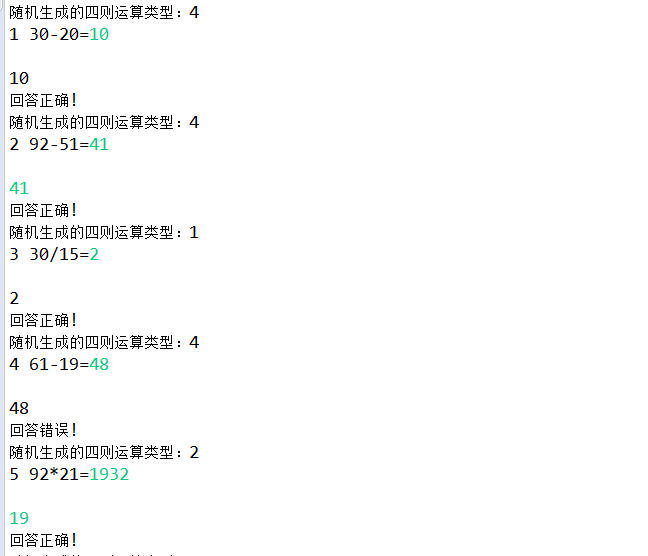
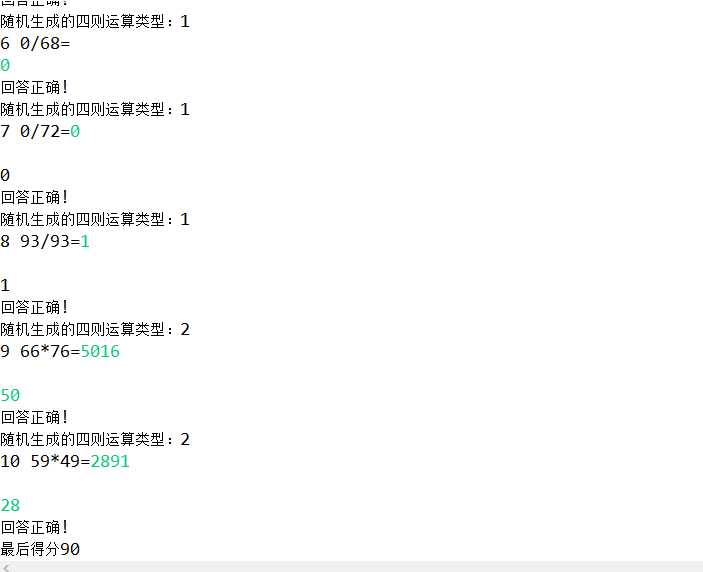
运行结果:
实验总结:这一章学习第九章类泛型程序设计,主要学习了如何定义简单泛型类,是用Pair类引入一个类型变量T,用<>,放在类名的后面,泛型类可以有多个泛型变量以及通配符胡类型,有带有上界和下界,分别是?extends type,?super type等基础知识,学习泛型程序设计是编写的代码可以被很多不同的对象所重用,程序员必掌握的技术,因此,之前也接触到了ArrayList类,泛型程序设计是用继承实现的,总而言之,将这几周学过的知识相结合运用到编写代码才是一种提升能力,自己还需要不断练习。
201771010128王玉兰《面向对象程序设计(Java)》第十周学习总结的更多相关文章
- 201771010134杨其菊《面向对象程序设计java》第九周学习总结
第九周学习总结 第一部分:理论知识 异常.断言和调试.日志 1.捕获 ...
- 201871010132-张潇潇《面向对象程序设计(java)》第一周学习总结
面向对象程序设计(Java) 博文正文开头 项目 内容 这个作业属于哪个课程 https://www.cnblogs.com/nwnu-daizh/ 这个作业的要求在哪里 https://www.cn ...
- 扎西平措 201571030332《面向对象程序设计 Java 》第一周学习总结
<面向对象程序设计(java)>第一周学习总结 正文开头: 项目 内容 这个作业属于哪个课程 https://www.cnblogs.com/nwnu-daizh/ 这个作业的要求在哪里 ...
- 201871010124 王生涛《面向对象程序设计JAVA》第一周学习总结
项目 内容 这个作业属于哪个课程 https://www.cnblogs.com/nwnu-daizh/ 这个作业的要求在哪里 https://edu.cnblogs.com/campus/xbsf/ ...
- 201871010115——马北《面向对象程序设计JAVA》第二周学习总结
项目 内容 这个作业属于哪个课程 https://www.cnblogs.com/nwnu-daizh/ 这个作业的要求在哪里 https://www.cnblogs.com/nwnu-daizh/p ...
- 杨其菊201771010134《面向对象程序设计Java》第二周学习总结
第三章 Java基本程序设计结构 第一部分:(理论知识部分) 本章主要学习:基本内容:数据类型:变量:运算符:类型转换,字符串,输入输出,控制流程,大数值以及数组. 1.基本概念: 1)标识符:由字母 ...
- 201777010217-金云馨《面向对象程序设计(Java)》第二周学习总结
项目 内容 这个作业属于哪个课程 https://www.cnblogs.com/nwnu-daizh/ 这个作业的要求在哪里 https://www.cnblogs.com/nwnu-daizh/p ...
- 201871010132——张潇潇《面向对象程序设计JAVA》第二周学习总结
项目 内容 这个作业属于哪个课程 https://www.cnblogs.com/nwnu-daizh/ 这个作业的要求在哪里 https://www.cnblogs.com/nwnu-daizh/p ...
- 201771010123汪慧和《面向对象程序设计Java》第二周学习总结
一.理论知识部分 1.标识符由字母.下划线.美元符号和数字组成, 且第一个符号不能为数字.标识符可用作: 类名.变量名.方法名.数组名.文件名等.第二部分:理论知识学习部分 2.关键字就是Java语言 ...
- 20155303 2016-2017-2 《Java程序设计》第十周学习总结
20155303 2016-2017-2 <Java程序设计>第十周学习总结 目录 学习内容总结 网络编程 数据库 教材学习中的问题和解决过程 代码调试中的问题和解决过程 代码托管 上周考 ...
随机推荐
- vue 开发规范
本文档为前端 vue 开发规范 规范目的 命名规范 结构化规范 注释规范 编码规范 CSS 规范 规范目的 为提高团队协作效率 便于后台人员添加功能及前端后期优化维护 输出高质量的文档 命名规范 为了 ...
- [redis]SDS和链表
一.SDS 1.SDS结构体 redis3.2之前:不管buf的字节数有多少,都用 4字节的len来储存长度,对于只存短字符串那么优点浪费空间,比如只存 name,则len=4 则只需要一个字节8位即 ...
- (转)对 Linux 新手非常有用的 20 个命令
你打算从Windows换到Linux上来,还是你刚好换到Linux上来?哎哟!!!我说什么呢,是什么原因你就出现在我的世界里了.从我以往的经验来说,当我刚使用Linux,命令,终端啊什么的,吓了我一跳 ...
- awk命令及随机数的产生
3.sed 操作,将文件第9行至第15行的数据复制到第十六行 sed -i '9,15H;16G' 文件 4.用awk获取文件中的三行的倒数第二列字段 awk -F":" 'NR ...
- java 之 servlet简介
Servlet 是什么? Java Servlet 是运行在 Web 服务器或应用服务器上的程序,它是作为来自 Web 浏览器或其他 HTTP 客户端的请求和 HTTP 服务器上的数据库或应用程序之间 ...
- java之 惰性初始化
class Soap { private String s; Soap(){ System.out.println("Soap()"); s="Constructed&q ...
- JavaScript HTMlL DOM对象(上)
Dom:document.相当于把所有的html文件,转换成了文档对象. 之前说过:html-裸体的人:css-穿上衣服:js-让人动起来. 让人动起来,就得先找到他,再修改它内容或属性. 找到标签 ...
- POJ 2230 Watchcow 欧拉回路的DFS解法(模板题)
Watchcow Time Limit: 3000MS Memory Limit: 65536K Total Submissions: 9974 Accepted: 4307 Special Judg ...
- The 2019 Asia Nanchang First Round Online Programming Contest B Fire-Fighting Hero(阅读理解)
This is an era of team success, but also an era of heroes. Throughout the ages, there have been nume ...
- 轻量化模型:MobileNet v2
MobileNet v2 论文链接:https://arxiv.org/abs/1801.04381 MobileNet v2是对MobileNet v1的改进,也是一个轻量化模型. 关于Mobile ...