
c++派生类中构造函数和析构函数执行顺序、判断对象类型、抽象类、虚函数
一、
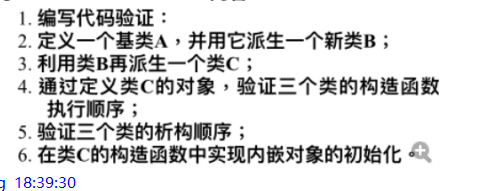
代码:
 1 #include<stdio.h>

 2 #include<string.h>

 3 #include<algorithm>

 4 #include<iostream>

 5 using namespace std;

 6 class A

 7 {

 8 public:

 9     int a,b;

10     A();

11     A(int x,int y);

12     ~A();

13 };

14 A::A()

15 {

16     printf("调用A类构造函数\n");

17 }

18 A::A(int x,int y)

19 {

20     a=x;

21     b=y;

22     printf("调用A类构造函数\n");

23 }

24 A::~A()

25 {

26     printf("调用A类析构函数\n");

27 }

28 class B:public A

29 {

30 public:

31     int aa,bb;

32     B()

33     {

34         printf("调用B类构造函数\n");

35     }

36     B(int x,int y)

37     {

38         aa=x;

39         bb=y;

40         printf("调用B类构造函数\n");

41     }

42     ~B()

43     {

44         printf("调用B类析构函数\n");

45     }

46 };

47 class C:public B

48 {

49 public:

50     int aaa,bbb;

51     B one;

52     C(int x,int y)

53     {

54         aaa=x;

55         bbb=y;

56         one.aa=x;

57         one.bb=y;

58         printf("调用C类构造函数\n");

59     }

60     ~C()

61     {

62         printf("调用C类析构函数\n");

63     }

64 };

65 int main()

66 {

67     C first(0,0);

68     printf("%d %d %d %d\n",first.aaa,first.bbb,first.one.aa,first.one.bb);

69     return 0;

70 }
二、

  1 #include<stdio.h>

  2 #include<string.h>

  3 #include<algorithm>

  4 #include<iostream>

  5 using namespace std;

  6 class Base

  7 {

  8 public:

  9     Base(int x,int y)

 10     {

 11         a=x;

 12         b=y;

 13     }

 14     virtual void show()  //声明了虚函数,那么指针指向哪个对象就用那个对象的函数

 15     {     //否则的话,声明指针是什么类型就会用那个类型的函数

 16         cout<<"基类内容show打印"<<endl;

 17         cout<<"a:"<<a<<"b:"<<b<<endl;

 18     }

 19     void prinf()

 20     {

 21         cout<<"基类内容prinf打印"<<endl;

 22         cout<<"a:"<<a<<"b:"<<b<<endl;

 23     }

 24 private:

 25     int a,b;

 26

 27 };

 28 class One:public Base

 29 {

 30 public:

 31

 32     One(int x,int y):Base(x,y)

 33     {

 34         aa=x;

 35         bb=y;

 36     }

 37     void show()

 38     {

 39         cout<<"派生类内容show打印"<<endl;

 40         cout<<"aa:"<<aa<<"bb:"<<bb<<endl;

 41     }

 42     void prinf()

 43     {

 44         cout<<"派生类内容prinf打印"<<endl;

 45         cout<<"aa:"<<aa<<"bb:"<<bb<<endl;

 46     }

 47 private:

 48     int aa,bb;

 49 };

 50 int main()

 51 {

 52     Base mb(100,200),*pc;

 53     One mc(200,300);

 54     pc=&mc;

 55     pc->show();

 56     pc->prinf();

 57     pc=&mb;

 58     pc->show();

 59     pc->prinf();

 60     return 0;

 61 }

 62

 63 //2、

 64 #include<stdio.h>

 65 #include<string.h>

 66 #include<algorithm>

 67 #include<iostream>

 68 using namespace std;

 69 class Shape   //抽象类定义是只要里面有一个纯虚函数那他就是抽象类,

 70 {   //抽象类不需要什么关键字来定义,且它的派生类必须覆盖重写他的纯虚方法

 71 public :

 72     double a;

 73     Shape(double x)

 74     {

 75         a=x;

 76     }

 77     virtual void area()=0;

 78     virtual void show()=0;

 79 };

 80 class Circle:public Shape

 81 {

 82 public:

 83     Circle(double x):Shape(x)

 84     {

 85

 86     }

 87     void area()

 88     {

 89         cout<<"the circle area is :"<<endl;

 90         cout<<3.14*a*a<<endl;

 91     }

 92     void show()

 93     {

 94         cout<<"a:"<<a<<endl;

 95     }

 96 };

 97 int main()

 98 {

 99     Shape *ptr;

100     Circle r(6);

101     ptr=&r;

102     ptr->area();

103     ptr->show();

104     return 0;

105 }

106

107 //3、

108 #include<stdio.h>

109 #include<string.h>

110 #include<algorithm>

111 #include<iostream>

112 #include<typeinfo>

113 using namespace std;

114 class Sqare

115 {

116 public :

117     double a;

118     Sqare(double x)

119     {

120         a=x;

121     }

122 };

123 class Circle

124 {

125 public :

126     double a;

127     Circle(double x)

128     {

129         a=x;

130     }

131 };

132 int main()

133 {

134     Sqare one(1);

135     Circle two(2);

136     if(typeid(one)==typeid(Sqare))  //判断对象类型

137     {

138         cout<<"它是Sqare对象"<<endl;

139     }

140     else

141     {

142         cout<<"它是Circle对象"<<endl;

143     }

144

145     if(typeid(two)==typeid(Sqare))

146     {

147         cout<<"它是Sqare对象"<<endl;

148     }

149     else

150     {

151         cout<<"它是Circle对象"<<endl;

152     }

153     return 0;

154 }
c++派生类中构造函数和析构函数执行顺序、判断对象类型、抽象类、虚函数的更多相关文章
- C++学习笔记(6)----基类和派生类的构造函数和析构函数的执行顺序
基类和派生类:构造函数和析构函数的执行顺序 在Visual Studio中,新建控制台工程,构造类如下: #include<iostream> using namespace std; c ...
- C++:派生类的构造函数和析构函数
4.2 派生类的构造函数和析构函数4.2.1 派生类构造函数和析构函数的执行顺序 通常情况下,当创建派生类对象时,首先执行基类的构造函数,随后再执行派生类的构造函数:当撤销派生类对象时,则先执行派生类 ...
- C++学习之路—继承与派生(二):派生类的构造函数与析构函数
(根据<C++程序设计>(谭浩强)整理,整理者:华科小涛,@http://www.cnblogs.com/hust-ghtao转载请注明) 由于基类的构造函数和析构函数是不能被继承的,所以 ...
- C++:派生类的构造函数和析构函数的调用顺序
一.派生类 在C++编程中,我们在编写一个基类的派生类时,大致可以分为四步: • 吸收基类的成员:不论是数据成员还是函数成员,派生类吸收除基类的构造函数和析构函数之外的全部成员. • 改造基类函数:在 ...
- 不可或缺 Windows Native (21) - C++: 继承, 组合, 派生类的构造函数和析构函数, 基类与派生类的转换, 子对象的实例化, 基类成员的隐藏(派生类成员覆盖基类成员)
[源码下载] 不可或缺 Windows Native (21) - C++: 继承, 组合, 派生类的构造函数和析构函数, 基类与派生类的转换, 子对象的实例化, 基类成员的隐藏(派生类成员覆盖基类成 ...
- cc28c_demo.cpp,派生类的构造函数和析构函数-代码示范3
cc28c_demo.cpp,派生类的构造函数和析构函数-代码示范3 //派生类的构造函数和析构函数//派生类的构造函数(执行步骤)//--执行基类的构造函数//--执行成员对象的构造函数//--执行 ...
- c++, 派生类的构造函数和析构函数 , [ 以及operator=不能被继承 or Not的探讨]
说明:文章中关于operator=实现的示例,从语法上是对的,但逻辑和习惯上都是错误的. 参见另一篇专门探究operator=的文章:<c++,operator=>http://www.c ...
- c++学习笔记4,派生类的构造函数与析构函数的调用顺序(一)
測试源代码: //測试派生类的构造函数的调用顺序何时调用 //Fedora20 gcc version=4.8.2 #include <iostream> using namespace ...
- C++-理解构造函数、析构函数执行顺序
先初始化序列中的函数调用,如果基类构造函数为非引用传递,则引起参数的拷贝构造 再: 先类内的成员构造函数(拷贝/默认),再类的构造函数:先基类,再派生类: 本文主要说明对象创建时构造函数的执行顺序,对 ...
随机推荐
- 技术基础 | Cassandra RBAC助你打击“虚拟海盗”,让他们对数据“战利品”望而不得
现如今,我们称虚拟世界里的海盗们为"黑客",他们所追寻的战利品就是在你数据库某处的数据. 而我们能够保证你的数据安全的工具之一,就是"Cassandra基于角色的访问 ...
- 【高级排序算法】2、归并排序法的实现-Merge Sort
简单记录 - bobo老师的玩转算法系列–玩转算法 -高级排序算法 Merge Sort 归并排序 Java实现归并排序 SortTestHelper 排序测试辅助类 package algo; im ...
- 一文读懂 Kubernetes APIServer 原理
前言 整个Kubernetes技术体系由声明式API以及Controller构成,而kube-apiserver是Kubernetes的声明式api server,并为其它组件交互提供了桥梁.因此加深 ...
- C++ STL getline()函数
getline() C++11 <string> 函数原型 //(1) istream& getline (istream& is, string& str, ch ...
- Angular入门到精通系列教程(11)- 模块(NgModule),延迟加载模块
1. 摘要 2. NgModule举例.说明 3. Angular CLI生成模块 4. 延迟加载模块 5. 总结 环境: Angular CLI: 11.0.6 Angular: 11.0.7 No ...
- CISCO 如何重置3850交换机密码
SUMMARY STEPS: Connect a terminal or PC to the switch. Set the line speed on the emulation software ...
- (Oracle)看懂Oracle执行计划(转载)
最近一直在跟Oracle打交道,从最初的一脸懵逼到现在的略有所知,也来总结一下自己最近所学,不定时更新ing- 一:什么是Oracle执行计划? 执行计划是一条查询语句在Oracle中的执行过程或访问 ...
- TCMalloc源码学习(四)(小内存块释放)
pagemap_和pagemap_cache_ PageHeap有两个map,pagemap_记录某一内存页对应哪一个span,显然可能多页对应一个span,pagemap_cache_记录某一内存页 ...
- collections,random
collections模块 在内置数据类型(dict.list.set.tuple)的基础上,collections模块还提供了几个额外的数据类型:Counter.deque.defaultdict. ...
- 日记 + sb错误
置顶消息cpdd 1.29 完了,文化课没了 我是废物 1.28 更新了自己的副标题 前副标题:Future never has to do with past time,but present ti ...