
B - Stacks of Flapjacks UVA - 120
Background
Stacks and Queues are often considered the bread and butter of data structures and find use in architecture, parsing, operating systems, and discrete event simulation. Stacks are also important in the theory of formal languages.
This problem involves both butter and sustenance in the form of pancakes rather than bread in addition to a finicky server who flips pancakes according to a unique, but complete set of rules.
The Problem
Given a stack of pancakes, you are to write a program that indicates how the stack can be sorted so that the largest pancake is on the bottom and the smallest pancake is on the top. The size of a pancake is given by the pancake's diameter. All pancakes in a stack have different diameters.
Sorting a stack is done by a sequence of pancake ``flips''. A flip consists of inserting a spatula between two pancakes in a stack and flipping (reversing) the pancakes on the spatula (reversing the sub-stack). A flip is specified by giving the position of the pancake on the bottom of the sub-stack to be flipped (relative to the whole stack). The pancake on the bottom of the whole stack has position 1 and the pancake on the top of a stack of n pancakes has position n.
A stack is specified by giving the diameter of each pancake in the stack in the order in which the pancakes appear.
For example, consider the three stacks of pancakes below (in which pancake 8 is the top-most pancake of the left stack):
8 7 2
4 6 5
6 4 8
7 8 4
5 5 6
2 2 7
The stack on the left can be transformed to the stack in the middle via flip(3). The middle stack can be transformed into the right stack via the command flip(1).
The Input
The input consists of a sequence of stacks of pancakes. Each stack will consist of between 1 and 30 pancakes and each pancake will have an integer diameter between 1 and 100. The input is terminated by end-of-file. Each stack is given as a single line of input with the top pancake on a stack appearing first on a line, the bottom pancake appearing last, and all pancakes separated by a space.
The Output
For each stack of pancakes, the output should echo the original stack on one line, followed by some sequence of flips that results in the stack of pancakes being sorted so that the largest diameter pancake is on the bottom and the smallest on top. For each stack the sequence of flips should be terminated by a 0 (indicating no more flips necessary). Once a stack is sorted, no more flips should be made.
Sample Input
1 2 3 4 5
5 4 3 2 1
5 1 2 3 4
Sample Output
1 2 3 4 5
0
5 4 3 2 1
1 0
5 1 2 3 4
1 2 0
题意:一摞盘子,从上到下。个数1=<N<=30,盘子直径D,1~100,求:每次只能执行从顶部到某一个的反转,也就是像堆栈一样,先倒出来,再倒回去,最终实现,从顶到底有序(升序)。输出每次反转的位置(即每次反转的底层位置),编号从底到顶从1~N。
解析:根据自己的模拟,需要每次找一个最大值,以它为反转开始点反转到第一个位置,再从它所对应的正确位置反转到正确位置。所以需要另开一个数组p[]排好序来记录原数组的排序后的状态,第一层for倒序p[]来更换最大值,第二层for来找出等于当前最大值而且不重合的数,进行swap操作。这里面有个细节就是对于j!=1时,需要先把它搞到最前面,然后再是放到最后面。最后注意输入输出,输入时小心T掉。
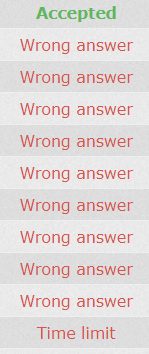
2个h,WA了9次,T了1次,相当不容易地搞出来了。也许我是个菜鸡吧,但是我提高了,我就很满意啦。
#include<iostream>

#include<cstdio>

#include<cstring>

#include<algorithm>

using namespace std;

const int maxn=;

int a[maxn],p[maxn];

void ac(int id)

{

        for(int i=id;i>=id/+;i--)

            swap(a[id-i+],a[i]);

}

int main()

{

    while(scanf("%d",&a[])!=EOF)

    {

        if(getchar()=='\n')

        {

            cout<<a[]<<endl<<""<<endl;

            continue;

        }

        int tot=;

        p[]=a[];

        while()

        {

            tot++;

            scanf("%d",&a[tot]);

            p[tot]=a[tot];

            if(getchar()=='\n')

                break;

        }

        for(int i=;i<tot;i++)

            cout<<a[i]<<" ";

            cout<<a[tot]<<endl;

        sort(p+,p++tot);

        for(int i=tot;i>=;i--)

        {

            if(a[i]==p[i])

                    continue;

            for(int j=i-;j>=;j--)

            {

                if(a[j]==p[i])

                {

                    //cout<<a[j]<<"--"<<i<<endl;

                    if(j!=)

                    {

                        cout<<tot-j+<<" ";

                        ac(j);

                    }

                        cout<<tot-i+<<" ";

                        ac(i);

                    break;

                }

            }

        }

        cout<<""<<endl;

    }

}
B - Stacks of Flapjacks UVA - 120的更多相关文章
- Uva 120 - Stacks of Flapjacks(构造法)
UVA - 120 Stacks of Flapjacks Time Limit: 3000MS Memory Limit: Unknown 64bit IO Format: %lld &a ...
- uva 120 stacks of flapjacks ——yhx
Stacks of Flapjacks Background Stacks and Queues are often considered the bread and butter of data ...
- (白书训练计划)UVa 120 Stacks of Flapjacks(构造法)
题目地址:UVa 120 水题. 从最大的開始移,每次都把大的先翻到最上面,再翻到以下. 代码例如以下: #include <iostream> #include <cstdio&g ...
- UVaOJ 120 - Stacks of Flapjacks
120 - Stacks of Flapjacks 题目看了半天......英语啊!!! 好久没做题...循环输入数字都搞了半天...罪过啊!!! 还是C方便一点...其实C++应该更方便的...C+ ...
- uva Stacks of Flapjacks
Stacks of Flapjacks 题目链接:Click Here~ 题目描写叙述: ...
- 【思维】Stacks of Flapjacks
[UVa120] Stacks of Flapjacks 算法入门经典第8章8-1 (P236) 题目大意:有一个序列,可以翻转[1,k],构造一种方案使得序列升序排列. 试题分析:从插入排序即可找到 ...
- Stacks of Flapjacks(栈)
Stacks of Flapjacks Background Stacks and Queues are often considered the bread and butter of data ...
- Stacks of Flapjacks
Stacks of Flapjacks Background Stacks and Queues are often considered the bread and butter of data s ...
- UVa 120 Stacks of Flapjacks【构造法】
题意:给出n张煎饼,从上到下输入,每张煎饼上面都有一个数字,厨师每次可以选择第k张煎饼,进行翻转操作,设计一种方法使得所有煎饼按照从小到大排序(最上面的煎饼最小) 首先是这个翻转的操作,如下图 如图所 ...
随机推荐
- EC20的指令
AT+QURCCFG="urcport","usbat" :当设置在主串口时且用主串口进行AT交互时开机会收到一串状态的信息,默认USBAT就不会 AT+IPR ...
- scala的trait执行报错: 错误: 找不到或无法加载主类 cn.itcast.scala.`trait`
scala的trait执行报错: 错误: 找不到或无法加载主类 cn.itcast.scala.`trait`.Children 原因:包名写成了trait,与trait关键字重名了: package ...
- Atcoder Beginner Contest 139E(模拟,思维)
#define HAVE_STRUCT_TIMESPEC#include<bits/stdc++.h>using namespace std;int n;int a[1007][1007] ...
- 【PAT甲级】1019 General Palindromic Number (20 分)
题意: 输入两个正整数n和b(n<=1e9,2<=b<=1e9),分别表示数字的大小和进制大小,求在b进制下n是否是一个回文串,输出“Yes”or“No”,并将数字n在b进制下打印出 ...
- Qtxlsx的使用
上一遍讲述了基于Qt5.9.8下编译Xtxlsx,本遍讲述基于Qt5.9.8下使用Qtxlsx 1.打开Qt Creator 4.8.2(Enterprise),创建工程,选择版本 2.在pro文件中 ...
- MongoDB基础篇2:数据库/用户/数据集合的增删改
一.数据库操作 创建并进入数据库: 命令:use DATABASE_NAME 示例:use tms 查看所有数据库: 命令:show dbs 注意: (1)新创建的数据库在show dbs命令 ...
- Java - 使用hibernate配置文件 + JPA annotation注解操作数据库
本程序运行环境:IDEA. 实际上我对hiberbate与注解的关系还不是太清晰.据我所知注解都是Java JPA的,那么我的理解是:hibernate就应该只是通过这些JPA标识及hibernate ...
- mysql 命令行个性化设置
通过配置显示主机和用户名 mysql -u root -p --prompt="(\u@\h) [\d]>" 或在配置文件中修改,可在命令行中的目标位置查看 --tee na ...
- 解决Missing artifact com.microsoft.sqlserver:sqljdbc4:jar:4.0问题
当我们项目中用到的数据库为sql server时 我们一般在maven项目的pom.xml只添加依赖: <dependency> <groupId>com.micros ...
- linux编译C
1. 编译单个源文件 为了进行测试,你可以创建"Hello World"程序: #include #include int main(int argc, char **argv) ...