
LeetCode 381. Insert Delete GetRandom O(1) - Duplicates allowed O(1) 时间插入、删除和获取随机元素 - 允许重复(C++/Java)
题目:
Design a data structure that supports all following operations in averageO(1) time.
Note: Duplicate elements are allowed.
insert(val): Inserts an item val to the collection.remove(val): Removes an item val from the collection if present.getRandom: Returns a random element from current collection of elements. The probability of each element being returned is linearly related to the number of same value the collection contains.
Example:
// Init an empty collection.

RandomizedCollection collection = new RandomizedCollection();

// Inserts 1 to the collection. Returns true as the collection did not contain 1.

collection.insert(1);

// Inserts another 1 to the collection. Returns false as the collection contained 1. Collection now contains [1,1].

collection.insert(1);

// Inserts 2 to the collection, returns true. Collection now contains [1,1,2].

collection.insert(2);

// getRandom should return 1 with the probability 2/3, and returns 2 with the probability 1/3.

collection.getRandom();

// Removes 1 from the collection, returns true. Collection now contains [1,2].

collection.remove(1);

// getRandom should return 1 and 2 both equally likely.

collection.getRandom();
分析:
这道题是leetcode380的进阶版,也就是允许出现重复的元素。这里附上380的题解LeetCode 380. Insert Delete GetRandom O(1) 常数时间插入、删除和获取随机元素(C++/Java)。
同样使用HashMap来支持插入和移除操作,利用数组来支持对数据的随机访问。只不过hashmap中val对应的是一个存放该元素在数组中索引的数组,当删除操作时,可以快速定位到该元素在数组的位置。
而数组中不只存放val,而是将val和该val在hashmap中对应的数组的索引,用来支持
我们来配合例子看一下:
依次执行
insert(1);insert(1);insert(2);
此时存储的情况如图:
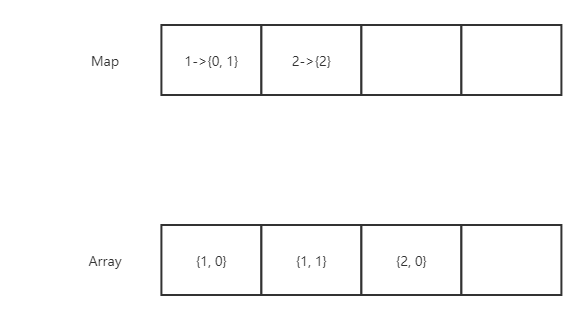
此时我们执行remove(1)的操作,我们首先通过map找到1这个元素对应的数组,取出数组中最后一个元素,表示的便是1这个元素在Array数组中的索引。
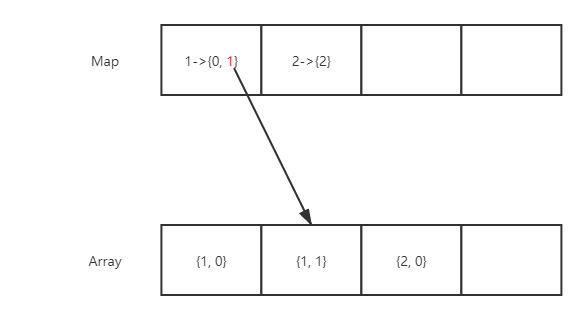
由于数组删除最后一个元素的时间复杂度为O(1)(不考虑扩容这种情况),我们将要删除的位置和数组中最后一个元素置换,或者是覆盖都可以。
然后我们再根据当前位置的这个元素去修改Map中数据,Array中元素的第二个值表示这个val在map中val对应的数组中的索引,此时我们要修改这个索引的值,改为array中调整后的索引值。最后在将无用的数据删除掉即可。
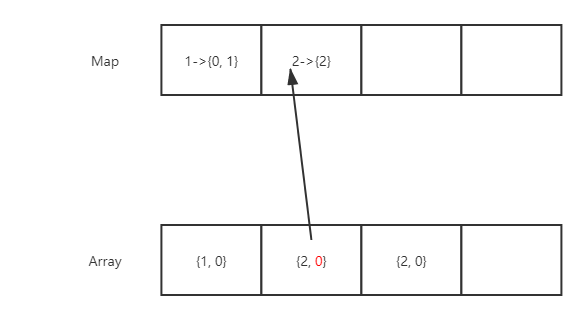
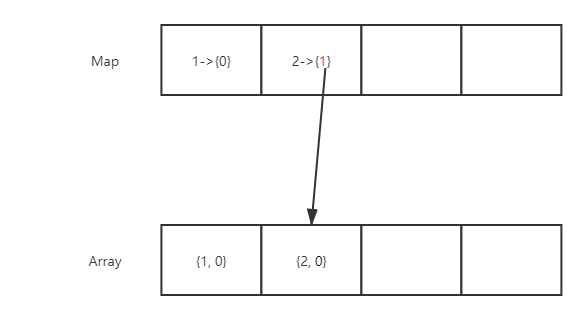
说着确实有些繁琐,不过通过实例配合图片过一遍应该比较好理解!
程序:
C++
class RandomizedCollection {

public:

    /** Initialize your data structure here. */

    RandomizedCollection() {

    }

    /** Inserts a value to the collection. Returns true if the collection did not already contain the specified element. */

    bool insert(int val) {

        m[val].push_back(v.size());

        v.emplace_back(val, m[val].size() - );

        return true;

    }

    /** Removes a value from the collection. Returns true if the collection contained the specified element. */

    bool remove(int val) {

        if(!m.count(val))

            return false;

        int lIndex = m[val].back();

        auto entry = v.back();

        v[lIndex] = entry;

        m[entry.first][entry.second] = lIndex;

        v.pop_back();

        m[val].pop_back();

        if(m[val].empty())

            m.erase(val);

        return true;

    }

    /** Get a random element from the collection. */

    int getRandom() {

        int index = rand() % v.size();

        return v[index].first;

    }

private:

    unordered_map<int, vector<int>> m;

    vector<pair<int, int>> v;

};
Java
class RandomizedCollection {

    /** Initialize your data structure here. */

    public RandomizedCollection() {

    }

    /** Inserts a value to the collection. Returns true if the collection did not already contain the specified element. */

    public boolean insert(int val) {

        List<Integer> l = map.getOrDefault(val, new ArrayList<Integer>());

        l.add(list.size());

        map.put(val, l);

        list.add(new Pair<>(val, l.size()-1));

        return true;

    }

    /** Removes a value from the collection. Returns true if the collection contained the specified element. */

    public boolean remove(int val) {

        if(!map.containsKey(val))

            return false;

        List<Integer> l = map.get(val);

        int lastIndex = l.get(l.size()-1);

        Pair<Integer, Integer> p = list.get(list.size()-1);

        list.set(lastIndex, p);

        List<Integer> cl = map.get(p.getKey());

        cl.set(p.getValue(), lastIndex);

        map.put(p.getKey(), cl);

        list.remove(list.size()-1);

        l.remove(l.size()-1);

        if(l.size() == 0)

            map.remove(val);

        return true;

    }

    /** Get a random element from the collection. */

    public int getRandom() {

        Random r = new Random();

        int index = r.nextInt(list.size());

        return list.get(index).getKey();

    }

    private HashMap<Integer, List> map = new HashMap<>();

    private ArrayList<Pair<Integer, Integer>> list = new ArrayList<>();

}
LeetCode 381. Insert Delete GetRandom O(1) - Duplicates allowed O(1) 时间插入、删除和获取随机元素 - 允许重复(C++/Java)的更多相关文章
- 381 Insert Delete GetRandom O(1) - Duplicates allowed O(1) 时间插入、删除和获取随机元素 - 允许重复
设计一个支持在平均 时间复杂度 O(1) 下, 执行以下操作的数据结构.注意: 允许出现重复元素. insert(val):向集合中插入元素 val. remove(val):当 val ...
- [LeetCode] 381. Insert Delete GetRandom O(1) - Duplicates allowed 插入删除和获得随机数O(1)时间 - 允许重复
Design a data structure that supports all following operations in average O(1) time. Note: Duplicate ...
- [LeetCode] 381. Insert Delete GetRandom O(1) - Duplicates allowed 常数时间内插入删除和获得随机数 - 允许重复
Design a data structure that supports all following operations in average O(1) time. Note: Duplicate ...
- LeetCode 381. Insert Delete GetRandom O(1) - Duplicates allowed
原题链接在这里:https://leetcode.com/problems/insert-delete-getrandom-o1-duplicates-allowed/?tab=Description ...
- LeetCode 381. Insert Delete GetRandom O(1) - Duplicates allowed (插入删除和获得随机数 常数时间 允许重复项)
Design a data structure that supports all following operations in average O(1) time. Note: Duplicate ...
- [leetcode]381. Insert Delete GetRandom O(1) - Duplicates allowed常数时间插入删除取随机值
Design a data structure that supports all following operations in average O(1) time. Note: Duplicate ...
- leetcode 380. Insert Delete GetRandom O(1) 、381. Insert Delete GetRandom O(1) - Duplicates allowed
380. Insert Delete GetRandom O(1) 实现插入.删除.获得随机数功能,且时间复杂度都在O(1).实际上在插入.删除两个功能中都包含了查找功能,当然查找也必须是O(1). ...
- 381. Insert Delete GetRandom O(1) - Duplicates allowed
Design a data structure that supports all following operations in average O(1) time. Note: Duplicate ...
- 381. Insert Delete GetRandom O(1) - Duplicates allowed允许重复的设计1数据结构
[抄题]: Design a data structure that supports all following operations in average O(1) time. Note: Dup ...
随机推荐
- 014 Ceph管理和自定义CRUSHMAP
一.概念 1.1 Ceph集群写操作流程 client首先访问ceph monitor获取cluster map的一个副本,知晓集群的状态和配置 数据被转化为一个或多个对象,每个对象都具有对象名称和存 ...
- Java中日期格式化YYYY-DD的坑
写这篇博文是记录下跨年的bug.去年隔壁组的小伙伴就是计算两个日期之间间隔的天数,因为跨年的原因计算有误. 当时测试组的小姐姐也没有模拟出来这种场景,导致上生产环境直接影响线上的数据. 今天逛技术论论 ...
- 6.python在windows下用批处理文件在运行中输入程序名直接运行的方法
最近由于平时自由时间比较多,在看一本python入门书籍,在里面学习了一种用windows下的批处理文件在电脑运行界面中直接输入程序名称就可运行的方法,现将其详细说明如下: 1.首先编写一个教程上的程 ...
- Cassandra数据建模中最重要的事情:主键
Cassandra数据建模中要了解的最重要的事情:主键 使用关系数据建模,您可以从主键开始,但是RDBMS中的有效数据模型更多地是关于表之间的外键关系和关系约束.由于Cassandra无法使用JOIN ...
- 负载均衡之ribbon
一.什么是负载均衡? 做web开发都会接触到负载均衡,这里我们就不细说了. (摘自百度百科)负载均衡,英文名称为Load Balance,其含义就是指将负载(工作任务)进行平衡.分摊到多个操作单元上进 ...
- 迭代器使用过程中为什么抛出ConcurrentModificationException
出现的场景:在迭代器对集合进行遍历的同时,集合本身进行变更操作(add(), remove(), set()). 当正常调用时: import java.util.ArrayList; import ...
- Java Calendar类(java.util包)
Date 类最主要的作用就是获得当前时间,同时这个类里面也具有设置时间以及一些其他的功能,但是由于本身设计的问题,这些方法却遭到众多批评,不建议使用,更推荐使用 Calendar 类进行时间和日期的处 ...
- ubuntu16.04 docker kubernetes(k8s) istio 安装
版本: docker: 19.03.5 kubernetes: 1.17.0 istio: 1.4.3 步骤一:给ubuntu换源 https://www.cnblogs.com/lfri/p/106 ...
- 重拾c++第一天(3):数据处理
1.short至少16位:int至少与short一样长:long至少32位,且至少与int一样长:long long至少64位,且至少与long一样长 2.sizeof 变量 返回变量长度 或者s ...
- Spring Boot2 系列教程 (十四) | 统一异常处理
如题,今天介绍 SpringBoot 是如何统一处理全局异常的.SpringBoot 中的全局异常处理主要起作用的两个注解是 @ControllerAdvice 和 @ExceptionHandler ...