
CMDB学习之四 ——DEBUG模式
定义一个debug,进行解析调试,到测试文件
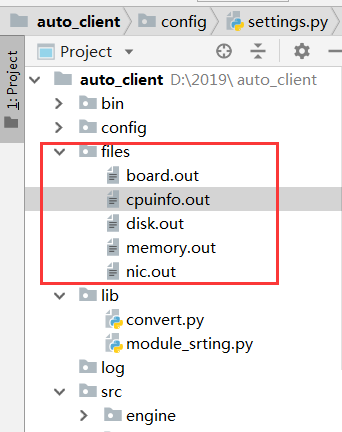
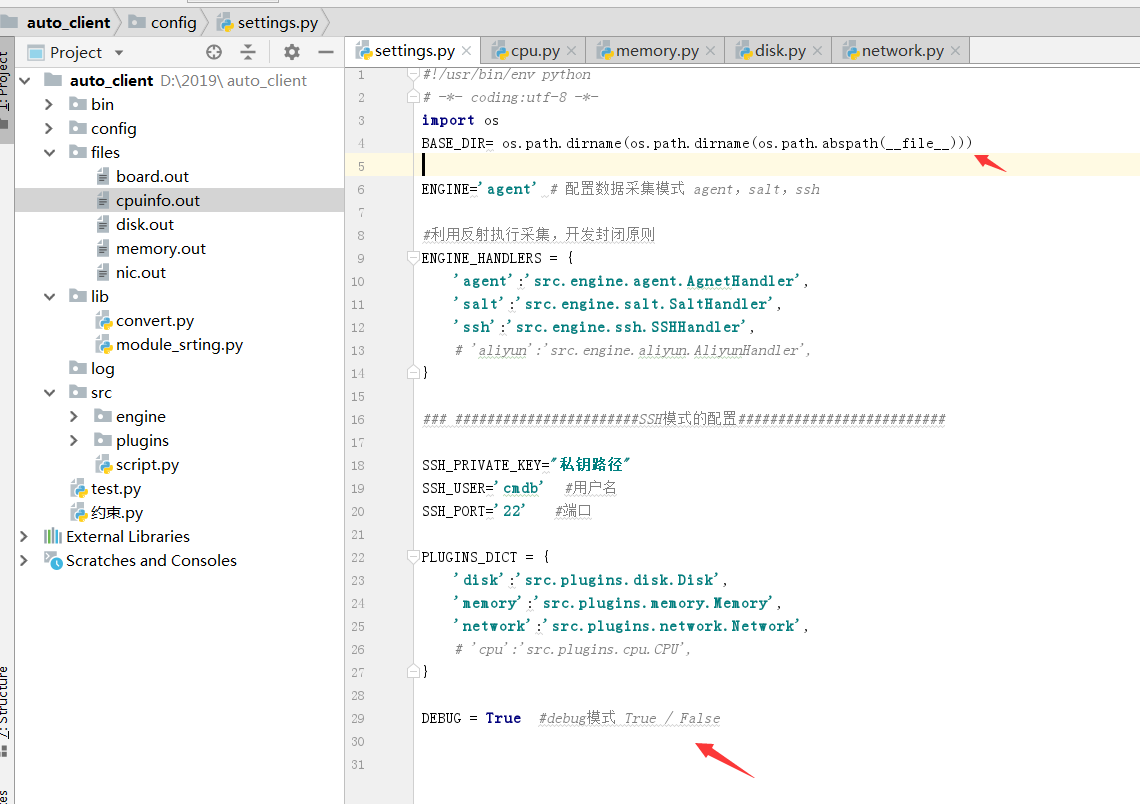
配置文件,配置debug模式,定义环境变量,
#!/usr/bin/env python

# -*- coding:utf-8 -*-

import os

BASE_DIR= os.path.dirname(os.path.dirname(os.path.abspath(__file__)))

ENGINE='agent' # 配置数据采集模式 agent,salt,ssh

#利用反射执行采集,开发封闭原则

ENGINE_HANDLERS = {

    'agent':'src.engine.agent.AgnetHandler',

    'salt':'src.engine.salt.SaltHandler',

    'ssh':'src.engine.ssh.SSHHandler',

    # 'aliyun':'src.engine.aliyun.AliyunHandler',

}

### #######################SSH模式的配置##########################

SSH_PRIVATE_KEY="私钥路径"

SSH_USER='cmdb'  #用户名

SSH_PORT=''   #端口

PLUGINS_DICT = {

    'disk':'src.plugins.disk.Disk',

    'memory':'src.plugins.memory.Memory',

    'network':'src.plugins.network.Network',

    # 'cpu':'src.plugins.cpu.CPU',

}

DEBUG = True  #debug模式 True / False
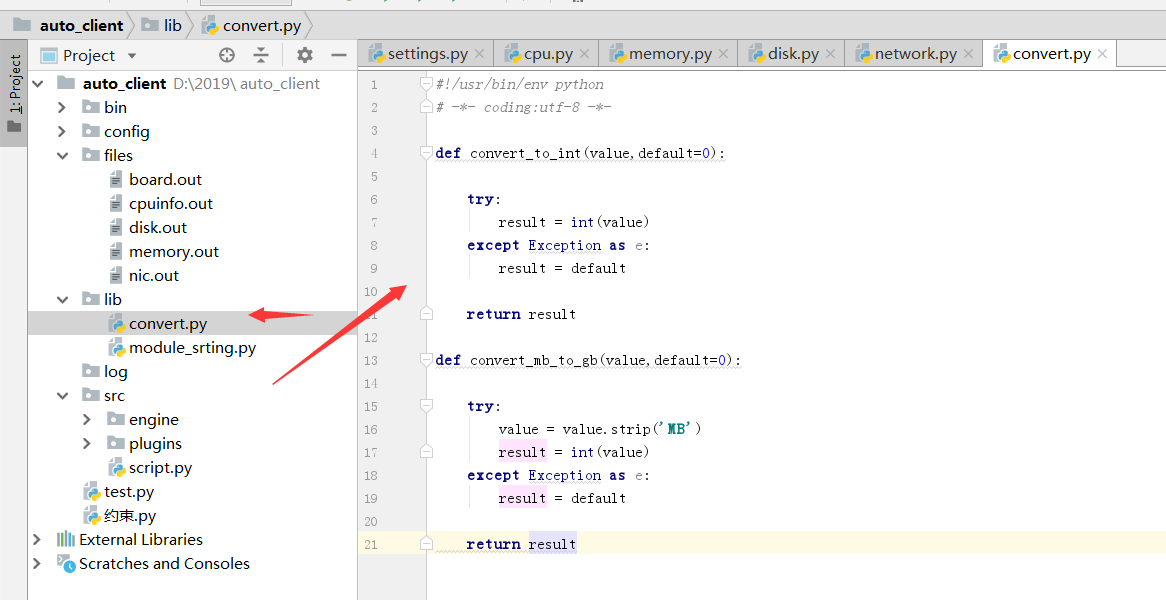
内存采集解析,内存采集中使用的 convert,导入文件在lib目录下
#!/usr/bin/env python

# -*- coding:utf-8 -*-

def convert_to_int(value,default=0):

    try:

        result = int(value)

    except Exception as e:

        result = default

    return result

def convert_mb_to_gb(value,default=0):

    try:

        value = value.strip('MB')

        result = int(value)

    except Exception as e:

        result = default

    return result
#!/usr/bin/env python

# -*- coding:utf-8 -*-

import os

from .base import BasePlugin

from lib import convert

class Memory(BasePlugin):

    def win(self,handler,hostname):

        '''

        执行命令拿到结果-内存

        :return:

        '''

        print("执行win方法")

        ret = handler.cmd('wmic memphysical list brief',hostname)[0:10]

        return ret

    # def linux(self,handler,hostname):

    #     '''

    #     执行命令拿到结果-内存

    #     :return:

    #     '''

    #     print("执行Linux方法")

    #     ret = handler.cmd('free',hostname)[0:10]

    #     return ret

    def linux(self, handler, hostname):

        if self.debug:

            output = open(os.path.join(self.base_dir, 'files', 'memory.out'), 'r').read()

        else:

            shell_command = "sudo dmidecode  -q -t 17 2>/dev/null"

            output = handler.cmd(shell_command, hostname)

        return self.parse(output)

    def parse(self, content):

        """

        解析shell命令返回结果

        :param content: shell 命令结果

        :return:解析后的结果

        """

        ram_dict = {}

        key_map = {

            'Size': 'capacity',

            'Locator': 'slot',

            'Type': 'model',

            'Speed': 'speed',

            'Manufacturer': 'manufacturer',

            'Serial Number': 'sn',

        }

        devices = content.split('Memory Device')

        for item in devices:

            item = item.strip()

            if not item:

                continue

            if item.startswith('#'):

                continue

            segment = {}

            lines = item.split('\n\t')

            for line in lines:

                if len(line.split(':')) > 1:

                    key, value = line.split(':')

                else:

                    key = line.split(':')[0]

                    value = ""

                if key in key_map:

                    if key == 'Size':

                        segment[key_map['Size']] = convert.convert_mb_to_gb(value, 0)

                    else:

                        segment[key_map[key.strip()]] = value.strip()

            ram_dict[segment['slot']] = segment

        return ram_dict
磁盘采集解析
# !/usr/bin/env python

# -*- coding:utf-8 -*-

from .base import BasePlugin

import os,re

class Disk(BasePlugin):

    def win(self,handler,hostname):

        '''

        执行命令拿到结果-磁盘

        :return:

        '''

        print("执行win方法")

        ret = handler.cmd('wmic diskdrive',hostname)[0:10]

        return ret

    # def linux(self,handler,hostname):

    #     '''

    #     执行命令拿到结果-磁盘

    #     :return:

    #     '''

    #     print("执行Linux方法")

    #

    #     ret = handler.cmd('df -h',hostname)[0:10]

    #     return ret

    def linux(self, handler, hostname):

        if self.debug:

            output = open(os.path.join(self.base_dir, 'files', 'disk.out'), 'r').read()

        else:

            shell_command = "sudo MegaCli  -PDList -aALL" #根据执行的命令

            output = handler.cmd(shell_command, hostname)

        return self.parse(output)

    def parse(self, content):

        """

        解析shell命令返回结果

        :param content: shell 命令结果

        :return:解析后的结果

        """

        response = {}

        result = []

        for row_line in content.split("\n\n\n\n"):

            result.append(row_line)

        for item in result:

            temp_dict = {}

            for row in item.split('\n'):

                if not row.strip():

                    continue

                if len(row.split(':')) != 2:

                    continue

                key, value = row.split(':')

                name = self.mega_patter_match(key)

                if name:

                    if key == 'Raw Size':

                        raw_size = re.search('(\d+\.\d+)', value.strip())

                        if raw_size:

                            temp_dict[name] = raw_size.group()

                        else:

                            raw_size = ''

                    else:

                        temp_dict[name] = value.strip()

            if temp_dict:

                response[temp_dict['slot']] = temp_dict

        return response

    @staticmethod

    def mega_patter_match(needle):

        grep_pattern = {'Slot': 'slot', 'Raw Size': 'capacity', 'Inquiry': 'model', 'PD Type': 'pd_type'}

        for key, value in grep_pattern.items():

            if needle.startswith(key):

                return value

        return False
网络采集解析
#!/usr/bin/env python

# -*- coding:utf-8 -*-

import os,re

from .base import BasePlugin

class Network(BasePlugin):

    def win(self,handler,hostname):

        '''

        执行命令拿到结果-网卡

        :return:

        '''

        print("执行win方法")

        ret = handler.cmd('ipconfig',hostname)[0:10]

        return ret

    # def linux(self,handler,hostname):

    #         '''

    #         执行命令拿到结果-网卡

    #         :return:

    #         '''

    #         print("执行Linux方法")

    #         ret = handler.cmd('ifconfig',hostname)[0:10]

    #         return ret

    def linux(self, handler, hostname):

        if self.debug:

            output = open(os.path.join(self.base_dir, 'files', 'nic.out'), 'r').read()

            interfaces_info = self._interfaces_ip(output)

        else:

            interfaces_info = self.linux_interfaces(handler)

        self.standard(interfaces_info)

        return interfaces_info

    def linux_interfaces(self, handler):

        '''

        Obtain interface information for *NIX/BSD variants

        '''

        ifaces = dict()

        ip_path = 'ip'

        if ip_path:

            cmd1 = handler.cmd('sudo {0} link show'.format(ip_path))

            cmd2 = handler.cmd('sudo {0} addr show'.format(ip_path))

            ifaces = self._interfaces_ip(cmd1 + '\n' + cmd2)

        return ifaces

    def which(self, exe):

        def _is_executable_file_or_link(exe):

            # check for os.X_OK doesn't suffice because directory may executable

            return (os.access(exe, os.X_OK) and

                    (os.path.isfile(exe) or os.path.islink(exe)))

        if exe:

            if _is_executable_file_or_link(exe):

                # executable in cwd or fullpath

                return exe

            # default path based on busybox's default

            default_path = '/bin:/sbin:/usr/bin:/usr/sbin:/usr/local/bin'

            search_path = os.environ.get('PATH', default_path)

            path_ext = os.environ.get('PATHEXT', '.EXE')

            ext_list = path_ext.split(';')

            search_path = search_path.split(os.pathsep)

            if True:

                # Add any dirs in the default_path which are not in search_path. If

                # there was no PATH variable found in os.environ, then this will be

                # a no-op. This ensures that all dirs in the default_path are

                # searched, which lets salt.utils.which() work well when invoked by

                # salt-call running from cron (which, depending on platform, may

                # have a severely limited PATH).

                search_path.extend(

                    [

                        x for x in default_path.split(os.pathsep)

                        if x not in search_path

                    ]

                )

            for path in search_path:

                full_path = os.path.join(path, exe)

                if _is_executable_file_or_link(full_path):

                    return full_path

        return None

    def _number_of_set_bits_to_ipv4_netmask(self, set_bits):  # pylint: disable=C0103

        '''

        Returns an IPv4 netmask from the integer representation of that mask.

        Ex. 0xffffff00 -> '255.255.255.0'

        '''

        return self.cidr_to_ipv4_netmask(self._number_of_set_bits(set_bits))

    def cidr_to_ipv4_netmask(self, cidr_bits):

        '''

        Returns an IPv4 netmask

        '''

        try:

            cidr_bits = int(cidr_bits)

            if not 1 <= cidr_bits <= 32:

                return ''

        except ValueError:

            return ''

        netmask = ''

        for idx in range(4):

            if idx:

                netmask += '.'

            if cidr_bits >= 8:

                netmask += ''

                cidr_bits -= 8

            else:

                netmask += '{0:d}'.format(256 - (2 ** (8 - cidr_bits)))

                cidr_bits = 0

        return netmask

    def _number_of_set_bits(self, x):

        '''

        Returns the number of bits that are set in a 32bit int

        '''

        # Taken from http://stackoverflow.com/a/4912729. Many thanks!

        x -= (x >> 1) & 0x55555555

        x = ((x >> 2) & 0x33333333) + (x & 0x33333333)

        x = ((x >> 4) + x) & 0x0f0f0f0f

        x += x >> 8

        x += x >> 16

        return x & 0x0000003f

    def _interfaces_ip(self, out):

        '''

        Uses ip to return a dictionary of interfaces with various information about

        each (up/down state, ip address, netmask, and hwaddr)

        '''

        ret = dict()

        right_keys = ['name', 'hwaddr', 'up', 'netmask', 'ipaddrs']

        def parse_network(value, cols):

            '''

            Return a tuple of ip, netmask, broadcast

            based on the current set of cols

            '''

            brd = None

            if '/' in value:  # we have a CIDR in this address

                ip, cidr = value.split('/')  # pylint: disable=C0103

            else:

                ip = value  # pylint: disable=C0103

                cidr = 32

            if type_ == 'inet':

                mask = self.cidr_to_ipv4_netmask(int(cidr))

                if 'brd' in cols:

                    brd = cols[cols.index('brd') + 1]

            return (ip, mask, brd)

        groups = re.compile('\r?\n\\d').split(out)

        for group in groups:

            iface = None

            data = dict()

            for line in group.splitlines():

                if ' ' not in line:

                    continue

                match = re.match(r'^\d*:\s+([\w.\-]+)(?:@)?([\w.\-]+)?:\s+<(.+)>', line)

                if match:

                    iface, parent, attrs = match.groups()

                    if 'UP' in attrs.split(','):

                        data['up'] = True

                    else:

                        data['up'] = False

                    if parent and parent in right_keys:

                        data[parent] = parent

                    continue

                cols = line.split()

                if len(cols) >= 2:

                    type_, value = tuple(cols[0:2])

                    iflabel = cols[-1:][0]

                    if type_ in ('inet',):

                        if 'secondary' not in cols:

                            ipaddr, netmask, broadcast = parse_network(value, cols)

                            if type_ == 'inet':

                                if 'inet' not in data:

                                    data['inet'] = list()

                                addr_obj = dict()

                                addr_obj['address'] = ipaddr

                                addr_obj['netmask'] = netmask

                                addr_obj['broadcast'] = broadcast

                                data['inet'].append(addr_obj)

                        else:

                            if 'secondary' not in data:

                                data['secondary'] = list()

                            ip_, mask, brd = parse_network(value, cols)

                            data['secondary'].append({

                                'type': type_,

                                'address': ip_,

                                'netmask': mask,

                                'broadcast': brd,

                            })

                            del ip_, mask, brd

                    elif type_.startswith('link'):

                        data['hwaddr'] = value

            if iface:

                if iface.startswith('pan') or iface.startswith('lo') or iface.startswith('v'):

                    del iface, data

                else:

                    ret[iface] = data

                    del iface, data

        return ret

    def standard(self, interfaces_info):

        for key, value in interfaces_info.items():

            ipaddrs = set()

            netmask = set()

            if not 'inet' in value:

                value['ipaddrs'] = ''

                value['netmask'] = ''

            else:

                for item in value['inet']:

                    ipaddrs.add(item['address'])

                    netmask.add(item['netmask'])

                value['ipaddrs'] = '/'.join(ipaddrs)

                value['netmask'] = '/'.join(netmask)

                del value['inet']
CMDB学习之四 ——DEBUG模式的更多相关文章
- python flask框架学习——开启debug模式
学习自:知了课堂Python Flask框架——全栈开发 1.flask的几种debug模式的方法 # 1.app.run 传参debug=true app.run(debug=True) #2 设置 ...
- 8086汇编语言学习(二) 8086汇编开发环境搭建和Debug模式介绍
1. 8086汇编开发环境搭建 在上篇博客中简单的介绍了8086汇编语言.工欲善其事,必先利其器,在8086汇编语言正式开始学习之前,先介绍一下如何搭建8086汇编的开发环境. 汇编语言设计之初是用于 ...
- 初学node.js,安装nodemon,学习debug模式,安装cpu-stat
1.运行node 文件 node .\01.js 文件内容 console.log('aaaa'); 2.因为每次更新文件都需要重新,所以安装nodemon npm i ...
- flask学习(四):debug模式
一. 设置debug模式 1. flask 1.0之前 在app.run()中传入一个关键字参数debug,app.run(debug=True),就设置当前项目为debug模式 2. flask 1 ...
- odoo Windows10启动debug模式报错(Process finished with exit code -1073740940 (0xC0000374))
之前用win10系统,安装odoo总是启动debug模式启动不起来很恼火. 报错问题:Process finished with exit code -1073740940 (0xC0000374) ...
- Flask debug 模式 PIN 码生成机制安全性研究笔记
Flask debug 模式 PIN 码生成机制安全性研究笔记 0x00 前言 前几天我整理了一个笔记:Flask开启debug模式等于给黑客留了后门,就Flask在生产网络中开启debug模式可能产 ...
- Eclipse Debug模式的开启与关闭问题简析_java - JAVA
文章来源:嗨学网 敏而好学论坛www.piaodoo.com 欢迎大家相互学习 默认情况下,eclipse中右键debug,当运行到设置的断点时会自动跳到debug模式下.但由于我的eclipse环境 ...
- IDea 工具debug模式详细使用说明
IDea 工具debug模式详细使用说明 IDEA中如何使用debug调试项目 一步一步详细教程 Debug用来追踪代码的运行流程,通常在程序运行过程中出现异常,启用Debug模式可以分析定位异常发生 ...
- 手机改 user模式为debug模式
logcat 是Android中一个命令行工具,可用于监控手机应用程序的log信息.网上相关的教学很多,这里只想把自己折腾 2 部手机(一个是三星S4 I9500 港水,Android 5.01,一个 ...
随机推荐
- c3p0-config.xml
<?xml version="1.0" encoding="UTF-8"?> <!DOCTYPE xml> <c3p0-confi ...
- 20180929 北京大学 人工智能实践:Tensorflow笔记06
入戏 需要修改成如下: (完)
- shrio 加密/编码
在涉及到密码存储问题上,应该加密/生成密码摘要存储,而不是存储明文密码.比如之前的600w csdn账号泄露对用户可能造成很大损失,因此应加密/生成不可逆的摘要方式存储. 5.1 编码/解码 Shir ...
- Java读取txt文件和覆盖写入txt文件和追加写入txt
//创建文件 public static void createFile(File filename) { try { if(!filename.exists()) { filename.create ...
- 在performancepoint里面建立数据源的时候,总是发生以下的报警
就是我在performancepoint里面建立数据源的时候,总是发生以下的报警. 在管理中心主页的“应用程序管理”部分,单击“管理服务应用程序”,然后单击“PerformancePoint Se ...
- SELinux 入门
几乎可以肯定每个人都听说过 SELinux (更准确的说,尝试关闭过),甚至某些过往的经验让您对 SELinux 产生了偏见.不过随着日益增长的 0-day 安全漏洞,或许现在是时候去了解下这个在 L ...
- 联想杨天 S4130-12 win10改win7 bios参数设置
一.进入bios 开机后按 F1 二.改bion参数 1.移动到 save& Exit ,修改 OS optimized defaults 为“Disbled” 再 “F9” 保存 2. ...
- GridView单元格取值显示为
在通过GridView取一个单元格(cell)的值时,数据库中为NULL,而页面上显示为空格.发现通过gridview.cell[i].text取出来的值为 ,导致获取数据出现问题. 解决方法: 一. ...
- 【Django】Cookie
目录 Cookie介绍 操作Cookie 获取Cookie 设置 Cookie 删除Cookie @ Cookie介绍 Cookie的由来 大家都知道==HTTP协议是无状态的==. ==无状态的的意 ...
- 本地运行github上的vue2.0仿饿了么webapp项目
在vue刚刚开始流行的时候,大多数人学习大概都见到过这样的一个项目吧,可以作为学习此框架的一个模板了 github源码地址:https://github.com/RegToss/Vue-SPA 课程教 ...