
Windows Phone开发(6):处理屏幕方向的改变
原文:Windows Phone开发(6):处理屏幕方向的改变
俺们都知道,智能手机可以通过旋转手机来改变屏幕的显示方向,更多的时候,对于屏幕方向的改变,我们要做出相应的处理,例如,当手机屏幕方向从纵向变为横向时,可能要重新排列页面上的控件以适应显示区域的变化。
要使页面支持旋转,要把PhoneApplicationPage的SupportedOrientations属性改为PortraitOrLandscape,然后可以通过定义OrientationChanged事件来处理布局。形如:
<phone:PhoneApplicationPage

    ..............

    SupportedOrientations="PortraitOrLandscape"

    Orientation="Portrait"

    OrientationChanged="PhoneApplicationPage_OrientationChanged">
一、Grid控件的处理。
<phone:PhoneApplicationPage

    x:Class="Sample_PageDir.Page1"

    xmlns="http://schemas.microsoft.com/winfx/2006/xaml/presentation"

    xmlns:x="http://schemas.microsoft.com/winfx/2006/xaml"

    xmlns:phone="clr-namespace:Microsoft.Phone.Controls;assembly=Microsoft.Phone"

    xmlns:shell="clr-namespace:Microsoft.Phone.Shell;assembly=Microsoft.Phone"

    xmlns:d="http://schemas.microsoft.com/expression/blend/2008"

    xmlns:mc="http://schemas.openxmlformats.org/markup-compatibility/2006"

    FontFamily="{StaticResource PhoneFontFamilyNormal}"

    FontSize="{StaticResource PhoneFontSizeNormal}"

    Foreground="{StaticResource PhoneForegroundBrush}"

    mc:Ignorable="d" d:DesignHeight="768" d:DesignWidth="480"

    shell:SystemTray.IsVisible="True"

    SupportedOrientations="PortraitOrLandscape"

    Orientation="Portrait"

    OrientationChanged="PhoneApplicationPage_OrientationChanged">

    <Grid x:Name="layoutRoot">

        <Grid.RowDefinitions>

            <RowDefinition Height="Auto" />

            <RowDefinition Height="Auto" />

        </Grid.RowDefinitions>

        <Grid.ColumnDefinitions>

            <ColumnDefinition Width="Auto" />

            <ColumnDefinition Width="Auto" />

        </Grid.ColumnDefinitions>

        <Image x:Name="img" Source="http://gubapic.eastmoney.com/member/e68/e681999/e68199920091216131540.jpg" Stretch="UniformToFill" Width="270" Grid.Row="0" Grid.Column="0" />

        <TextBlock x:Name="txtBlock"

            Grid.Row="1"

            Grid.Column="0"

            FontSize="70"

            Margin="28">

            <Run Foreground="Coral">信春哥</Run>

            <LineBreak/>

            <Run Foreground="Yellow">唱情歌</Run>

            <LineBreak/>

            <Run Foreground="SkyBlue">不挂科</Run>

        </TextBlock>

    </Grid>

</phone:PhoneApplicationPage>
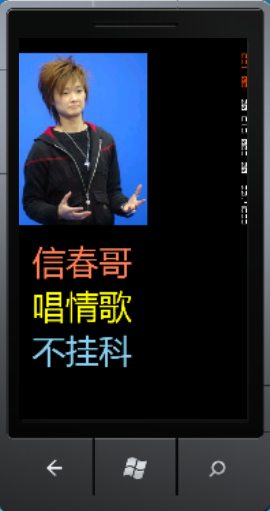
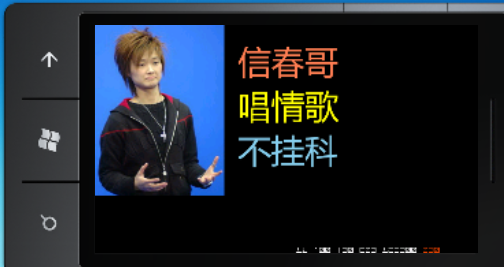
页面主要有两个控件,一个用于显示图片,一个用于显示文本信息,通过事件处理代码来相应改变两个控件的布局。
        private void PhoneApplicationPage_OrientationChanged(object sender, OrientationChangedEventArgs e)

        {

            // 如果是横向的

            if (e.Orientation == PageOrientation.Landscape ||

                e.Orientation == PageOrientation.LandscapeLeft ||

                e.Orientation == PageOrientation.LandscapeRight)

            {

                Grid.SetColumn(this.img, 0);

                Grid.SetRow(this.img, 0);

                Grid.SetRow(this.txtBlock, 0);

                Grid.SetColumn(this.txtBlock, 1);

            }

            // 如果是纵向

            else if (e.Orientation == PageOrientation.Portrait ||

                e.Orientation == PageOrientation.PortraitDown ||

                e.Orientation == PageOrientation.PortraitUp)

            {

                Grid.SetColumn(this.img, 0);

                Grid.SetRow(this.img, 0);

                Grid.SetRow(this.txtBlock, 1);

                Grid.SetColumn(this.txtBlock, 0);

            }

            else

            {

                Grid.SetColumn(this.img, 0);

                Grid.SetRow(this.img, 0);

                Grid.SetRow(this.txtBlock, 1);

                Grid.SetColumn(this.txtBlock, 0);

            }

        }
按F5运行程序,默认的屏幕方向是纵向的,如下图所示:
好,现在,我们把屏幕旋转一下,看看会怎么样。
二、StackPanel控件的处理。
<phone:PhoneApplicationPage

    x:Class="Sample_PageDir.Page2"

    xmlns="http://schemas.microsoft.com/winfx/2006/xaml/presentation"

    xmlns:x="http://schemas.microsoft.com/winfx/2006/xaml"

    xmlns:phone="clr-namespace:Microsoft.Phone.Controls;assembly=Microsoft.Phone"

    xmlns:shell="clr-namespace:Microsoft.Phone.Shell;assembly=Microsoft.Phone"

    xmlns:d="http://schemas.microsoft.com/expression/blend/2008"

    xmlns:mc="http://schemas.openxmlformats.org/markup-compatibility/2006"

    FontFamily="{StaticResource PhoneFontFamilyNormal}"

    FontSize="{StaticResource PhoneFontSizeNormal}"

    Foreground="{StaticResource PhoneForegroundBrush}"

    SupportedOrientations="PortraitOrLandscape"

    OrientationChanged="PhoneApplicationPage_OrientationChanged"

    Orientation="Portrait"

    mc:Ignorable="d" d:DesignHeight="768" d:DesignWidth="480"

    shell:SystemTray.IsVisible="True">

    <phone:PhoneApplicationPage.Resources>

        <Style TargetType="TextBlock">

            <Setter Property="FontSize" Value="46"/>

        </Style>

    </phone:PhoneApplicationPage.Resources>

    <StackPanel x:Name="pl">

        <TextBlock Text="文本一"/>

        <TextBlock Text="文本二"/>

        <TextBlock Text="文本三"/>

    </StackPanel>

</phone:PhoneApplicationPage>
后台事件处理代码。
        private void PhoneApplicationPage_OrientationChanged(object sender, OrientationChangedEventArgs e)

        {

            if (e.Orientation == PageOrientation.Landscape ||

                e.Orientation == PageOrientation.LandscapeLeft ||

                e.Orientation == PageOrientation.LandscapeRight)

            {

                this.pl.Orientation = System.Windows.Controls.Orientation.Horizontal;

            }

            else

            {

                this.pl.Orientation = System.Windows.Controls.Orientation.Vertical;

            }

        }
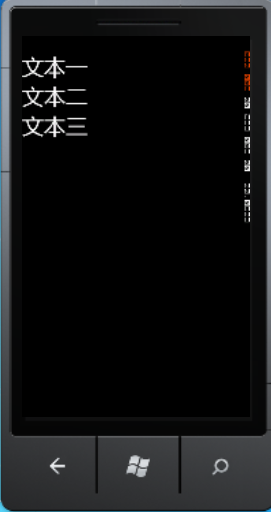
运行,默认方向是纵向。
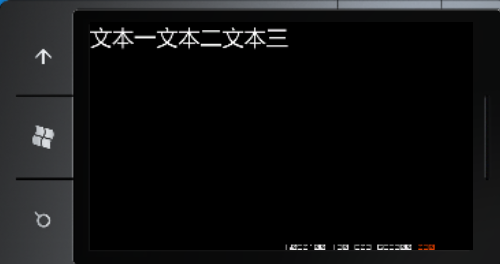
把屏幕旋转后。
三、Canvas控件的处理。
<phone:PhoneApplicationPage

    x:Class="Sample_PageDir.Page3"

    xmlns="http://schemas.microsoft.com/winfx/2006/xaml/presentation"

    xmlns:x="http://schemas.microsoft.com/winfx/2006/xaml"

    xmlns:phone="clr-namespace:Microsoft.Phone.Controls;assembly=Microsoft.Phone"

    xmlns:shell="clr-namespace:Microsoft.Phone.Shell;assembly=Microsoft.Phone"

    xmlns:d="http://schemas.microsoft.com/expression/blend/2008"

    xmlns:mc="http://schemas.openxmlformats.org/markup-compatibility/2006"

    FontFamily="{StaticResource PhoneFontFamilyNormal}"

    FontSize="{StaticResource PhoneFontSizeNormal}"

    Foreground="{StaticResource PhoneForegroundBrush}"

    SupportedOrientations="PortraitOrLandscape"

    Orientation="Portrait"

    OrientationChanged="PhoneApplicationPage_OrientationChanged"

    mc:Ignorable="d" d:DesignHeight="768" d:DesignWidth="480"

    shell:SystemTray.IsVisible="True">

    <Canvas x:Name="cv">

        <Rectangle x:Name="rect1"

            Width="232"

            Height="238"

            Fill="Red"

            Canvas.Left="88"

            Canvas.Top="88"/>

        <Rectangle x:Name="rect2"

            Height="192"

            Width="275"

            Fill="Yellow"

            Canvas.Top="268"

            Canvas.Left="155"/>

    </Canvas>

</phone:PhoneApplicationPage>
后台代码。后台代码。
        private void PhoneApplicationPage_OrientationChanged(object sender, OrientationChangedEventArgs e)

        {

            if (e.Orientation== PageOrientation.Landscape||e.Orientation== PageOrientation.LandscapeLeft||e.Orientation== PageOrientation.LandscapeRight)

            {

                Canvas.SetTop(this.rect1, 37);

                Canvas.SetLeft(this.rect1, 46);

                Canvas.SetTop(this.rect2, 240);

                Canvas.SetLeft(this.rect2, 462);

            }

            else

            {

                Canvas.SetTop(this.rect1, 88);

                Canvas.SetLeft(this.rect1, 88);

                Canvas.SetTop(this.rect2, 268);

                Canvas.SetLeft(this.rect2, 155);

            }

        }
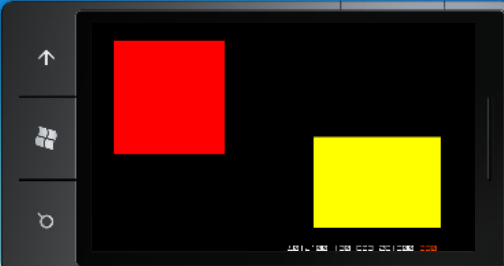
看看效果。看看效果。
纵向。

横向。
Windows Phone开发(6):处理屏幕方向的改变的更多相关文章
- Android开发之改动屏幕方向
有的场景下.我们须要把手机屏幕方向改变,以下是我写的一个样例. xml页面文件: <RelativeLayout xmlns:android="http://schemas.andro ...
- Silverlight for Windows Phone开发系列课程
Silverlight for Windows Phone开发系列课程(1):Windows Phone平台概况 课程简介:本节开始介绍系列课程的概况,包括课程内容,先决条件,学习目的 ...
- Windows phone开发 页面布局之屏幕方向
(博客部分内容参考Windows phone开发文档) Windows phone的屏幕方向是利用Windows phone设备的方向传感器提供的数据实现切换的. Windows Phone支持纵向和 ...
- 背水一战 Windows 10 (2) - UI: 概述, 启动屏幕, 屏幕方向
[源码下载] 背水一战 Windows 10 (2) - UI: 概述, 启动屏幕, 屏幕方向 作者:webabcd 介绍背水一战 Windows 10 之 UI UI 设计概述 启动屏幕(闪屏) 屏 ...
- Android开发之屏幕方向
一.处理屏幕方向变化的两种技术 1.锚定方法 2.调整大小和重新定位,这种方法一般是分别为横向和纵向两种模式各自定义用户界面xml界面文件,当方向变化时读取对应的界面配置文件即可. 二.检测屏幕方向改 ...
- 【NX二次开发】获得屏幕矩阵并设置WCS为屏幕方向
说明:获得屏幕矩阵并设置WCS为屏幕方向(Z朝向自己,X轴朝右,Y轴超上). 方法: 1 extern DllExport void ufusr(char *param, int *retcode, ...
- Kinect for Windows SDK开发入门(15):进阶指引 下
Kinect for Windows SDK开发入门(十五):进阶指引 下 上一篇文章介绍了Kinect for Windows SDK进阶开发需要了解的一些内容,包括影像处理Coding4Fun K ...
- Windows Phone开发(19):三维透视效果
原文:Windows Phone开发(19):三维透视效果 三维效果也可以叫透视效果,所以,我干脆叫三维透视效果.理论知识少讲,直接用例开场吧,因为这个三维效果其实很简单,比上一节中的变换更省事,不信 ...
- Windows Phone开发(4):框架和页
原文:Windows Phone开发(4):框架和页 在开如之前,我想更正一个小问题,之前我在第一篇文章中说,Visual Studio Express for Windows Phone的中文版没有 ...
随机推荐
- 百度地图new BMap.LocalCity() 问题
<html> <head> <meta http-equiv="Content-Type" content="text/html; char ...
- jquery的ajax提交form表单方式总结
方法一: function AddHandlingFeeToRefund() { var AjaxURL= "../OrderManagement/AjaxModifyOrderServic ...
- Git 图解剖析(转)
git中文件内容并没有真正存储在索引(.git/index)或者提交对象中,而是以blob的形式分别存储在数据库中(.git/objects),并用SHA-1值来校验. 索引文件用识别码列出相关的bl ...
- Python语法
- WM_PARENTNOTIFY的作用(不完全)
VCL里源码如下: procedure TWinControl.WMParentNotify(var Message: TWMParentNotify); begin with Message do ...
- SilkTest高级进阶系列9 – 异步执行命令
我们常常会使用sys_execute函数执行一些外部的程序或者命令来做一些事情,但是由于sys_execute是一个同步的函数,它会等待执行的命令完成后才会返回.在大多数情况下,这个函数足够用了. 但 ...
- IOS开发之----四舍五入问题
方法一: -(NSString *)notRounding:(float)price afterPoint:(int)position{ NSDecimalNumberHandler* roundin ...
- fopen()惹的祸
读一个文件,刚开始只读“r” 打开,读数据,刚开始的一段数据还好,但只读了一小部分就读不到正确的数据了,后来反复的看自己的代码,比对文件的内容,纠结了一天了都,感觉什么都没写错啊.心里总认为是这个文 ...
- Python基础 - 关键字
前言 与C一样,python也有自己的关键字,关键字有特殊的意义,不能作为普通的变量名类名等用途 关键字列表 以python2.7.5为例,有如下关键字: and del from not while ...
- 使用CXF创建REST WEBSERVICE
简单小结下CXF跟REST搭配webservice的做法,直接举代码为样例: 1 order.java package com.example.rest; import javax.xml.bin ...