
ACTIVEMQ主题、队列设置用户名密码
修改文件%ACTIVEMQ_BASE%/conf/activemq.xml,用户名密码储存在文件%ACTIVEMQ_BASE%/conf/credentials.properties中,
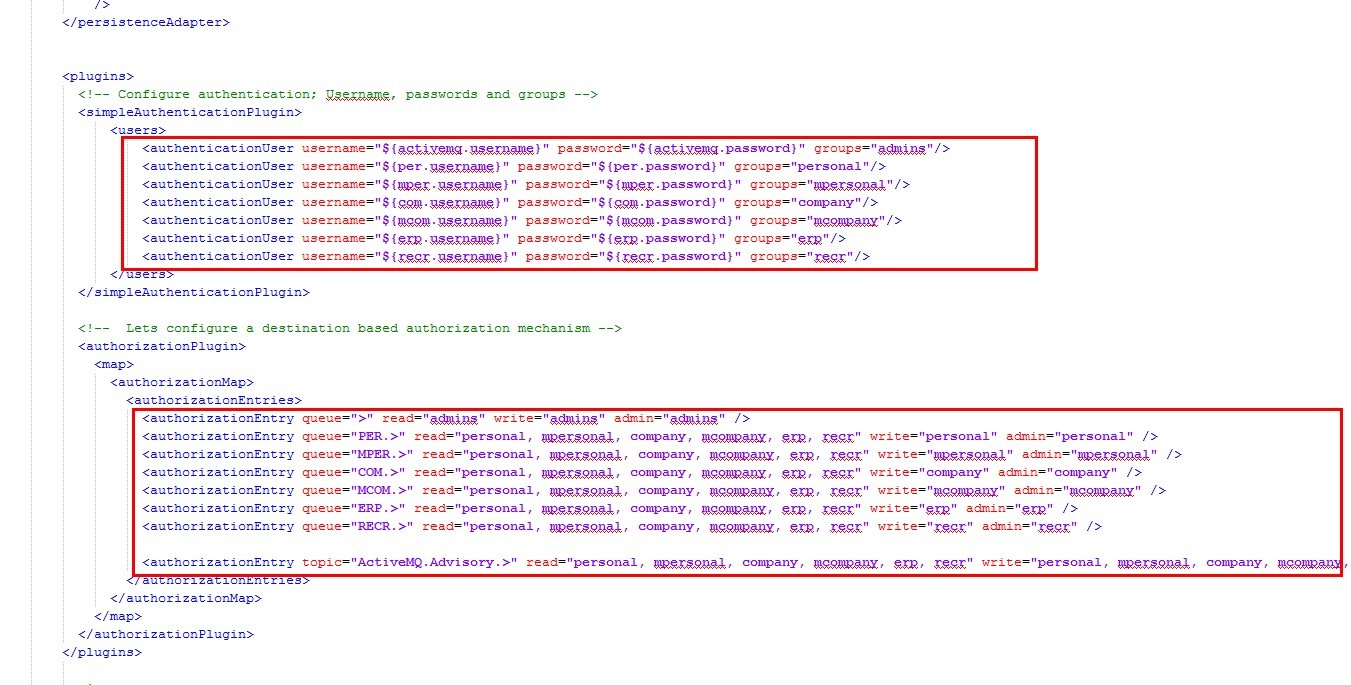
activemq.xml详细如下:
<!--
Licensed to the Apache Software Foundation (ASF) under one or more
contributor license agreements. See the NOTICE file distributed with
this work for additional information regarding copyright ownership.
The ASF licenses this file to You under the Apache License, Version 2.0
(the "License"); you may not use this file except in compliance with
the License. You may obtain a copy of the License at
http://www.apache.org/licenses/LICENSE-2.0
Unless required by applicable law or agreed to in writing, software
distributed under the License is distributed on an "AS IS" BASIS,
WITHOUT WARRANTIES OR CONDITIONS OF ANY KIND, either express or implied.
See the License for the specific language governing permissions and
limitations under the License.
-->
<!-- START SNIPPET: example -->
<beans
xmlns="http://www.springframework.org/schema/beans"
xmlns:xsi="http://www.w3.org/2001/XMLSchema-instance"
xsi:schemaLocation="http://www.springframework.org/schema/beans http://www.springframework.org/schema/beans/spring-beans.xsd
http://activemq.apache.org/schema/core http://activemq.apache.org/schema/core/activemq-core.xsd">
<!-- Allows us to use system properties as variables in this configuration file -->
<bean class="org.springframework.beans.factory.config.PropertyPlaceholderConfigurer">
<property name="locations">
<value>file:${activemq.conf}/credentials.properties</value>
</property>
</bean>
<!-- Allows log searching in hawtio console -->
<bean id="logQuery" class="org.fusesource.insight.log.log4j.Log4jLogQuery"
lazy-init="false" scope="singleton"
init-method="start" destroy-method="stop">
</bean>
<!--
The <broker> element is used to configure the ActiveMQ broker.
-->
<broker xmlns="http://activemq.apache.org/schema/core" brokerName="localhost" dataDirectory="${activemq.data}" useJmx="true">
<destinationPolicy>
<policyMap>
<policyEntries>
<policyEntry queue=">" producerFlowControl="true" memoryLimit="1mb">
<!-- The constantPendingMessageLimitStrategy is used to prevent
slow topic consumers to block producers and affect other consumers
by limiting the number of messages that are retained
For more information, see:
http://activemq.apache.org/slow-consumer-handling.html
-->
<!-- 分发策略 -->
<dispatchPolicy>
<!-- 按顺序分发 -->
<strictOrderDispatchPolicy/>
</dispatchPolicy>
<!-- 恢复策略-->
<subscriptionRecoveryPolicy>
<!-- 只恢复最后一个message -->
<lastImageSubscriptionRecoveryPolicy/>
</subscriptionRecoveryPolicy>
<pendingQueuePolicy>
<!-- 首先在内存中保存消息的引用,如果内存使用量达到上限,那么会把消息引用保存到临时文件中 -->
<fileQueueCursor/>
</pendingQueuePolicy>
<pendingMessageLimitStrategy>
<constantPendingMessageLimitStrategy limit="1000"/>
</pendingMessageLimitStrategy>
</policyEntry>
<!-- 个人简历 -->
<policyEntry queue="PER.>" producerFlowControl="true" memoryLimit="10mb">
<!-- The constantPendingMessageLimitStrategy is used to prevent
slow topic consumers to block producers and affect other consumers
by limiting the number of messages that are retained
For more information, see:
http://activemq.apache.org/slow-consumer-handling.html
-->
<!-- 分发策略 -->
<dispatchPolicy>
<!-- 按顺序分发 -->
<strictOrderDispatchPolicy/>
</dispatchPolicy>
<!-- 恢复策略-->
<subscriptionRecoveryPolicy>
<!-- 只恢复最后一个message -->
<lastImageSubscriptionRecoveryPolicy/>
</subscriptionRecoveryPolicy>
<pendingQueuePolicy>
<!-- 首先在内存中保存消息的引用,如果内存使用量达到上限,那么会把消息引用保存到临时文件中 -->
<fileQueueCursor/>
</pendingQueuePolicy>
<pendingMessageLimitStrategy>
<constantPendingMessageLimitStrategy limit="1000"/>
</pendingMessageLimitStrategy>
</policyEntry>
<!-- 企业 -->
<policyEntry queue="COM.>" producerFlowControl="true" memoryLimit="10mb">
<!-- The constantPendingMessageLimitStrategy is used to prevent
slow topic consumers to block producers and affect other consumers
by limiting the number of messages that are retained
For more information, see:
http://activemq.apache.org/slow-consumer-handling.html
-->
<!-- 分发策略 -->
<dispatchPolicy>
<!-- 按顺序分发 -->
<strictOrderDispatchPolicy/>
</dispatchPolicy>
<!-- 恢复策略-->
<subscriptionRecoveryPolicy>
<!-- 只恢复最后一个message -->
<lastImageSubscriptionRecoveryPolicy/>
</subscriptionRecoveryPolicy>
<pendingQueuePolicy>
<!-- 首先在内存中保存消息的引用,如果内存使用量达到上限,那么会把消息引用保存到临时文件中 -->
<fileQueueCursor/>
</pendingQueuePolicy>
<pendingMessageLimitStrategy>
<constantPendingMessageLimitStrategy limit="1000"/>
</pendingMessageLimitStrategy>
</policyEntry>
<!-- 招聘会 -->
<policyEntry queue="RECR.>" producerFlowControl="true" memoryLimit="10mb">
<!-- The constantPendingMessageLimitStrategy is used to prevent
slow topic consumers to block producers and affect other consumers
by limiting the number of messages that are retained
For more information, see:
http://activemq.apache.org/slow-consumer-handling.html
-->
<!-- 分发策略 -->
<dispatchPolicy>
<!-- 按顺序分发 -->
<strictOrderDispatchPolicy/>
</dispatchPolicy>
<!-- 恢复策略-->
<subscriptionRecoveryPolicy>
<!-- 只恢复最后一个message -->
<lastImageSubscriptionRecoveryPolicy/>
</subscriptionRecoveryPolicy>
<pendingQueuePolicy>
<!-- 首先在内存中保存消息的引用,如果内存使用量达到上限,那么会把消息引用保存到临时文件中 -->
<fileQueueCursor/>
</pendingQueuePolicy>
<pendingMessageLimitStrategy>
<constantPendingMessageLimitStrategy limit="1000"/>
</pendingMessageLimitStrategy>
</policyEntry>
<!-- 微招聘 -->
<policyEntry queue="MCOM.>" producerFlowControl="true" memoryLimit="10mb">
<!-- The constantPendingMessageLimitStrategy is used to prevent
slow topic consumers to block producers and affect other consumers
by limiting the number of messages that are retained
For more information, see:
http://activemq.apache.org/slow-consumer-handling.html
-->
<!-- 分发策略 -->
<dispatchPolicy>
<!-- 按顺序分发 -->
<strictOrderDispatchPolicy/>
</dispatchPolicy>
<!-- 恢复策略-->
<subscriptionRecoveryPolicy>
<!-- 只恢复最后一个message -->
<lastImageSubscriptionRecoveryPolicy/>
</subscriptionRecoveryPolicy>
<pendingQueuePolicy>
<!-- 首先在内存中保存消息的引用,如果内存使用量达到上限,那么会把消息引用保存到临时文件中 -->
<fileQueueCursor/>
</pendingQueuePolicy>
<pendingMessageLimitStrategy>
<constantPendingMessageLimitStrategy limit="1000"/>
</pendingMessageLimitStrategy>
</policyEntry>
<!-- 微求职 -->
<policyEntry queue="MPER.>" producerFlowControl="true" memoryLimit="10mb">
<!-- The constantPendingMessageLimitStrategy is used to prevent
slow topic consumers to block producers and affect other consumers
by limiting the number of messages that are retained
For more information, see:
http://activemq.apache.org/slow-consumer-handling.html
-->
<!-- 分发策略 -->
<dispatchPolicy>
<!-- 按顺序分发 -->
<strictOrderDispatchPolicy/>
</dispatchPolicy>
<!-- 恢复策略-->
<subscriptionRecoveryPolicy>
<!-- 只恢复最后一个message -->
<lastImageSubscriptionRecoveryPolicy/>
</subscriptionRecoveryPolicy>
<pendingQueuePolicy>
<!-- 首先在内存中保存消息的引用,如果内存使用量达到上限,那么会把消息引用保存到临时文件中 -->
<fileQueueCursor/>
</pendingQueuePolicy>
<pendingMessageLimitStrategy>
<constantPendingMessageLimitStrategy limit="1000"/>
</pendingMessageLimitStrategy>
</policyEntry>
<!-- 后台 -->
<policyEntry queue="ERP.>" producerFlowControl="true" memoryLimit="10mb">
<!-- The constantPendingMessageLimitStrategy is used to prevent
slow topic consumers to block producers and affect other consumers
by limiting the number of messages that are retained
For more information, see:
http://activemq.apache.org/slow-consumer-handling.html
-->
<!-- 分发策略 -->
<dispatchPolicy>
<!-- 按顺序分发 -->
<strictOrderDispatchPolicy/>
</dispatchPolicy>
<!-- 恢复策略-->
<subscriptionRecoveryPolicy>
<!-- 只恢复最后一个message -->
<lastImageSubscriptionRecoveryPolicy/>
</subscriptionRecoveryPolicy>
<pendingQueuePolicy>
<!-- 首先在内存中保存消息的引用,如果内存使用量达到上限,那么会把消息引用保存到临时文件中 -->
<fileQueueCursor/>
</pendingQueuePolicy>
<pendingMessageLimitStrategy>
<constantPendingMessageLimitStrategy limit="1000"/>
</pendingMessageLimitStrategy>
</policyEntry>
</policyEntries>
</policyMap>
</destinationPolicy>
<!--
The managementContext is used to configure how ActiveMQ is exposed in
JMX. By default, ActiveMQ uses the MBean server that is started by
the JVM. For more information, see:
http://activemq.apache.org/jmx.html
-->
<managementContext>
<managementContext createConnector="false"/>
</managementContext>
<!--
Configure message persistence for the broker. The default persistence
mechanism is the KahaDB store (identified by the kahaDB tag).
For more information, see:
http://activemq.apache.org/persistence.html
-->
<persistenceAdapter>
<kahaDB directory="E:/activemq_data"
enableJournalDiskSyncs="false"
indexWriteBatchSize="1000"
indexCacheSize="10000"
journalMaxFileLength="32mb"
/>
</persistenceAdapter>
<plugins>
<!-- Configure authentication; Username, passwords and groups -->
<simpleAuthenticationPlugin>
<users>
<authenticationUser username="${activemq.username}" password="${activemq.password}" groups="admins"/>
<authenticationUser username="${per.username}" password="${per.password}" groups="personal"/>
<authenticationUser username="${mper.username}" password="${mper.password}" groups="mpersonal"/>
<authenticationUser username="${com.username}" password="${com.password}" groups="company"/>
<authenticationUser username="${mcom.username}" password="${mcom.password}" groups="mcompany"/>
<authenticationUser username="${erp.username}" password="${erp.password}" groups="erp"/>
<authenticationUser username="${recr.username}" password="${recr.password}" groups="recr"/>
</users>
</simpleAuthenticationPlugin>
<!-- Lets configure a destination based authorization mechanism -->
<authorizationPlugin>
<map>
<authorizationMap>
<authorizationEntries>
<authorizationEntry queue=">" read="admins" write="admins" admin="admins" />
<authorizationEntry queue="PER.>" read="personal, mpersonal, company, mcompany, erp, recr" write="personal" admin="personal" />
<authorizationEntry queue="MPER.>" read="personal, mpersonal, company, mcompany, erp, recr" write="mpersonal" admin="mpersonal" />
<authorizationEntry queue="COM.>" read="personal, mpersonal, company, mcompany, erp, recr" write="company" admin="company" />
<authorizationEntry queue="MCOM.>" read="personal, mpersonal, company, mcompany, erp, recr" write="mcompany" admin="mcompany" />
<authorizationEntry queue="ERP.>" read="personal, mpersonal, company, mcompany, erp, recr" write="erp" admin="erp" />
<authorizationEntry queue="RECR.>" read="personal, mpersonal, company, mcompany, erp, recr" write="recr" admin="recr" />
<authorizationEntry topic="ActiveMQ.Advisory.>" read="personal, mpersonal, company, mcompany, erp, recr" write="personal, mpersonal, company, mcompany, erp, recr" admin="personal, mpersonal, company, mcompany, erp, recr" />
</authorizationEntries>
</authorizationMap>
</map>
</authorizationPlugin>
</plugins>
<!--
The systemUsage controls the maximum amount of space the broker will
use before disabling caching and/or slowing down producers. For more information, see:
http://activemq.apache.org/producer-flow-control.html
-->
<systemUsage>
<systemUsage>
<memoryUsage>
<memoryUsage percentOfJvmHeap="100" />
</memoryUsage>
<storeUsage>
<storeUsage limit="1 gb"/>
</storeUsage>
<tempUsage>
<tempUsage limit="100 mb"/>
</tempUsage>
</systemUsage>
</systemUsage>
<!--
The transport connectors expose ActiveMQ over a given protocol to
clients and other brokers. For more information, see:
http://activemq.apache.org/configuring-transports.html
-->
<transportConnectors>
<!-- DOS protection, limit concurrent connections to 1000 and frame size to 100MB -->
<transportConnector name="openwire" uri="tcp://0.0.0.0:61616?maximumConnections=1000&wireFormat.maxFrameSize=104857600"/>
<transportConnector name="amqp" uri="amqp://0.0.0.0:5672?maximumConnections=1000&wireFormat.maxFrameSize=104857600"/>
<transportConnector name="stomp" uri="stomp://0.0.0.0:61613?maximumConnections=1000&wireFormat.maxFrameSize=104857600"/>
<transportConnector name="mqtt" uri="mqtt://0.0.0.0:1883?maximumConnections=1000&wireFormat.maxFrameSize=104857600"/>
<transportConnector name="ws" uri="ws://0.0.0.0:61614?maximumConnections=1000&wireFormat.maxFrameSize=104857600"/>
</transportConnectors>
<!-- destroy the spring context on shutdown to stop jetty -->
<shutdownHooks>
<bean xmlns="http://www.springframework.org/schema/beans" class="org.apache.activemq.hooks.SpringContextHook" />
</shutdownHooks>
</broker>
<!--
Enable web consoles, REST and Ajax APIs and demos
The web consoles requires by default login, you can disable this in the jetty.xml file
Take a look at ${ACTIVEMQ_HOME}/conf/jetty.xml for more details
-->
<import resource="jetty.xml"/>
</beans>
<!-- END SNIPPET: example -->
credentials.properties详细如下:
## ---------------------------------------------------------------------------
## Licensed to the Apache Software Foundation (ASF) under one or more
## contributor license agreements. See the NOTICE file distributed with
## this work for additional information regarding copyright ownership.
## The ASF licenses this file to You under the Apache License, Version 2.0
## (the "License"); you may not use this file except in compliance with
## the License. You may obtain a copy of the License at
##
## http://www.apache.org/licenses/LICENSE-2.0
##
## Unless required by applicable law or agreed to in writing, software
## distributed under the License is distributed on an "AS IS" BASIS,
## WITHOUT WARRANTIES OR CONDITIONS OF ANY KIND, either express or implied.
## See the License for the specific language governing permissions and
## limitations under the License.
## ---------------------------------------------------------------------------
# Defines credentials that will be used by components (like web console) to access the broker
activemq.username=***
activemq.password=***
per.username=***
per.password=***
mper.username=***
mper.password=***
com.username=***
com.password=***
mcom.username=***
mcom.password=***
erp.username=***
erp.password=***
recr.username=***
recr.password=***
以上配置今天发现队列监控出现异常,最后查到问题出现在这里:
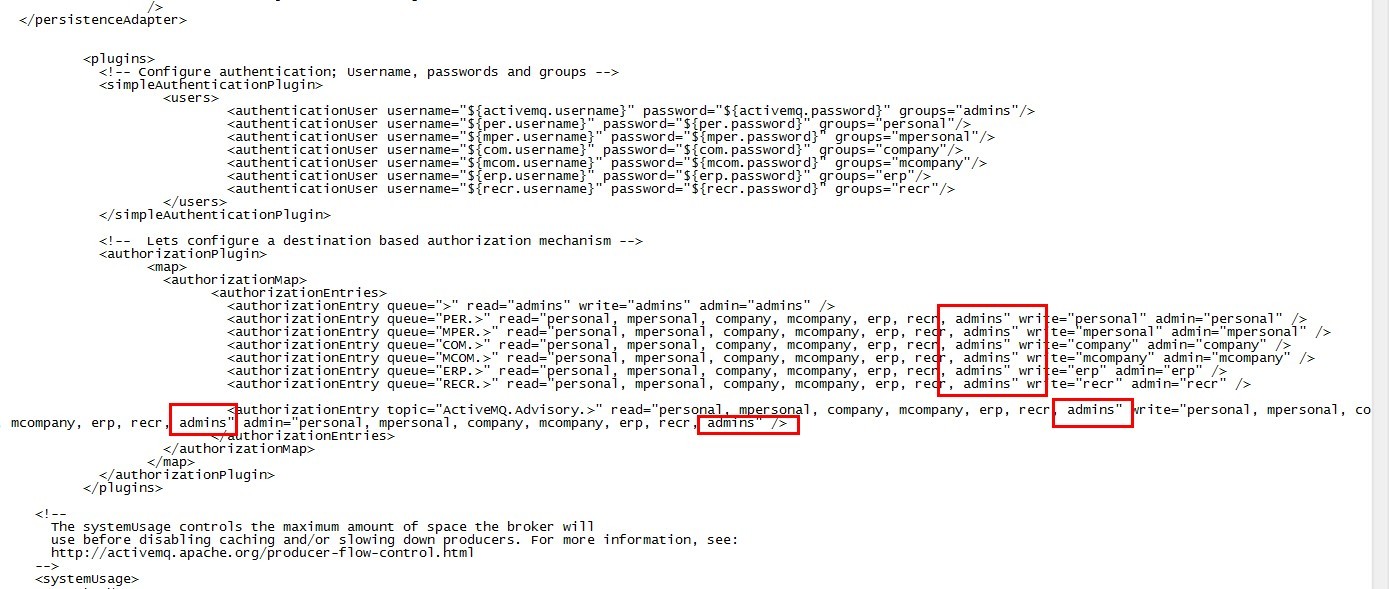
由于队列监控项目admin里使用的账户为system/manager(webapps\admin\WEB-INF\webconsole-embedded.xml
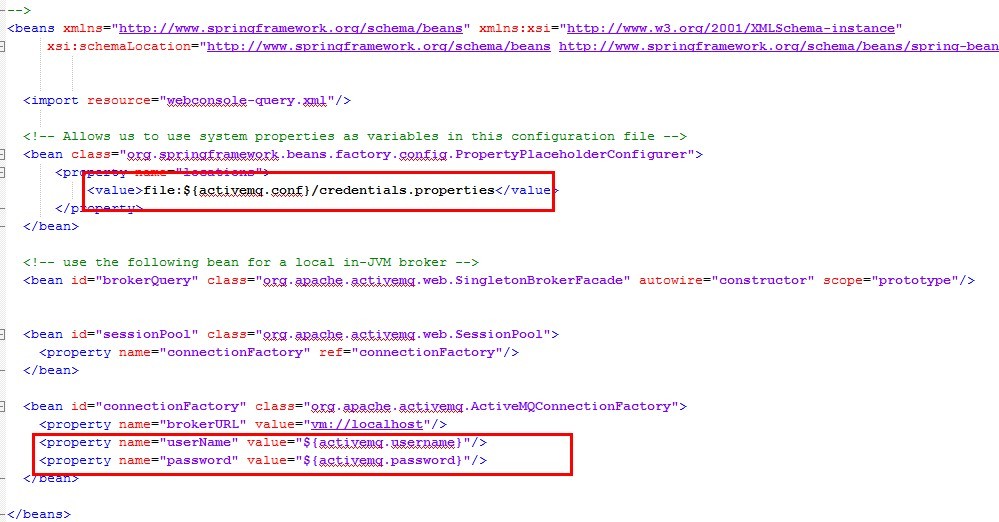
),属于admins群组,需要加上权限。
ACTIVEMQ主题、队列设置用户名密码的更多相关文章
- windows下mongodb设置用户名密码&用python连接
环境: 主机:WIN10 python版本:3.5 mongodb版本:3.4.2 开发环境:pyCharm mongodb设置用户名密码: 编写mongodb配置文件mongodb.confdbpa ...
- 你的MongoDB Redis设置用户名密码了吗?看看shodan这款邪恶的搜索引擎吧!~
早上看新闻的时候看到了个醒目的新闻 开源中国:MongoDB 赎金事件持续发酵,究竟是谁之过? 博客园:MongoDB数据库勒索,中国受害者数量超乎你的想象,SOS! 1. 由于自己之前做过的项目,R ...
- ElasticSearch设置用户名密码访问
版本号:7.3.1 1.需要在配置文件中开启x-pack验证, 修改config目录下面的elasticsearch.yml文件,在里面添加如下内容,并重启. xpack.security.enabl ...
- eureka注册中心设置用户名密码
1.加入安全认证依赖 <dependency> <groupId>org.springframework.boot</groupId> <artifactId ...
- 创建一个MongoDB数据库再到配置成Window服务再设置用户名密码
1.安装MongoDB数据在官网下载安装 然后在C盘找到C:\Program Files\MongoDB\Server\4.0\bin这个可执行目录 使用cmd进入到这: 2.在C盘根目录创建一个名为 ...
- ActiveMQ修改连接的用户名密码
安装目录下conf/activemq.xml 添加如下内容: <plugins> <simpleAuthenticationPlugin> <users> < ...
- mongodb3 设置用户名密码 ,linux
--29T09:: I CONTROL [initandlisten] ** WARNING: You are running on a NUMA machine. --29T09:: I CONTR ...
- 不同版本的 Tomcat 设置用户名密码 的方法
Tomcat : tomcat根目录\conf\tomcat-users.xml,找到 <tomcat-users> 标签,在后面添加 <user username="ad ...
- ActiveMQ安全机制设置
一.设置后台管理密码a.ActiveMQ使用的是jetty服务器,找到D:\div\apache-activemq-5.11.1\conf\jetty.xml文件: <bean id=" ...
随机推荐
- Codeforces 691C. Exponential notation 模拟题
C. Exponential notation time limit per test: 2 seconds memory limit per test:256 megabytes input: st ...
- 2015湖南湘潭 D 二分
2015湖南湘潭第七届大学生程序设计比赛 D题 Fraction Accepted : 133 Submit : 892 Time Limit : 1000 MS Memory Limit : ...
- StartServiceCtrlDispatcher
服务程序通常编写成控制台类型的应用程序,总的来说,一个遵守服务控制管理程序接口要求的程序 包含下面三个函数: 1.服务程序主函数(main):调用系统函数 StartServiceCtrlDispat ...
- 设计模式-生成者模式之c#代码
using System; using System.Collections.Generic; using System.Linq; using System.Text; using System.T ...
- 上海第八中学 shader
http://shiba.hpe.cn/jiaoyanzu/wuli/soft/xna.aspx?classId=4
- jQuery使用大全
我的程序人生 提供基于Lesktop的IM二次开发,联系QQ:76159179 CnBlogs Home New Post Contact Admin Rss Posts - 476 Article ...
- 使用java做paypal开发时购买东西支付不成功的原因
使用java做paypal开发时购买东西支付不成功的原因 没有设置网站习惯设定,登陆自己的paypal账户,在网站习惯设定上填写回调的url路径,这样就可以 支付成功了并且异步修改订单的状态. 支付成 ...
- hdu-1179(匈牙利算法)
题目链接: 思路:找n个巫师和m个魔棒匹配的问题,匈牙利算法模板 匈牙利算法:https://blog.csdn.net/sunny_hun/article/details/80627351 #inc ...
- 【Unity】1.0 第1章 Unity—3D游戏开发和虚拟现实应用开发的首选
分类:Unity.C#.VS2015 创建日期:2016-03-23 一.简介 Unity是跨平台2D.3D游戏和虚拟现实高级应用程序的专业开发引擎,是由Unity Technologies公司研制的 ...
- python调用dll方法
在python中调用dll文件中的接口比较简单,实例代码如下: 如我们有一个test.dll文件,内部定义如下: extern "C"{ int __stdcall test( v ...