
Leetcode 446.等差数列划分II 子序列
等差数列划分II 子序列
如果一个数列至少有三个元素,并且任意两个相邻元素之差相同,则称该数列为等差数列。
例如,以下数列为等差数列:
1, 3, 5, 7, 9
7, 7, 7, 7
3, -1, -5, -9
以下数列不是等差数列。
1, 1, 2, 5, 7
数组 A 包含 N 个数,且索引从 0 开始。该数组子序列将划分为整数序列 (P0, P1, ..., Pk),P 与 Q 是整数且满足 0 ≤ P0 < P1 < ... < Pk < N。
如果序列 A[P0],A[P1],...,A[Pk-1],A[Pk] 是等差的,那么数组 A 的子序列 (P0,P1,…,PK) 称为等差序列。值得注意的是,这意味着 k ≥ 2。
函数要返回数组 A 中所有等差子序列的个数。
输入包含 N 个整数。每个整数都在 -231 和 231-1 之间,另外 0 ≤ N ≤ 1000。保证输出小于 231-1。
示例:
输入:[2, 4, 6, 8, 10]
输出:7
解释:
所有的等差子序列为:
[2,4,6]
[4,6,8]
[6,8,10]
[2,4,6,8]
[4,6,8,10]
[2,4,6,8,10]
[2,6,10]
Dynamic Programming [Accepted]
Intuition
To determine an arithmetic sequence, we need at least two parameters: the first (or last) element of the sequence, and the common difference.
Algorithm
Starting from this point, we can easily figure out that one state representation that may work:
f[i][d] denotes the number of arithmetic subsequences that ends with A[i] and its common difference is d.
Let's try to find the state transitions based on the representation above. Assume we want to append a new element A[i] to existing arithmetic subsequences to form new subsequences. We can append A[i] to an existing arithmetic subsequence, only if the difference between the sequence's last element and A[i] is equal to the sequence's common difference.
Thus, we can define the state transitions for the element A[i] intuitively :
for all j < i, f[i][A[i] - A[j]] += f[j][A[i] - A[j]].
This demonstrates the appending process above to form new arithmetic subsequences.
But here comes the problem. Initially all f[i][d] are set to be 0, but how can we form a new arithmetic subsequence if there are no existing subsequences before?
In the original definition of arithmetic subsequences, the length of the subsequence must be at least 3. This makes it hard to form new subsequences if only two indices i and j are given. How about taking the subsequences of length 2 into account?
We can define weak arithmetic subsequences as follows:
Weak arithmetic subsequences are subsequences that consist of at least two elements and if the difference between any two consecutive elements is the same.
There are two properties of weak arithmetic subsequences that are very useful:
- For any pair i, j (i != j), A[i] and A[j] can always form a weak arithmetic subsequence.
- If we can append a new element to a weak arithmetic subsequence and keep it arithmetic, then the new subsequence must be an arithmetic subsequence.
The second property is quite trival, because the only difference between arithmetic subsequences and weak arithmetic subsequences is their length.
Thus we can change the state representations accordingly:
f[i][d] denotes the number of weak arithmetic subsequences that ends with A[i] and its common difference is d.
Now the state transitions are quite straightforward:
for all j < i, f[i][A[i] - A[j]] += (f[j][A[i] - A[j]] + 1).
The 1 appears here because of the property one, we can form a new weak arithmetic subsequence for the pair (i, j).
Now the number of all weak arithmetic subsequences is the sum of all f[i][d]. But how can we get the number of arithmetic subsequences that are not weak?
There are two ways:
- First, we can count the number of pure weak arithmetic subsequences directly. The pure weak arithmetic subsequences are the arithmetic subsequences of length 2, so the number of pure weak arithmetic subsequences should be equal to the number of pairs (i, j), which is (n2)=n∗(n−1)2.\binom{n}{2} = \frac{n * (n - 1)}{2}.(2n)=2n∗(n−1).
- Second, for the summation f[i][A[i] - A[j]] += (f[j][A[i] - A[j]] + 1), f[j][A[i] - A[j]] is the number of existing weak arithmetic subsequences, while 1 is the new subsequence built with A[i] and A[j]. Based on property two, when we are appending new elements to existing weak arithmetic subsequences, we are forming arithmetic subsequences. So the first part, f[j][A[i] - A[j]] is the number of new formed arithmetic subsequences, and can be added to the answer.
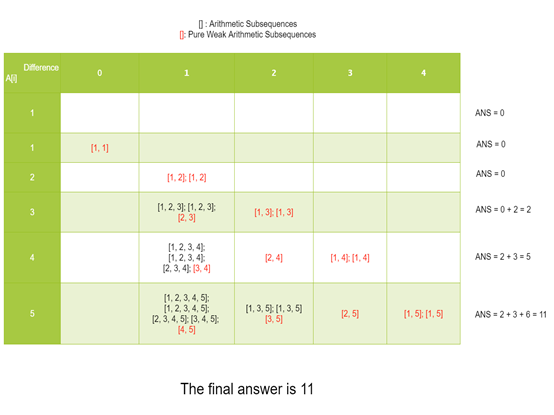
We can use the following example to illustrate the process:
[1, 1, 2, 3, 4, 5]
We need to count the answer for the above sequence.
- For the first element 1, there is no element in front of it, the answer remains 0.
- For the second element 1, the element itself with the previous 1 can form a pure weak arithmetic subsequence with common difference 0 : [1, 1].
- For the third element 2, it cannot be appended to the only weak arithmetic subsequence [1, 1], so the answer remains 0. Similar to the second element, it can form new weak arithmetic subsequences [1, 2] and [1, 2].
- For the forth element 3, if we append it to some arithmetic subsequences ending with 2, these subsequences must have a common difference of 3 - 2 = 1. Indeed there are two: [1, 2] and [1, 2]. So we can append 3 to the end of these subsequences, and the answer is added by 2. Similar to above, it can form new weak arithmetic subsequences [1, 3], [1, 3] and [2, 3].
- The other elements are the same, we can view the process in the figure below. The red bracket indicates the weak arithmetic subsequence of length 2, and the black bracket indicates the arithmetic subsequence. The answer should be the total number of black brackets.
 class Solution {

     public int numberOfArithmeticSlices(int[] A) {

         int n = A.length;

         long ans = 0;

         Map<Integer, Integer>[] cnt = new Map[n];

         for (int i = 0; i < n; i++) {

             cnt[i] = new HashMap<>(i);

             for (int j = 0; j < i; j++) {

                 long delta = (long)A[i] - (long)A[j];

                 if (delta < Integer.MIN_VALUE || delta > Integer.MAX_VALUE) {

                     continue;

                 }

                 int diff = (int)delta;

                 int sum = cnt[j].getOrDefault(diff, 0);

                 int origin = cnt[i].getOrDefault(diff, 0);

                 cnt[i].put(diff, origin + sum + 1);

                 ans += sum;

             }

         }

         return (int)ans;

     }

 }
Leetcode 446.等差数列划分II 子序列的更多相关文章
- Java实现 LeetCode 446 等差数列划分 II - 子序列
446. 等差数列划分 II - 子序列 如果一个数列至少有三个元素,并且任意两个相邻元素之差相同,则称该数列为等差数列. 例如,以下数列为等差数列: 1, 3, 5, 7, 9 7, 7, 7, 7 ...
- [Swift]LeetCode446. 等差数列划分 II - 子序列 | Arithmetic Slices II - Subsequence
A sequence of numbers is called arithmetic if it consists of at least three elements and if the diff ...
- Leetcode 413.等差数列划分
等差数列划分 如果一个数列至少有三个元素,并且任意两个相邻元素之差相同,则称该数列为等差数列. 例如,以下数列为等差数列: 1, 3, 5, 7, 9 7, 7, 7, 7 3, -1, -5, -9 ...
- Java实现 LeetCode 413 等差数列划分
413. 等差数列划分 如果一个数列至少有三个元素,并且任意两个相邻元素之差相同,则称该数列为等差数列. 例如,以下数列为等差数列: 1, 3, 5, 7, 9 7, 7, 7, 7 3, -1, - ...
- Leetcode——413. 等差数列划分
题目描绘:题目链接 题目中需要求解一个数组中等差数组的个数,这个问题可以利用动态规划的思路来分析. 三步骤: 1:问题归纳.题目需要求解等差数列的和,我们可以用一个数组保存前i个元素可以构成的等差数列 ...
- LeetCode 446. Arithmetic Slices II - Subsequence
原题链接在这里:https://leetcode.com/problems/arithmetic-slices-ii-subsequence/ 题目: A sequence of numbers is ...
- 第六周 Leetcode 446. Arithmetic Slices II - Subsequence (HARD)
Leetcode443 题意:给一个长度1000内的整数数列,求有多少个等差的子数列. 如 [2,4,6,8,10]有7个等差子数列. 想了一个O(n^2logn)的DP算法 DP[i][j]为 对于 ...
- Leetcode之动态规划(DP)专题-413. 等差数列划分(Arithmetic Slices)
Leetcode之动态规划(DP)专题-413. 等差数列划分(Arithmetic Slices) 如果一个数列至少有三个元素,并且任意两个相邻元素之差相同,则称该数列为等差数列. 例如,以下数列为 ...
- LeetCode Single Number I / II / III
[1]LeetCode 136 Single Number 题意:奇数个数,其中除了一个数只出现一次外,其他数都是成对出现,比如1,2,2,3,3...,求出该单个数. 解法:容易想到异或的性质,两个 ...
随机推荐
- 枚举转List
将枚举值转为list (name,value) 的形式 /// <summary> /// 获取口味 /// </summary> /// <returns>< ...
- HDU 1864 最大报销额(01背包,烂题)
题意:被坑惨,单项不能超过600,其实是一张发票上A类/B类/C类的总和分别不能超过600. 思路:此题的数据很烂.用贪心也能过,用01背包也可以.都测试不出到底那些是错的. #include < ...
- 【Python图像特征的音乐序列生成】使用Python生成简单的MIDI文件
这个全新的Python音乐创作系列,将会不定期更新.写作这个系列的初衷,是为了做一个项目<基于图像特征的音乐序列生成模型>,实时地提取照片特征,进行神经网络处理,生成一段音乐. 千里之行, ...
- 微软Bot Framework文档中,关于Sign-in Card的一处代码错误及更正
Bot Framework文档出错处网址:https://docs.botframework.com/en-us/csharp/builder/sdkreference/attachments.htm ...
- Eclipse中添加MyEclipse插件
下载准备: 下载myeclipse7.0:http://downloads.myeclipseide.com/downloads/products/eworkbench/7.0M1/MyEclipse ...
- 【转】iOS开发-文件管理(一)
iOS开发-文件管理(一) 一.iOS中的沙盒机制 iOS应用程序只能对自己创建的文件系统读取文件,这个独立.封闭.安全的空间,叫做沙盒.它一般存放着程序包文件(可执行文件).图片.音频.视频.pli ...
- SQL Server将列以分隔符分割后存到临时表
begin if object_id('tempdb..#t') is not null drop table #t; create table #t ( filepath ) ); declare ...
- ORACLE的SQL JOIN方式大全
ORACLE的SQL JOIN方式大全 在ORACLE数据库中,表与表之间的SQL JOIN方式有多种(不仅表与表,还可以表与视图.物化视图等联结),官方的解释如下所示 A join is a que ...
- Sum All Numbers in a Range-freecodecamp算法题目
Sum All Numbers in a Range 要求 给你一个包含两个数字的数组.返回这两个数字和它们之间所有数字的和. 最小的数字并非总在最前面. 思路 定义结果变量num 在for循环中,i ...
- LEETCODE60——第K个排列
class Solution { public: string getPermutation(int n, int k) { '); vector<bool> flag(n, false) ...