
Machine learning吴恩达第三周 Logistic Regression
1. Sigmoid function
function g = sigmoid(z)

%SIGMOID Compute sigmoid function

%   g = SIGMOID(z) computes the sigmoid of z.

% You need to return the following variables correctly

g = zeros(size(z));

% ====================== YOUR CODE HERE ======================

% Instructions: Compute the sigmoid of each value of z (z can be a matrix,

%               vector or scalar).

g=1./(1+exp(-z));

% =============================================================

end
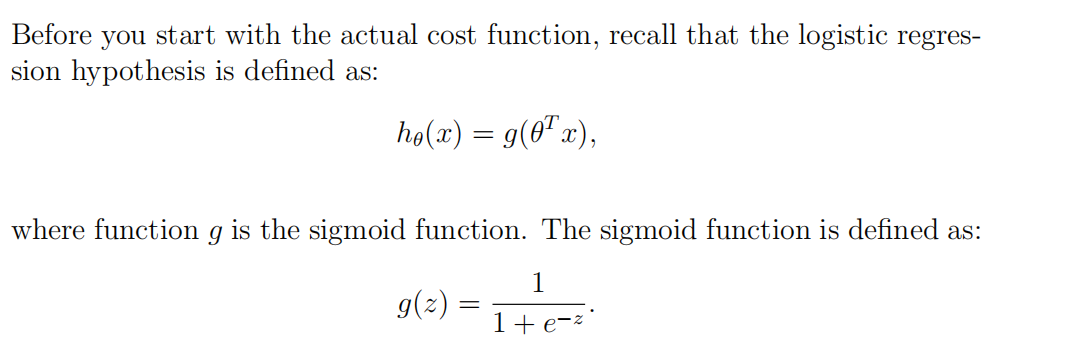
2. Logistic Regression Cost & Logistic Regression Gradient

首先可以将h(x)表示出来----sigmoid函数
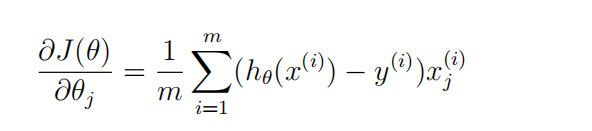
然后对于gredient(j)来说,
可以现在草稿纸上把矩阵画出来,然后观察,用向量来解决;
function [J, grad] = costFunction(theta, X, y)

%COSTFUNCTION Compute cost and gradient for logistic regression

%   J = COSTFUNCTION(theta, X, y) computes the cost of using theta as the

%   parameter for logistic regression and the gradient of the cost

%   w.r.t. to the parameters.

% Initialize some useful values

m = length(y); % number of training examples

% You need to return the following variables correctly

J = 0;

grad = zeros(size(theta));

% ====================== YOUR CODE HERE ======================

% Instructions: Compute the cost of a particular choice of theta.

%               You should set J to the cost.

%               Compute the partial derivatives and set grad to the partial

%               derivatives of the cost w.r.t. each parameter in theta

%

% Note: grad should have the same dimensions as theta

%

h=sigmoid(X*theta);

for i=1:m,

  J=J+1/m*(-y(i)*log(h(i))-(1-y(i))*log(1-h(i)));

endfor

grad=1/m*X'*(h.-y);

% =============================================================

end
3. Predict
function p = predict(theta, X)

%PREDICT Predict whether the label is 0 or 1 using learned logistic

%regression parameters theta

%   p = PREDICT(theta, X) computes the predictions for X using a

%   threshold at 0.5 (i.e., if sigmoid(theta'*x) >= 0.5, predict 1)

m = size(X, 1); % Number of training examples

% You need to return the following variables correctly

p = zeros(m, 1);

% ====================== YOUR CODE HERE ======================

% Instructions: Complete the following code to make predictions using

%               your learned logistic regression parameters.

%               You should set p to a vector of 0's and 1's

%

p=sigmoid(X*theta);

for i=1:m

  if(p(i)>=0.5)p(i)=1;

else p(i)=0;

  end

endfor

% =========================================================================

end
4.Regularized Logistic Regression Cost & Regularized Logistic Regression Gradient



要注意的是:
Octave中,下标是从1开始的;
其次:
对于gradient(j)而言;
我们可以用X(:,j)的方式获取第j列的所有元素;
function [J, grad] = costFunctionReg(theta, X, y, lambda)

%COSTFUNCTIONREG Compute cost and gradient for logistic regression with regularization

%   J = COSTFUNCTIONREG(theta, X, y, lambda) computes the cost of using

%   theta as the parameter for regularized logistic regression and the

%   gradient of the cost w.r.t. to the parameters.

% Initialize some useful values

m = length(y); % number of training examples

% You need to return the following variables correctly

J = 0;

grad = zeros(size(theta));

% ====================== YOUR CODE HERE ======================

% Instructions: Compute the cost of a particular choice of theta.

%               You should set J to the cost.

%               Compute the partial derivatives and set grad to the partial

%               derivatives of the cost w.r.t. each parameter in theta

h=sigmoid(X*theta);

for i=1:m

  J=J+1/m*(-y(i)*log(h(i))-(1-y(i))*log(1-h(i)));

endfor

for i=2:length(theta)

  J=J+lambda/(2*m)*theta(i)^2;

endfor

grad(1)=1/m*(h-y)'*X(:,1);

for i=2:length(theta)

  grad(i)=1/m*(h-y)'*X(:,i)+lambda/m*theta(i);

endfor

% =============================================================

end
Machine learning吴恩达第三周 Logistic Regression的更多相关文章
- Machine Learning——吴恩达机器学习笔记(酷
[1] ML Introduction a. supervised learning & unsupervised learning 监督学习:从给定的训练数据集中学习出一个函数(模型参数), ...
- Machine learning吴恩达第二周coding作业(选做)
1.Feature Normalization: 归一化的处理 function [X_norm, mu, sigma] = featureNormalize(X) %FEATURENORMALIZE ...
- Machine learning 吴恩达第二周coding作业(必做题)
1.warmUpExercise: function A = warmUpExercise() %WARMUPEXERCISE Example function in octave % A = WAR ...
- 吴恩达+neural-networks-deep-learning+第二周作业
Logistic Regression with a Neural Network mindset v4 简单用logistic实现了猫的识别,logistic可以被看做一个简单的神经网络结构,下面是 ...
- Deap Learning (吴恩达) 第一章深度学习概论 学习笔记
Deap Learning(Ng) 学习笔记 author: 相忠良(Zhong-Liang Xiang) start from: Sep. 8st, 2017 1 深度学习概论 打字太麻烦了,索性在 ...
- 吴恩达机器学习笔记 —— 7 Logistic回归
http://www.cnblogs.com/xing901022/p/9332529.html 本章主要讲解了逻辑回归相关的问题,比如什么是分类?逻辑回归如何定义损失函数?逻辑回归如何求最优解?如何 ...
- Github | 吴恩达新书《Machine Learning Yearning》完整中文版开源
最近开源了周志华老师的西瓜书<机器学习>纯手推笔记: 博士笔记 | 周志华<机器学习>手推笔记第一章思维导图 [博士笔记 | 周志华<机器学习>手推笔记第二章&qu ...
- 我在 B 站学机器学习(Machine Learning)- 吴恩达(Andrew Ng)【中英双语】
我在 B 站学机器学习(Machine Learning)- 吴恩达(Andrew Ng)[中英双语] 视频地址:https://www.bilibili.com/video/av9912938/ t ...
- Coursera课程《Machine Learning》吴恩达课堂笔记
强烈安利吴恩达老师的<Machine Learning>课程,讲得非常好懂,基本上算是无基础就可以学习的课程. 课程地址 强烈建议在线学习,而不是把视频下载下来看.视频中间可能会有一些问题 ...
随机推荐
- 利用django中间件CsrfViewMiddleware防止csrf攻击
一.在django后台处理 1.将django的setting中的加入django.contrib.messages.middleware.MessageMiddleware,一般新建的django项 ...
- 【原创】cython and python for kenlm
未经允许不可转载 Kenlm相关知识 Kenlm下载地址 kenlm中文版本训练语言模型 如何使用kenlm训练出来的模型C++版本 关于Kenlm模块的使用及C++源码说明 加载Kenlm模块命令 ...
- real-Time Correlative Scan Matching
启发式算法(heuristic algorithm)是相对于最优化算法提出的.一个问题的最优算法求得该问题每个实例的最优解.启发式算法可以这样定义:一个基于直观或经验构造的算法,在可接受的花费(指计算 ...
- nginx在windows平台下的使用笔记
nginx主要提供反向代理及负载均衡的能力,重定向报文代理及报文数据替换也是常用功能.(参考https://www.cnblogs.com/fanzhidongyzby/p/5194895.html) ...
- 更改文本的编码jsp.xml.java
JSP改为UTF-8编码 更改xml workspace resource
- app里面嵌套的H5页面上电话号码怎么才能点击拨号?
代码: <p>联系我们:<a href="tel://66666666666">66666666666</a> </p>
- Hadoop分布式模式下SSH免密码登录
1.Hadoop中为什么要配置免密码登录 最近在学习Hadoop,在集群中,Hadoop控制脚本依赖SSH来执行针对整个集群的操作.例如,某个脚本能够终止并重启集群中的所有守护进程.所以,需要安装SS ...
- SpringMVC源码解读 - RequestMapping注解实现解读 - RequestMappingInfo
使用@RequestMapping注解时,配置的信息最后都设置到了RequestMappingInfo中. RequestMappingInfo封装了PatternsRequestCondition, ...
- Memory Analysis Part 1 – Obtaining a Java Heapdump
转自: https://blog.codecentric.de/en/2008/07/memory-analysis-part-1-obtaining-a-java-heapdump/ For tro ...
- Python 数据分析—第十章 日期处理
日期时间数据类型及工具 from datetime import datetime now = datetime.now() print(now.year,now.month,now.day) #以毫 ...