
POJ3020Antenna Placement(最小路径覆盖+重在构图)
| Time Limit: 1000MS | Memory Limit: 65536K | |
| Total Submissions: 7788 | Accepted: 3880 |
Description
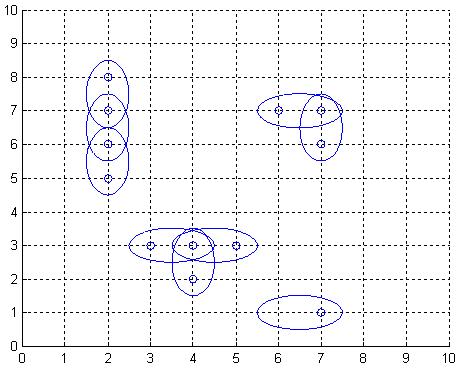
Obviously, it is desirable to use as few antennas as possible, but still provide coverage for each place of interest. We model the problem as follows: Let A be a rectangular matrix describing the surface of Sweden, where an entry of A either is a point of interest, which must be covered by at least one antenna, or empty space. Antennas can only be positioned at an entry in A. When an antenna is placed at row r and column c, this entry is considered covered, but also one of the neighbouring entries (c+1,r),(c,r+1),(c-1,r), or (c,r-1), is covered depending on the type chosen for this particular antenna. What is the least number of antennas for which there exists a placement in A such that all points of interest are covered?
Input
Output
Sample Input
2

7 9

ooo**oooo

**oo*ooo*

o*oo**o**

ooooooooo

*******oo

o*o*oo*oo

*******oo

10 1

*

*

*

o

*

*

*

*

*

*
Sample Output
17

5

http://blog.csdn.net/lyy289065406/article/details/6647040
题目大意:
一个矩形中,有N个城市’*’,现在这n个城市都要覆盖无线,若放置一个基站,那么它至多可以覆盖相邻的两个城市。
问至少放置多少个基站才能使得所有的城市都覆盖无线?
解题思路:
思前想后,依稀可以认为是一道求二分图的最小路径覆盖问题(我就想求点覆盖了,但是如果想想如果是独立的点的话,就会排除点覆盖,因为点覆盖的是连线)
(注意不是最小点覆盖)
那么接下来需要确认的是,
究竟是求 有向二分图的最小路覆盖,还是求 无向二分图的最小路覆盖
因为有向和无向是截然不同的计算方法。
要确认是构造有向图,还是构造无向图,那么就需要先根据题意,看看构造二分图时所使用的方式,更适合构造哪一种二分图。
然后就进入了本题难点:如何构造二分图
首先要明确的是,输入的一堆“圈圈星星”可以看做是一张大地图,地图上有所有城市的坐标,但是这里有一个误区:不能简单地把城市的两个x、y坐标作为准备构造的二分图的两个顶点集。
城市才是要构造的二分图的顶点!
构造方法如下:
例如输入:
*oo
***
O*o
时,可以抽象为一个数字地图:
100
234
050
数字就是根据输入的城市次序作为该城市的编号,0代表该位置没有城市。
然后根据题目的“范围”规则,从第一个城市开始,以自身作为中心城市,向四个方向的城市进行连线(覆盖)
因此就能够得到边集:
e12 e21 e32 e43 e53
e23 e34
e35
可以看到,这些边都是有向边,但是每一条边都有与其对应的一条相反边。
即任意两个城市(顶点)之间的边是成对出现的
那么我们就可以确定下来,应该 构造无向二分图(其实无向=双向)
因为若要构造有向的二分图时,需要判断已出现的边,是很麻烦的工作
为了把有向图G构造为无向二分图,这里需要引入一个新名词“拆点”
其实就是把原有向图G的每一个顶点都”拆分(我认为复制更准确)”为2个点,分别属于所要构造的二分图的两个顶点集
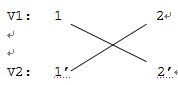
例如在刚才的例子中抽出一条有向边e12举例说明:
复制顶点1和顶点2,使得1,2∈V1; 1’,2’∈V2 ,不难发现|V1|=|V2|
根据边e12和e21,得到无向二分图:
那么同理就可以得到刚才的例子的 无向二分图为:

再继而通过无向二分图,以V1的元素作为row,V2的元素作为col,构造 可达矩阵 存储到计算机
1’ 2’ 3’ 4’ 5’
1 F T F F F
2 T F T F F
3 F T F T T
4 F F T F F
5 F F T F F
接下来就是要求这个 无向二分图的最小路径覆盖 了
利用公式:
无向二分图的最小路径覆盖 = 顶点数 – 最大二分匹配数/2
顶点数:就是用于构造无向二分图的城市数,即进行“拆点”操作前的顶点数量
最大二分匹配书之所以要除以2,是因为进行了“拆点”擦奥做做使得匹配总数多了一倍,因此除以2得到原图的真正的匹配数
最后剩下的问题就是求最大二分匹配数了,用匈牙利算法,这就不多说了,参考POJ3041的做法,基本一摸一样。
从这道题得出了一个结论:
当二分图的两个顶点子集基数相等时,该二分图所有顶点的匹配数 等于 任意一个顶点子集匹配数的2倍
其实匈牙利算法解题是极为简单的,但是图论的难并不是难在解答,而是建图的过程,也难怪会有牛曰:用匈牙利算法,建图是痛苦的,最后是快乐的。
 #include <iostream>

 #include <cstdio>

 #include <cstring>

 #include <algorithm>

 using namespace std;

 const int MAX = ;

 int g[MAX][MAX],s[MAX*MAX][MAX*MAX];

 int vis[],link[];

 char ch;

 int t,m,n,k;

 int dfs(int x)

 {

     for(int i = ; i < k; i++)

     {

         if(vis[i] ==  && s[x][i])

         {

             vis[i] = ;

             if(link[i] ==  || dfs(link[i]))

             {

                 link[i] = x;

                 return true;

             }

         }

     }

     return false;

 }

 int main()

 {

     scanf("%d",&t);

     while(t--)

     {

         k = ;

         scanf("%d%d",&n,&m);

         memset(g,,sizeof(g));

         memset(s,,sizeof(s));

         memset(link,,sizeof(link));

         getchar();

         for(int i = ; i <= n; i++)

         {

             for(int j = ; j <= m; j++)

             {

                 scanf("%c",&ch);

                 if(ch == '*')

                     g[i][j] = k++;

             }

             getchar();

         }

         for(int i = ; i <= n; i++)

         {

             for(int j = ; j <= m; j++)

             {

                 if(g[i][j])

                 {

                     if(g[i - ][j])

                         s[ g[i][j] ][ g[i - ][j] ] = ;

                     if(g[i + ][j])

                         s[ g[i][j] ][ g[i + ][j] ] = ;

                     if(g[i][j + ])

                         s[ g[i][j] ][ g[i][j + ] ] = ;

                     if(g[i][j - ])

                         s[ g[i][j] ][ g[i][j - ] ] = ;

                 }

             }

         }

         int ans = ;

         for(int i = ; i < k; i++)

         {

             memset(vis,,sizeof(vis));

             if(dfs(i))

                 ans++;

         }

         printf("%d\n",k - ans /  - );

     }

     return ;

 }
POJ3020Antenna Placement(最小路径覆盖+重在构图)的更多相关文章
- poj 3020 Antenna Placement (最小路径覆盖)
链接:poj 3020 题意:一个矩形中,有n个城市'*'.'o'表示空地,如今这n个城市都要覆盖无线,若放置一个基站, 那么它至多能够覆盖本身和相邻的一个城市,求至少放置多少个基站才干使得全部的城市 ...
- poj 3020 Antenna Placement(最小路径覆盖 + 构图)
http://poj.org/problem?id=3020 Antenna Placement Time Limit: 1000MS Memory Limit: 65536K Total Sub ...
- POJ 3020 Antenna Placement【二分匹配——最小路径覆盖】
链接: http://poj.org/problem?id=3020 http://acm.hust.edu.cn/vjudge/contest/view.action?cid=22010#probl ...
- POJ3020 Antenna Placement(二分图最小路径覆盖)
The Global Aerial Research Centre has been allotted the task of building the fifth generation of mob ...
- POJ 3020——Antenna Placement——————【 最小路径覆盖、奇偶性建图】
Antenna Placement Time Limit:1000MS Memory Limit:65536KB 64bit IO Format:%I64d & %I64u S ...
- POJ:3020-Antenna Placement(二分图的最小路径覆盖)
原题传送:http://poj.org/problem?id=3020 Antenna Placement Time Limit: 1000MS Memory Limit: 65536K Descri ...
- POJ 3020:Antenna Placement(无向二分图的最小路径覆盖)
Antenna Placement Time Limit: 1000MS Memory Limit: 65536K Total Submissions: 6334 Accepted: 3125 ...
- poj 3020 Antenna Placement (最小路径覆盖)
二分图题目 当时看到网上有人的博客写着最小边覆盖,也有人写最小路径覆盖,我就有点方了,斌哥(kuangbin)的博客上只给了代码,没有解释,但是现在我还是明白了,这是个最小路径覆盖(因为我现在还不知道 ...
- Antenna Placement POJ - 3020 二分图匹配 匈牙利 拆点建图 最小路径覆盖
题意:图没什么用 给出一个地图 地图上有 点 一次可以覆盖2个连续 的点( 左右 或者 上下表示连续)问最少几条边可以使得每个点都被覆盖 最小路径覆盖 最小路径覆盖=|G|-最大匹配数 ...
随机推荐
- DevExpress主从表 按组分页一组不足一页为一页--以此记录
本文的主要是说明Dev的报表的主从表,主从表的每一组显示在一页,当一组超出一页,第二页只显示第一组的. 一.每上报表设置图 简单设计图如上 二.后台代码 报表页代码 public partial cl ...
- RDLC系列之三 图片显示
一.头像效果
- GitLab/Git在AndroidStudio上的使用(转)
1.在AndroidStudio上的配置GitLab 1)首先先将gitlab上的开发项目clone到本地(可以使用命令行或者管理工具,具体操作在GitLab中已经涉及,这里不再赘述),然后导入到An ...
- WPF SDK研究 之 AppModel
Jianqiang's Mobile Dev Blog iOS.Android.WP CnBlogs Home New Post Contact Admin Rss Posts - 528 Artic ...
- heartbeat初探
1,概念及原理 http://www.mingxiao.info/tag/heartbeat/
- MS-SQL SERVER单列合并的四种常用方法
/* 原始数据 ID Name ----------- -------------------- 1 吕布 2 张飞 3 赵云 结果 ----------------- 吕布,张飞,赵云 */ )) ...
- 高性能网站性能优化与系统架构(ZT)
转载请保留出处:俊麟 Michael’s blog (http://space.itpub.net/7311285/viewspace-97) 我在CERNET做过拨号接入平台的搭建,而后在Yahoo ...
- 有关JVM内存
程序计数器是一个比较小的内存区域,用于指示当前线程所执行的字节码执行到了第几行,是线程隔离的 Java方法执行内存模型,用于存储局部变量,操作数栈,动态链接,方法出口等信息,是线程隔离的 原则上讲,所 ...
- Thrift搭建分布式微服务(二)
第二篇 连接池 连接池配置,请前往Thrift搭建分布式微服务(一) 下面要介绍的其实不是单一的连接池,应该说是连接池集合.因为它要管理多个Tcp Socket连接节点,每个服务节点都有设置了自己 ...
- 大数据:从开源告诉你身边的IT故事
最近我们Team利用Dream分布式计算平台,做了这样一件事情,将Github的大量数据通过爬虫抓取下来,通过分析后,我们抽取最近一年中部分的开发者和项目信息,得到了如下有趣的信息,故分享之,数据原汁 ...