
torch.cat()和torch.stack()
torch.cat() 和 torch.stack()略有不同
torch.cat(tensors,dim=0,out=None)→ Tensor
torch.cat()对tensors沿指定维度拼接,但返回的Tensor的维数不会变,可理解为续接;
torch.stack(tensors,dim=0,out=None)→ Tensor
torch.stack()同样是对tensors沿指定维度拼接,但返回的Tensor会多一维,可理解为叠加;
————————————————
版权声明:本文为CSDN博主「进阶媛小吴」的原创文章,遵循CC 4.0 BY-SA版权协议,转载请附上原文出处链接及本声明。
原文链接:https://blog.csdn.net/wuli_xin/article/details/118972316
torch.cat((a,b),dim=1)和torch.cat((a,b)axis=1)一样。
同理:torch.stack((a,b),dim=1)和torch.stack((a,b)axis=1)一样。
zz=torch.rand(100)#默认zz是列向量。而非行向量。
上述3行的情况,自己已经实际实验过。

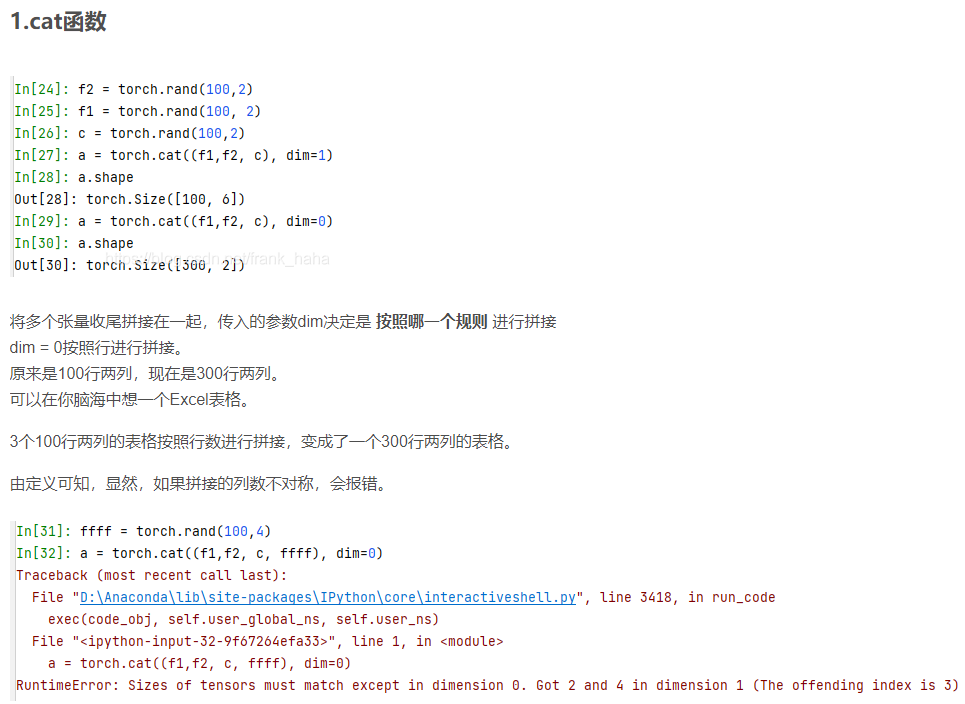
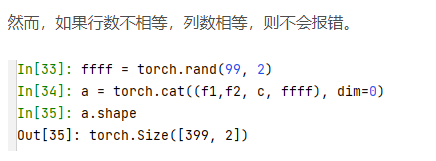
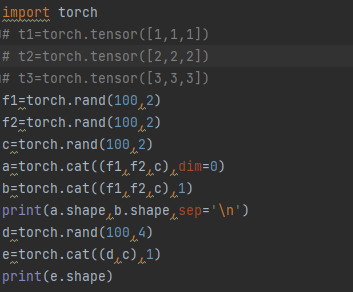
结果为:

上述行数相同d,c,在第一维度也即列上拼接时,能拼接成100行六列的tensor.
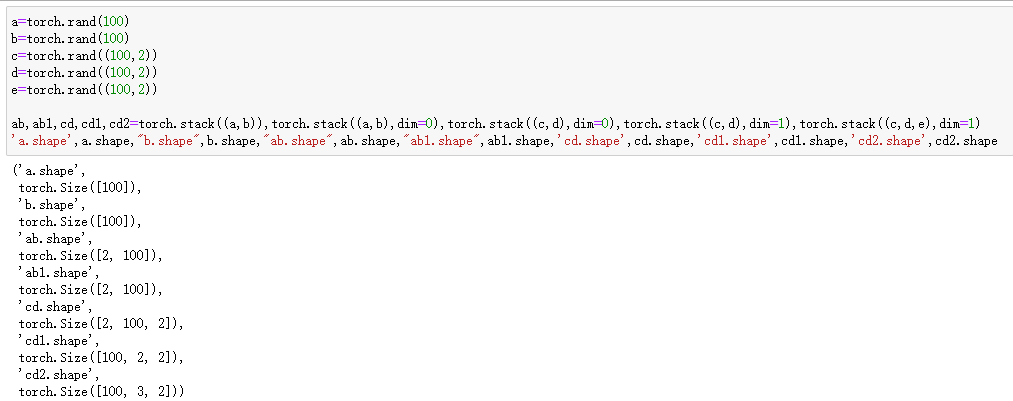
import torch

a=torch.rand(100)

b=torch.rand(100)

c=torch.rand((100,2))

d=torch.rand((100,2))

e=torch.rand((100,2))

ab,ab1,cd,cd1,cd2,cd3=torch.stack((a,b)),torch.stack((a,b),dim=0),torch.stack((c,d),dim=0),torch.stack((c,d),dim=1),torch.stack((c,d,e),axis=1),torch.stack((c,d,e),dim=-1)

'a.shape',a.shape,"b.shape",b.shape,"ab.shape",ab.shape,"ab1.shape",ab1.shape,'cd.shape',cd.shape,'cd1.shape',cd1.shape,'cd2.shape',cd2.shape,cd3.shape
此处需注意的是:torch.stack((c,d,e),dim=-1)和torch.stack((c,d,e),dim=2)结果是一样的;
('a.shape',

 torch.Size([100]),

 'b.shape',

 torch.Size([100]),

 'ab.shape',

 torch.Size([2, 100]),

 'ab1.shape',

 torch.Size([2, 100]),

 'cd.shape',

 torch.Size([2, 100, 2]),

 'cd1.shape',

 torch.Size([100, 2, 2]),

 'cd2.shape',

 torch.Size([100, 3, 2]),

 torch.Size([100, 2, 3]))
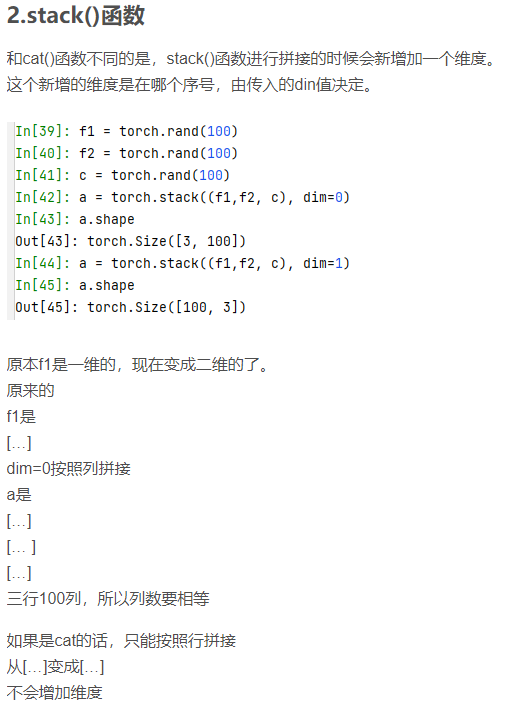
import torch

# t1=torch.tensor([1,1,1])

# t2=torch.tensor([2,2,2])

# t3=torch.tensor([3,3,3])

f1=torch.tensor([[1,2,3],[4,5,6]])

f2=torch.tensor([[7,8,9],[10,11,12]])

c=torch.tensor([[13,14,15],[16,17,18]])

# a=torch.cat((f1,f2,c),dim=0)

# b=torch.cat((f1,f2,c),1)

# print(a.shape,b.shape,sep='\n')

# d=torch.rand(100,4)

# e=torch.cat((d,c),1)

# print(e.shape)

g=torch.stack((f1,f2,c),0)

g1=torch.stack((f1,f2,c),1)

print(f1.shape,f2.shape,c.shape)

print('g: ',g.shape,g,sep='\n')

print('g1: ',g1.shape,g1,sep='\n')

输出结果为:

torch.Size([2, 3]) torch.Size([2, 3]) torch.Size([2, 3])

g:

torch.Size([3, 2, 3])#本来3个,就3个;本来2行3列就两行三列;只不过把他们放到一起,变成了3维的,多了一个维度;个人理解,可能有误。

tensor([[[ 1,  2,  3],

         [ 4,  5,  6]],

        [[ 7,  8,  9],

         [10, 11, 12]],

        [[13, 14, 15],

         [16, 17, 18]]])

g1:

torch.Size([2, 3, 3])#把本来的三个中,每个的第一列拼在一块;第二列拼在一块;再把拼过后的第一列和第二列分别作为一个二维矩阵; 个人理解,可能有误。

tensor([[[ 1,  2,  3],

         [ 7,  8,  9],

         [13, 14, 15]],

        [[ 4,  5,  6],

         [10, 11, 12],

         [16, 17, 18]]])
import torch

# t1=torch.tensor([1,1,1])

# t2=torch.tensor([2,2,2])

# t3=torch.tensor([3,3,3])

f1=torch.tensor([[1,2,3],[4,5,6]])

f2=torch.tensor([[7,8,9],[10,11,12]])

c=torch.tensor([[13,14,15],[16,17,18]])

# a=torch.cat((f1,f2,c),dim=0)

# b=torch.cat((f1,f2,c),1)

# print(a.shape,b.shape,sep='\n')

# d=torch.rand(100,4)

# e=torch.cat((d,c),1)

# print(e.shape)

g=torch.stack((f1,f2,c),0)

g1=torch.stack((f1,f2,c),2)

print(f1.shape,f2.shape,c.shape)

print('g: ',g.shape,g,sep='\n')

print('g1: ',g1.shape,g1,sep='\n')

输出结果:

torch.Size([2, 3]) torch.Size([2, 3]) torch.Size([2, 3])

g:

torch.Size([3, 2, 3])

tensor([[[ 1,  2,  3],

         [ 4,  5,  6]],

        [[ 7,  8,  9],

         [10, 11, 12]],

        [[13, 14, 15],

         [16, 17, 18]]])

g1:

torch.Size([2, 3, 3])

tensor([[[ 1,  7, 13],

         [ 2,  8, 14],

         [ 3,  9, 15]],

        [[ 4, 10, 16],

         [ 5, 11, 17],

         [ 6, 12, 18]]])
import torch

# t1=torch.tensor([1,1,1])

# t2=torch.tensor([2,2,2])

# t3=torch.tensor([3,3,3])

f1=torch.tensor([[1,2,3],[4,5,6]])

f2=torch.tensor([[7,8,9],[10,11,12]])

c=torch.tensor([[13,14,15],[16,17,18]])

# a=torch.cat((f1,f2,c),dim=0)

# b=torch.cat((f1,f2,c),1)

# print(a.shape,b.shape,sep='\n')

# d=torch.rand(100,4)

# e=torch.cat((d,c),1)

# print(e.shape)

g=torch.stack((f1,f2,c),0)

g1=torch.stack((f1,f2,c),3)#此处dim=3,或比3大的任何正数,都是如下报错结果。

print(f1.shape,f2.shape,c.shape)

print('g: ',g.shape,g,sep='\n')

print('g1: ',g1.shape,g1,sep='\n')

输出结果:

Traceback (most recent call last):

  File "<input>", line 17, in <module>

IndexError: Dimension out of range (expected to be in range of [-3, 2], but got 3)
此外:
如果,torch.stack()的维度dim输入的是-1,-2,-3,也都可以正确输出结果。但是如果输入比-3小的任何数则会报错;具体如下:
import torch

# t1=torch.tensor([1,1,1])

# t2=torch.tensor([2,2,2])

# t3=torch.tensor([3,3,3])

f1=torch.tensor([[1,2,3],[4,5,6]])

f2=torch.tensor([[7,8,9],[10,11,12]])

c=torch.tensor([[13,14,15],[16,17,18]])

# a=torch.cat((f1,f2,c),dim=0)

# b=torch.cat((f1,f2,c),1)

# print(a.shape,b.shape,sep='\n')

# d=torch.rand(100,4)

# e=torch.cat((d,c),1)

# print(e.shape)

g=torch.stack((f1,f2,c),0)

g1=torch.stack((f1,f2,c),-1) #此时,维度是-1

print(f1.shape,f2.shape,c.shape)

print('g: ',g.shape,g,sep='\n')

print('g1: ',g1.shape,g1,sep='\n')

输出结果为:

torch.Size([2, 3]) torch.Size([2, 3]) torch.Size([2, 3])

g:

torch.Size([3, 2, 3])

tensor([[[ 1,  2,  3],

         [ 4,  5,  6]],

        [[ 7,  8,  9],

         [10, 11, 12]],

        [[13, 14, 15],

         [16, 17, 18]]])

g1:

torch.Size([2, 3, 3])

tensor([[[ 1,  7, 13],

         [ 2,  8, 14],

         [ 3,  9, 15]],

        [[ 4, 10, 16],

         [ 5, 11, 17],

         [ 6, 12, 18]]])
torch.stack()的维度dim输入的是--2;
输出结果为:

torch.Size([2, 3]) torch.Size([2, 3]) torch.Size([2, 3])

g:

torch.Size([3, 2, 3])

tensor([[[ 1,  2,  3],

         [ 4,  5,  6]],

        [[ 7,  8,  9],

         [10, 11, 12]],

        [[13, 14, 15],

         [16, 17, 18]]])

g1:

torch.Size([2, 3, 3])

tensor([[[ 1,  2,  3],

         [ 7,  8,  9],

         [13, 14, 15]],

        [[ 4,  5,  6],

         [10, 11, 12],

         [16, 17, 18]]])
torch.stack()的维度dim输入的是-3;
torch.Size([2, 3]) torch.Size([2, 3]) torch.Size([2, 3])

g:

torch.Size([3, 2, 3])

tensor([[[ 1,  2,  3],

         [ 4,  5,  6]],

        [[ 7,  8,  9],

         [10, 11, 12]],

        [[13, 14, 15],

         [16, 17, 18]]])

g1:

torch.Size([3, 2, 3])

tensor([[[ 1,  2,  3],

         [ 4,  5,  6]],

        [[ 7,  8,  9],

         [10, 11, 12]],

        [[13, 14, 15],

         [16, 17, 18]]])
import torch

# t1=torch.tensor([1,1,1])

# t2=torch.tensor([2,2,2])

# t3=torch.tensor([3,3,3])

f1=torch.tensor([[1,2,3],[4,5,6]])

f2=torch.tensor([[7,8,9],[10,11,12]])

c=torch.tensor([[13,14,15],[16,17,18]])

# a=torch.cat((f1,f2,c),dim=0)

# b=torch.cat((f1,f2,c),1)

# print(a.shape,b.shape,sep='\n')

# d=torch.rand(100,4)

# e=torch.cat((d,c),1)

# print(e.shape)

g=torch.stack((f1,f2,c),0)

g1=torch.stack((f1,f2,c),-4)#此处是dim=-4,小于-4的任何负数,输出类似的结果。

print(f1.shape,f2.shape,c.shape)

print('g: ',g.shape,g,sep='\n')

print('g1: ',g1.shape,g1,sep='\n')

输出结果为:

Traceback (most recent call last):

  File "<input>", line 17, in <module>

IndexError: Dimension out of range (expected to be in range of [-3, 2], but got -4)
import torch

a=torch.rand(100)

b=torch.rand(100)

c=torch.stack((a,b))

d=torch.stack((a,b),dim=0)

e=torch.stack((a,b),dim=1)

f=torch.cat((a,b))

f1=torch.cat((a,b),dim=0)

# f2=torch.cat((a,b),dim=1)#错误提示:Dimension out of range (expected to be in range of [-1, 0], but got 1)

c.size,c.size(),c.shape,d.shape,e.shape,f.shape,f.size(),f1.shape

#从输出结果可看出,torch.rand(100)生成的是100行1列的数据,也即是一个列向量;concat沿着已有的维度拼接,stack在新创建的维度上拼接;

#输出:

(<function Tensor.size>,

 torch.Size([2, 100]),

 torch.Size([2, 100]),

 torch.Size([2, 100]),

 torch.Size([100, 2]),

 torch.Size([200]),

 torch.Size([200]),

 torch.Size([200]))
torch.cat()和torch.stack()的更多相关文章
- torch.stack()与torch.cat()
torch.stack():http://www.45fan.com/article.php?aid=1D8JGDik5G49DE1X torch.stack()个人理解:属于先变形再cat的操作,所 ...
- torch.cat拼接 stack拼接 分块chunk
torch.cat拼接 stack拼接 分块chunk 待办 https://blog.csdn.net/qq_39709535/article/details/80803003 stack dim理 ...
- Pytorch中的torch.cat()函数
cat是concatnate的意思:拼接,联系在一起. 先说cat( )的普通用法 如果我们有两个tensor是A和B,想把他们拼接在一起,需要如下操作: C = torch.cat( (A,B),0 ...
- Pytorch的torch.cat实例
import torch 通过 help((torch.cat)) 可以查看 cat 的用法 cat(seq,dim,out=None) 其中 seq表示要连接的两个序列,以元组的形式给出,例如:se ...
- 从 relu 的多种实现来看 torch.nn 与 torch.nn.functional 的区别与联系
从 relu 的多种实现来看 torch.nn 与 torch.nn.functional 的区别与联系 relu多种实现之间的关系 relu 函数在 pytorch 中总共有 3 次出现: torc ...
- 【Pytorch】关于torch.matmul和torch.bmm的输出tensor数值不一致问题
发现 对于torch.matmul和torch.bmm,都能实现对于batch的矩阵乘法: a = torch.rand((2,3,10))b = torch.rand((2,2,10))### ma ...
- [pytorch笔记] torch.nn vs torch.nn.functional; model.eval() vs torch.no_grad(); nn.Sequential() vs nn.moduleList
1. torch.nn与torch.nn.functional之间的区别和联系 https://blog.csdn.net/GZHermit/article/details/78730856 nn和n ...
- Pytorch本人疑问(1) torch.nn和torch.nn.functional之间的区别
在写代码时发现我们在定义Model时,有两种定义方法: torch.nn.Conv2d()和torch.nn.functional.conv2d() 那么这两种方法到底有什么区别呢,我们通过下述代码看 ...
- torch.rand、torch.randn、torch.normal、torch.linespace
torch.rand(*size, *, out=None, dtype=None, layout=torch.strided, device=None, requires_grad=False) # ...
随机推荐
- 搭建MySQL集群-注意版本
系统环境采样(来自其他机器,直接copy过来的,在安装的机器上,按照步骤查看即可,当然这些还不够实际,后续补充) 检查系统内是否有其他mysql rpm -qa | grep mysql 是否存在my ...
- Java-GUI编程之菜单组件
前面讲解了如果构建GUI界面,其实就是把一些GUI的组件,按照一定的布局放入到容器中展示就可以了.在实际开发中,除了主界面,还有一类比较重要的内容就是菜单相关组件,可以通过菜单相关组件很方便的使用特定 ...
- Blazor Bootstrap 组件库语音组件介绍
Speech 语音识别与合成 通过麦克风语音采集转换为文字(STT),或者通过文字通过语音朗读出来(TTS) 本组件依赖于 BootstrapBlazor.AzureSpeech,使用本组件时需要引用 ...
- go interface{}使用
先上代码 func In(haystack []interface{}, needle interface{}) (bool, error) { sVal := reflect.ValueOf(hay ...
- 20202127 实验二《Python程序设计》实验报告
20202127 2021-2022-2 <Python程序设计>实验二报告 课程:<Python程序设计>班级: 2021姓名: 马艺洲学号:20202127实验教师:王志强 ...
- 树莓派开发笔记(十二):入手研华ADVANTECH工控树莓派UNO-220套件(一):介绍和运行系统
前言 树莓派也可以做商业应用,工业控制,其稳定性和可靠性已经得到了验证,故而工业控制,一些停车场等场景也有采用树莓派作为主控的,本片介绍了研华ADVANTECH的树莓派套件组UNO-220-P4N ...
- 攻防世界-MISC:如来十三掌
这是攻防世界新手练习区的第三题,题目如下: 点击附件1下载,打开后内容如下: 没看懂是什么,还是参考一下WP吧.WP说去一个叫"与佛论禅"的网站,登进去后 发现是一个加解密网站,将 ...
- 自己的~/.vimrc
" 语法高亮syntax on " 搜索高亮set hlsearch " 显示行号set number" let mapleader="," ...
- elasticSearch 7.6.1 入门及elasticSearch整合springboot
一.ElasticSearch概述 官网:https://www.elastic.co/cn/downloads/elasticsearch Elaticsearch,简称为es,es是一个开源的高扩 ...
- 手脱UPX(3.91)
1.使用Detect It Easy进行查壳: 2.使用x32dbg打开该带壳程序,在选项->选项->异常中添加区间设置0~FFFFFFFF全忽略: 3.我们F9运行到程序入口处,看到了p ...