
吴裕雄 python 神经网络——TensorFlow训练神经网络:花瓣识别
import os

import glob

import os.path

import numpy as np

import tensorflow as tf

from tensorflow.python.platform import gfile

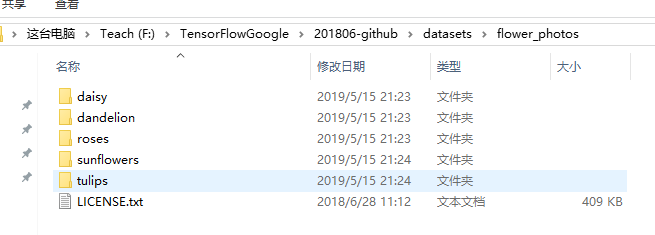
# 原始输入数据的目录,这个目录下有5个子目录,每个子目录底下保存这属于该

# 类别的所有图片。

INPUT_DATA = 'F:\\TensorFlowGoogle\\201806-github\\datasets\\flower_photos'

# 输出文件地址。我们将整理后的图片数据通过numpy的格式保存。

OUTPUT_FILE = 'F:\\flower_processed_data.npy'

# 测试数据和验证数据比例。

VALIDATION_PERCENTAGE = 10

TEST_PERCENTAGE = 10

# 读取数据并将数据分割成训练数据、验证数据和测试数据。

def create_image_lists(sess, testing_percentage, validation_percentage):

    sub_dirs = [x[0] for x in os.walk(INPUT_DATA)]

    is_root_dir = True

    # 初始化各个数据集。

    training_images = []

    training_labels = []

    testing_images = []

    testing_labels = []

    validation_images = []

    validation_labels = []

    current_label = 0

    # 读取所有的子目录。

    for sub_dir in sub_dirs:

        if is_root_dir:

            is_root_dir = False

            continue

        # 获取一个子目录中所有的图片文件。

        extensions = ['jpg', 'jpeg', 'JPG', 'JPEG']

        file_list = []

        dir_name = os.path.basename(sub_dir)

        for extension in extensions:

            file_glob = os.path.join(INPUT_DATA, dir_name, '*.' + extension)

            file_list.extend(glob.glob(file_glob))

        if not file_list: continue

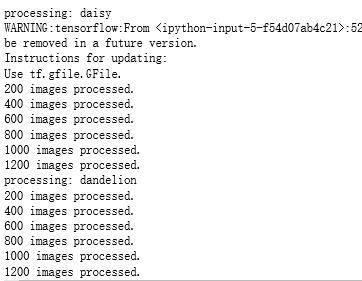
        print("processing:", dir_name)

        i = 0

        # 处理图片数据。

        for file_name in file_list:

            i += 1

            # 读取并解析图片,将图片转化为299*299以方便inception-v3模型来处理。

            image_raw_data = gfile.FastGFile(file_name, 'rb').read()

            image = tf.image.decode_jpeg(image_raw_data)

            if image.dtype != tf.float32:

                image = tf.image.convert_image_dtype(image, dtype=tf.float32)

            image = tf.image.resize_images(image, [299, 299])

            image_value = sess.run(image)

            # 随机划分数据聚。

            chance = np.random.randint(100)

            if chance < validation_percentage:

                validation_images.append(image_value)

                validation_labels.append(current_label)

            elif chance < (testing_percentage + validation_percentage):

                testing_images.append(image_value)

                testing_labels.append(current_label)

            else:

                training_images.append(image_value)

                training_labels.append(current_label)

            if i % 200 == 0:

                print(i, "images processed.")

        current_label += 1

    # 将训练数据随机打乱以获得更好的训练效果。

    state = np.random.get_state()

    np.random.shuffle(training_images)

    np.random.set_state(state)

    np.random.shuffle(training_labels)

    return np.asarray([training_images, training_labels,validation_images, validation_labels,testing_images, testing_labels])

with tf.Session() as sess:

    processed_data = create_image_lists(sess, TEST_PERCENTAGE, VALIDATION_PERCENTAGE)

    # 通过numpy格式保存处理后的数据。

    np.save(OUTPUT_FILE, processed_data)
吴裕雄 python 神经网络——TensorFlow训练神经网络:花瓣识别的更多相关文章
- 吴裕雄 python 神经网络——TensorFlow训练神经网络:不使用滑动平均
import tensorflow as tf from tensorflow.examples.tutorials.mnist import input_data INPUT_NODE = 784 ...
- 吴裕雄 python 神经网络——TensorFlow训练神经网络:不使用隐藏层
import tensorflow as tf from tensorflow.examples.tutorials.mnist import input_data INPUT_NODE = 784 ...
- 吴裕雄 python 神经网络——TensorFlow训练神经网络:不使用激活函数
import tensorflow as tf from tensorflow.examples.tutorials.mnist import input_data INPUT_NODE = 784 ...
- 吴裕雄 python 神经网络——TensorFlow训练神经网络:不使用指数衰减的学习率
import tensorflow as tf from tensorflow.examples.tutorials.mnist import input_data INPUT_NODE = 784 ...
- 吴裕雄 python 神经网络——TensorFlow训练神经网络:不使用正则化
import tensorflow as tf from tensorflow.examples.tutorials.mnist import input_data INPUT_NODE = 784 ...
- 吴裕雄 python 神经网络——TensorFlow训练神经网络:全模型
import tensorflow as tf from tensorflow.examples.tutorials.mnist import input_data INPUT_NODE = 784 ...
- 吴裕雄 python 神经网络——TensorFlow训练神经网络:MNIST最佳实践
import os import tensorflow as tf from tensorflow.examples.tutorials.mnist import input_data INPUT_N ...
- 吴裕雄 python 神经网络——TensorFlow训练神经网络:卷积层、池化层样例
import numpy as np import tensorflow as tf M = np.array([ [[1],[-1],[0]], [[-1],[2],[1]], [[0],[2],[ ...
- 吴裕雄--天生自然 Tensorflow卷积神经网络:花朵图片识别
import os import numpy as np import matplotlib.pyplot as plt from PIL import Image, ImageChops from ...
随机推荐
- 怎么把VS里的scanf_s换成scanf
转自:https://blog.csdn.net/hansionz/article/details/79889039 方法一:在项目属性中---->配置属性------>C\C++---- ...
- linux 内存,cpu占用最高进程查询
1. 可以使用一下命令查使用内存最多的10个进程 ps -aux | sort -k4nr | head -n 10 2. 可以使用一下命令查使用CPU最多的10个进程 ps -aux | sort ...
- .NET知识梳理——2.反射
1. 反射 1.1 DLL-IL-Metadata-反射 DLL:程序集,包含IL 和Metadada IL:面向对象中间语言(不太好阅读) Metadata描述了dll.exe中的各种 ...
- MyBatis(5)——解决属性名与列名不一致的问题
解决属性名与列名不一致的问题 问题描述: 当实体类的属性与数据库的列名不对应时取不到该列数据 说明:MyBatis会根据查询的列名设值(列名的setter方法),然后以此列名为做查询等操作,在此过程中 ...
- 概率dp poj 2151
题意: 这道题目的意思很简单,有t个ACM队,m个题目,题目给出了每个队对每个题目做出的概率大小(0到1之间,包含0和1),要求每个队至少做出一道题(签到题),同时,要求获胜队必须至少能够做出n道题( ...
- ARM架构安装Anaconda3出现错误:cannot execute binary file: Exec format error
ARM架构安装Anaconda3出现错误:cannot execute binary file: Exec format error 原因是:安装包格式不对. 在Anaconda官网上只有x86(32 ...
- 神经网络之反向传播算法(BP)公式推导(超详细)
反向传播算法详细推导 反向传播(英语:Backpropagation,缩写为BP)是"误差反向传播"的简称,是一种与最优化方法(如梯度下降法)结合使用的,用来训练人工神经网络的常见 ...
- C# 篇基础知识9——特性、程序集和反射
特性(Attribute)是用于为程序元素添加额外信息的一种机制.比如记录文件修改时间或代码作者.提示某方法已经过期.描述如何序列化数据等等.方法.变量.属性.类.接口.结构体以及程序集等都是程序元素 ...
- Plastic Bottle Manufacturer Profile: Plastic Bottle Forming Process
Plastic bottle molding refers to the process of making a final plastic product from a polymer produc ...
- Ubuntu16 nginx 配置 Let's Encrypt 免费ssl
每篇一句 Some of us get dipped in flat, some in satin, some in gloss. But every once in a while you find ...