
numpy,matplotlib,pandas
numpy模块
numpy简介
numpy官方文档:https://docs.scipy.org/doc/numpy/reference/?v=20190307135750
numpy是Python的一种开源的数值计算扩展库。这种库可用来存储和处理大型numpy数组,比Python自身的嵌套列表结构要高效的多(该结构也可以用来表示numpy数组)。
numpy库有两个作用:
- 区别于list列表,提供了数组操作、数组运算、以及统计分布和简单的数学模型
- 计算速度快,甚至要由于python内置的简单运算,使得其成为pandas、sklearn等模块的依赖包。高级的框架如TensorFlow、PyTorch等,其数组操作也和numpy非常相似。
numpy使用
import numpy as np

lt1 = [1,2,3]

lt2 = [4,5,6]

arry1 = np.array(lt1)

arry2 = np.array(lt2)

print(arry1*arry2)    # [ 4 10 18]
创建numpy数组
# 一维数组

arr1 = np.array([1,2,4])

print(type(arr1), arr1)  # <class 'numpy.ndarray'> [1 2 4]

# 二维数组

arr = np.array([

    [1,2,3],

    [4,5,6]

])

print(arr)

'''

[[1 2 3]

 [4 5 6]]

'''

# 三维数组

arr = np.array([

    [[1, 2, 3],

     [4, 5, 6]],

    [[1, 2, 3],

     [4, 5, 6]]

])

print(arr)

'''

[[[1 2 3]

  [4 5 6]]

 [[1 2 3]

  [4 5 6]]]

'''
numpy数组的常用属性
| 属性 | 解释 |
|---|---|
| T | 数组的转置(对高维数组而言) |
| dtype | 数组元素的数据类型 |
| size | 数组元素的个数 |
| ndim | 数组的维数 |
| shape | 数组的维度大小(以元组形式) |
| astype | 类型转换 |
dtype 数组元素的数据类型,numpy数组是属于python解释器的,int32 / float64 属于numpy
# 转置

arr = np.array([

    [1, 2, 3],

    [4, 5, 6]

])

print(f'arr的转置为\n{arr.T}')

'''

arr的转置为

[[1 4]

 [2 5]

 [3 6]]

'''

# dtype数据类型

arr = np.array([

    [1., 2., 3.],

    [4, 5, 6]

])

print(arr.dtype)  # float64

# 数组元素的个数

print(arr.size)   # 6

# 数组的维数

print(arr.ndim)  # 2

# 数组的维度大小(以元组形式, 几行几列)

print(arr.shape)  # (2,3)

# 数组类型转换

arr = np.array([

    [1, 2, 3],

    [4, 5, 6]

])

res = arr.astype(np.float64)

print(res)

'''

[[1. 2. 3.]

 [4. 5. 6.]]

'''
切割numpy数组
切分数组类似于列表的切割,numpy数组的切割涉及到行和列的切割
arr = np.array([

    [1, 2, 3],

    [4, 5, 6]

])

print(arr[:,:])  # 行;列  取整个数组

print(arr[0,0])  # 取第一行第一列,1

print(arr[0,:])  # 取第一行  [1 2 3]

print(arr[:,2:])  # 取第三列

'''

[[3]

 [6]]

'''
赋值
arr = np.array([

    [1, 2, 3],

    [4, 5, 6]

])

arr[0,0] = 0

print(arr)   # 将二维数组第一行第一列元素赋值为0

arr[:,:] = 0

print(arr)  # 全部换为0

'''

[[0 0 0]

 [0 0 0]]

'''
元组合并
# 水平合并

arr1 = np.array([

    [1, 2, 3],

    [4, 5, 6]

])

arr2 = np.array([

    [7, 8, 9],

    ['a', 'b', 'c']

])

print(np.hstack((arr1,arr2))) # 只能放元组

'''

[['1' '2' '3' '7' '8' '9']

 ['4' '5' '6' 'a' 'b' 'c']]

'''

# 垂直合并

print(np.vstack((arr1, arr2)))

'''

[['1' '2' '3']

 ['4' '5' '6']

 ['7' '8' '9']

 ['a' 'b' 'c']]

'''

print(np.concatenate((arr1, arr2)))  # 默认以列合并

'''

[['1' '2' '3']

 ['4' '5' '6']

 ['7' '8' '9']

 ['a' 'b' 'c']]

'''

print(np.concatenate((arr1, arr2), axis=1)) # 以行合并

'''

[['1' '2' '3' '7' '8' '9']

 ['4' '5' '6' 'a' 'b' 'c']]

'''
通过函数创建数组
| 方法 | 详解 |
|---|---|
| array() | 将列表转换为数组,可选择显式指定dtype |
| arange() | range的numpy版,支持浮点数 |
| linspace() | 类似arange(),第三个参数为数组长度 |
| zeros() | 根据指定形状和dtype创建全0数组 |
| ones() | 根据指定形状和dtype创建全1数组 |
| eye() | 创建单位矩阵 |
| empty() | 创建一个元素全随机的数组 |
| reshape() | 重塑形状 |
ones / zeros / eye / empty
# ones

print(np.ones((2,3)))  # 构建两行三列的1

'''

[[1. 1. 1.]

 [1. 1. 1.]]

'''

# zeros

print(np.zeros((2,3)))  # 创建2行3列的0

'''

[[0. 0. 0.]

 [0. 0. 0.]]

'''

# eye

print(np.eye(3,3))  # 创建单位矩阵

'''

[[1. 0. 0.]

 [0. 1. 0.]

 [0. 0. 1.]]

'''

# empty

print(np.empty((2,2)))  # 创建一个2行2列的数组,里面的元素是随机生成的

'''

[[1.42419938e-306 9.34609790e-307]

 [1.29060871e-306 7.56601165e-307]]

'''
linspace / logspace
print(np.linspace(1,100,10)) # 创建一个等差数列,1-100,有10个数

# [  1.  12.  23.  34.  45.  56.  67.  78.  89. 100.]

print(np.logspace(1,10,5))  # 创建等比数列、

# [1.00000000e+01 1.77827941e+03 3.16227766e+05 5.62341325e+07 1.00000000e+10]
arrange
print(np.arange(2,10))

# [2 3 4 5 6 7 8 9]

print(np.arange(2,10,2))  # 2-10,步长为2的数组

# [2 4 6 8]
reshape 重构形状
arr = np.ones([2,2])  # 本来是2*2的1

# print(arr)

print(arr.reshape(1,4))  # 变成1*4的1

# [[1. 1. 1. 1.]]
数组运算
| 运算符 | 说明 |
|---|---|
| + | 两个numpy数组对应元素相加 |
| - | 两个numpy数组对应元素相减 |
| * | 两个numpy数组对应元素相乘 |
| / | 两个numpy数组对应元素相除,如果都是整数则取商 |
| % | 两个numpy数组对应元素相除后取余数 |
| **n | 单个numpy数组每个元素都取n次方,如**2:每个元素都取平方 |
arr = np.array([

    [3, 4, 56],

    [12, 4, 25]

])

print(arr / 2)

'''

[[ 1.5  2.  28. ]

 [ 6.   2.  12.5]]

'''

arr = np.array([

    [3, 4, 56],

    [12, 4, 25]

])

print(arr ** 2)

'''

[[   9   16 3136]

 [ 144   16  625]]

'''
numpy数组函数运算
| numpy数组函数 | 详解 |
|---|---|
| np.sin(arr) | 对numpy数组arr中每个元素取正弦,sin(x)sin(x) |
| np.cos(arr) | 对numpy数组arr中每个元素取余弦,cos(x)cos(x) |
| np.tan(arr) | 对numpy数组arr中每个元素取正切,tan(x)tan(x) |
| np.arcsin(arr) | 对numpy数组arr中每个元素取反正弦,arcsin(x)arcsin(x) |
| np.arccos(arr) | 对numpy数组arr中每个元素取反余弦,arccos(x)arccos(x) |
| np.arctan(arr) | 对numpy数组arr中每个元素取反正切,arctan(x)arctan(x) |
| np.exp(arr) | 对numpy数组arr中每个元素取指数函数,exex |
| np.sqrt(arr) | 对numpy数组arr中每个元素开根号x−−\(\sqrt[2]{x}\) |
arr = np.array([

    [3, 4, 56],

    [12, 4, 25]

])

print(np.sin(arr))

'''

[[ 0.14112001 -0.7568025  -0.521551  ]

 [-0.53657292 -0.7568025  -0.13235175]]

'''
numpy.random生成随机数
| 函数名称 | 函数功能 | 参数说明 |
|---|---|---|
| rand(d0,d1,⋯,dnd0,d1,⋯,dn) | 产生均匀分布的随机数 | dndn为第n维数据的维度 |
| randn(d0,d1,⋯,dnd0,d1,⋯,dn) | 产生标准正态分布随机数 | dndn为第n维数据的维度 |
| randint(low[, high, size, dtype]) | 产生随机整数 | low:最小值;high:最大值;size:数据个数 |
| random_sample([size]) | 在[0,1)[0,1)内产生随机数 | size为随机数的shape,可以为元祖或者列表 |
| choice(a[, size]) | 从arr中随机选择指定数据 | arr为1维数组;size为数组形状 |
| uniform(low,high [,size]) | 给定形状产生随机数组 | low为最小值;high为最大值,size为数组形状 |
| shuffle(a) | 与random.shuffle相同 | a为指定数组 |
matplotlib模块
条形图
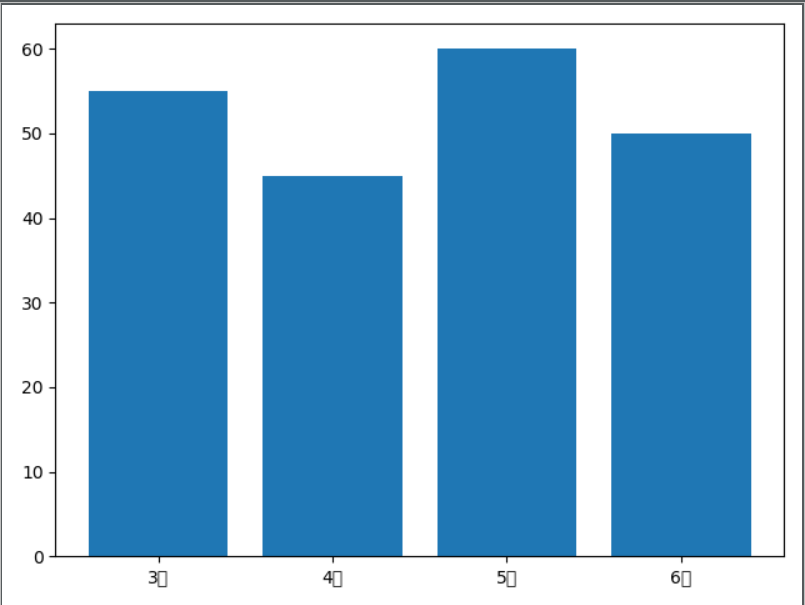
初始的:
from matplotlib import pyplot as plt

classes = ['3班', '4班', '5班', '6班']

students = [55, 45, 60, 50]

plt.bar(classes, students)

plt.show()
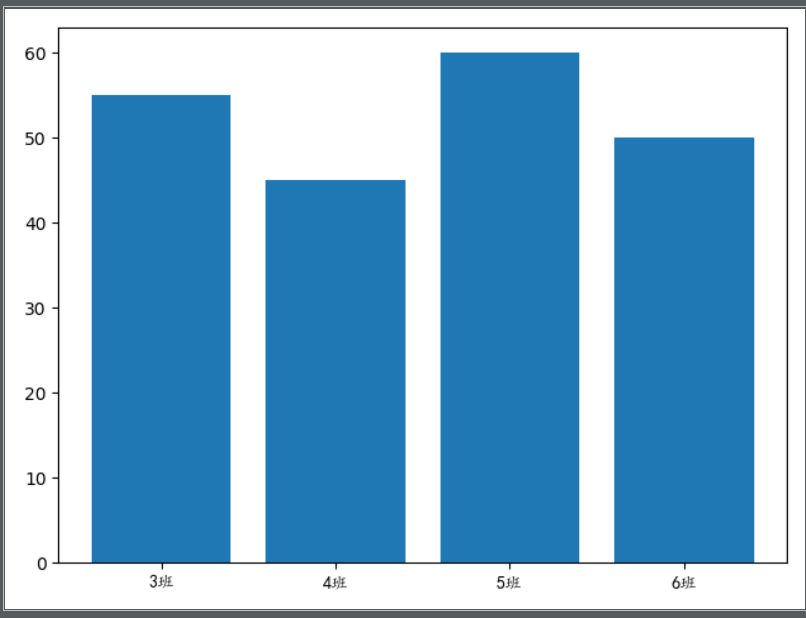
from matplotlib import pyplot as plt

from matplotlib.font_manager import FontProperties  # 修改字体

font = FontProperties(fname='C:\Windows\Fonts\simkai.ttf')  # 中文字体

classes = ['3班', '4班', '5班', '6班']

students = [55, 45, 60, 50]

classes_index = range(len(classes))

plt.bar(classes_index, students)

plt.xticks(classes_index, classes, FontProperties=font)

plt.show()
from matplotlib import pyplot as plt

from matplotlib.font_manager import FontProperties  # 修改字体

font = FontProperties(fname='C:\Windows\Fonts\simkai.ttf')  # 中文字体

plt.style.use('ggplot')  # 设置背景条纹

classes = ['3班', '4班', '5班', '6班']

students = [55, 45, 60, 50]

classes_index = range(len(classes))

plt.bar(classes_index, students, color='darkblue')

plt.xlabel('学生', FontProperties=font)

plt.ylabel('学生人数', FontProperties=font)

plt.title('班级-学生人数', FontProperties=font, fontsize=20, fontweight=25)

plt.xticks(classes_index, classes, FontProperties=font)  # 将x轴坐标替换成classes

plt.show()

直方图
import numpy as np

from matplotlib import pyplot as plt

from matplotlib.font_manager import FontProperties  # 修改字体

font = FontProperties(fname='C:\Windows\Fonts\simkai.ttf')  # 中文字体

# 修改背景为条纹

plt.style.use('ggplot')

x1 = np.random.randn(10000)  # 随机生成符合正太分布的数

x2 = np.random.randn(10000)

plt.hist(x1, bins=50, color='darkgreen')  # bins=50表示每个变量的值分成50份,即会有50根柱子

plt.show()

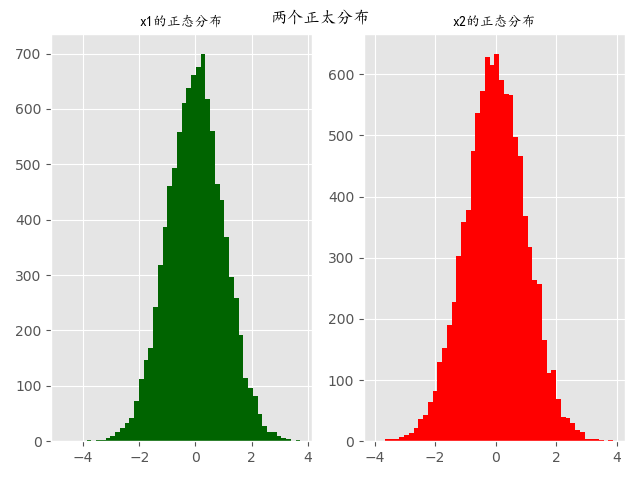
# 直方图

import numpy as np

from matplotlib import pyplot as plt

from matplotlib.font_manager import FontProperties  # 修改字体

font = FontProperties(fname='C:\Windows\Fonts\simkai.ttf')  # 中文字体

# 修改背景为条纹

plt.style.use('ggplot')

x1 = np.random.randn(10000)  # 随机生成符合正太分布的数

x2 = np.random.randn(10000)

fig = plt.figure()  # 生成一张画布

ax1 = fig.add_subplot(1,2,1) # 一行两列取第一个

ax2 = fig.add_subplot(1,2,2) # 一行两列取第二个

ax1.hist(x1, bins=50, color='darkgreen')  # bins=50表示每个变量的值分成50份,即会有50根柱子

ax2.hist(x2, bins=50, color='red')

# 大标题

fig.suptitle('两个正太分布', FontProperties=font)

# 添加子标题

ax1.set_title('x1的正态分布', FontProperties=font)

ax2.set_title('x2的正态分布', FontProperties=font)

plt.show()
折线图
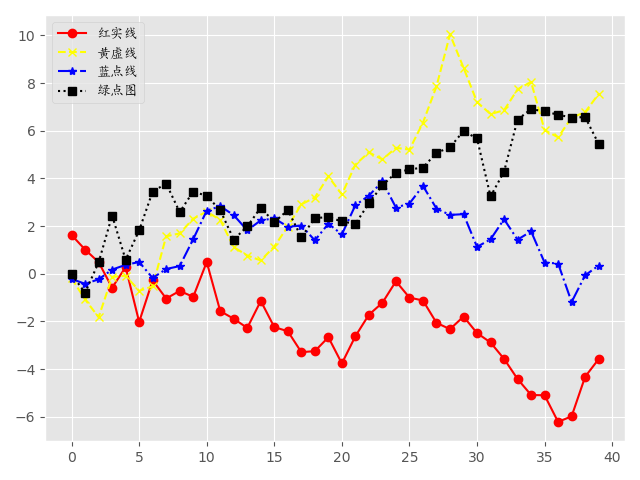
# 折线图

import numpy as np

from matplotlib import pyplot as plt

from matplotlib.font_manager import FontProperties  # 修改字体

font = FontProperties(fname='C:\Windows\Fonts\simkai.ttf')  # 中文字体

# 修改背景为条纹

plt.style.use('ggplot')

np.random.seed(1)

# 使用numpy的累加和,保证数据取值范围不会在(0,1)内波动

x1 = np.random.randn(40).cumsum()

x2 = np.random.randn(40).cumsum()

x3 = np.random.randn(40).cumsum()

x4 = np.random.randn(40).cumsum()

plt.plot(x1, color='red', marker='o', linestyle='-', label='红实线')

plt.plot(x2, color='yellow', marker='x', linestyle='--', label='黄虚线')

plt.plot(x3, color='blue', marker='*', linestyle='-.', label='蓝点线')

plt.plot(x4, color='black', marker='s', linestyle=':', label='绿点图')

# loc='best'给label自动选择最好的位置

plt.legend(loc='best', prop=font)

plt.show()
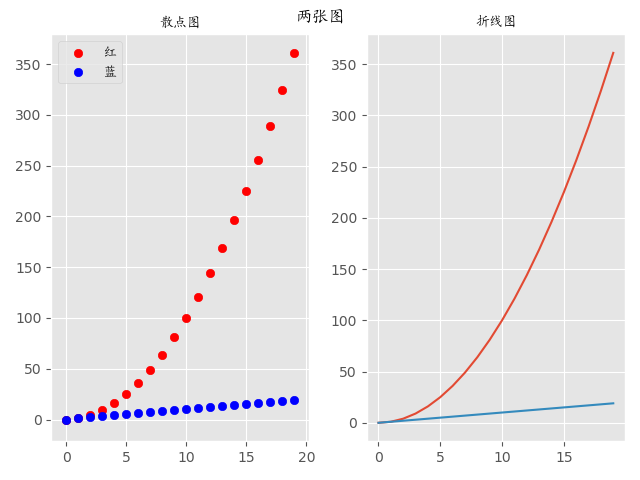
散点图+直线图
# 散点图

import numpy as np

from matplotlib import pyplot as plt

from matplotlib.font_manager import FontProperties  # 修改字体

font = FontProperties(fname='C:\Windows\Fonts\simkai.ttf')

plt.style.use('ggplot')

# fig = plt.figure(figsize=(10,20)) # 控制画布大小

fig = plt.figure()

ax1 = fig.add_subplot(1,2,1)

ax2 = fig.add_subplot(1,2,2)

x1 = np.arange(20)

y1 = x1 ** 2

x2 = np.arange(20)

y2 = x2

ax1.scatter(x1, y1, color='red', label='红')

ax1.scatter(x2, y2, color='blue', label='蓝')

ax2.plot(x1,y1)

ax2.plot(x2,y2)

fig.suptitle('两张图', FontProperties=font)

ax1.set_title('散点图', FontProperties=font)

ax2.set_title('折线图', FontProperties=font)

ax1.legend(prop=font)

plt.show()
pandas模块
pandas中有两个主要的数据结构,其中Series数据结构类似于Numpy中的一维数组,DataFrame类似于多维表格数据结构。
pandas是python数据分析的核心模块。它主要提供了五大功能:
- 支持文件存取操作,支持数据库(sql)、html、json、pickle、csv(txt、excel)、sas、stata、hdf等。
- 支持增删改查、切片、高阶函数、分组聚合等单表操作,以及和dict、list的互相转换。
- 支持多表拼接合并操作。
- 支持简单的绘图操作。
- 支持简单的统计分析操作。
import pandas as pd

index = pd.date_range('2019-01-01', periods=6, freq='M')

print(index)

'''

DatetimeIndex(['2019-01-31', '2019-02-28', '2019-03-31', '2019-04-30',

               '2019-05-31', '2019-06-30'],

              dtype='datetime64[ns]', freq='M')

'''
import numpy as np

import pandas as pd

index = pd.date_range('2019-01-01', periods=6, freq='M')

columns = ['c1','c2','c3','c4']

# print(columns)

val = np.random.randn(6, 4)

# print(val)

df = pd.DataFrame(index=index, columns=columns, data=val)

# 保存文件,读出文件

df.to_excel('data.xls')

# 读出文件

df = pd.read_excel('data.xls', index_col=[0])

print(df)

'''

                  c1        c2        c3        c4

2019-01-31 -1.469848 -0.875899 -0.571439  0.274287

2019-02-28  0.783315 -0.333277  0.091470  1.484056

2019-03-31  0.611354  0.565803 -1.298068  0.666117

2019-04-30 -0.892975 -0.144261 -2.596248  1.103916

2019-05-31 -1.207643 -0.475502 -1.577926 -0.373518

2019-06-30 -0.233937 -1.492533 -0.207368  0.163620

'''

print(df.index)

'''

DatetimeIndex(['2019-01-31', '2019-02-28', '2019-03-31', '2019-04-30',

               '2019-05-31', '2019-06-30'],

              dtype='datetime64[ns]', freq=None)

'''

print(df.columns)

'''

Index(['c1', 'c2', 'c3', 'c4'], dtype='object')

'''

print(df[['c1', 'c2']])

# 按照index取值

print(df.loc['2019-01-31'])

'''

c1   -0.511065

c2    0.173715

c3    0.460645

c4   -0.105340

Name: 2019-01-31 00:00:00, dtype: float64

'''

# 按照values取值

print(df.iloc[0,1])

'''

-0.515215674883499

'''

df.iloc[0,:] = 0

print(df)

'''

                  c1        c2        c3        c4

2019-01-31  0.000000  0.000000  0.000000  0.000000

2019-02-28 -0.473829  0.647171 -1.026075 -0.630721

2019-03-31  1.112496  2.454119 -0.339265  0.600856

2019-04-30 -0.264615 -0.035386 -0.717795  0.320868

2019-05-31 -0.638794 -0.926775  0.247402 -0.824648

2019-06-30 -0.100243 -1.077409 -1.063229 -1.314213

'''
numpy,matplotlib,pandas的更多相关文章
- win7系统下python安装numpy,matplotlib,scipy和scikit-learn
1.安装numpy,matplotlib,scipy和scikit-learn win7系统下直接采用pip或者下载源文件进行安装numpy,matplotlib,scipy时会遇到各种问题,这是因为 ...
- windows下python2.7版本numpy,Scipy,matplotlib,sklearn安装
系统是windows32位,安装了python2.7.13. 安装顺序就是numpy,Scipy,matplotlib,sklearn. 首先是更新一下pip (确保pip能使用) 然后将setupt ...
- 数据分析常用库(numpy,pandas,matplotlib,scipy)
概述 numpy numpy(numeric python)是 python 的一个开源数值计算库,主要用于数组和矩阵计算.底层是 C 语言,运行效率远高于纯 python 代码.numpy主要包含2 ...
- 【机器学习】利用 Python 进行数据分析的环境配置 Windows(Jupyter,Matplotlib,Pandas)
环境配置 安装 python 博主使用的版本是 3.10.6 在 Windows 系统上使用 Virtualenv 搭建虚拟环境 安装 Virtualenv 打开 cmd 输入并执行 pip inst ...
- 利用python设计PDF报告,jinja2,whtmltopdf,matplotlib,pandas
转自:https://foofish.net/python-crawler-html2pdf.html 工具准备 弄清楚了网站的基本结构后就可以开始准备爬虫所依赖的工具包了.requests.beau ...
- python-数据分析与展示(Numpy、matplotlib、pandas)---3
笔记内容整理自mooc上北京理工大学嵩天老师python系列课程数据分析与展示,本人小白一枚,如有不对,多加指正 0.pandas基于Numpy实现的,前者注重应用,后者注重结构 1.Series类型 ...
- python-数据分析与展示(Numpy、matplotlib、pandas)---2
笔记内容整理自mooc上北京理工大学嵩天老师python系列课程数据分析与展示,本人小白一枚,如有不对,多加指正 1.python自带的图像库PIL 1.1常用API Image.open() ...
- python-数据分析与展示(Numpy、matplotlib、pandas)---1
笔记内容整理自mooc上北京理工大学嵩天老师python系列课程数据分析与展示,本人小白一枚,如有不对,多加指正 1.ndarray对象的属性 .ndim..shape..size(元素个数,不是占用 ...
- 数据可视化实例(三): 散点图(pandas,matplotlib,numpy)
关联 (Correlation) 关联图表用于可视化2个或更多变量之间的关系. 也就是说,一个变量如何相对于另一个变化. 散点图(Scatter plot) 散点图是用于研究两个变量之间关系的经典的和 ...
随机推荐
- requests---requests发送xml数据类型
上一篇简单的介绍了post常见的4种数据类型,今天我们一起学习通过requests发送xml数据类型 xml数据类型 下方数据为xml数据,我们就通过这段数据学习如果通过requests发送xml数据 ...
- C学习笔记(4)--- 指针的应用(第一部分)
1.指针(pointer)概念: 指针是一个变量,其值为另一个变量的地址,即,内存位置的直接地址.就像其他变量或常量一样,您必须在使用指针存储其他变量地址之前,对其进行声明.指针变量声明的一般形式为: ...
- 关于tomcat的环境参数配置
在linux里 export CATALINA_OPTS=”-Xms(min heap)m -Xmx(max heap)m” 修改堆内存: -XX:MaxPermSize=128m 修改最大持久带内存 ...
- [PHP] laravel5.5 搭建流程
1.nginx 配置 server { listen 80; server_name laravel5-test.d.com; charset utf-8; location ...
- ORB-SLAM2初步--局部地图构建
一.局部地图构建简介 为什么叫“局部”地图构建,我的理解是这个线程的主要任务是像地图中插入关键帧(包括地图点等信息),以及需要进行LocalBA优化一个局部地图,这是相对于回环检测时进行的全局优化来说 ...
- 第09组 Beta版本演示
组长博客 本组(组名)所有成员 短学号 姓名 2236 王耀鑫(组长) 2210 陈超颖 2209 陈湘怡 2228 许培荣 2204 滕佳 2205 何佳琳 2237 沈梓耀 2233 陈志荣 22 ...
- 【Java并发专题之一】Java内存模型
一.计算机内存模型 针对计算机机器而言,操作系统.JVM程序等其他所有程序都需要遵循内存模型规范.1.CPU技术发展1.1 CPU缓存的出现CPU的发展快于内存条,CPU的运算速度越来越快,内存条的读 ...
- linux root用户无法删除文件,提示permission denied
我用root用户登录,删除一个普通的文件,怎么删也删不了.最后用lsattr命令查看,原来是被保护了.lsattr查看一个文件 1. chattr权限简介 chattr - change file a ...
- OpenCV 相机标定 findChessboardCorners() 与 cornerSubPix() 函数
OpenCV 官方文档 findChessboardCorners():Finds the positions of internal corners of the chessboard. bool ...
- npm install说明
一.常用简写 npm install=npm i.在git clone项目的时候,项目文件中并没有 node_modules文件夹,项目的依赖文件可能很大.直接执行,npm会根据package.jso ...