
bcftools
beftools非常复杂,大概有20个命令,每个命令下面还有N多个参数
annotate .. edit VCF files, add or remove annotations
call .. SNP/indel calling (former "view")
cnv .. Copy Number Variation caller
concat .. concatenate VCF/BCF files from the same set of samples
consensus .. create consensus sequence by applying VCF variants
convert .. convert VCF/BCF to other formats and back
csq .. haplotype aware consequence caller
filter .. filter VCF/BCF files using fixed thresholds
gtcheck .. check sample concordance, detect sample swaps and contamination
index .. index VCF/BCF
isec .. intersections of VCF/BCF files
merge .. merge VCF/BCF files files from non-overlapping sample sets
mpileup .. multi-way pileup producing genotype likelihoods
norm .. normalize indels
plugin .. run user-defined plugin
polysomy .. detect contaminations and whole-chromosome aberrations
query .. transform VCF/BCF into user-defined formats
reheader .. modify VCF/BCF header, change sample names
roh .. identify runs of homo/auto-zygosity
sort .. sort VCF/BCF files
stats .. produce VCF/BCF stats (former vcfcheck)
view .. subset, filter and convert VCF and BCF files
下面讲一下过滤参数
1、bcftools filter(以-i参数为例)
- -i, --include EXPRESSION :
- include only sites for which EXPRESSION is true. For valid expressions see EXPRESSIONS.(根据正则保留)
- 其中包括:
- 1.1、numerical constants, string constants, file names (this is currently supported only to filter by the ID column)
1, 1.0, 1e-4
"String"
@file_name
1.2、算术运算
+,*,-,/
1.3、comparison operators
== (same as =), >, >=, <=, <, !=
1.4、regex操作符“~”和它的否定“!~”。表达式区分大小写,除非添加“/i”。
INFO/HAYSTACK ~ "needle"
INFO/HAYSTACK ~ "NEEDless/i"
1.5、圆括号
(, )
1.6、逻辑运算符。参见下面的示例和有关“&&”与“&”以及“||”与“|”之间区别的过滤教程。
&&, &, ||, |
1.7、信息标签,格式标签,列名
INFO/DP or DP
FORMAT/DV, FMT/DV, or DV
FILTER, QUAL, ID, CHROM, POS, REF, ALT[0]
1.8、1 (or 0) to test the presence (or absence) of a flag
FlagA=1 && FlagB=0
1.9、"." to test missing values
DP=".", DP!=".", ALT="."
2.0、missing genotypes can be matched regardless of phase and ploidy (".|.", "./.", ".") using these expressions
GT~"\.", GT!~"\."
2.1、sample genotype: reference (haploid or diploid), alternate (hom or het, haploid or diploid), missing genotype, homozygous, heterozygous, haploid, ref-ref hom, alt-alt hom, ref-alt het, alt-alt het, haploid ref, haploid alt (case-insensitive)
GT="ref"
GT="alt"
GT="mis"
GT="hom"
GT="het"
GT="hap"
GT="RR"
GT="AA"
GT="RA" or GT="AR"
GT="Aa" or GT="aA"
GT="R"
GT="A"
2.2、TYPE for variant type in REF,ALT columns (indel,snp,mnp,ref,bnd,other,overlap). Use the regex operator "\~" to require at least one allele of the given type or the equal sign "=" to require that all alleles are of the given type. Compare
TYPE="snp"
TYPE~"snp"
TYPE!="snp"
TYPE!~"snp"
2.3、array subscripts (0-based), "*" for any element, "-" to indicate a range. Note that for querying FORMAT vectors, the colon ":" can be used to select a sample and an element of the vector, as shown in the examples below
INFO/AF[0] > 0.3             .. first AF value bigger than 0.3
FORMAT/AD[0:0] > 30          .. first AD value of the first sample bigger than 30
FORMAT/AD[0:1]               .. first sample, second AD value
FORMAT/AD[1:0]               .. second sample, first AD value
DP4[*] == 0                  .. any DP4 value
FORMAT/DP[0]   > 30          .. DP of the first sample bigger than 30
FORMAT/DP[1-3] > 10          .. samples 2-4
FORMAT/DP[1-]  < 7           .. all samples but the first
FORMAT/DP[0,2-4] > 20        .. samples 1, 3-5
FORMAT/AD[0:1]               .. first sample, second AD field
FORMAT/AD[0:*], AD[0:] or AD[0] .. first sample, any AD field
FORMAT/AD[*:1] or AD[:1]        .. any sample, second AD field
(DP4[0]+DP4[1])/(DP4[2]+DP4[3]) > 0.3
CSQ[*] ~ "missense_variant.*deleterious"
2.4、with many samples it can be more practical to provide a file with sample names, one sample name per line
GT[@samples.txt]="het" & binom(AD)<0.01
2.5、function on FORMAT tags (over samples) and INFO tags (over vector fields): maximum; minimum; arithmetic mean (AVG is synonymous with MEAN); median; standard deviation; sum; string length; absolute value; number of elements (matching columns for FORMAT tags or number of fields for INFO tags).
MAX, MIN, AVG, MEAN, MEDIAN, STDEV, SUM, STRLEN, ABS, COUNT
2.6、two-tailed binomial test. Note that for N=0 the test evaluates to a missing value and when FORMAT/GT is used to determine the vector indices, it evaluates to 1 for homozygous genotypes.
binom(FMT/AD)                .. GT can be used to determine the correct index
binom(AD[0],AD[1])           .. or the fields can be given explicitly
phred(binom())               .. the same as binom but phred-scaled
2.7、variables calculated on the fly if not present: number of alternate alleles; number of samples; count of alternate alleles; minor allele count (similar to AC but is always smaller than 0.5); frequency of alternate alleles (AF=AC/AN); frequency of minor alleles (MAF=MAC/AN); number of alleles in called genotypes; number of samples with missing genotype; fraction of samples with missing genotype; indel length (deletions negative, insertions positive)
N_ALT, N_SAMPLES, AC, MAC, AF, MAF, AN, N_MISSING, F_MISSING, ILEN
2.8、the number (N_PASS) or fraction (F_PASS) of samples which pass the expression
N_PASS(GQ>90 & GT!="mis") > 90
F_PASS(GQ>90 & GT!="mis") > 0.9
2.9、custom perl filtering. Note that this command is not compiled in by default, see the section Optional Compilation with Perl in the INSTALL file for help and misc/demo-flt.pl for a working example. The demo defined the perl subroutine "severity" which can be invoked from the command line as follows:
perl:path/to/script.pl; perl.severity(INFO/CSQ) > 3
注意事项:
字符串比较和正则表达式不区分大小写;变量和函数名不区分大小写,但是flag区分大小写。例如,"qual"可以代替"qual", "strlen()"可以代替"strlen()",但不是“dp”而是“DP”。当查询多个值时,将测试所有元素并对结果使用OR逻辑。例如,查询“TAG=1,2,3,4”时,计算如下:
-i 'TAG[*]=1'   .. true, the record will be printed
-i 'TAG[*]!=1'  .. true
-e 'TAG[*]=1'   .. false, the record will be discarded
-e 'TAG[*]!=1'  .. false
-i 'TAG[0]=1'   .. true
-i 'TAG[0]!=1'  .. false
-e 'TAG[0]=1'   .. false
-e 'TAG[0]!=1'  .. true
举例:
MIN(DV)>5
MIN(DV/DP)>0.3
MIN(DP)>10 & MIN(DV)>3
FMT/DP>10  & FMT/GQ>10 .. both conditions must be satisfied within one sample
FMT/DP>10 && FMT/GQ>10 .. the conditions can be satisfied in different samples
QUAL>10 |  FMT/GQ>10   .. true for sites with QUAL>10 or a sample with GQ>10, but selects only samples with GQ>10
QUAL>10 || FMT/GQ>10   .. true for sites with QUAL>10 or a sample with GQ>10, plus selects all samples at such sites
TYPE="snp" && QUAL>=10 && (DP4[2]+DP4[3] > 2)
COUNT(GT="hom")=0      .. no homozygous genotypes at the site
AVG(GQ)>50             .. average (arithmetic mean) of genotype qualities bigger than 50
ID=@file       .. selects lines with ID present in the file
ID!=@~/file    .. skip lines with ID present in the ~/file
MAF[0]<0.05    .. select rare variants at 5% cutoff
POS>=100   .. restrict your range query, e.g. 20:100-200 to strictly sites with POS in that range.
shell 扩展:
注意表达式必须经常引用,因为在shell中有些字符有特殊的含义。一个用单引号括起来的表达式的例子,它导致整个表达式按照预期传递给程序:
bcftools view -i '%ID!="." & MAF[0]<0.01'
------------------------过滤Filtering-------------
1、按照固定列(fixed columns)过滤
固定列,例如“QUAL, FILTER, INFO”可以直接过滤。例如:
bcftools query -e'FILTER="."' -f'%CHROM %POS %FILTER\n' file.bcf #过滤掉FILTER字段中为.的行

bcftools query -i'QUAL>20 && DP>10' -f'%CHROM %POS %QUAL %DP\n' file.bcf | head -2 #只保留质量值大于20,且覆盖深度高于10的位点

2、FORMAT columns
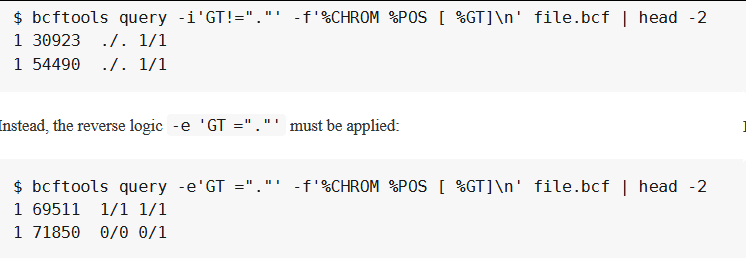
在过滤FORMAT字段的时候,OR 逻辑用于所有samples。When filtering FORMAT tags, the OR logic is applied with multiple samples,而不是单个sample.例如,如果我们想删除任何样本中带有未知基因型的位点,表达式-i 'GT!="会不起作用,必须用相反的逻辑 -e 'GT ="."' :
bcftools query -i 'GT!="."' #不行
bcftools query -e 'GT ="."' #相反逻辑才可行
3、FORMAT列与 布尔值(&& vs & and || vs |)
我们希望一个sample或多个samples具有足够大的覆盖率(DP>10)和基因型质量(GQ>20)的snp位点:
bcftools query -i'FMT/DP>10 & FMT/GQ>20' -f'%POS[\t%SAMPLE:DP=%DP GQ=%GQ]\n' file.bcf ##-i 'FMT/DP>10和FMT/GQ>20'在同一个sample中选择满足条件的位点:

另一方面,如果我们需要在同一sample中两个条件都满足但不一定相同样品,我们使用&&操作符而不是&:
bcftools query -i'FMT/DP>10 && FMT/GQ>20' -f'%POS[\t%SAMPLE:DP=%DP GQ=%GQ]\n' file.bcf

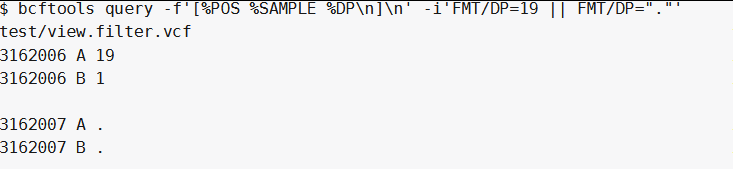
|操作符可以只选择匹配的样本:
bcftools query -f'[%POS %SAMPLE %DP\n]\n' -i 'FMT/DP=19 | FMT/DP="."' test/view.filter.vcf

whole samples record when || is used(就是有一个样本符合该位点,那么该位点所有的样本记录都会被显示出来):
bcftools query -f '[%POS %SAMPLE %DP\n]\n' -i 'FMT/DP=19 || FMT/DP="."' test/view.filter.vcf
过滤:
bcftools filter -i 'SVLEN<100000 | SVLEN< -50 & DV>10' -Oz --threads 8 -o B1952.filter.clean.vcf.gz B1952.ngmlr_sniffle.vcf #例如过滤-50<绝对SVLEN<10000
重要网址:
http://samtools.github.io/bcftools/howtos/filtering.html
bcftools的更多相关文章
- bcftools合并vcf文件
见命令: bcftools merge A.vcf.gz B.vcf.gz C.vcf.gz -Oz -o ABC.vcf.gz 参考链接:http://vcftools.sourceforge.ne ...
- bcftools或vcftools提取指定区段的vcf文件(extract specified position )
下载安装bcftools 见如下命令: bcftools filter 1000Genomes.vcf.gz --regions 9:4700000-4800000 > 4700000-4800 ...
- 使用bcftools提取指定样本的vcf文件(extract specified samples in vcf format)
1.下载安装bcftools. 2.准备样本ID文件,这里命名为samplelistname.txt,一个样本一行,如下所示: sample1 sample2 sample3 3.输入命令: bcft ...
- bcftools将vcf生成bgzip和index格式
利用bcftools软件将vcf格式生成gz格式和index格式,需要用到“-Oz”和“index”命令,具体如下: /bcftools-1.8/bin/bcftools view ExAC.vcf ...
- 【Bcftools】合并不同sample的vcf文件,通过bcftools
通过GATK calling出来的SNP如果使用UnifiedGenotype获得的SNP文件是分sample的,但是如果使用vcftools或者ANGSD则需要Vcf文件是multi-sample的 ...
- 【BCFTOOLS】按样本拆分VCF文件
在对vcf的操作有这样三个软件: Vcftools:主要用于群体分析,文本处理的功能不是很强大,虽然这个软件也可以拆分样本,但是这种拆分不涉及文件的处理,只是保留在分析流程里. GATK .x:这个软 ...
- samtools+bcftools 进行SNP calling
两个软件的作用:1.samtools mpileup 主要是用于收集BAM文件中的信息,这个位点上有多少条read匹配,匹配read的碱基是什么,并将这些信息存储在BCF文件中.2.bcftools ...
- bcftools 提取vcf(snp/indel)文件子集
做群体变异检测后,通常会有提取子集的操作,之前没有发现bcftools有这个功能,都是自己写脚本操作,数据量一上来,速度真的是让人无语凝噎.这里记录下提取子vcf文件的用法,软件版本:bcftools ...
- linux 安装SAMtools,bcftools,htslib,sratoolkit,bedtools,GATK,TrimGalore,qualimap,vcftools,bwa
--------------------安装Samtools---------------------------------------------------------------------- ...
随机推荐
- Educational Codeforces Round 76 (Rated for Div. 2) E. The Contest dp
E. The Contest A team of three programmers is going to play a contest. The contest consists of
- 06-Django视图
什么是视图? 视图就是应用中views.py文件中的函数,视图函数的第一个参数必须是request(HttpRequest)对象.返回的时候必须返回一个HttpResponse对象或子对象(包含Htt ...
- Protractor - 环境设置
去年出于好奇搭建过一个Protractor+Cucumber的测试框架,当时项目上并没有用到AngularJS,所以框架能运行起来之后没有再深入了.最近新项目引入了AngularJS,想起去年搭的那个 ...
- 【计算机网络】WebSocket实现原理分析
1.介绍一下websocket和通信过程? 1.1 基本概念 [!NOTE] Websocket是应用层第七层上的一个应用层协议,它必须依赖 HTTP 协议进行一次握手 ,握手成功后,数据就直接从 T ...
- 计算机组成原理——中央处理器(CPU)考研题
(一) CPU的功能和基本结构 (二) 指令执行过程 (三) 数据通路的功能和基本结构 (四) 控制器的功能和工作原理 1. 硬布线控制器2. 微程序控制器微程序.微指 ...
- 诚聘.NET架构师、高级开发工程师(2019年8月29日发布)
招聘单位是ABP架构设计交流群(134710707)群主阳铭所在的公司 公司简介 七二四科技有限公司成立于2015年,成立之初便由金茂资本按估值2亿投资2200万,进行“健康724”平台搭建,2017 ...
- DB2 catalog 编目
(步骤)ap用户: (1)进入db2 db2 (2)catalog database 命令 catalog db list (3)查看本地节点目录.IP.节点名.服务名称.目录条目类型 list no ...
- Dynamics CRM 中Web API中的深度创建(Deep Insert)
我是微软Dynamics 365 & Power Platform方面的工程师罗勇,也是2015年7月到2018年6月连续三年Dynamics CRM/Business Solutions方面 ...
- iOS中进程与线程(多线程、主次线程)
一.什么是线程?什么是多线程? 线程是用来执行任务的,线程彻底执行完任务A才能去执行任务B.为了同时执行两个任务,产生了多线程. 例子: 打开一个音乐软件,用户开辟一个线程A ...
- MD5 加密工具类MD5Util
我们在使用MD5 在线加密的时候,会发现下面情况,大小写的区别就不说啦,那么16位和32位有啥区别呢,其实16 位实际上是从 32 位字符串中,取中间的第 9 位到第 24 位的部分,就是str.su ...