
Entity Framework Code-First(9.9):DataAnnotations - ForeignKey Attribute
DataAnnotations - ForeignKey Attribute:
ForeignKey attribute can be applied to properties of a class. Default Code-First convention for ForeignKey relationship expects foreign key property name match with primary key property.
Consider the following example.
public class Student

{

    public Student()

    {

    }

    public int StudentID { get; set; }

    public string StudentName { get; set; }

    //Foreign key for Standard

    public int StandardId { get; set; }

    public Standard Standard { get; set; }

}

public class Standard

{

    public Standard()

    {

    }

    public int StandardId { get; set; }

    public string StandardName { get; set; }

    public ICollection<Student> Students { get; set; }

 }
As you can see in the above code, Student class includes foreign key StandardId, which is key property in Standard class. So now, Code First will create StandardId column in Students class as shown below.
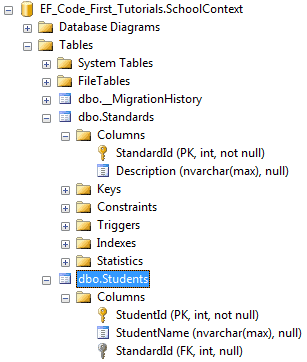
ForeignKey attribute overrides this convention. You can have a different name of a foreign key property name than the primary key of a dependent class.
public class Student

{

    public Student()

    {

    }

    public int StudentID { get; set; }

    public string StudentName { get; set; }

    //Foreign key for Standard

    public int StandardRefId { get; set; }

    [ForeignKey("StandardRefId")]

    public Standard Standard { get; set; }

}

public class Standard

{

    public Standard()

    {

    }

    public int StandardId { get; set; }

    public string StandardName { get; set; }

    public ICollection<Student> Students { get; set; }

}
As you can see in the above example, Student class includes StandardRefId foreign key property name instead of StandardId. We specify it using ForeignKey attribute on Standard navigation property so that Code-First will consider StandardRefId as foreign key, as shown below.
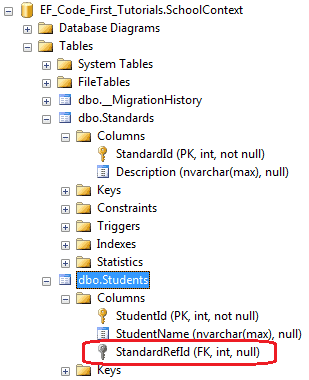
ForeignKey attribute can be applied to key property to specify which navigation property it points to, as shown below.
public class Student

{

    public Student()

    {

    }

    public int StudentID { get; set; }

    public string StudentName { get; set; }

    //Foreign key for Standard

    [ForeignKey("Standard")]

    public int StandardRefId { get; set; }

    public Standard Standard { get; set; }

}

public class Standard

{

    public Standard()

    {

    }

    public int StandardId { get; set; }

    public string StandardName { get; set; }

    public ICollection<Student> Students { get; set; }

}
Thus, you can use ForeignKey attribute to give a different name to a foreign key property.
Entity Framework Code-First(9.9):DataAnnotations - ForeignKey Attribute的更多相关文章
- Entity Framework Code-First(9.6):DataAnnotations - StringLength Attribute
DataAnnotations - StringLength Attribute: StringLength attribute can be applied to a string type pro ...
- Entity Framework Code-First(9.5):DataAnnotations - MaxLength Attribute
DataAnnotations - MaxLength Attribute: MaxLength attribute can be applied to a string or array type ...
- Entity Framework Code-First(9.10):DataAnnotations - NotMapped Attribute
DataAnnotations - NotMapped Attribute: NotMapped attribute can be applied to properties of a class. ...
- Entity Framework Code-First(9.8):DataAnnotations - Column Attribute
DataAnnotations - Column Attribute: Column attribute can be applied to properties of a class. Defaul ...
- Entity Framework Code-First(9.7):DataAnnotations - Table Attribute
DataAnnotations - Table Attribute: Table attribute can be applied to a class. Default Code-First con ...
- Entity Framework Code-First(9.2):DataAnnotations - TimeStamp Attribute
DataAnnotations - TimeStamp Attribute: TimeStamp attribute can be applied to only one byte array pro ...
- Entity Framework Code-First(9.1):DataAnnotations - Key Attribute
DataAnnotations - Key Attribute: Key attribute can be applied to properties of a class. Default Code ...
- Entity Framework Code-First(9.4):DataAnnotations - Required Attribute
Required attribute can be applied to a property of a domain class. EF Code-First will create a NOT N ...
- Entity Framework Code-First(9.3):DataAnnotations - ConcurrencyCheck Attribute
ConcurrencyCheck Attribute: ConcurrencyCheck attribute can be applied to a property of a domain clas ...
随机推荐
- Codeforces Round #256 (Div. 2) E. Divisors 因子+dfs
E. Divisors time limit per test 2 seconds memory limit per test 256 megabytes input standard input o ...
- tkinter窗口系列之一——列表框
以下内容来自https://tkdocs.com/tutorial/morewidgets.html 一个列表框显示由单行文本所组成的一栏条目,通常它很冗长,它允许使用者通过列表浏览其中的内容,选择一 ...
- js操作url的常用函数
1. //替换指定传入参数的值,paramName为参数,replaceWith为新值 function replaceParamVal(oUrl,paramName, replaceWith) { ...
- Linux课程---6、别名管理和网络配置(Linux命令如何记)
Linux课程---6.别名管理和网络配置(Linux命令如何记) 一.总结 一句话总结: 理解记忆:因为命令要实现那么多功能,必须有那么多参数,而不同的参数就适用不用的情况 命令基本格式:命令关键字 ...
- python_doc 读写docx文件
python读写word文档有现成的库可以处理,在这里采用了 python-docx. 首先先安装 pip install python-docx #!/usr/bin/env python # -* ...
- io.js的六大新特性
io.js是nodejs的友好版的分支("friendly fork”).它支持npm中所有的同样模块,且使用了v8最新版本的截取(v8是被node.js使用js解释器),且修复了很多的bu ...
- tomcat使用JDNI配置信息和使用信息。用于JDBC连接池
JNDI: JNDI(java Naming and Directory Interface),java命名和目录接口.JNDI的作用就是:在服务器上配置资源,然后通过统一的方式来获取配置的资源 在t ...
- stl_queue.h
stl_queue.h // Filename: stl_queue.h // Comment By: 凝霜 // E-mail: mdl2009@vip.qq.com // Blog: http:/ ...
- Java 时间和日期类型的 Hibernate 映射
以下情况下必须显式指定 Hibernate 映射类型 一个 Java 类型可能对应多个 Hibernate 映射类型. 例如: 如果持久化类的属性为 java.util.Date 类型, 对应的 Hi ...
- 【遍历二叉树】08判断两个二叉树是否相同【Same Tree】
迭代版本用的是二叉树的DFS,中的root->right->left +++++++++++++++++++++++++++++++++++++++++++++++++++++++++++ ...