
Redis 源码简洁剖析 03 - Dict Hash 基础
Redis Hash 源码
- dict.h:定义 Hash 表的结构、哈希项,和 Hash 表的各种函数操作
- dict.c:函数的具体实现
Redis Hash 数据结构
在 dict.h 文件中,Hash 表是一个二维数组(dictEntry **table)。
typedef struct dictht {

    // 二维数组

    dictEntry **table;

    // Hash 表大小

    unsigned long size;

    unsigned long sizemask;

    unsigned long used;

} dictht;
dictEntry **table 是个二维数组,其中第一维是 bucket,每一行就是 bucket 指向的元素列表(因为键哈希冲突,Redis 采用了链式哈希)。

为了实现链式哈希,Redis 的 dictEntry 结构中,除了包含键和值的指针,还包含了一个指向下一个哈希项的指针 next。
typedef struct dictEntry {

    void *key;

    union {

        void *val;

        uint64_t u64;

        int64_t s64;

        double d;

    } v;

    struct dictEntry *next;

} dictEntry;
整体的哈希流程都是老生常谈了,和 Java 几乎是一样的,这里就不叙述了。
Redis rehash 原理
为什么要 rehash?
为了性能。如果哈希表 bucket 的数量是 1,但是里面有了 1000 个元素,不管怎么样都变成了一个链表,查询效率变得很低。同理,当哈希表里元素的个数比 bucket 数量多很多的时候,效率也会低很多。
Redis dict 数据结构
Redis 实际使用的是 dict 数据结构,内部用两个 dictht(ht[0] 和 ht[1]),用于 rehash 使用。
typedef struct dict {

    ……

    // 两个 Hash 表,交替使用,用于 rehash 操作

    dictht ht[2];

    // Hash 表是否进行 rehash 的标识,-1 表示没有进行 rehash

    long rehashidx;

    ……

} dict;
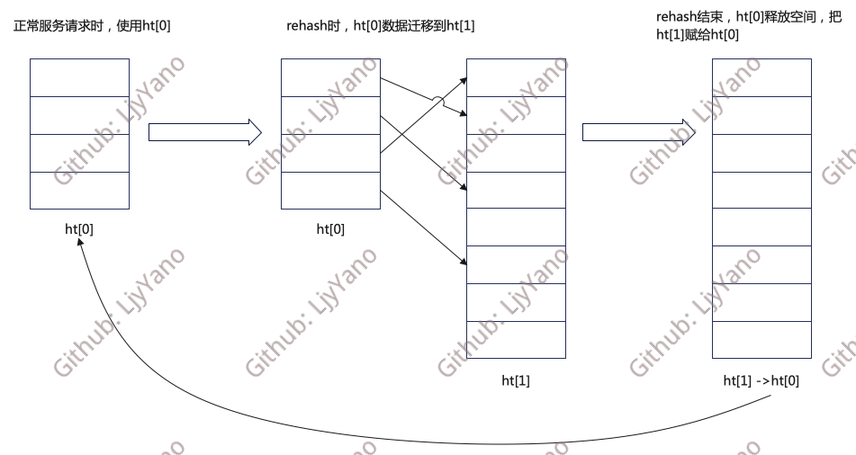
Redis rehash 过程
- 正常请求阶段,所有的键值对都写入哈希表 ht[0]
- 进行 rehash 时,键值对被迁移到 ht[1]
- 迁移完成后,是否 ht[0] 空间,把 ht[1] 的地址赋值给 ht[0],ht[1] 的表大小设置为 0
什么时候触发 rehash?
- ht[0] 大小=0
- ht[0] 里的元素个数已经超过 ht[0] 大小 && Hash 表可以扩容
- ht[0] 里的元素个数,是 ht[0] 大小的 5 倍(dict_force_resize_ratio)(类似于 Java 里 HashMap 的负载因子)
static int _dictExpandIfNeeded(dict *d)

{

    /* Incremental rehashing already in progress. Return. */

    if (dictIsRehashing(d)) return DICT_OK;

    // Hash 表为空,将 Hash 表扩展为初始大小 DICT_HT_INITIAL_SIZE(4)

    if (d->ht[0].size == 0) return dictExpand(d, DICT_HT_INITIAL_SIZE);

    // Hash 表当前的元素数量超过表的大小 && (可以扩容 || 当前数量是表大小的 5 倍以上)

    if (d->ht[0].used >= d->ht[0].size &&

        (dict_can_resize ||

         d->ht[0].used/d->ht[0].size > dict_force_resize_ratio) &&

        dictTypeExpandAllowed(d))

    {

        return dictExpand(d, d->ht[0].used + 1);

    }

    return DICT_OK;

}
上面代码中有个参数 dict_can_resize,设置函数为:
void dictEnableResize(void) {

    dict_can_resize = 1;

}

void dictDisableResize(void) {

    dict_can_resize = 0;

}
这两个函数被封装在了 server.c 中的 updateDictResizePolicy:
void updateDictResizePolicy(void) {

    if (!hasActiveChildProcess())

        dictEnableResize();

    else

        dictDisableResize();

}
/* Return true if there are active children processes doing RDB saving,

 * AOF rewriting, or some side process spawned by a loaded module. */

int hasActiveChildProcess() {

    return server.child_pid != -1;

}
我们可以看到,hasActiveChildProcess 函数是判断 Redis 存在 RDB 子进程、AOF 子进程是否存在。可以看到 dict_can_resize 只有在不存在 RDB 子进程、AOF 子进程时才为 TRUE。
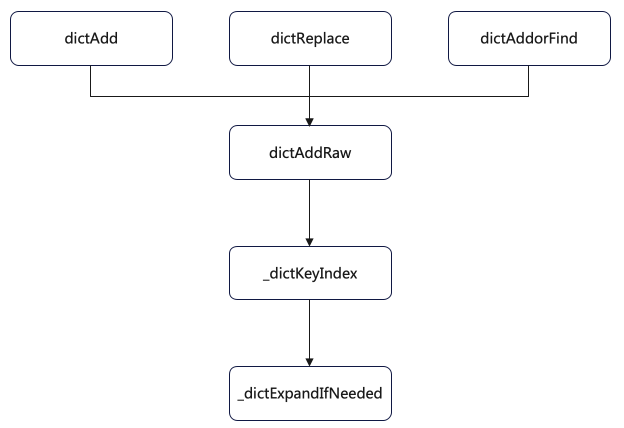
那 _dictExpandIfNeeded 是在哪里调用的呢?
rehash 扩容多大?
_dictExpandIfNeeded 里调用了扩容函数 dictExpand。
/* return DICT_ERR if expand was not performed */

int dictExpand(dict *d, unsigned long size) {

    return _dictExpand(d, size, NULL);

}
int _dictExpand(dict *d, unsigned long size, int* malloc_failed)

{

    ……

    dictht n; /* the new hash table */

    unsigned long realsize = _dictNextPower(size);

    ……

}
里面有一个 _dictNextPower 函数,啥都不说了,都在注释里。
static unsigned long _dictNextPower(unsigned long size) {

    unsigned long i = DICT_HT_INITIAL_SIZE;

    // 要扩容的大小已经超过了最大值

    if (size >= LONG_MAX) return LONG_MAX + 1LU;

    // 要扩容的大小没有超过最大值,找到第一个比 size 大的 2^i

    while (1) {

        if (i >= size)

            return i;

        i *= 2;

    }

}
渐进式 rehash
为什么需要渐进式 rehash?
Hash 表空间很大,全量 rehash 时间会很长,阻塞 Redis 主线程。为了降低 rehash 开销,Redis 使用了「渐进式 rehash」。
具体一点
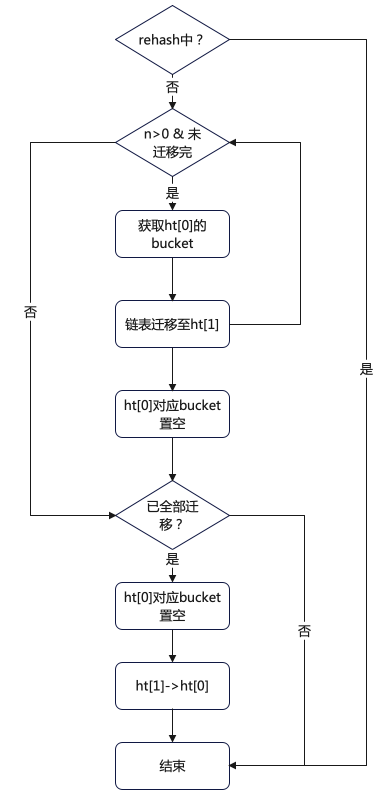
渐进式 rehash 并不是一次性把当前 Hash 表的所有键,都拷贝到新的位置,而是「分批拷贝」,每次只拷贝 Hash 表中一个 bucket 中的哈希项。
int dictRehash(dict *d, int n) {

    int empty_visits = n*10; /* Max number of empty buckets to visit. */

    if (!dictIsRehashing(d)) return 0;

    // 循环 n 次后停止,或 ht[0] 迁移完成

    while(n-- && d->ht[0].used != 0) {

        dictEntry *de, *nextde;

        assert(d->ht[0].size > (unsigned long) d->rehashidx);

        // 如果要迁移的 bucket 中没有元素

        while (d->ht[0].table[d->rehashidx] == NULL) {

            d->rehashidx++;

            if (--empty_visits == 0) return 1;

        }

        // 获取待迁移的 ht[0] 的 bucket

        de = d->ht[0].table[d->rehashidx];

        /* Move all the keys in this bucket from the old to the new hash HT */

        while (de) {

            uint64_t h;

            // 获取下一个迁移项

            nextde = de->next;

            // 计算 de 在 ht[1](扩容后)中的位置

            h = dictHashKey(d, de->key) & d->ht[1].sizemask;

            // 将当前的哈希项放到扩容后的 ht[1] 中

            de->next = d->ht[1].table[h];

            d->ht[1].table[h] = de;

            d->ht[0].used--;

            d->ht[1].used++;

            //指向下一个哈希项

            de = nextde;

        }

        // 当前 bucket 已经没有哈希项了,将该 bucket 设置为 null

        d->ht[0].table[d->rehashidx] = NULL;

        // 将 rehash+1,下次迁移下一个 bucket

        d->rehashidx++;

    }

    // 判断 ht[0] 是否已经全部迁移

    if (d->ht[0].used == 0) {

        // ht[0] 已经全部迁移到 ht[1] 了,释放 ht[0]

        zfree(d->ht[0].table);

        // ht[0] 指向 ht[1]

        d->ht[0] = d->ht[1];

        // 重置 ht[1] 大小为 0

        _dictReset(&d->ht[1]);

        //设置全局哈希表的 rehashidx=-1,表示 rehash 结束

        d->rehashidx = -1;

        return 0;

    }

    // ht[0] 中仍然有元素没有迁移完

    return 1;

}
几点说明:
- rehashidx 表示当前 rehash 在对哪个 bucket 做数据迁移,每次迁移完对应 bucket 时,会将 rehashidx+1。
- empty_visits 表示连续 bucket 为空的情况,此时渐进式 rehash 不会一直递增检查 rehashidx,因为一直检测会阻塞主线程,Redis 主线程就无法处理其他请求了。
那么 rehash 是在什么哪些步骤进行操作的呢?查看源码发现 dictRehash 是在 _dictRehashStep 函数中调用的,且传入的 n=1。
static void _dictRehashStep(dict *d) {

    if (d->pauserehash == 0) dictRehash(d,1);

}
而 _dictRehashStep 分别被 5 个方法调用了:
- dictAddRaw
- dictGenericDelete
- dictFind
- dictGetRandomKey
- dictGetSomeKeys
下面是 dictAddRaw 部分代码:
dictEntry *dictAddRaw(dict *d, void *key, dictEntry **existing)

{

    ……

    if (dictIsRehashing(d)) _dictRehashStep(d);

    ……

}
下面是 dictAdd 部分代码:
int dictAdd(dict *d, void *key, void *val)

{

    dictEntry *entry = dictAddRaw(d,key,NULL);

    if (!entry) return DICT_ERR;

    dictSetVal(d, entry, val);

    return DICT_OK;

}
Redis 源码简洁剖析系列
Java 编程思想-最全思维导图-GitHub 下载链接,需要的小伙伴可以自取~
原创不易,希望大家转载时请先联系我,并标注原文链接。
Redis 源码简洁剖析 03 - Dict Hash 基础的更多相关文章
- Redis 源码简洁剖析 07 - main 函数启动
前言 问题 阶段 1:基本初始化 阶段 2:检查哨兵模式,执行 RDB 或 AOF 检测 阶段 3:运行参数解析 阶段 4:初始化 server 资源管理 初始化数据库 创建事件驱动框架 阶段 5:执 ...
- Redis 源码简洁剖析 04 - Sorted Set 有序集合
Sorted Set 是什么 Sorted Set 命令及实现方法 Sorted Set 数据结构 跳表(skiplist) 跳表节点的结构定义 跳表的定义 跳表节点查询 层数设置 跳表插入节点 zs ...
- Redis 源码简洁剖析 12 - 一条命令的处理过程
命令的处理过程 Redis server 和一个客户端建立连接后,会在事件驱动框架中注册可读事件--客户端的命令请求.命令处理对应 4 个阶段: 命令读取:对应 readQueryFromClient ...
- Redis 源码简洁剖析 13 - RDB 文件
RDB 是什么 RDB 文件格式 Header Body DB Selector AUX Fields Key-Value Footer 编码算法说明 Length 编码 String 编码 Scor ...
- Redis 源码简洁剖析 16 - 客户端
整体概述 客户端属性 套接字描述符 标志 输入缓冲区 命名及命令参数 命令的实现函数 输出缓冲区 客户端的创建与关闭 创建普通客户端 关闭普通客户端 参考链接 Redis 源码简洁剖析系列 整体概述 ...
- Redis 源码简洁剖析 02 - SDS 字符串
C 语言的字符串函数 C 语言 string 函数,在 C 语言中可以使用 char* 字符数组实现字符串,C 语言标准库 string.h 中也定义了多种字符串操作函数. 字符串使用广泛,需要满足: ...
- Redis 源码简洁剖析 05 - ziplist 压缩列表
ziplist 是什么 Redis 哪些数据结构使用了 ziplist? ziplist 特点 优点 缺点 ziplist 数据结构 ziplist 节点 pre_entry_length encod ...
- Redis 源码简洁剖析 06 - quicklist 和 listpack
quicklist 为什么要设计 quicklist 特点 数据结构 quicklistCreate quicklistDelIndex quicklistDelEntry quicklistInse ...
- Redis 源码简洁剖析 09 - Reactor 模型
Reactor 模型 事件驱动框架 Redis 如何实现 Reactor 模型 事件的数据结构:aeFileEvent 主循环:aeMain 函数 事件捕获与分发:aeProcessEvents 函数 ...
随机推荐
- 【九度OJ】题目1207:质因数的个数 解题报告
[九度OJ]题目1207:质因数的个数 解题报告 标签(空格分隔): 九度OJ 原题地址:http://ac.jobdu.com/problem.php?pid=1207 题目描述: 求正整数N(N& ...
- 【LeetCode】808. Soup Servings 解题报告(Python)
作者: 负雪明烛 id: fuxuemingzhu 个人博客: http://fuxuemingzhu.cn/ 题目地址:https://leetcode.com/problems/soup-serv ...
- 【LeetCode】153. Find Minimum in Rotated Sorted Array 解题报告(Python)
[LeetCode]153. Find Minimum in Rotated Sorted Array 解题报告(Python) 标签: LeetCode 题目地址:https://leetcode. ...
- Counting Offspring(hdu3887)
Counting Offspring Time Limit: 15000/5000 MS (Java/Others) Memory Limit: 32768/32768 K (Java/Othe ...
- 分布式(CAP)
1. Consistency ------->C---------->一致性[写操作之后的读操作,必须返回该值] 2. Availability-------->A-------- ...
- Are Loss Functions All the Same?
目录 概 主要内容 一些假设 损失函数 损失函数的统计性质 收敛速度 分类的界 Rosasco L, De Vito E, Caponnetto A, et al. Are loss function ...
- CS5212Capstone|DP转VGA方案设计芯片|CS5212设计资料
CS5212是台湾CAPSTONE最新开发出一款用于DP转VGA方案设计芯片,其周围器件较少,设计简单,整体BOM成本低,市场性价比较高. CS5212内置MCU是工业标准8051核心单片机处理器.C ...
- 2 - 基于ELK的ElasticSearch 7.8.x技术整理 - java操作篇 - 更新完毕
3.java操作ES篇 3.1.摸索java链接ES的流程 自行创建一个maven项目 3.1.1.依赖管理 点击查看代码 <properties> <ES-version>7 ...
- python all用法记录
all函数可以返回对象中是否所有元素均为True 代码如下:(此处仅做简单记录,日后不忙时再认真总结) >>> print(list(map(lambda x: True if x ...
- Nginx_安装配置
一.安装gcc依赖库 检查是否安装(linux默认是安装了的) gcc –version