
什么是极坐标? —— 一点微小的想法 What is Polar Coordinate ? - Some Naive Thoughts about It
Can you answer these three questions? The answer seems to be trivial, since we can use our eyes to obtain the answer. But can you use mathematical methods to answer it correctly?
- Find the intersection point(s) of \(r=2\theta\) (called the Archimedes spirals, or equation A) and \(\theta=\pi\) (equation B), in the polar coordinate system. (Given that \(r \geq 0\).) (Adapted from Thomas Calculus P675, Q88)
- Suppose we have a polar equation \(r = 1 + \cos2\theta\)(equation A). Determine whether the following statement is true: When we plug in \((-r, \theta)\), the equation becomes \(-r = 1 + \cos2\theta\) (equation B), which is evidently not on the original curve. Therefore, the curve is not symmetric about the origin. (Adapted from Home Assignment 4, Q3(2))
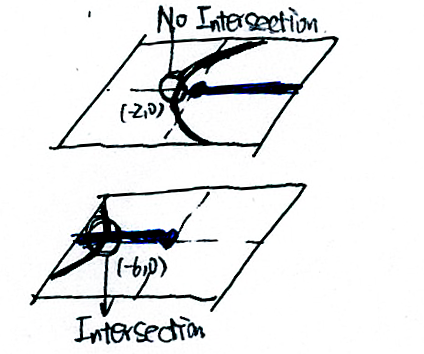
- Suppose a hyperbola is determined by the equation \(r=\frac{6}{1-2\cos\theta}\) (equation A). Calculate the intersection point(s) with the curve \(\theta = 0\) (equation B). If we try to find the common solution to the two equations, we will only get \((-6,0)\) but miss \((-2,0)\). So what is wrong with it? (Given that \(r \in \mathbb{R}\) and \(\theta \in \left[0, 2\pi\right]\), as is claimed to be default by the textbook.) (Adapted from lecture notes, week 4)
Firstly, let's think about a question which seems to be quite trivial: What are the intersection points of two curves? What are the common solutions of two polar equations? Are they the same, or, can I obtain the intersection if I know the common solutions? It seems quite trivial that the two are equivalent, as is taught since junior high school. However, if that is true, the answer in Q1 should be \((2\pi, \pi)\), and you can only get one common solution to Q3, which by intuition is wrong if you draw its curve. So what's wrong with it?
The main problem is that one point in a classical plane has multiple corresponding coordinates. For instance, in Q1, although \((6\pi, 3\pi) \in A\) and \((6\pi, \pi) \in B\) are exactly the same point in the classical plane, it is not the common solution to the two equations because the two are different coordinates. Generally speaking, common solutions to two equations can only determine those who have same coordinates. They will miss out those who are actually same points but have different coordinates.
To address this problem, please allow me to first define the so-called "stack planes", or SP. To avoid confusion, the "plane" that we usually talks about is called "classical plane" in this essay. As is shown in Fig.1, a SP consists of a stack of planes with the names of \(\ldots\), \(\#0^+\), \(\#0^-\), \(\#1^+\), \(\#1^-\), \(\ldots\) . In this notation, the \(\#k\) represents that all points in this plane must satisfy \(\theta \in \left[2k\pi, 2\left(k+1\right)\pi\right]\). The superscript denotes the range of \(r\). \(\#k^+\) requires \(r \geq 0\), and \(\#k^-\) requires \(r < 0\).
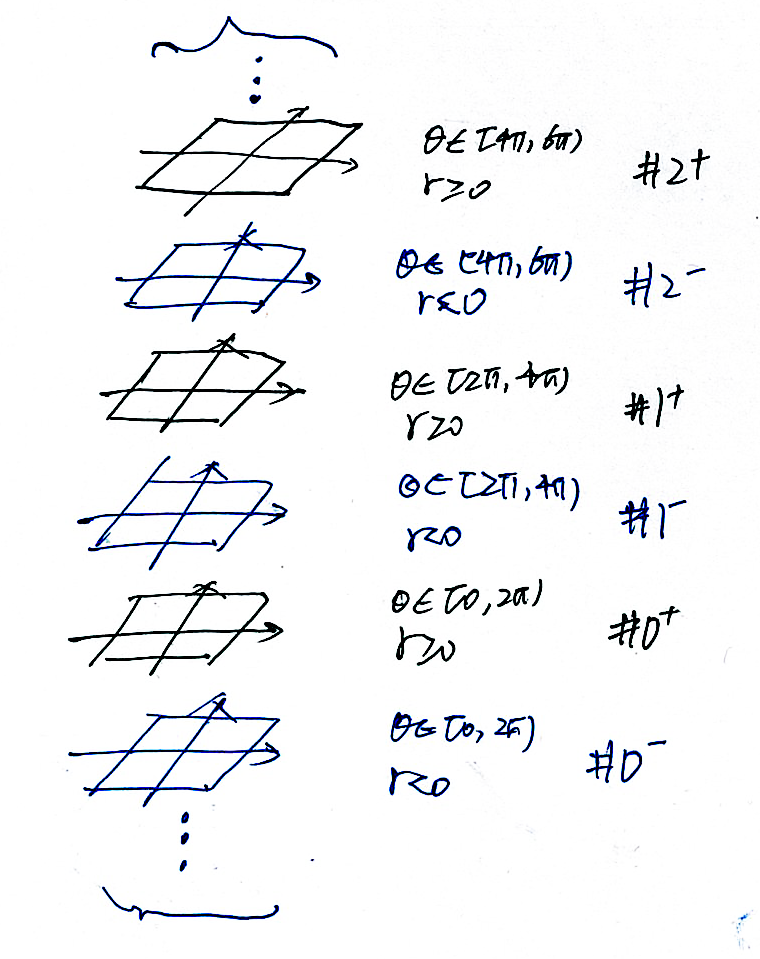
For instance, the plane \(\#0^+\) contains all points whose \(\theta \in \left[0,2\pi\right]\) and \(r \geq 0\), and the plane \(\#0^-\) contains those satisfying \(\theta \in \left[0,2\pi\right]\) and \(r < 0\).
If we there is no constrain on \(r\) and \(\theta\), there will be infinitely many planes in SP. If we constrain \(r \in \mathbb{R} \ and \ \theta \in \left[0,2\pi\right)\), there will be only 2 planes, \(\#0^+\) and \(\#0^-\), in the SP. Similarly, if we constrain \(r \geq 0\) and \(\theta \geq 0\), only the \(\#0^+, \#1^+, \ldots\) will be in the SP.
It can be seen that every point in SP has a one-to-one mapping to the polar coordinate. Therefore, there is no trouble about multiple-to-one correspondence in a normal plane. For example, the point in \(\#1^+\) plane which is one unit top from the origin is uniquely associated with coordinate \((1, \frac{5}{2}\pi)\).
We can further apply it to equations easily. That is, every solution in a polar equation has a one-to-one mapping with a point in SP. Take \(r = 2\theta\) in Q1 as an example. As is shown in Fig. 2, the corresponding graph in SP spreads through \(\#0^+, \#1^+, \ldots\), each of which has a part of the curve.
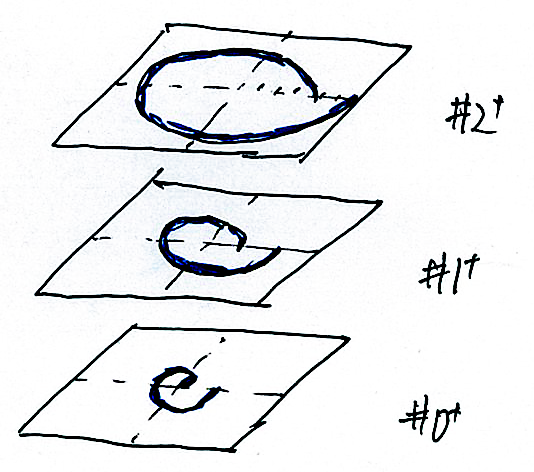
Therefore, the meaning of the common solutions of two equations is clear. It is not the intersection of two corresponding curves in the classical plane, due to the multiple-to-one mapping. Instead, it is the intersection of two curves in SP, since they have a one-to-one correspondence.
What is the relationship between SP and a classical plane? Or, what is the curve in a classical plane given a curve in SP? The answer is that the classical plane is the superposition of all the planes in a SP. Intuitively, you just "squeeze", "flatten" or "project" all the planes in a SP down, and the result is the classical plane. Take Q3 as an example. As is shown in Fig. 3, the bottom one is the classical plane, while the above two make up SP, and you can see the meaning of "projection" clearly.

How can we get the intersection in a classical plane, if we cannot do it by directly calculating the common solutions of two equations?
Recall that the common solutions of two equations only have the one-to-one correspondence with the intersections in SP, not intersection in classical planes. Therefore, the methodology is to transform the equation, such that all the intersections in classical planes are also intersections in SP. At the same time, the corresponding curve in the classical plane should not be changed. There are mainly two approaches to achieve that goal.
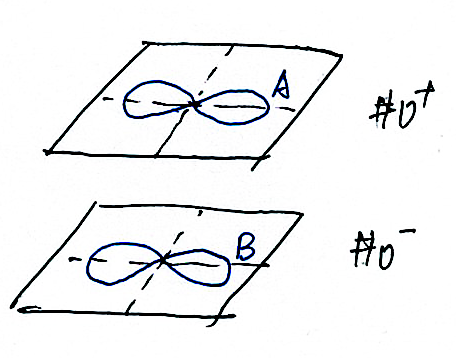
Firstly, we can transform the equations, such that the corresponding points are all in one single plane of SP, typically \(\#0^+\). It can be intuitively called "squeeze". For instance, in Q2, equation \(A\) and \(B\) do have no common solutions. But that is because curve \(A\) is in plane \(\#0^+\) while curve \(B\) is in plane \(\#0^-\), which is shown in Fig. 4. Therefore, we should transform the equation \(B\) to plane \(\#0^+\) by means of \((r, \theta) \to (-r, \theta + \pi)\). Then \(B\) becomes \(B'\), or \(-(-r) = 1 + \cos(2(\theta+\pi))\), i.e. \(r = 1 + \cos(2\theta)\). Therefore, it is clear that \(B'\) is essentially the same as \(A\), so the curve is symmetric about the origin.
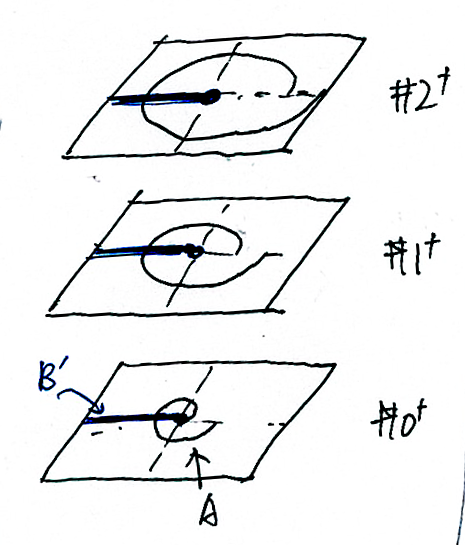
Secondly, we can transform the equations such that there is one duplicate in every plane. Therefore, there is no chance for them to "miss" each other. It can be called "expand". For example, to solve Q1, we can expand curve \(B\) to all planes of SP which curve \(A\) lies in. To achieve this, we transform \(B\) into \(B'\), which is defined by the union of \(\theta=\pi\) and \(\theta=3\pi\) and \(\theta=5\pi\) and \(\ldots\) . As is shown in Fig. 5, now the curve \(B'\) not only stay in plane \(\#0^+\) as \(B\) does, but is in all planes that \(A\) is in. Then we can find the common solutions of \(A\) and \(B'\), which is \((2\pi, \pi)\), \((6\pi, 3\pi)\), \(\ldots\), or equivalently, \(((4k-2)\pi, \pi)\) where \(k \in \mathbb{N}\).
How to plot a curve in SP? It is quite similar to what you have done when you want to plot a curve in the polar plane or Cartesian plane. You just need to traverse the \(\theta\), find out the \(r\), and plot them into lines. The only difference is that you need to plot into corresponding planes in SP, instead of putting all into one classical plane.
With all the discussion above, now we can come to the solutions to the questions above. Q1 and Q2 have been solved during the discussion, and here is the solution to Q3:
We first plot the two curves in SP, which is shown in Fig. 6. Then we can clearly see that the two curves in SP have only one intersection, the point \(P\), but miss out point \(Q\). That is the reason why we miss one point. In order to prevent this, we can use the "expand" method and change equation \(B\) to \(\theta = 0\) and \(\theta = \pi\). Therefore, all two solutions can be calculated.
The aforementioned ideas are just my naive thoughts, but it really solved what had troubled me since my high school, and I hope that it can be of some help to you! :)
Tom Chen
2018.02.07
什么是极坐标? —— 一点微小的想法 What is Polar Coordinate ? - Some Naive Thoughts about It的更多相关文章
- 关于分开编写多个LaTeX文件的一点微小的总结
[转载请注明出处]http://www.cnblogs.com/mashiqi 2016/11/05 在编写LaTeX文档的时候,由于文档的section较多,或者section的编写时间各不相同,我 ...
- 06. Matplotlib 2 |折线图| 柱状图| 堆叠图| 面积图| 填图| 饼图| 直方图| 散点图| 极坐标| 图箱型图
1.基本图表绘制 plt.plot() 图表类别:线形图.柱状图.密度图,以横纵坐标两个维度为主同时可延展出多种其他图表样式 plt.plot(kind='line', ax=None, figsiz ...
- LogPolar 对数极坐标
LogPolar 对数极坐标 cvLogPolar 对数极坐标(logpolar)是仿真生物视网膜中央凹陷的特性,具有数据压缩的能力,可用于目标跟踪中快速尺度和旋转变换不变的模板匹配. 对数极坐标其实 ...
- PS 滤镜——平面坐标变换到极坐标
%%% orthogonal coordinate to polar coordinate %%% 平面坐标转极坐标 clc; clear all; close all; addpath('E:\Ph ...
- 《清华梦的粉碎》by王垠
清华梦的诞生 小时候,妈妈给我一个梦.她指着一个大哥哥的照片对我说,这是爸爸的学生,他考上了清华大学,他是我们中学的骄傲.长大后,你也要进入清华大学读书,为我们家争光.我不知道清华是什么样子,但是我 ...
- Software Engineering-HW1
title: Software Engineering-HW1 date: 2017-09-13 15:41:13 tags: HW --- 阅读随笔 在<徐宥:掉进读书的兔子洞>里面, ...
- Spring+SpringMVC+MyBatis+easyUI整合基础篇(一)项目简述及技术选型介绍
作者:13GitHub:https://github.com/ZHENFENG13版权声明:本文为原创文章,未经允许不得转载. 萌芽阶段 很久之前就开始打算整理一下自己的技术博客了,由于各种原因(借口 ...
- 清华梦的粉碎—写给清华大学的退学申请(转自王垠Blog)
清华梦的诞生 小时候,妈妈给我一个梦.她指着一个大哥哥的照片对我说,这是爸爸的学生,他考上了清华大学,他是我们中学的骄傲.长大后,你也要进入清华大学读书,为我们家争光.我不知道清华是什么样子,但是我知 ...
- 组件化 得到 DDComponent JIMU 模块 插件 MD
Markdown版本笔记 我的GitHub首页 我的博客 我的微信 我的邮箱 MyAndroidBlogs baiqiantao baiqiantao bqt20094 baiqiantao@sina ...
随机推荐
- Axure Base 03
(三)Axure rp元件的触发事件 l OnClick(点击时): 鼠标点击事件,除了动态面板的所有的其他元件的点击时触发.比如点击按钮. l OnMouseEnter(鼠标移入时): 鼠标进入 ...
- JS简单正则得到字符串中特定的值
这里就直接看演示样例吧.演示样例的目的是为了获取 a 字符串中的 c02806015 <script language="javascript"> var a = '礼 ...
- #import @import #include
1.在xcode5以后 ,Replace #import <Cocoa/Cocoa.h> with @import Cocoa; 在这之前 必须手动设置一下才能用. 2.#import 与 ...
- bzoj4103: [Thu Summer Camp 2015]异或运算
对于每个询问暴力枚举x~y,然后在Trie去找第k大,开始我写了个二分答案然后算比当前答案大的个数,打了个第10个点的表就跑出19s+比bzoj垫底还慢4s+ 然而不用二分,直接1000个点一起在树上 ...
- android.annotation.SuppressLint
Lint是一个静态检查器,它围绕Android项目的正确性.安全性.性能.可用性以及可访问性进行分析.它检查的对象包括XML资源.位图.ProGuard配置文件.源文件甚至编译后的字节码. Lint包 ...
- 换行和flush()
在尝试使用BufferedReader的readLine方法读出每一行数据,再用FileWriter依次写到文件里的时候,用了下面的代码段: fr = new FileReader("c:/ ...
- Crontab Build_setting的定期检查
一.脚本功能 (1)检查所有的builting_setting.h是否能够编译通过,并将编译结果写入 编译结果.h文件中. (2)将编译结果通过邮箱发送给相关负责人. (3)系统定期执行任务,检查bu ...
- node安装升级npm
安装npm npm上有很多优秀的nodejs包,来解决常见的一些问题,比如用node-mysql,就可以方便通过nodejs链接到mysql,进行数据库的操作 在开发过程往往会需要用到其他的包,使用n ...
- HDU 5884 Sort (二分+k叉哈夫曼树)
题意:n 个有序序列的归并排序.每次可以选择不超过 k 个序列进行合并,合并代价为这些序列的长度和.总的合并代价不能超过T, 问 k最小是多少. 析:首先二分一下这个 k .然后在给定 k 的情况下, ...
- 【WIP】客户端JavaScript Web Object
创建: 2017/10/11 更新: 2017/10/14 标题加上[WIP],增加[TODO] 更新: 2018/01/22 更改标题 [客户端JavaScript Web Object, UR ...