
libevent中最小堆实现算法解析
libevent,一个非常好的c的网络库,最近开始学习并分析下,做个记录。源码选用的1.4版本。因为感觉这版的代码比较精简,也没有太多宏定义,个人感觉适合学习原理。
从哪里开始呢,我选择从一些最简单的基础的东西开始,由简入繁。
今天就带来libevent的最小堆生成,体会下libevent作者如何实现最小堆的。最小堆用在libevent的时间管理上,来计算是否超时。
最小堆:是一种经过排序的完全二叉树,其中任一非终端节点的数据值均不大于其左子节点和右子节点的值。
1.min_heap_shift_up_ 插入元素后向上调整
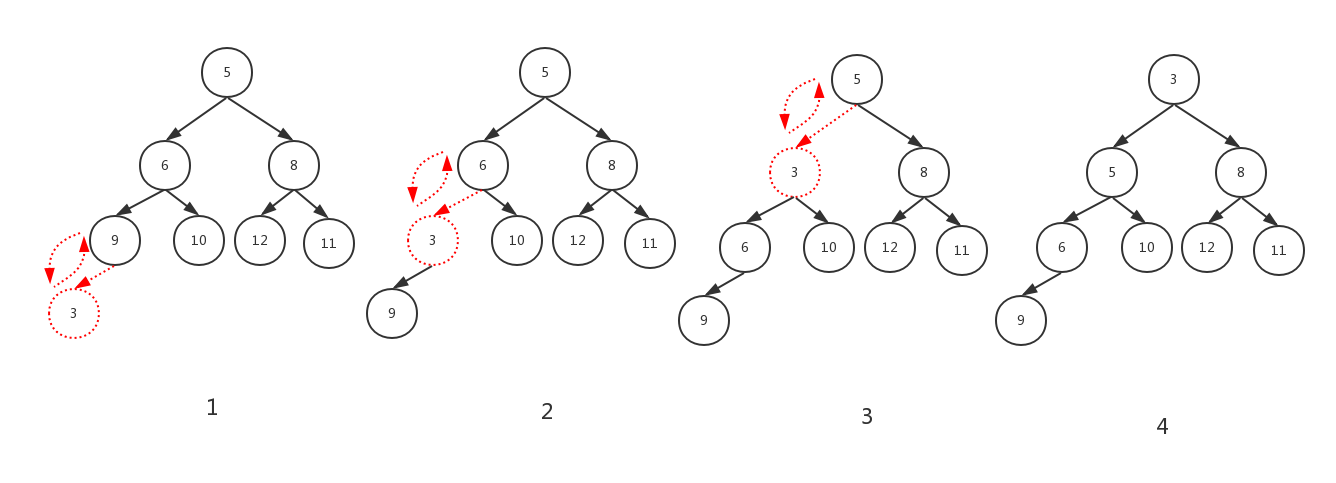
2.min_heap_shift_down_ 元素向下调整(删除元素)

3.代码注释
  1 /*

  2  * Copyright (c) 2006 Maxim Yegorushkin <maxim.yegorushkin@gmail.com>

  3  * All rights reserved.

  4  *

  5  * Redistribution and use in source and binary forms, with or without

  6  * modification, are permitted provided that the following conditions

  7  * are met:

  8  * 1. Redistributions of source code must retain the above copyright

  9  *    notice, this list of conditions and the following disclaimer.

 10  * 2. Redistributions in binary form must reproduce the above copyright

 11  *    notice, this list of conditions and the following disclaimer in the

 12  *    documentation and/or other materials provided with the distribution.

 13  * 3. The name of the author may not be used to endorse or promote products

 14  *    derived from this software without specific prior written permission.

 15  *

 16  * THIS SOFTWARE IS PROVIDED BY THE AUTHOR ``AS IS'' AND ANY EXPRESS OR

 17  * IMPLIED WARRANTIES, INCLUDING, BUT NOT LIMITED TO, THE IMPLIED WARRANTIES

 18  * OF MERCHANTABILITY AND FITNESS FOR A PARTICULAR PURPOSE ARE DISCLAIMED.

 19  * IN NO EVENT SHALL THE AUTHOR BE LIABLE FOR ANY DIRECT, INDIRECT,

 20  * INCIDENTAL, SPECIAL, EXEMPLARY, OR CONSEQUENTIAL DAMAGES (INCLUDING, BUT

 21  * NOT LIMITED TO, PROCUREMENT OF SUBSTITUTE GOODS OR SERVICES; LOSS OF USE,

 22  * DATA, OR PROFITS; OR BUSINESS INTERRUPTION) HOWEVER CAUSED AND ON ANY

 23  * THEORY OF LIABILITY, WHETHER IN CONTRACT, STRICT LIABILITY, OR TORT

 24  * (INCLUDING NEGLIGENCE OR OTHERWISE) ARISING IN ANY WAY OUT OF THE USE OF

 25  * THIS SOFTWARE, EVEN IF ADVISED OF THE POSSIBILITY OF SUCH DAMAGE.

 26  */

 27 #ifndef _MIN_HEAP_H_

 28 #define _MIN_HEAP_H_

 29

 30 #include "event.h"

 31 #include "evutil.h"

 32

 33 //最小堆,是一种经过排序的完全二叉树,其中任一非终端节点的数据值均不大于其左子节点和右子节点的值。

 34 typedef struct min_heap

 35 {

 36     //动态分配内存用来保存指向*event的指针

 37     struct event** p;

 38     //n为元素个数,a为个数容量

 39     unsigned n, a;

 40 } min_heap_t;

 41

 42 static inline void           min_heap_ctor(min_heap_t* s);

 43 static inline void           min_heap_dtor(min_heap_t* s);

 44 static inline void           min_heap_elem_init(struct event* e);

 45 static inline int            min_heap_elem_greater(struct event *a, struct event *b);

 46 static inline int            min_heap_empty(min_heap_t* s);

 47 static inline unsigned       min_heap_size(min_heap_t* s);

 48 static inline struct event*  min_heap_top(min_heap_t* s);

 49 static inline int            min_heap_reserve(min_heap_t* s, unsigned n);

 50 static inline int            min_heap_push(min_heap_t* s, struct event* e);

 51 static inline struct event*  min_heap_pop(min_heap_t* s);

 52 static inline int            min_heap_erase(min_heap_t* s, struct event* e);

 53 static inline void           min_heap_shift_up_(min_heap_t* s, unsigned hole_index, struct event* e);

 54 static inline void           min_heap_shift_down_(min_heap_t* s, unsigned hole_index, struct event* e);

 55

 56 int min_heap_elem_greater(struct event *a, struct event *b)

 57 {

 58     return evutil_timercmp(&a->ev_timeout, &b->ev_timeout, >);

 59 }

 60

 61 void min_heap_ctor(min_heap_t* s) { s->p = 0; s->n = 0; s->a = 0; }

 62 void min_heap_dtor(min_heap_t* s) { if(s->p) free(s->p); }

 63 void min_heap_elem_init(struct event* e) { e->min_heap_idx = -1; }

 64 int min_heap_empty(min_heap_t* s) { return 0u == s->n; }

 65 unsigned min_heap_size(min_heap_t* s) { return s->n; }

 66 struct event* min_heap_top(min_heap_t* s) { return s->n ? *s->p : 0; }

 67

 68 //插入元素

 69 int min_heap_push(min_heap_t* s, struct event* e)

 70 {

 71     //检查内存

 72     if(min_heap_reserve(s, s->n + 1))

 73         return -1;

 74

 75     //插入元素向上调整

 76     min_heap_shift_up_(s, s->n++, e);

 77     return 0;

 78 }

 79

 80 //pop头元素

 81 struct event* min_heap_pop(min_heap_t* s)

 82 {

 83     if(s->n)

 84     {

 85         //->优先级比*高

 86         //e指向头元素的指针

 87         struct event* e = *s->p;

 88         //元素向下调整,0U代表头节点索引,s->p[--s->n]:最下层最右边元素,用于插入后填充空出的位置

 89         min_heap_shift_down_(s, 0u, s->p[--s->n]);

 90

 91         //头元素在堆中索引赋值为-1,出堆

 92         e->min_heap_idx = -1;

 93         return e;

 94     }

 95     return 0;

 96 }

 97

 98 //删除堆中等于e的元素

 99 int min_heap_erase(min_heap_t* s, struct event* e)

100 {

101     if(((unsigned int)-1) != e->min_heap_idx)

102     {

103         struct event *last = s->p[--s->n];

104         //父节点索引

105         unsigned parent = (e->min_heap_idx - 1) / 2;

106     /* we replace e with the last element in the heap.  We might need to

107        shift it upward if it is less than its parent, or downward if it is

108        greater than one or both its children. Since the children are known

109        to be less than the parent, it can't need to shift both up and

110        down. */

111         //如果e不是根元素,当前e的父节点值大于last,需要进行向上调整

112         if (e->min_heap_idx > 0 && min_heap_elem_greater(s->p[parent], last))

113              min_heap_shift_up_(s, e->min_heap_idx, last);

114         else

115         //如果e是根元素或者e的父节点元素值不大于last,元素向下调整,e->min_heap_idx为头节点索引,last:最下层最右边元素

116         //,用于插入后填充空出的位置

117              min_heap_shift_down_(s, e->min_heap_idx, last);

118         //将e元素出堆

119         e->min_heap_idx = -1;

120         return 0;

121     }

122     return -1;

123 }

124

125 //调整分配内存

126 int min_heap_reserve(min_heap_t* s, unsigned n)

127 {

128     //如果元素的容量小于元素个数,需要重新分配内存

129     if(s->a < n)

130     {

131         struct event** p;

132         //a原来默认为0就分配为8,如果以前有值(不是第一次调整),就扩大两倍

133         unsigned a = s->a ? s->a * 2 : 8;

134         //如果a还不够,直接让a等于n,元素个数和容量相同

135         if(a < n)

136             a = n;

137         //重新调整内存,连续分配

138         if(!(p = (struct event**)realloc(s->p, a * sizeof *p)))

139             return -1;

140         //首地址

141         s->p = p;

142         //容量

143         s->a = a;

144     }

145     return 0;

146 }

147

148 //插入元素后向上调整

149 void min_heap_shift_up_(min_heap_t* s, unsigned hole_index, struct event* e)

150 {

151     //父节点的索引

152     unsigned parent = (hole_index - 1) / 2;

153     //如果hole_index不等于0且父节点元素大于所给的元素,继续比较,直到到达hole_index为根元素,

154     //或者现在的父元素大于了e,找到插入的位置

155     while(hole_index && min_heap_elem_greater(s->p[parent], e))

156     {

157         //父节点元素值大,将父节点放到现在的hole_index上的位置

158         (s->p[hole_index] = s->p[parent])->min_heap_idx = hole_index;

159

160         //hole_index赋值为父节点的索引

161         hole_index = parent;

162

163         //找到现在的hole_index的父节点索引

164         parent = (hole_index - 1) / 2;

165     }

166

167     //跳出循环找到了要插入的位置,位置的索引就是现在的hole_index

168     (s->p[hole_index] = e)->min_heap_idx = hole_index;

169 }

170

171 //元素向下调整(删除元素)

172 void min_heap_shift_down_(min_heap_t* s, unsigned hole_index, struct event* e)

173 {

174     //右孩子索引

175     unsigned min_child = 2 * (hole_index + 1);

176     //存在右孩子,如果不存在右子树,直接向下调整,因为最多存在左子树,且值肯定不小于父节点,可以直接向下调整

177     while(min_child <= s->n)

178     {

179         //选择左右孩子值最小的孩子的索引,根据优先级可以加()进行更好的查看

180         min_child -= ((min_child == s->n) || min_heap_elem_greater(s->p[min_child], s->p[min_child - 1]));

181         //如果e元素不大于最小的孩子元素,没有必要再继续,hole_index就是他的位置

182         if(!(min_heap_elem_greater(e, s->p[min_child])))

183             break;

184         //将小的孩子元素放到hole_index位置上

185         (s->p[hole_index] = s->p[min_child])->min_heap_idx = hole_index;

186         //hole_index保存当前小的孩子索引

187         hole_index = min_child;

188         //当前小的孩子位置空出,继续下一次循环,比较当前小的孩子的左右孩子

189         min_child = 2 * (hole_index + 1);

190     }

191     //将e元素放到hole_index,然后向上调整。一般e元素是取最下层最右节点。不排除有可能比现在的位置上的父节点下

192     //所以需要向上调整

193     min_heap_shift_up_(s, hole_index,  e);

194 }

195

196 #endif /* _MIN_HEAP_H_ */
libevent中最小堆实现算法解析的更多相关文章
- Android逆向之旅---Android中锁屏密码算法解析以及破解方案
一.前言 最近玩王者荣耀,下载了一个辅助样本,结果被锁机了,当然破解它很简单,这个后面会详细分析这个样本,但是因为这个样本引发出的欲望就是解析Android中锁屏密码算法,然后用一种高效的方式制作锁机 ...
- ArcGIS中生成蜂窝多边形算法解析
近来有不少同学.都有问我关于蜂窝多边形的问题.也就是正六边形,也就是以下这个东东: 一般的问答模式例如以下: 亲们问:ArcGIS里面那个工具能够做这个东东? 虾神答:额,没有原生的工具. 亲们问:那 ...
- Python3实现最小堆建堆算法
今天看Python CookBook中关于“求list中最大(最小)的N个元素”的内容,介绍了直接使用python的heapq模块的nlargest和nsmallest函数的解决方式,记得学习数据结构 ...
- 【转】JDK5.0中JVM堆模型、GC垃圾收集详细解析
基本概念 堆/Heap JVM管理的内存叫堆:在32Bit操作系统上有4G的限制,一般来说Windows下为2G,而Linux下为3G:64Bit的就没有这个限制.JVM初始分配的内存由-Xms指定, ...
- 窥探算法之美妙——寻找数组中最小的K个数&python中巧用最大堆
原文发表在我的博客主页,转载请注明出处 前言 不论是小算法或者大系统,堆一直是某种场景下程序员比较亲睐的数据结构,而在python中,由于数据结构的极其灵活性,list,tuple, dict在很多情 ...
- Libevent源码分析(一):最小堆
Libevent中的timeout事件是使用最小堆来管理维护的.代码位于<minheap-internal.h>. 看函数命名和代码风格应该是一个C++程序员,函数名都挺好懂的,只是下面这 ...
- .net下使用最小堆实现TopN算法
测试代码: using System; using System.Collections.Generic; using System.Linq; using System.Text; namespac ...
- [算法]找到无序数组中最小的K个数
题目: 给定一个无序的整型数组arr,找到其中最小的k个数. 方法一: 将数组排序,排序后的数组的前k个数就是最小的k个数. 时间复杂度:O(nlogn) 方法二: 时间复杂度:O(nlogk) 维护 ...
- libevent(二)尾队列 && 最小堆
本文主要研究libevent中用来存储事件的两个结构体. 尾队列 具体定义位于queue.h中. #define TAILQ_HEAD(name, type) \ struct name { \ st ...
随机推荐
- python3使用迭代生成器yield减少内存占用
技术背景 在python编码中for循环处理任务时,会将所有的待遍历参量加载到内存中.其实这本没有必要,因为这些参量很有可能是一次性使用的,甚至很多场景下这些参量是不需要同时存储在内存中的,这时候就会 ...
- Http Get与Post的区别
GET和POST是HTTP请求的两种基本方法,要说它们的区别,接触过WEB开发的人都能说出一二. 最直观的区别就是GET把参数包含在URL中,POST通过request body传递参数. 你可能自己 ...
- CVE-2018-0798:Microsoft office 公式编辑器 Matrix record 字段栈溢出漏洞调试分析
\x01 前言 2018 年 1 月 9 日,Office 公式编辑器再曝出新漏洞,编号为 CVE-2018-0798.提起公式编辑器大家都不陌生,之前的 CVE-2017-11882 和 CVE-2 ...
- 12.PHP_PDO数据库抽象层
PDO数据库抽象层 其实也就是说,为了方便PHP项目各种数据库切换的方便以及代码兼容性,再各种数据库上又封装了一层,做成了统一的接口,方便数据库使用和切换. PDO链接mysql数据库: <?p ...
- Windows核心编程 第四章 进程(上)
第4章 进 程 本章介绍系统如何管理所有正在运行的应用程序.首先讲述什么是进程,以及系统如何创建进程内核对象,以便管理每个进程.然后将说明如何使用相关的内核对象来对进程进行操作.接着,要介绍进 ...
- 3.逆向分析Hello World!程序-下
5.继续补充,常用操作指令: Ctrl+G Go to 移动到指定地址,用来查看代码或内存,运行时不可用 F4 Execute till Cursor 执行到光标位置, ...
- 一起来刷《剑指Offer》-- 题目一:找出数组中重复的数字(Python多种方法实现)
数组中重复的数字 最近在复习算法和数据结构(基于Python实现),然后看了Python的各种"序列"--比如列表List.元组Tuple和字符串String,后期会写一篇博客介绍 ...
- Pytest自动化测试-简易入门教程(03)
今天分享内容的重点,和大家来讲一下我们的测试框架--Pytest 讲到这个框架的话呢,可能有伙伴就会问老师,我在学习自动化测试过程中,我们要去学一些什么东西? 第一个肯定要学会的是一门编程语言,比如说 ...
- Java常用类详解
目录 1. String类 1.1 String的特性 1.2 String字面量赋值的内存理解 1.3 String new方式赋值的内存理解 1.4 String 拼接字面量和变量的方式赋值 1. ...
- Web安全之PHP反序列化漏洞
漏洞原理: 序列化可以将对象变成可以传输的字符串,方便数据保存传输,反序列化就是将字符串还原成对象.如果web应用没有对用户输入的反序列化字符串进行检测,导致反序列化过程可以被控制,就会造成代码执行, ...