
Java 设计模式--策略模式,枚举+工厂方法实现
如果项目中的一个页面跳转功能存在10个以上的if else判断,想要做一下整改
一、什么是策略模式
策略模式是对算法的包装,是把使用算法的责任和算法本身分割开来,委派给不同的对象管理,最终可以实现解决多重If判断问题。
1.环境(Context)角色:持有一个Strategy的引用。
2.抽象策略(Strategy)角色:这是一个抽象角色,通常由一个接口或抽象类实现。此角色给出所有的具体策略类所需的接口。
3.具体策略(ConcreteStrategy)角色:包装了相关的算法或行为。
(定义策略接口→实现不同的策略类→利用多态或其他方式调用策略。)
二、策略模式优缺点
优点:
算法可以自由切换(高层屏蔽算法,角色自由切换)
避免使用多重条件判断(如果算法过多就会出现很多相同的判断,很难维护)
扩展性好(可自由添加取消算法,而不影响整个功能)
缺点:
策略数量增多(每一个策略类复用性小,如果需要增加算法,就只能新增类)
所有的策略类都需要对外暴露(使用的人必须了解使用策略,这个就需要其他模式来补充,比如工厂模式、代理模式)
三、代码示例
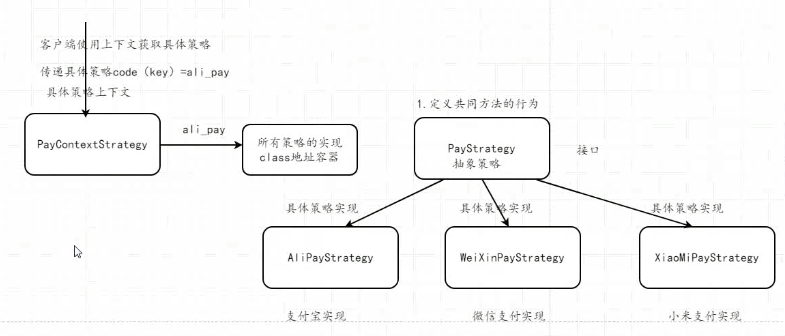
1.定义共同的方法和行为
package com.ultiwill.strategy;

public interface PayStrategy {

    /**

     * 共同的行为方法

     * @return

     */

    String toPayHtml();

}
2. 三种具体策略的实现 (阿里支付, 微信支付, 小米支付)
package com.ultiwill.strategy.impl;

import com.ultiwill.strategy.PayStrategy;

/**

 * @author chong.zuo

 * @date 2020/9/24 15:21

 */

public class AliPayStrategy implements PayStrategy {

    @Override

    public String toPayHtml() {

        return "调用阿里支付...AliPayStrategy";

    }

}
package com.ultiwill.strategy.impl;

import com.ultiwill.strategy.PayStrategy;

/**

 * @author chong.zuo

 * @date 2020/9/24 15:29

 */

public class WeChatPayStrategy implements PayStrategy {

    @Override

    public String toPayHtml() {

        return "调用微信支付...WeChatPayStrategy";

    }

}
package com.ultiwill.strategy.impl;

import com.ultiwill.strategy.PayStrategy;

/**

 * @author chong.zuo

 * @date 2020/9/24 15:34

 */

public class XiaomiPayStrategy implements PayStrategy {

    @Override

    public String toPayHtml() {

        return "调用小米支付...XiaomiPayStrategy";

    }

}
3. 枚举类定义映射地址
package com.ultiwill.strategy.enums;

import org.apache.commons.lang.StringUtils;

/**

 * 枚举

 * @author chong.zuo

 * @date 2020/9/24 15:45

 */

public enum PayEnumStrategy {

    /**

     * 阿里支付

     */

    ALI_PAY("1","com.ultiwill.strategy.impl.AliPayStrategy"),

    /**

     * 微信支付

     */

    WECHAT_PAY("2","com.ultiwill.strategy.impl.WeChatPayStrategy"),

    /**

     * 小米支付

     */

    XIAOMI_PAY("3","com.ultiwill.strategy.impl.XiaomiPayStrategy");

    private String code;

    private String className;

    PayEnumStrategy() {

    }

    PayEnumStrategy(String code, String className) {

        this.code = code;

        this.className = className;

    }

    public static String getClassNameByCode(String code) {

        String className = "";

        if (StringUtils.isEmpty(code)) {

            return className;

        }

        for (PayEnumStrategy e : PayEnumStrategy.values()) {

            if (e.code.equalsIgnoreCase(code)) {

                className = e.className;

                break;

            }

        }

        return className;

    }

    public String getCode() {

        return code;

    }

    public String getClassName() {

        return className;

    }

}
4.工厂类反射执行
package com.ultiwill.strategy.factory;

import com.ultiwill.strategy.PayStrategy;

import com.ultiwill.strategy.enums.PayEnumStrategy;

/**

 * @author chong.zuo

 * @date 2020/9/24 16:10

 */

public class StrategyFactory {

    /**

     * 使用策略工厂获取具体策略实现

     * @param code

     * @return

     */

    public static PayStrategy getPayStrategy(String code) {

        try {

            return (PayStrategy) Class.forName(PayEnumStrategy.getClassNameByCode(code)).newInstance();

        } catch (InstantiationException e) {

            e.printStackTrace();

        } catch (IllegalAccessException e) {

            e.printStackTrace();

        } catch (ClassNotFoundException e) {

            e.printStackTrace();

        }

        return null;

    }

}
5.上下文获取具体策略
package com.ultiwill.strategy.context;

import com.ultiwill.strategy.PayStrategy;

import com.ultiwill.strategy.enums.PayEnumStrategy;

import com.ultiwill.strategy.factory.StrategyFactory;

import org.apache.commons.lang.StringUtils;

/**

 * 上下文

 *

 * @author chong.zuo

 * @date 2020/9/24 15:41

 */

public class PayContextStrategy {

    /**

     * 获取具体的策略实现

     *

     * @param code

     * @return

     */

    public static String toPayHtml(String code) {

        if (StringUtils.isBlank(code)) {

            return "code不能为空...";

        }

        PayStrategy payStrategy = StrategyFactory.getPayStrategy(code);

        if (payStrategy == null) {

            return "没有找到具体的策略...";

        }

        return payStrategy.toPayHtml();

    }

}
四、测试
controller:
package com.ultiwill.controller;

import com.ultiwill.strategy.context.PayContextStrategy;

import org.springframework.web.bind.annotation.RequestMapping;

import org.springframework.web.bind.annotation.RestController;

/**

 * @author c

 * @date 2020/5/14 9:59

 */

@RestController

public class TestController {

    @RequestMapping("/helloworld")

    public String hello(String code) {

        return PayContextStrategy.toPayHtml(code);

        /*if ("0".equals(code)) {

            return "调用阿里支付...AliPayStrategy";

        } else if ("1".equals(code)) {

            return "调用微信支付...AliPayStrategy";

        } else if ("2".equals(code)) {

            return "调用小米支付...AliPayStrategy";

        }

        return "调用接口不存在";

        */

    }

}
pom:
<?xml version="1.0" encoding="UTF-8"?>

<project xmlns="http://maven.apache.org/POM/4.0.0"

         xmlns:xsi="http://www.w3.org/2001/XMLSchema-instance"

         xsi:schemaLocation="http://maven.apache.org/POM/4.0.0 http://maven.apache.org/xsd/maven-4.0.0.xsd">

    <modelVersion>4.0.0</modelVersion>

    <groupId>com.ultiwill</groupId>

    <artifactId>springboot-jar</artifactId>

    <version>1.0-SNAPSHOT</version>

    <packaging>jar</packaging>

    <dependencies>

        <dependency>

            <groupId>org.springframework.boot</groupId>

            <artifactId>spring-boot-starter-tomcat</artifactId>

            <version>2.1.8.RELEASE</version>

        </dependency>

        <dependency>

            <groupId>org.springframework.boot</groupId>

            <artifactId>spring-boot-starter-actuator</artifactId>

            <version>2.1.8.RELEASE</version>

        </dependency>

        <dependency>

            <groupId>org.springframework.boot</groupId>

            <artifactId>spring-boot-starter-web</artifactId>

            <version>2.1.8.RELEASE</version>

        </dependency>

        <dependency>

            <groupId>commons-lang</groupId>

            <artifactId>commons-lang</artifactId>

            <version>2.6</version>

        </dependency>

    </dependencies>

    <build>

        <plugins>

            <plugin>

                <groupId>org.apache.maven.plugins</groupId>

                <artifactId>maven-compiler-plugin</artifactId>

                <configuration>

                    <source>1.8</source>

                    <target>1.8</target>

                    <encoding>UTF-8</encoding>

                </configuration>

            </plugin>

            <plugin>

                <groupId>org.springframework.boot</groupId>

                <artifactId>spring-boot-maven-plugin</artifactId>

                <version>2.1.8.RELEASE</version>

                <configuration>

                    <includeSystemScope>true</includeSystemScope>

                    <mainClass>com.ultiwill.Application</mainClass>

                </configuration>

                <executions>

                    <execution>

                        <goals>

                            <goal>repackage</goal>

                        </goals>

                    </execution>

                </executions>

            </plugin>

        </plugins>

    </build>

</project>
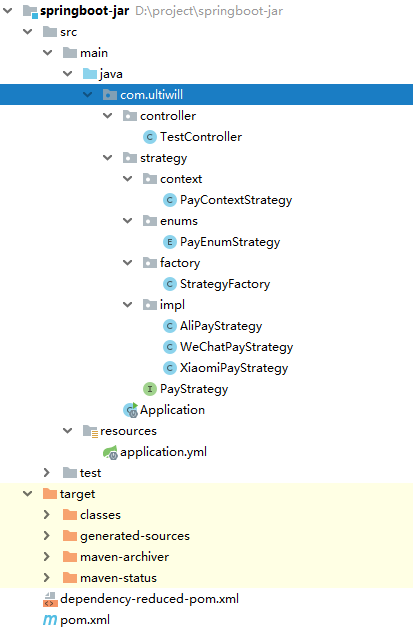
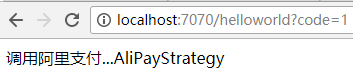
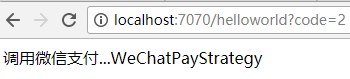
五、结果
六、在spring中通过Autowired注解实现策略模式
使用AutowireCapableBeanFactory手动注入
使用.newInstance();创建对象的话,如果其他对象都使用Spring Autowired,还需要手动创建所有依赖的Bean:
private @Autowired AutowireCapableBeanFactory beanFactory;

public void process() {

  MyBean obj = new MyBean();

  beanFactory.autowireBean(obj);

  // obj will now have its dependencies autowired.

}
本例中可以使用
private @Autowired AutowireCapableBeanFactory beanFactory;

    /**

     * 使用策略工厂获取具体策略实现

     * @param code

     * @return

     */

    public  PayStrategy getPayStrategy(String code) {

        String className = PayEnumStrategy.getClassNameByCode(code);

        try {

            PayStrategy str = (PayStrategy) Class.forName(className).getDeclaredConstructor().newInstance();

            beanFactory.autowireBean(str);

            return str;

        } catch (InstantiationException |

                NoSuchMethodException |

                ClassNotFoundException |

                IllegalAccessException |

                InvocationTargetException e) {

            e.printStackTrace();

        }

       return null;

    }
使用Map<String,?> 自动注入
先附上如下的代码:
public interface TalkService {

    void talk(String content);

}
@Service(value = "withSisterTalkService")

public class WithSisterTalkService implements TalkService {

    @Override

    public void talk(String content) {

        System.out.println(this.getClass().getName() + ":" + content);

    }

}
@Service(value = "withGirlFriendTalkService")

public class WithGirlFriendTalkService implements TalkService {

    @Override

    public void talk(String content) {

        System.out.println(this.getClass().getName() + ":" + content);

    }

}
@Service

public class TalkServiceStrategyContext implements TalkService {

    private Map<String, TalkService> strategyMap = new ConcurrentHashMap<>();

    @Autowired

    public TalkServiceStrategyContext(Map<String, TalkService> strategyMap) {

        this.strategyMap.clear();

        this.strategyMap.putAll(strategyMap);

    }

    @Override

    public void talk(String content) {

    }

}
注意,这里必须是Map<String, TalkService>类型!
@Autowired

private Map<String, TalkService> talkServiceMap;

    @GetMapping(value = "doTest")

    public String doTest() {

        Set<String> strings = talkServiceMap.keySet();

        for (String string : strings) {

            System.out.println(string + ":" + talkServiceMap.get(string).toString());

        }

        return this.getClass().getName();

    }
其访问测试controller后,打印的信息如下:
talkServiceStrategyContext:com.haiyang.onlinejava.complier.service.impl.TalkServiceStrategyContext@2f0b1419

withGirlFriendTalkService:com.haiyang.onlinejava.complier.service.impl.WithGirlFriendTalkService@1cf19a02

withSisterTalkService:com.haiyang.onlinejava.complier.service.impl.WithSisterTalkService@1ef3c76d
看了后感觉很奇怪,在上方只定义了一个map<String,TalkService>的map,居然它就能自动找到实现了TalkService的所有bean,并将service的beanName作为了key,感觉还是牛逼啊,spring的注解居然还能这样用。
然后简单看了下Autowired的源码,其javaDoc文档里也有说明:
package org.springframework.beans.factory.annotation;

import java.lang.annotation.Documented;

import java.lang.annotation.ElementType;

import java.lang.annotation.Retention;

import java.lang.annotation.RetentionPolicy;

import java.lang.annotation.Target;

/**

 * Marks a constructor, field, setter method or config method as to be

 * autowired by Spring's dependency injection facilities.

   *

 * <p>Only one constructor (at max) of any given bean class may carry this

 * annotation, indicating the constructor to autowire when used as a Spring

 * bean. Such a constructor does not have to be public.

   *

 * <p>Fields are injected right after construction of a bean, before any

 * config methods are invoked. Such a config field does not have to be public.

   *

 * <p>Config methods may have an arbitrary name and any number of arguments;

 * each of those arguments will be autowired with a matching bean in the

 * Spring container. Bean property setter methods are effectively just

 * a special case of such a general config method. Such config methods

 * do not have to be public.

   *

 * <p>In the case of multiple argument methods, the 'required' parameter is

 * applicable for all arguments.

   *

 * <p>In case of a {@link java.util.Collection} or {@link java.util.Map}

 * dependency type, the container will autowire all beans matching the

 * declared value type. In case of a Map, the keys must be declared as

 * type String and will be resolved to the corresponding bean names.

   *

 * <p>Note that actual injection is performed through a

 * {@link org.springframework.beans.factory.config.BeanPostProcessor

 * BeanPostProcessor} which in turn means that you <em>cannot</em>

 * use {@code @Autowired} to inject references into

 * {@link org.springframework.beans.factory.config.BeanPostProcessor

 * BeanPostProcessor} or

 * {@link org.springframework.beans.factory.config.BeanFactoryPostProcessor BeanFactoryPostProcessor}

 * types. Please consult the javadoc for the {@link AutowiredAnnotationBeanPostProcessor}

 * class (which, by default, checks for the presence of this annotation).

   *

 * @author Juergen Hoeller

 * @author Mark Fisher

 * @since 2.5

 * @see AutowiredAnnotationBeanPostProcessor

 * @see Qualifier

 * @see Value

   */

   @Target({ElementType.CONSTRUCTOR, ElementType.METHOD, ElementType.PARAMETER, ElementType.FIELD, ElementType.ANNOTATION_TYPE})

   @Retention(RetentionPolicy.RUNTIME)

   @Documented

   public @interface Autowired {

   /**

    * Declares whether the annotated dependency is required.

    * <p>Defaults to {@code true}.

      */

      boolean required() default true;

}
关注这句:
In case of a java.util.Collection or java.util.Map dependency type, the container will autowire all beans matching the declared value type. In case of a Map, the keys must be declared as type String and will be resolved to the corresponding bean names.
它大致是说Autowired当使用在Collection里时,会将所申明类的所有实现类都放在那个指定的Collection里;
如果Autowired和map使用的话呢,它将它bean的名称作为key,所有的bean作为value.
使用Set<?>自动注入
如果不想使用bean的名字作为map的Key的话,我们可以自定义寻址方式,自动注入时候使用Set<?>:
public interface Strategy {

    void doStuff();

    StrategyName getStrategyName();

}

public enum StrategyName {

  StrategyA,

  StrategyB,

  StrategyC

}
@Component

public class StrategyA  implements Strategy{

  @Override

  public void doStuff() {

      //implement algorithm A here

  }

  @Override

  public StrategyName getStrategyName() {

    return StrategyName.StrategyA;

  }

}

@Component

public class StrategyB  implements Strategy{

  @Override

  public void doStuff() {

     //implement algorithm B here

   }

  @Override

  public StrategyName getStrategyName() {

     return StrategyName.StrategyB;

  }

}

@Component

public class StrategyC  implements Strategy{

  @Override

  public void doStuff() {

  }

  @Override

  public StrategyName getStrategyName() {

    return StrategyName.StrategyC;

  }

}
import java.util.HashMap;

import java.util.Map;

import java.util.Set;

import org.springframework.stereotype.Component;

@Component

public class StrategyFactory {

  private Map<StrategyName, Strategy> strategies;

  @Autowired

  public StrategyFactory(Set<Strategy> strategySet) {

     createStrategy(strategySet);

  }

  public Strategy findStrategy(StrategyName strategyName) {

     return strategies.get(strategyName);

  }

  private void createStrategy(Set<Strategy> strategySet) {

      strategies = new HashMap<StrategyName, Strategy>();

      strategySet.forEach(

   strategy ->strategies.put(strategy.getStrategyName(), strategy));

}

}
Now we can inject StrategyFactory using @Autowired annotation. Here is the sample code using our StrategyFactory.
import org.springframework.beans.factory.annotation.Autowired;

import org.springframework.stereotype.Service;

@Service

public class SomeService {

  @Autowired

  private StrategyFactory strategyFactory;

public void findSome(){

 // Now get the strategy by passing the name

 Strategy strategy = strategyFactory.findStrategy(StrategyName.StrategyA);

   // you can now call the methods defined in strategy.

    strategy.doStuff();

  }

}
Java 设计模式--策略模式,枚举+工厂方法实现的更多相关文章
- Java设计模式(二) 工厂方法模式
本文介绍了工厂方法模式的概念,优缺点,实现方式,UML类图,并介绍了工厂方法(未)遵循的OOP原则 原创文章.同步自作者个人博客 http://www.jasongj.com/design_patte ...
- 我的Java设计模式-策略模式
今天给大家说说田忌赛马的故事.如有雷同,纯属巧合!话说在战国时期,群雄割据,硝烟四起,茶余饭后还是少不了娱乐活动的,其中赛马是最火爆的.一天,孙膑看到田忌像个死鸡似的就知道肯定赛马又输给了齐威王,立马 ...
- Java设计模式学习笔记(三) 工厂方法模式
前言 本篇是设计模式学习笔记的其中一篇文章,如对其他模式有兴趣,可从该地址查找设计模式学习笔记汇总地址 1. 简介 上一篇博客介绍了简单工厂模式,简单工厂模式存在一个很严重的问题: 就是当系统需要引入 ...
- Java设计模式:Factory Method(工厂方法)模式
概念定义 工厂方法(Factory Method)模式,又称多态工厂(Polymorphic Factory)模式或虚拟构造器(Virtual Constructor)模式.工厂方法模式通过定义工厂抽 ...
- JAVA设计模式——第 5 章 工厂方法模式【Factory Method Pattern】(转)
女娲补天的故事大家都听说过吧,今天不说这个,说女娲创造人的故事,可不是“造人”的工作,这个词被现代人滥用了.这个故事是说,女娲在补了天后,下到凡间一看,哇塞,风景太优美了,天空是湛蓝的,水是清澈的,空 ...
- Java设计模式(四)工厂方法模式
定义与类型 定义:定义一个创建对象的接口,但让实现这个接口的类来决定实例化哪个类,工厂方法让类的实例化推迟到子类中进行. 类型:创建型 适用场景 创建对象需要大量重复的代码 客户端(应用层)不依赖于产 ...
- Java设计模式菜鸟系列(四)工厂方法模式建模与实现
转载请注明出处:http://blog.csdn.net/lhy_ycu/article/details/39760895 工厂方法模式(Factory Method) 工厂方法:顾名思义,就是调用工 ...
- Java设计模式—策略模式
1.策略模式(Strategy Pattern)是一种比较简单的模式,也叫做政策模式(PolicyPattern). 定义如下: Define a family of algorithms,e ...
- java设计模式 策略模式Strategy
本章讲述java设计模式中,策略模式相关的知识点. 1.策略模式定义 策略模式,又叫算法簇模式,就是定义了不同的算法族,并且之间可以互相替换,此模式让算法的变化独立于使用算法的客户.策略模式属于对象的 ...
随机推荐
- Django笔记&教程 3-4 模板继承
Django 自学笔记兼学习教程第3章第4节--模板继承 点击查看教程总目录 在介绍具体的技术之前,先介绍在什么样的场景中,需要使用这样的技术,我觉得这对于新手理解起来很重要. 一般来说,要渲染一个页 ...
- Maven中所用的Dependency查找方法
用了Maven,所需的JAR包就不能再像往常一样,自己找到并下载下来,用IDE导进去就完事了,Maven用了一个项目依赖(Dependency)的概念,用俗话说,就是我的项目需要用你这个jar包,就称 ...
- 关于Java内存泄漏的介绍
翻译自这篇文章 Java一个最显著的优势就是它的内存管理.你只需要简单地创建对象,而Java垃圾收集器会负责内存的分配与释放.不过,事情并没有那么简单,因为在Java应用中时常会出现内存泄漏. 1. ...
- 语音合成论文翻译:2019_MelGAN: Generative Adversarial Networks for Conditional Waveform Synthesis
论文地址:MelGAN:条件波形合成的生成对抗网络 代码地址:https://github.com/descriptinc/melgan-neurips 音频实例:https://melgan-neu ...
- Electron快速入门
node -v npm -v 安装node环境 my-electron-app/ ├── package.json ├── main.js └── index.html 为您的项目创建一个文件夹并安装 ...
- 藏书馆App基于Rainbond实现云原生DevOps的实践
我们需要的不是精通Kubernetes的工程师,我们需要一款小白都能用好的管理工具. -- 厦门正观易知科技有限公司运维负责人 郭传壕 大家好,我是厦门正观易知科技有限公司运维负责人郭传壕. 藏书馆是 ...
- UOJ #76 -【UR #6】懒癌(思维题)
UOJ 题面传送门 神仙题. orz czx,czxyyds 首先没有懒癌的狗肯定不会被枪毙,证明显然. 接下来考虑怎样计算一种局面的答案,假设 \(dp_S\) 表示对于有且仅有 \(S\) 中的狗 ...
- 洛谷 P5391 - [Cnoi2019]青染之心
洛谷题面传送门 介绍一种假做法,期望复杂度应该比较优秀,但可以卡掉( 首先这个问题显然严格强于只有添加元素的情况对吧,而只有添加元素的情况就是一个普通的背包,而只有插入操作的版本复杂度就已经达到了 \ ...
- 【2020五校联考NOIP #2】矩阵
咕咕咕到现在~ 题面传送门 题意: 给出一个 \(n\times n\) 的矩阵 \(A\).要你求有多少个 \(n\times n\) 的矩阵 \(B\) 满足: 每一行都是 \(1\) 到 \(n ...
- JOI 2020 Final 题解
T1. 只不过是长的领带 大水题,把 \(a_i,b_i\) 从小到大排序. 发现最优方案只可能是大的 \(a_i\) 跟大的 \(b_i\) 匹配,小的 \(a_i\) 与小的 \(b_i\) 匹配 ...